


Welcome to Edition 7 of the MOAT.
2025's winding down, and as we approach that yearly moment of setting new resolutions, I noticed something we've all been guilty of for a while now.
I caught it last week mid-conversation. "I recently read an article that said..."
I stopped mid-sentence.
Did I actually value the article or the points? Or was I just quoting something that sounded smart?
We've gotten really good at sounding informed. Someone drops a framework from Instagram. Another quotes an article they skimmed. We toss around buzzwords like "synergy" and "culture" without asking what we actually mean.
We're parroting. Collecting and repeating information without thinking about it.
This edition is about the gap between sounding smart and actually thinking.
This happens everywhere. In Slack threads, strategy sessions, meetings that matter. Someone asks "what do you think?" and our brains automatically search for what someone else already said.
Someone shares an Instagram reel about leadership on Monday. By Tuesday, three people are quoting it. Nobody asks if it's true, relevant, or applies to what we're building.
We collect. We repeat. We don't critique or internalize.
Walk into any corporate meeting. "Let's leverage synergies." "Build a culture of innovation." "Create alignment across teams."
These phrases sound like strategy. But push people to define what "synergy" means in this specific context, or what "alignment" looks like in practice, and the conversation gets vague fast.
The real risk isn't sounding stupid. It's sounding smart while thinking shallow. When decision-making becomes about repeating what worked elsewhere instead of synthesizing what makes sense here, we're not building strategy. We're playing corporate Mad Libs with buzzwords.
A few years ago, I was working through something in therapy. A pattern I kept repeating even though I knew it wasn't serving me. My therapist asked me why.
I had an answer ready. A good one that made logical sense.
She asked why again.
I gave another answer, a layer deeper.
She kept asking. Five times, maybe six. Each time, I thought I'd reached the real reason. Each time, she pushed further.
By the fifth "why," I was uncomfortable. The answer revealed something I hadn't wanted to admit.
That's when it clicked. The first answer is almost never the real one.
We stop at the surface because it's comfortable.
It's the explanation we've already accepted, the story we've told ourselves enough times that it feels true. But genuine understanding lives several layers down, in the uncomfortable place we usually avoid.
This technique exists in business too. It's called the Five Whys, designed to push past symptoms until you hit root causes. Most teams know about it. Very few use it. Because it's uncomfortable, takes more time than we think we have, and having a fast answer feels better than admitting we need to dig deeper.
Shallow thinking builds shallow teams.
When everyone repeats buzzwords, "culture" becomes something we say without defining. "Innovation" becomes a goal without strategy. "Alignment" never produces actual agreement.
Someone quotes a LinkedIn framework. It gets adopted for its catchy name, not because anyone asked if it fits our problem.
The costs are measurable: 55% of job candidates react negatively to buzzword-filled postings. Vague language slows everything down.
But what really gets lost? Innovation.
Real innovation comes from synthesis. Connecting ideas across disciplines. Seeing patterns others miss because you actually thought instead of just collected.
Leaders who synthesize spot opportunities sooner. They build their own understanding instead of borrowing frameworks. That's a competitive advantage you can't copy. It's not a process. It's actual thinking.
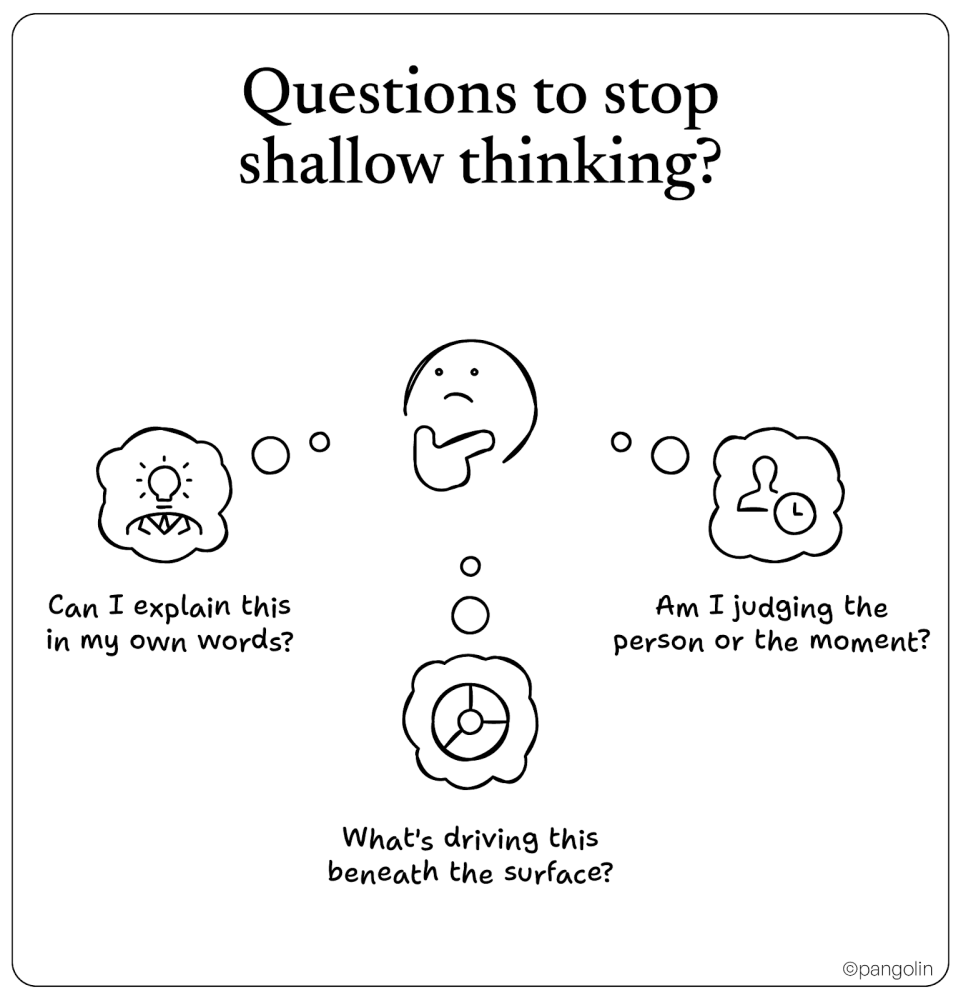
So what does this look like? Questions I've started asking:
Before quoting something: Can I explain this in my own words?
In conflict: What's driving this beneath the surface?
When giving feedback: Am I judging the person or the moment?
The uncomfortable one: What do I actually think?
Not what the article said. What do I genuinely think based on what I've seen and learned?
Sometimes the answer is "I don't know yet." That feels risky when everyone rewards sounding certain. But staying in that discomfort is where real understanding starts.
Real thinking is slower than parroting. Messier. Less quotable.
You'll sound less certain than the person confidently dropping frameworks they read yesterday. That feels risky when quick answers get rewarded.
So are you willing to stay uncomfortable long enough to actually think?

