Traditional lead generation is broken for IT companies; a staggering 87% of B2B tech leads never convert to customers.
Account-Based Marketing (ABM) is a focused strategy that treats individual high-value companies as a "market of one."
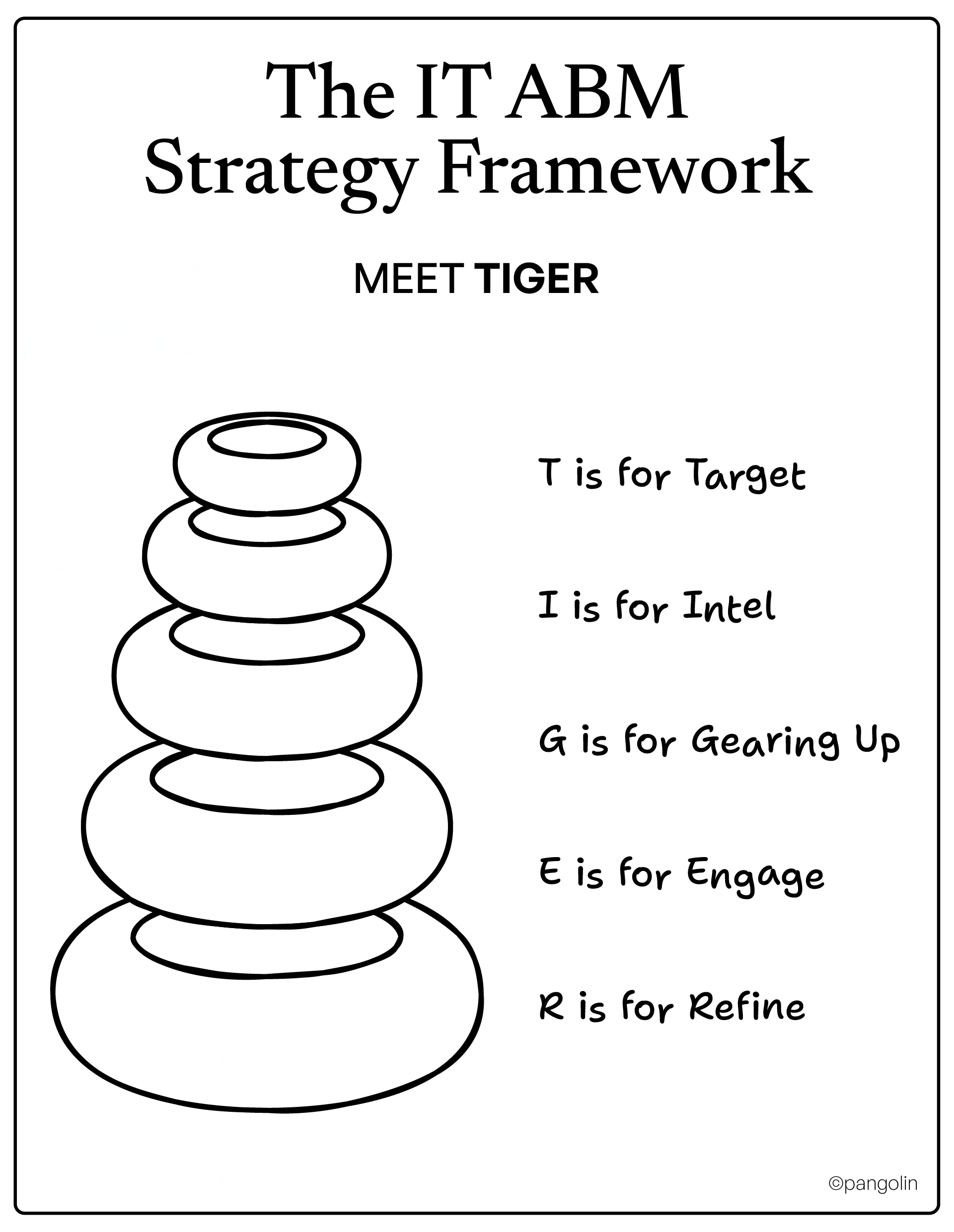
The TIGER framework (Target, Intel, Gear Up, Engage, Refine) provides a simple, repeatable playbook for ABM success.
Effective account selection combines a specific Ideal Customer Profile (ICP) with real-time intent data to find companies ready to buy now.
Gathering deep intelligence, technical, business, and stakeholder, is essential for creating a message that is radically relevant.
A well-integrated tech stack is crucial, as 51% of IT buyers see a vendor's disconnected internal tech as a major red flag.
The three-tiered execution approach (White Glove, High-Touch, Programmatic) allows you to apply the right level of effort to the right accounts.
Personalizing content for different stakeholders (e.g., ROI calculators for CFOs, technical specs for CTOs) is non-negotiable for success.
In 1981, a ranch dog named Shep from Meeteetse, Wyoming, dropped a strange creature on his owner's porch. It had a slender, wiry body about the size of a mink, with sleek, yellow-buff fur, a black mask across its eyes, black feet, and a black-tipped tail.
It was a black-footed ferret: a species officially declared extinct just two years earlier.
That single discovery proved an entire population was still out there, hiding in plain sight. It sparked a massive conservation effort that brought one of North America's most endangered mammals back from the brink.
Your best customers are a lot like that. You think they’re impossible to find, lost in a sea of low-quality leads and generic outreach. So you stop looking.
Sound familiar?
Meet Sarah, the VP of Marketing at a $50M cybersecurity firm. She was burning through a $200K budget to generate over 500 leads a month. The problem? Only 3% ever became customers. Her sales team was buried in junk leads, and her best prospects: the high-value accounts that could actually move the needle were nowhere to be found.
This is the reality for most IT companies. You're drowning in a flood of low-quality leads, your sales team is frustrated, and your most valuable prospects are slipping right through your generic marketing funnel. You’re casting a wide net and catching nothing but minnows.
It’s time to stop fishing with nets and start hunting with spears.
Account-Based Marketing (ABM) flips the traditional marketing funnel on its head. Instead of chasing thousands of low-value leads, you become a sniper, targeting a handful of your dream accounts with surgical precision. It’s about focusing all your energy on the customers that matter most, not just the ones who happen to fill out a form.
The ABM Wake-Up Call for IT Companies
Let’s be honest. The way you’ve been taught to do marketing is broken. Especially for IT companies.
Here's an uncomfortable truth that keeps CMOs up at night: a staggering 87% of B2B tech leads never convert into customers. Think about that. For every 100 leads your team chases, 87 are a complete waste of time and money. It's like fishing in a pond where most of the fish are just plastic lures.
Why is the system so flawed? Because selling complex IT solutions isn't like selling shoes.
An IT buying decision isn't one person giving a quick "yes." It's a committee of 6 to 10 stakeholders, from the CTO to the CFO to the end-user, each with their own questions and concerns, spread out over an 8-month (or longer) sales cycle. Your generic whitepaper isn't going to cut it when you need to convince a skeptical engineer and a budget-focused executive at the same time.
Now, add this to the mix: your ideal prospect is getting hammered with over 100 vendor touchpoints every single month. Your email is just one more drop in a tidal wave of noise. Trying to stand out by shouting louder is like trying to get noticed by yelling in the middle of Times Square. It’s a losing game.
The ABM Advantage: Numbers That Demand Attention
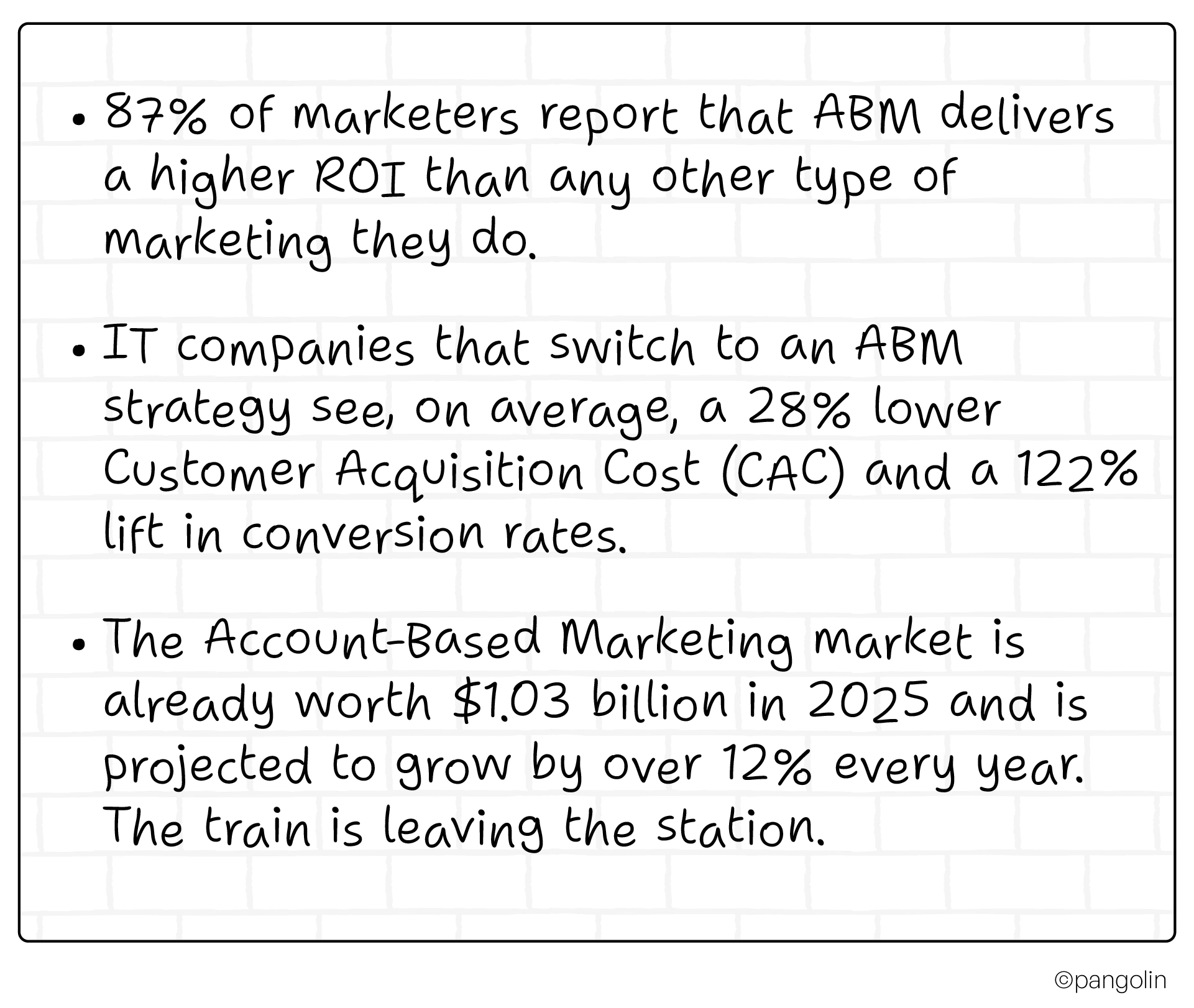
This is why the smartest IT marketers are ditching the old playbook. The data is just too compelling to ignore:
Why IT Companies Need ABM More Than Anyone
ABM isn’t just another buzzword; it feels like it was practically designed for the unique challenges of the tech industry:
Technical complexity requires personalized education. You’re not selling a simple product. You’re selling integration, security, and scalability. ABM lets you tailor that complex education to each specific person on the buying committee.
High deal values justify intensive targeting. When a single contract can be worth six or seven figures, it makes sense to invest heavily in winning that one perfect account, rather than spreading your budget thin across thousands of maybes.
Long sales cycles demand sustained engagement. An 8-month journey has a lot of "dead air." ABM ensures you stay top-of-mind with relevant, helpful content at every stage, not just at the beginning and the end.
Multiple stakeholders need different value propositions. The CFO cares about TCO and ROI. The IT manager cares about ease of integration. ABM allows you to speak to each of them in their own language, about what they actually care about.
The IT ABM Strategy Framework: Meet TIGER
So, how do you go from casting wide nets to hunting with a spear? You need a simple, repeatable playbook. Forget the 50-page strategy docs and complicated flowcharts. All you need to remember is one word: TIGER.
The TIGER framework is your five-step plan for ABM success. It’s simple on purpose, so you can actually execute it.
T is for Target: Stop trying to boil the ocean. Your first job is to curate a list of your Dream 100 accounts. Not 1,000, not 5,000. Just the 100 companies you’d kill to have as clients.
I is for Intel: Become an FBI profiler for each of your target accounts. Who are the real players on the buying committee? What are their biggest professional headaches? What tech are they already using, and where are the cracks?
G is for Gearing Up: You can't go to war without weapons. This is where you assemble your ABM tech stack. You need tools for gathering intent data, engaging across channels, and measuring what works.
E is for Engage: This is showtime. Armed with your intel, you execute coordinated, multi-channel campaigns that speak directly to the pains of your target accounts. No more generic messaging.
R is for Refine: ABM isn’t a crockpot, you can't just "set it and forget it." This is a live-fire exercise. You have to measure everything, learn what’s resonating, and relentlessly optimize your approach.
Account Selection: How to Find Your Dream 100
Everything in ABM hinges on getting this first step right. If you target the wrong accounts, nothing else matters. So how do you find your "Dream 100"? It’s a mix of art and science.
Define Your Ideal Customer Profile (ICP): Get ridiculously specific. Don't just think about company size and industry. Think about pain indicators. What are the clear signals that a company is a perfect fit for you right now? Are they hiring for a specific new role? Are they complaining online about a problem you solve? Are they stuck using a competitor's outdated tech? This is where you define what a "perfect" account looks like.
Use Intent Data Signals: This is your secret weapon. Intent data tools show you the digital footprints of companies that are actively researching solutions like yours. They'll tell you which accounts are suddenly reading articles about your niche, visiting competitor websites, or searching for keywords that scream "we have a problem." This is how you find the buyers who have already raised their hands, even if they haven't filled out a form yet.
Map the Stakeholders: For each target account, you need a map of the buying committee. Who is the Economic Buyer (the one with the budget)? Who is the Technical Buyer (the one who has to make it work)? Who are the End-Users (the ones whose daily lives will be affected)? Each of them needs a different message from you.
Create a Prioritization Matrix: Once you have a list of potential targets, plot them on a simple matrix: Revenue Potential vs. Win Probability. The accounts in the top-right quadrant, high revenue, high chance of winning, are your Tier 1 targets. This is where you'll focus your most intensive, white-glove efforts. This simple exercise ensures you're spending your energy where it will have the biggest impact.
Intel Gathering: Know Your Accounts Better Than They Know Themselves
If you've ever played high-stakes poker, you know the winner isn't always the one with the best cards. It's the one who can read the table, the player who knows everyone else's tells, habits, and what makes them tick.
In ABM, you're not just playing your cards; you're playing the other players. Your mission is to become an expert profiler for each of your Dream 100 accounts. You need to know their problems better than they do, so your solution feels less like a sales pitch and more like a rescue mission.
It's about gathering three specific types of intelligence.
1. Technical Intelligence: Look Under the Hood
This is where you put on your engineer's hat. Your goal is to understand the technical reality of your target account, warts and all. Ask these questions:
What's in their current tech stack? What CRM, ERP, or cloud platform are they using? More importantly, what are the cracks in that foundation?
Where are the duct-tape integrations? What systems are barely holding together and causing constant headaches for their technical teams?
What is their biggest compliance or security nightmare? Are they facing new regulations or constantly fighting off threats that their current tech can't handle?
Are they drowning in technical debt? Are they stuck with a legacy system that’s preventing them from innovating? This is often the single biggest unspoken pain point in an IT department.
2. Business Intelligence: Follow the Money and the Power
Now, take off the engineer's hat and put on your CFO hat. Technology doesn't exist in a vacuum; it serves the business.
What is the CEO's #1 priority for this year? Did they just announce a major expansion, a push for efficiency, or a new market entry on their last earnings call? Your solution must align with that top-level goal.
When does their budget get approved? Knowing their fiscal calendar is like knowing the combination to the vault. Pitching a major project two weeks after the budget is locked for the year is a rookie mistake.
Who are their current vendors, and who do they complain about? Look for public reviews, forum comments, or chatter about their frustrations with your competitors. One company's unhappy customer is another's perfect prospect.
Did they just have a big win or a major loss? A big new customer might mean they have an urgent need to scale. Losing a major client might mean they're desperate for a new competitive edge.
3. Stakeholder Intelligence: It's All About the People
This is the most important layer of intelligence because, at the end of the day, you're not selling to a company. You're selling to people inside a company.
Who holds the purse strings vs. who has to live with the solution? The CFO who signs the check cares about different things than the engineer who has to implement the software. You need a message for both.
What will make them a hero? What is the one thing you can help each stakeholder achieve that will get them a promotion or a bonus? Frame your solution around their personal win.
How do they consume information? Does the VP of Sales love short, punchy video case studies, while the Director of IT Security will only trust a 40-page technical whitepaper? Don't send a steak to a vegan.
What are their individual pain points? The VP of Marketing might be struggling with attribution, while the Head of Sales is worried about ramp time for new reps. Speak to each of their unique problems directly.
Gathering this level of intel isn't about being creepy; it's about being radically relevant. When you can walk into a conversation and articulate a company's problems with more clarity than they can themselves, you cease to be a vendor. You become an invaluable partner.
The Essential Four-Layer ABM Stack
Layer 1: The "Mission Control" Layer (Account Intelligence)
This is the brain of your entire operation. Its job is to tell you who to target and when to strike.
Intent Data Tools (like 6sense, Demandbase, or ZoomInfo): These are your early-warning systems. They track the digital breadcrumbs companies leave across the web, alerting you when a target account starts researching solutions like yours.
Technographic and Firmographic Tools (like Clearbit or Bombora): These tools give you the specs on your target. What tech are they already using? How big is their IT team? This is your cheat sheet for understanding their environment.
Stakeholder Mapping Tools (like LinkedIn Sales Navigator): This is your social reconnaissance tool for identifying the key players on the buying committee and understanding their roles.
Layer 2: The "Megaphone" Layer (Content & Engagement)
Once you know who to target, this layer helps you deliver your message with precision and personality.
Marketing Automation (like HubSpot or Pardot): This is the engine for your personalized email sequences and nurture campaigns, ensuring the right message gets to the right person at the right time.
Personalized Video (like Vidyard or Loom): In a world of faceless emails, sending a quick, personalized video to a key stakeholder is a pattern-interrupt that gets you noticed.
Targeted Advertising (like Terminus or RollWorks): These platforms let you serve digital ads only to the specific people at the specific companies on your target list. No more wasted ad spend.
Layer 3: The "Special Ops" Layer (Sales Enablement)
This is how you arm your sales team to continue the personalized conversation that marketing started.
Sales Sequencing Tools (like Outreach or SalesLoft): These platforms help your reps execute coordinated, multi-channel outreach (email, calls, social touches) so no lead falls through the cracks.
Conversation Intelligence (like Gong or Chorus): These tools record and analyze sales calls, giving you priceless insights into what messaging is actually resonating with prospects and what objections keep coming up.
Mutual Action Plans: These shared documents outline the steps both the buyer and seller need to take to move the deal forward, creating transparency and accountability.
Layer 4: The "Scoreboard" Layer (Analytics & Attribution)
This is how you prove to your CEO that all this effort is actually working.
CRM (like Salesforce or HubSpot): This is your ultimate source of truth for pipeline, revenue, and deal velocity.
Web Analytics (like Google Analytics with UTMs): This helps you track how target accounts are engaging with your website and content.
ABM Platform Analytics: A good ABM platform will tie all this data together, showing you account-level engagement and attributing revenue back to your marketing efforts.
But Here's the Catch: Integration Is Everything
You can have the best tools in the world, but if they don't talk to each other, you've just built a more expensive Frankenstein's monster.
Here’s a stat that should stop you in your tracks: 51% of IT buyers say that a vendor having a poorly integrated tech stack is a major red flag for them.
Think about that. As an IT company, you sell the promise of seamless integration and efficiency. Your own marketing and sales process needs to practice what you preach. A disconnected, chaotic internal process is the worst possible advertisement for your own products.
Your goal must be to create a single source of truth for all your account data. When your marketing team, your sales team, and your customer success team are all looking at the same information, you can finally deliver the kind of seamless, intelligent customer experience that wins and keeps high-value accounts.
The ABM Execution Playbook: Running Plays That Actually Score
You’ve got your target list, your intel, and your tech stack. Now it's game time. This is where most marketing plans fall apart, in the messy reality of execution. But not yours.
Effective ABM execution isn't about blasting everyone with the same message. It's about running different plays for different players. Not all target accounts are created equal, so you shouldn't treat them that way. Welcome to the Three-Tier Approach, your playbook for applying the right amount of pressure to the right accounts.
Tier 1: The "White Glove" Treatment (Your Top 25 Accounts)
These are your crown jewels. The game-changers. The accounts that could single-handedly make your quarter. For them, "personalized" isn't good enough. You need to be bespoke. The goal is to make them feel like they are your only customer in the world.
Think of this as a "campaign of one."
Custom Landing Pages: When the CIO of a Tier 1 account clicks a link, they shouldn't see your generic homepage. They should see a landing page that says, "Hey [Company Name], Here's How We Can Solve [Specific Problem We Uncovered]."
Executive-to-Executive Outreach: Have your CEO send a personalized video or email to their CEO. Peer-to-peer communication at this level cuts through all the noise
High-Impact Direct Mail: Forget cheap swag. Send a high-quality, custom gift box to the key decision-makers, with a handwritten note that references a specific conversation or pain point. If you know their engineering team is struggling with downtime, send them a high-end coffee-making kit with a note that says, "So your team can have fewer coffee breaks forced by server outages." It's creative, memorable, and shows you've been listening.
Private Briefings and Demos: Don't invite them to a generic webinar. Fly out to their office for a private executive briefing or build a custom demo environment that uses their company's own data to showcase your solution.
Tier 2: The "High-Touch" Play (Your Next 75 Accounts)
These accounts are your workhorses, still incredibly valuable, but you can't afford to build a completely custom campaign for each one. The goal here is scaled personalization.
Role-Based Email Sequences: The CFO gets a different email sequence than the Head of IT. The CFO's track focuses on ROI and cost savings, while the IT leader's track focuses on integration and security.
Account-Specific Webinars: Host a small, private webinar for a handful of companies in the same vertical. Instead of a generic topic, make it hyper-relevant: "A GTM Strategy for Mid-Sized FinTechs Struggling with Data Compliance."
Coordinated Sales & Marketing Plays: This is a tag-team effort. Marketing warms them up with targeted LinkedIn ads and relevant content, and then sales follows up with a call that references the exact content they just engaged with. It feels seamless and intelligent.
Tier 3: "Programmatic" Personalization (Everyone Else on Your List)
This is where you let technology do the heavy lifting. This isn't about spamming; it's about being relevant at scale.
Dynamic Website Content: When someone from a target account visits your site, your headlines and case studies should automatically change to reflect their industry.
Automated Nurture Sequences: Based on their behavior, prospects are automatically funneled into nurture streams that deliver the most relevant content for their stage in the buying journey.
Broad-Based Advertising: Use your ad platforms to keep your brand in front of your entire target account list, building brand awareness so that when they are ready to buy, you're the first one they think of.
Speaking Their Language: Content Personalization for Technical Audiences
Here’s the golden rule: you can’t send a business case to an engineer and expect them to care. You have to speak the language of each stakeholder.
For the CTOs and Technical Buyers (The "Will it Work?" Crowd):
They care about stability, security, and elegance. Give them:
Architecture Diagrams and Technical Specs: Show them exactly how your solution is built.
Security Whitepapers and Compliance Docs: Prove that you're not going to create a new vulnerability for them.
Detailed Implementation Timelines: Show them you respect their team's time and have a clear plan for deployment.
API Documentation: Give them the keys so they can see for themselves how easy it is to integrate.
For the CFOs and Business Buyers (The "What's it Worth?" Crowd):
They care about one thing: the bottom line. Give them:
ROI Calculators and Business Case Templates: Make it easy for them to justify the purchase to their board.
Total Cost of Ownership (TCO) Analyses: Show them that your solution is not just a cost, but an investment that pays off over time.
Competitive Pricing Comparisons: Be transparent and show them how you stack up.
Risk Mitigation and Business Continuity Plans: Show them you're a safe bet.
For the End-Users (The "Will it Make My Life Easier?" Crowd):
They are the ones who have to live with your software every day. Give them:
Interactive Demos and Free Trials: Let them get their hands dirty and see the value for themselves.
Training Materials and Certification Programs: Show them you're invested in their success.
Access to Peer Reviews and User Communities: Let them hear from people just like them who love your product.
Implementation Success Stories: Tell them stories of how other teams were able to do their jobs better after switching to your solution.
Execution isn't about a single "big bang" campaign. It's about a series of smart, coordinated, and relentlessly relevant touches that guide your ideal customers on a journey, a journey that ends with them signing on the dotted line.
Coming Up in Part 2: From Blueprint to Building
Alright, you've got the blueprint. You know why you need to stop fishing with nets and start hunting with spears. You have the TIGER framework for building your strategy, a field guide for gathering intel, and a map for assembling your tech stack.
But a blueprint is just a piece of paper. The real magic happens when you start building.
In Part 2 of our ABM Strategy Guide, we're rolling up our sleeves and getting into the messy, exhilarating reality of execution. We'll show you how to take your strategy and turn it into closed deals and real revenue.
FAQs
1. What exactly is Account-Based Marketing (ABM)?
Think of it as a flip of the traditional marketing funnel. Instead of casting a wide net to catch as many leads as possible (most of whom are a bad fit), you start by identifying a small number of your absolute dream customers. Then, you treat each of those companies as a "market of one," focusing all your sales and marketing energy on winning them over with hyper-relevant, personalized campaigns.
2. How is this different from just good B2B marketing?
The biggest difference is the starting point. Traditional B2B marketing focuses on creating a high volume of individual leads. ABM focuses on penetrating a small number of high-value accounts. It requires deep alignment between sales and marketing, with both teams working together from the very beginning to target the same companies with one coordinated strategy.
3. Is ABM only for large enterprise companies?
While it's most famous for enterprise sales, the principles of ABM can be adapted for any B2B company with a high-value, complex sale. If your deal size is significant and you have to convince multiple stakeholders to buy, ABM is a powerful approach. Most successful programs start small, often as a pilot with just 25-50 target accounts.
4. How do I know which accounts to target?
This is the most critical step. It’s a combination of your Ideal Customer Profile (ICP) and intent data. Your ICP defines the type of company that is a perfect fit (e.g., industry, size, revenue, tech they use). Intent data tells you which of those companies are currently showing buying signals (e.g., researching your competitors, hiring for relevant roles, etc.). Combining these two tells you where to focus.
5. What if I don't have a big budget or a fancy tech stack?
You don't need a massive budget to start. The core of ABM is strategy, not software. You can start with the tools you already have (your CRM, LinkedIn Sales Navigator, etc.) and a small, focused list of target accounts. The goal is to get a few early wins and use the ROI from those deals to justify further investment in technology. The key is to have your strategy sorted out before you start buying tools.
6. How much personalization is actually needed?
It depends on the value of the account. For your top-tier, "white glove" accounts, the personalization should be bespoke, think custom landing pages, high-end direct mail, and executive-to-executive outreach. For other tiers, you can use "scaled personalization," like role-based email tracks and industry-specific webinars. The rule of thumb is: the bigger the potential deal, the deeper the personalization should be.
7. Isn't gathering all that "intel" on accounts kind of creepy?
It's only creepy if your intent is to manipulate. The goal of intelligence gathering isn't to be invasive; it's to be radically relevant. When you understand a prospect's real problems, you can have a much more valuable, helpful conversation. It's about respecting their time by only showing up with ideas that actually matter to them.