


Beluga whales can reshape their foreheads into five completely different shapes. Researchers call it their "melon" - a rounded bulge above their snout.
The wild part?
They do it intentionally during social interactions. Each shape means something different. A pod of belugas doesn't scatter random signals hoping someone picks up the message. They adapt their shape to communicate with multiple members of their group at the exact same time.
Here's what most B2B IT services companies don't realize: Your sales process needs to work like a beluga pod, not like a one-man band.
Enterprise deals in IT services aren't won by reaching one person. They're won when you orchestrate signals that land with the right stakeholders—the CFO, the CTO, the operations lead, the procurement director at the right moments across their entire buying journey. Individually targeted retargeting (pixel-based to random visitors) won't cut it. Broad ABM campaigns without sustained retargeting across multiple channels won't either.
But coordinated account-based marketing + strategic retargeting across the right channels? That closes deals 60% faster and drives win rates up by 60%.
This is the playbook B2B IT consulting firms are using to compress 6-18 month sales cycles, escape commodity pricing, and turn targeted accounts into predictable revenue. Here's how to build it.
Let's start with the real problem. When your VP of Sales walks in, they see one person. Your VP of Marketing sends a retargeting ad to that person's browser. Your SDR emails that person's inbox. The three of you think you're synchronized. You're not.
Meanwhile, inside the prospect's organization, a buying committee is happening without you.
The Actual Committee (that you can't see):
That's not one buying journey. That's five buying journeys happening in parallel inside the same account.
Here's what most B2B IT companies do: They retarget the person who visited the website (usually the IT manager, the lowest-ranking person in that group). The gatekeeper never reaches the CFO. The CFO never even knows your brand exists. Meanwhile, your competitors are already in those conversations.
The Result?
The alternative isn't more channels. It's coordinated channels reaching multiple stakeholders simultaneously.
Before we talk about the solution, let's be honest: Most approaches fail because companies try them one at a time.
Account-Based Marketing sounds powerful:
"We identify 50 target accounts and customize our messaging to each one."
In theory, it's brilliant. In practice?
Retargeting sounds efficient:
"We show ads to people who visited our website."
The problem?

The moment you add both together with orchestration, everything changes.
Here's the framework that moves the needle:
Before you run a single ad, you need to be honest about your target.
Not all accounts are created equal. Some are worth $500K deals. Others are $20K dead-ends disguised as opportunities.
Tier 1 (1-to-1): The Crown Jewels
How you engage Tier 1:
Tier 2 (1-to-few): The Growth Segment
How you engage Tier 2:
Tier 3 (1-to-many/Programmatic): The Foundation
How you engage Tier 3:
The key insight: You can't afford to treat every prospect like Tier 1. But you absolutely can afford to treat your top 20 accounts like Tier 1.
Now that you know who you're targeting, here's how you reach them across channels.
Think of each channel as a "shape" the beluga uses - a different way to communicate. The trick is making sure all the shapes work toward the same goal.
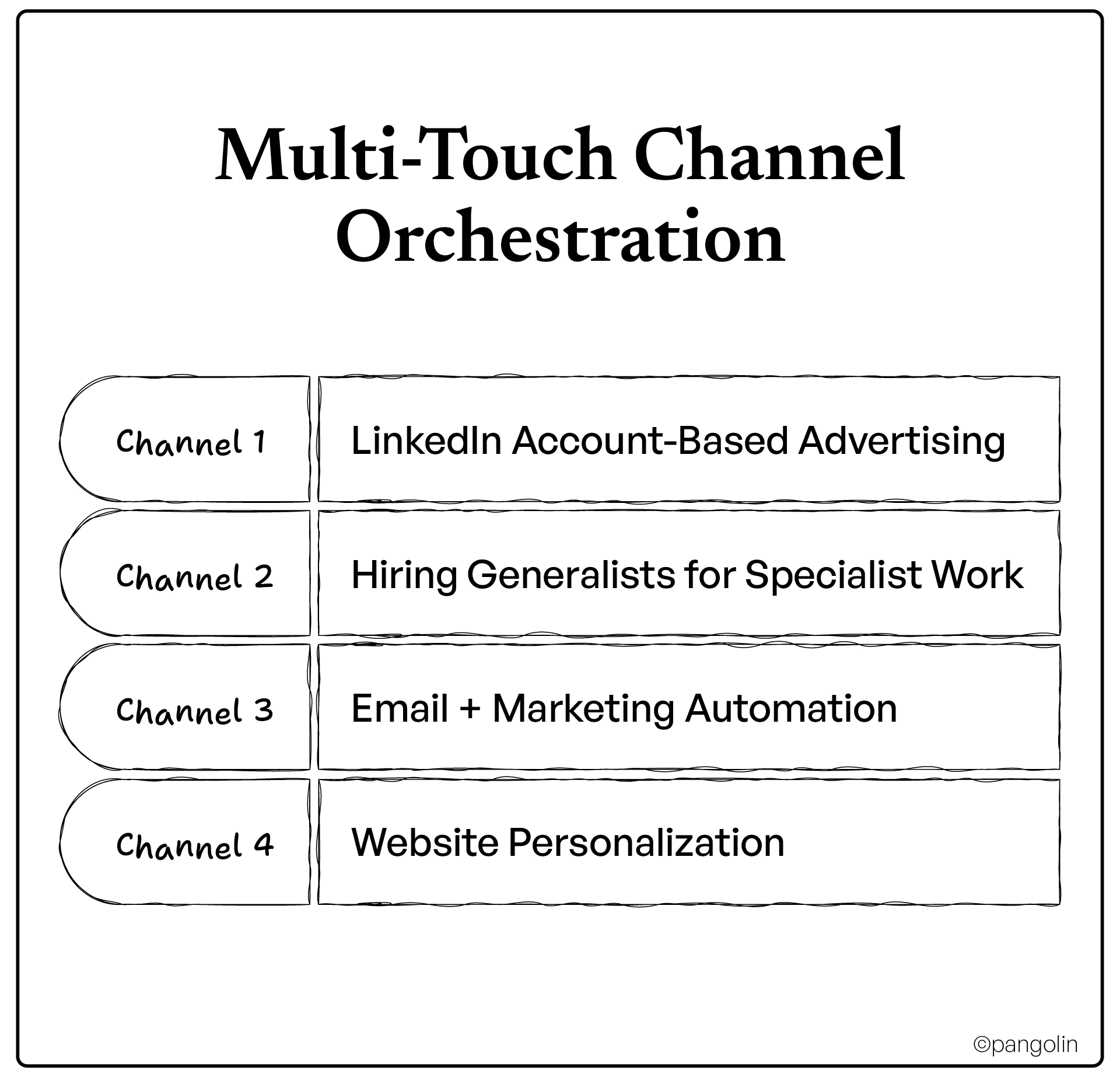
LinkedIn is where B2B decision-makers live. But most companies use it wrong.
The Wrong Way:
"Let's run a LinkedIn ad campaign to our industry."
Result: Generic ad, generic audience, generic performance.
The Right Way (Account-Based):
Upload your target account list (CSV) directly to LinkedIn as a "Matched Audience."
This creates an audience of people who work at those companies. Now:
This is where most companies lose money. They show the same generic ad to everyone who visited their website.
The ABM + Retargeting approach:
Step 1: Identify which visitors came from target accounts.
Use intent data platform (6sense, Bombora) or IP targeting (Terminus) to know when someone visiting your site is from a Tier 1, Tier 2, or Tier 3 account.
Step 2: Segment your retargeting by account tier AND behavior.
Retargeting Segment 1: Tier 1 Account Visitors
Retargeting Segment 2: Tier 2 Account Visitors
Retargeting Segment 3: Non-Target Accounts (Yes, segment these too)
Step 3: Control frequency and duration.
Email is where the ABM + retargeting strategy comes together. This is where signals from ads trigger strategic next steps.
How it works:
Someone from a Tier 1 account clicks your LinkedIn ad → They land on a personalized landing page → They see a "guided product tour" → Their email is captured → Your marketing automation platform notes:
Now your email sequences change based on this intelligence.
Tier 1 Email Sequence Example (if they clicked the CFO ad):
Email 1 (Next day): "Here's the [ROI calculation] for companies like yours"
Email 2 (Day 3): "CFOs who move fast see 30-day wins. Here's the timeline."
Email 3 (Day 7): "Your CTO is probably evaluating us right now. Here's what she should know."
Email 4 (Day 14): "Can we show your full buying committee this?"
Each email is triggered by account tier + engagement level. Not blasted to everyone.
Simultaneously, your sales team sees this account is engaged and reaches out to the other stakeholders they haven't reached yet (the CTO, the Finance director). Email prepares them. Ads reinforce them. Sales closes them.
When someone from a Tier 1 account lands on your website, they should see something different than someone from a Tier 3 account.
Tier 1 account visitor sees:
Tier 2 account visitor sees:
Tier 3 account visitor sees:
Same website. Different experiences. Dramatically different conversion rates.
Or better yet, Time-Decay Model:
Why? Because in IT services, closing an enterprise deal is the hard part. Getting them interested is only the beginning.
How to Measure Multi-Touch Attribution:
Before we talk about how to execute, let's talk about how this fails. Because most companies fail.
You send ABM campaigns to 50 accounts that look good on paper but aren't actually in-market.
How to avoid it:
Tier 1 should be 5-20 accounts that your sales team already wants to close.
You run retargeting ads to pixel-based audiences without knowing if they're from target accounts.
Result: Someone from a non-target company visits your website, they stay in your retargeting audience for 180 days, and you show them ads for 6 months. You're wasting budget on prospects you'll never close.
How to avoid it:
ABM + retargeting doesn't work like performance marketing.
Performance marketing: "We run ads to 50,000 people, 50 click, 5 buy. 10% conversion rate."
ABM: "We run ads to 50 accounts. Nobody clicks. But they remember us. On week 4, our SDR reaches out because they already know who we are. Sales cycle compresses from 9 months to 4 months."
It's not about immediate clicks. It's about pipeline velocity and deal size.
How to avoid it:
Let's get tactical. Here's exactly how to run an ABM + retargeting campaign for one Tier 1 account.
Target Account: "Enterprise Bank Inc."
Week 1:
Week 2-3:
Week 4:
LinkedIn ABM Ads:
Display Retargeting:
Email:
Sales Outreach:
If they book a call or demo:
If they don't respond:
If there's real interest:
Here's what you're actually tracking (not vanity metrics):
Account-Level Metrics:
Campaign-Level Metrics:
Let's be transparent about budget.
Total monthly for full ABM + retargeting program: $10,000-$75,000
Sounds expensive? Compare to:
ABM + retargeting pay for themselves if they close one extra deal per quarter.
After reviewing 50+ case studies and 100+ sources, here's what the top-performing B2B IT companies are doing differently:
They're obsessive about account selection. Not "50 accounts that look good on LinkedIn." Instead: "These 15 accounts represent 60% of our TAM; we're going to own them."
They coordinate channels deliberately. Not "run LinkedIn ads and hope people click." Instead: "LinkedIn creates awareness → retargeting keeps us visible → email moves them to consideration → sales closes them."
They use multi-touch attribution religiously. Not "How many leads did we generate?" Instead: "Which touchpoints actually drive deals? What's the winning sequence?"
They evolve messaging by stakeholder. Not "Here's our value prop." Instead: "CFOs care about cost. CTOs care about architecture. We have different ads for each."
They measure pipeline velocity, not lead volume. Not "500 MQLs." Instead: "Our ABM accounts move 40% faster through the funnel."
They play the long game. ABM + retargeting isn't about conversions in week 2. It's about owning your target market in 6 months.
Your competitors are competing on price and team size. You're going to compete on precision and results.
ABM + retargeting isn't a marketing tactic. It's a repositioning strategy. It says: "We don't spray and pray. We understand your business. We reach your entire decision-making team. We compress your buying cycle. We deliver measurable value."
That's not a service vendor message. That's a strategic partner message.
And strategic partners close bigger deals, faster.
Here's what to do Monday morning:
By week 8, you'll know if ABM + retargeting works for your company. By week 16, you'll have the proof to scale it.
The path from "generic IT services vendor" to "they actually understand our business" is through coordinated, multi-touch campaigns to the buying committee that matters.
That's the playbook. Now go use it.
Perfect. Now let me update the conclusion with Pangolin and provide the FAQs.
Your competitors are competing on price and team size. You're going to compete on precision and results.
ABM + retargeting isn't a marketing tactic. It's a repositioning strategy. It says: "We don't spray and pray. We understand your business. We reach your entire decision-making team. We compress your buying cycle. We deliver measurable value."
That's not a service vendor message. That's a strategic partner message.
And strategic partners close bigger deals, faster.
Here's what to do Monday morning:
By week 8, you'll know if ABM + retargeting works for your company. By week 16, you'll have the proof to scale it.
The path from "generic IT services vendor" to "they actually understand our business" is through coordinated, multi-touch campaigns to the buying committee that matters.
That's the playbook. Now go use it.
This is exactly what Pangolin Marketing specializes in. They engineer full-funnel growth marketing systems that integrate ABM, retargeting, demand generation, and revenue automation into one coordinated revenue engine.
Pangolin's approach for B2B IT companies:
Full-Funnel Growth Marketing: ABM that nurtures buying committees + paid media targeting decision-makers + content that builds authority + analytics proving ROI.
Revenue Automation: Integrates CRM, marketing automation, and sales workflows into one revenue
What makes them different:
The short answer: You'll see engagement signals (account visits, content downloads) within 4-6 weeks. But meaningful pipeline impact takes 4-6 months because B2B IT buying cycles are long. Initial metrics to track: buying committee size, account engagement score, sales cycle compression. Revenue impact typically shows by month 6-9 when multiple target accounts enter decision stage simultaneously. Don't measure success by lead volume; measure by account tier velocity and deal size.
Start with LinkedIn ABM ads if your decision-makers are LinkedIn-active (they are—CFOs, CTOs, VP of Operations all use LinkedIn). It's where you reach job titles and target accounts most precisely. Then layer in programmatic display retargeting for frequency and persistence. Email comes third—it orchestrates the engagement you've already created through paid channels. Most teams reverse this (email first), which is why their campaigns underperform. Channels work in sequence: LinkedIn creates awareness → retargeting keeps you visible → email closes.
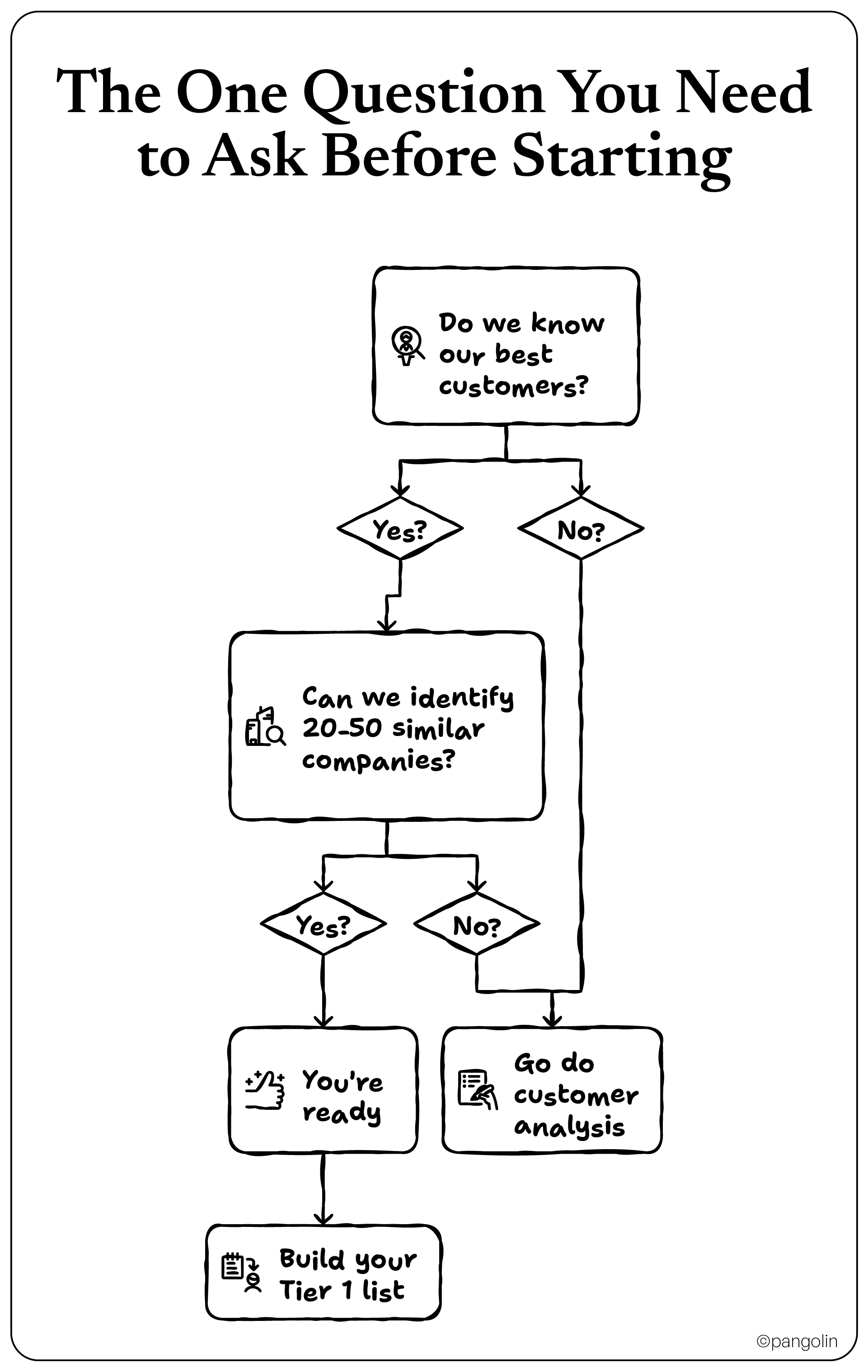
Work with your sales team first. Ask: "If you could close 20 accounts next year, which would they be?" That's your Tier 1 list. Then validate using intent data (6sense, Bombora, ZoomInfo Intelligence)—which accounts are actively searching for solutions like yours? Which recently got funding or hired in key departments? The intersection of sales instinct + intent data + ideal customer profile is your Tier 1. Don't overthink it; most companies pick 5-20 accounts they already want to close.
Yes, but you need tools. Programmatic ABM platforms (RollWorks, Demandbase) automate account targeting and audience segmentation so your 2-3 person team can execute at scale. Your biggest investment isn't headcount; it's tools ($10,000-$30,000/month depending on scale). For Tier 1 accounts, you do need sales + marketing coordination (that's not scalable without more people). For Tier 2-3, automation handles most of it. Most teams spend $50K on tools before they need to hire their first dedicated ABM person.
Stop reporting leads. Report revenue influenced. "Our ABM campaigns reached 50 target accounts, influenced 12 into pipeline, closed 3 deals worth $1.35M. Campaign cost: $180K. ROI: 7.5X." Use multi-touch attribution (not last-click) to show which touchpoints actually drove decisions. Track by account tier: "Our Tier 1 ABM accounts have 3X higher deal size and 40% shorter sales cycles than non-ABM accounts." Connect marketing activities directly to pipeline progression and closed revenue. That's the language CFOs understand.
Don't panic. Month 1-2 is brand awareness; you're not expecting clicks. Track: Did they visit your website? Did they download content? Did they engage with any of your ads (even if just views)? If total silence after 8 weeks, it means either: (1) your messaging is irrelevant, (2) you haven't reached the right stakeholder yet, or (3) they're not actually in-market. Pivot: Change messaging angle (try CFO angle instead of CTO), reach out to a different decision-maker, or swap this account for a higher-intent one. ABM requires flexibility, not rigid waiting.
Target 4-6 per account minimum. For Tier 1 accounts ($200K+ deals): 6-10 stakeholders. Most teams reach 1-2 and wonder why deals stall. Use LinkedIn to map org structure, find job titles (CFO, VP Finance, CTO, VP Operations, Procurement), then tailor ad messaging to each role. Different ads for different roles = 3-5X higher engagement than generic campaigns. Your SDR should help validate the buying committee; they usually have better intel than marketing.

