

In the Maldives and Puerto Rico, ocean waves glow brilliant blue-green at night. Millions of microorganisms light up when disturbed by movement and each one triggered by the same signal, all responding in perfect coordination. Touch one area of water, and bioluminescence ripples across the entire bay.
Your marketing channels should work the same way.
Right now, your email campaigns run independently. Your LinkedIn ads target prospects. Your website chatbot qualifies leads. But they don't coordinate. A prospect clicks your LinkedIn ad, lands on your website, sees generic content, and bounces. No one knows they came from LinkedIn. No personalized follow-up. No coordinated nurture.
That's where AI changes everything.
AI doesn't just automate individual channels, it orchestrates them. When a prospect shows buying intent on LinkedIn, AI triggers personalized email sequences, updates your CRM, adjusts website content, and alerts sales. One signal, coordinated response across every channel.
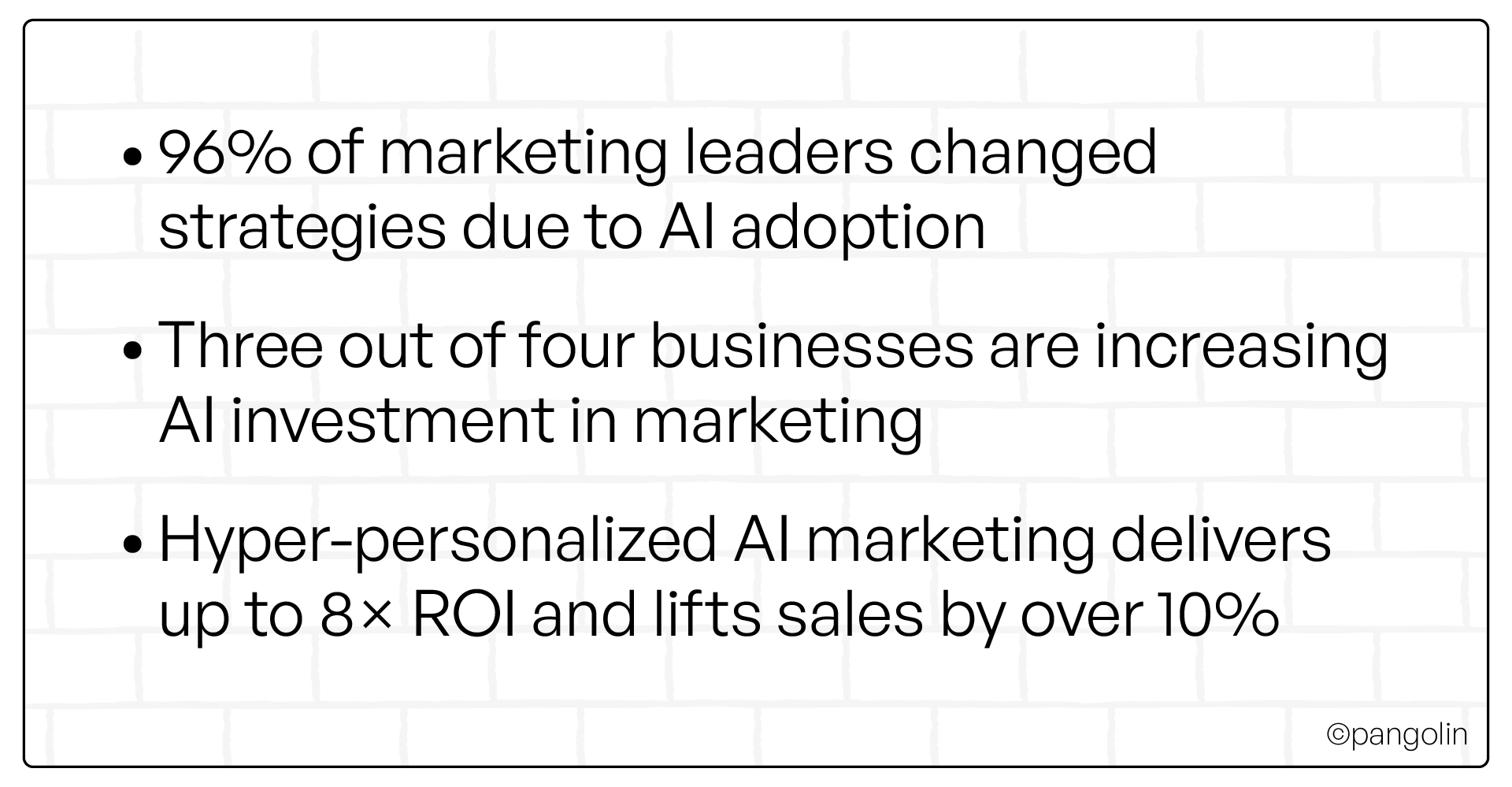
The results? Companies using AI-powered multi-channel marketing see 8× ROI and 10%+ sales lift. By 2029, 80% of customer service issues will be resolved by AI without human intervention. And 96% of marketing leaders have already changed their strategies in response to AI adoption.
The question isn't whether AI will transform B2B marketing. It's whether you'll lead that transformation or get left behind.
Here's how IT companies can use AI to unify multi-channel marketing, turning disconnected campaigns into one coordinated growth engine.
Let's start with why this conversation is happening in 2025, not 2020.
Your buyers aren't linear. They don't see one ad, visit your website, and request a demo. They research across 10+ channels before making decisions.
They see your LinkedIn post. Google your services. Read a third-party review. Visit your pricing page. Download a whitepaper. Attend a webinar. Compare competitors. Circle back to your website weeks later. Each touchpoint influences their decision, but only if those touchpoints coordinate.
By 2025, 80% of B2B interactions between vendors and buyers happen online. Multi-channel orchestration isn't optimization anymore. It's survival.
And here's the brutal part: multi-channel automation creates 3–4× higher engagement rates. If your competitors coordinate their channels and you don't, they're converting leads you're losing.
Manual multi-channel coordination doesn't scale. You can't personally track every prospect across LinkedIn, email, your website, ads, and webinars. You can't remember which leads downloaded your whitepaper vs. attended your demo. And you definitely can't personalize content for each prospect across every channel in real-time.
That's AI's superpower.
AI tracks behavior across channels, predicts buying intent, personalizes content dynamically, and orchestrates campaigns without human intervention. It does in milliseconds what would take your team hours, and it does it for thousands of prospects simultaneously.
The data backs this up:
Here's the advantage you have: you already understand technology.
While other industries struggle with basic martech integration, IT companies instinctively grasp APIs, data flows, and system architecture. You're not intimidated by terms like "machine learning models" or "predictive analytics." You speak the language.
And your buyers? They're technical too. They expect sophisticated, personalized experiences. They notice when your website shows generic content after they've visited five times. They appreciate when your chatbot remembers their previous questions.
Plus, your sales cycles are long, 6–18 months for complex IT services. That's exactly where AI excels. AI nurtures leads systematically over months, tracks engagement signals, and alerts sales at the perfect moment. Human marketers can't sustain that level of attention across hundreds of prospects. AI can.
AI isn't one thing, it's a collection of capabilities. Here are the five that matter most for coordinating multi-channel campaigns.

Static content is dead. Your prospects expect one-to-one experiences, website content that changes based on their industry, emails that reference their specific pain points, ads that acknowledge their previous interactions.
AI makes this scalable.
Real-time content tailoring: When a healthcare CTO visits your website, AI shows cloud security content emphasizing HIPAA compliance. When a fintech VP visits, they see content about PCI-DSS and financial regulations. Same website. Different experience. Zero manual work.
Dynamic email sequences: AI adjusts email content based on behavior. Clicked the pricing link? Next email includes ROI calculator. Ignored three emails? Switch to re-engagement sequence. Attended webinar? Send personalized follow-up with demo offer.
Personalized ads across platforms: LinkedIn ads that reference a prospect's company size and industry. Google Display ads that show content aligned with their previous website visits. All coordinated by AI.
The payoff: Hyper-personalized AI strategies deliver 8× ROI and 10%+ sales lift.
AI doesn't just react to behavior, it predicts it.
Forecast campaign performance: Before launching a campaign, AI predicts open rates, click rates, conversion rates based on historical data. You optimize before spending budget, not after.
Identify in-market accounts: AI analyzes intent signals, content consumption, search behavior, competitor research, to identify which accounts are actively evaluating solutions. You reach prospects when they're ready to buy, not months too early or too late.
Predict lead scores: AI scores leads based on demographic fit and behavioral engagement. High score = route to sales immediately. Medium score = nurture sequence. Low score = long-term education track.
Real-time optimization: Campaign underperforming? AI adjusts targeting, creative, and bidding automatically, no waiting for weekly review meetings.
The result: Marketing spend becomes 15–25% more efficient because you're targeting the right accounts at the right time with the right message.
Your website gets visitors 24/7. But your sales team works 9–5. That gap costs you leads.
AI chatbots fill it.
24/7 lead qualification: Chatbots ask qualifying questions, assess fit, and book demos, even at 2 AM. No lead falls through because they visited your site outside business hours.
Natural language understanding: Modern AI chatbots don't just follow scripts. They understand complex questions, reference previous conversations, and provide contextually relevant answers.
Personalized product education: Prospect asks, "How does your cloud migration process work?" Chatbot provides a detailed answer and offers to send a case study showing how you migrated a similar company. One interaction, multiple value-adds.
Seamless handoff to humans: When conversations need human expertise, chatbots pass the lead to sales with full context, no "start from scratch" frustration.
The trajectory: Gartner predicts that by 2029, agentic AI will resolve 80% of common customer service issues without human intervention. That's not far-off future. That's four years away.
Real-world proof: Intercom's AI chatbot, Fin, has already handled over 13 million customer queries across 4,000+ B2B businesses.
Content is the fuel for multi-channel marketing. But creating platform-specific content for email, LinkedIn, Twitter, blog posts, ads, and landing pages is time-consuming.
AI accelerates it.
Generate blog posts and articles: Feed AI a topic, target audience, and key points. It produces a first draft in minutes. Human editors refine, add brand voice, and publish.
Write email subject lines and body copy: AI tests hundreds of subject line variations, predicts open rates, and suggests the highest-performing options.
Create platform-specific social content: AI tailors messaging for LinkedIn (professional, value-driven) vs. Twitter (concise, punchy) vs. Instagram (visual, aspirational).
Optimize ad copy continuously: AI generates multiple ad variations, tests them, and doubles down on winners, all automatically.
The key: AI handles volume and speed. Humans handle strategy, brand voice, and quality control. It's augmentation, not replacement.
Here's the painful truth: most marketing teams have no idea which channels actually drive revenue.
They track last-click attribution, which credits only the final touchpoint before conversion. But B2B buyers interact with you across 10+ touchpoints before they buy. Last-click gives 100% credit to the demo request form and ignores the LinkedIn ad, blog post, webinar, and three emails that came before it.
AI fixes this with multi-touch attribution.
Track the full buyer journey: AI follows prospects across LinkedIn, Google Ads, email, website, webinars, and offline events. It maps every interaction and assigns credit proportionally.
Identify hidden revenue drivers: Discover that your thought leadership blog posts don't generate direct leads, but accounts that read them convert 40% faster. That's attribution insight you'd miss with last-click.
Optimize spend allocation: Shift budget toward channels that genuinely influence pipeline, not just those that get last-click credit.
Prove marketing's impact: Show leadership exactly how marketing contributed to closed deals, with data, not anecdotes.
AI-powered multi-touch attribution enables 15–25% more efficient marketing spend by revealing which channels truly drive revenue, not just clicks.
Theory is nice. Let's get tactical. Here's exactly how to apply AI to each channel.
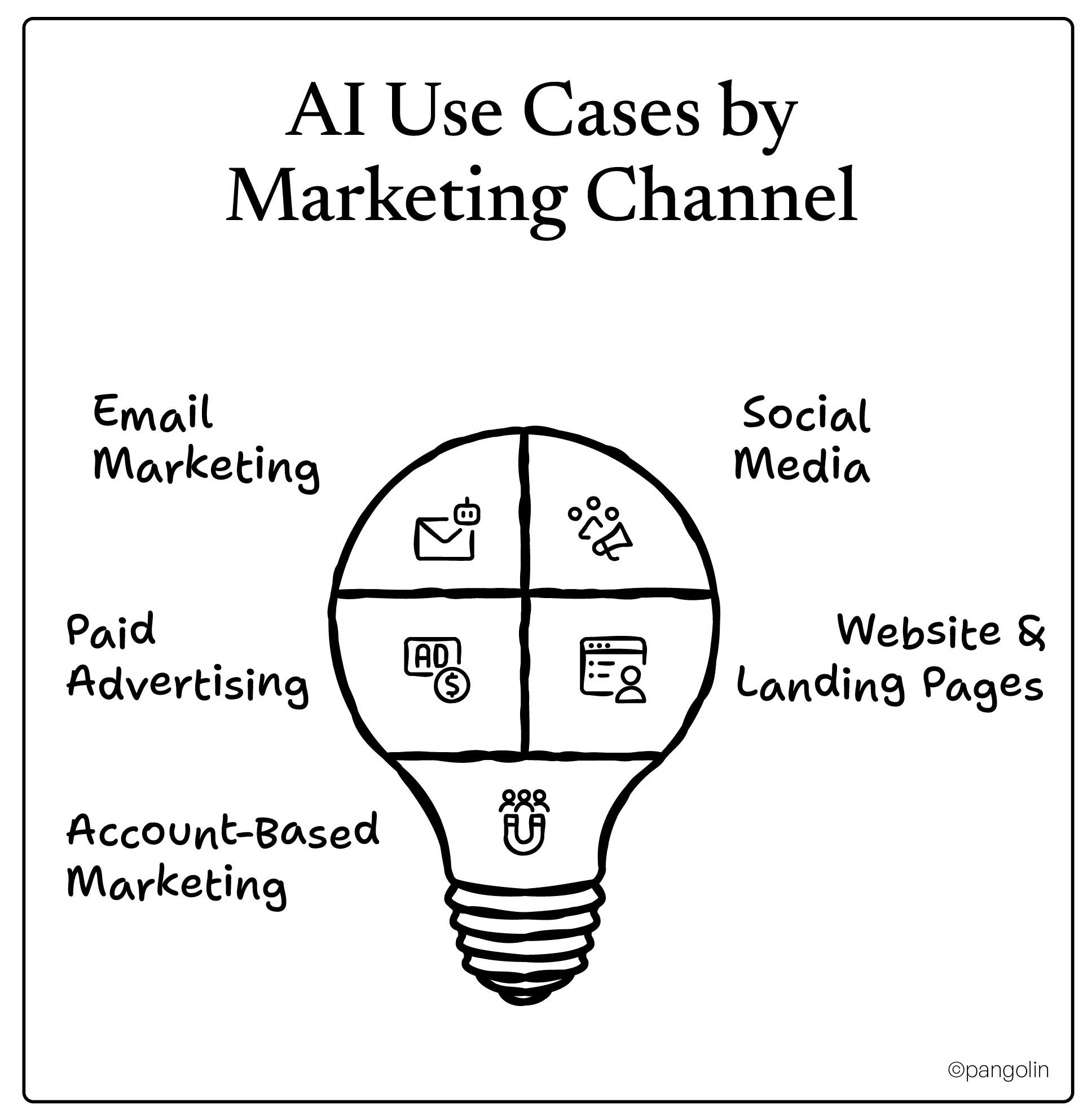
Predictive send-time optimization: AI analyzes when each prospect typically opens emails and schedules sends accordingly. Same email. Different send times. Higher open rates.
AI-generated subject lines: Tools like HubSpot and Jasper AI suggest subject lines proven to drive higher engagement. Test multiple variations automatically.
Dynamic content blocks: Email content changes based on recipient's industry, company size, or previous interactions. One template. Hundreds of personalized versions.
Automated segmentation: AI groups subscribers by behavior, engaged, inactive, high-intent, and routes them to appropriate sequences without manual list management.
Audience analysis at scale: AI analyzes your followers' demographics, behaviors, and engagement patterns to identify content themes that resonate.
Optimized scheduling: AI identifies peak engagement times for your specific audience and auto-schedules posts accordingly, no more guessing.
Social listening and sentiment analysis: AI monitors brand mentions, competitor activity, and industry conversations. It flags opportunities (positive sentiment) and threats (negative sentiment) in real-time.
Platform-specific content generation: AI adapts core messaging for LinkedIn (professional tone), Twitter (concise), and Instagram (visual storytelling).
AI-powered audience targeting: Machine learning identifies which audience segments respond best and automatically shifts budget toward high-performers.
Dynamic creative optimization: Upload multiple headlines, images, and CTAs. AI tests every combination and serves the highest-converting variant to each prospect.
Real-time bid adjustments: AI monitors auction dynamics and adjusts bids to maximize conversions within your budget, no manual CPC tweaking.
Lookalike audience creation: AI analyzes your best customers and finds similar prospects on LinkedIn, Google, and Facebook.
Dynamic headlines and CTAs: Website content changes based on visitor profile. Enterprise prospects see "Scale securely across 10,000+ endpoints." SMB prospects see "Cloud migration in under 30 days".
AI chatbots for instant qualification: Visitors get answers immediately. High-fit prospects get routed to sales. Low-fit get educational resources.
Personalized product recommendations: AI suggests case studies, whitepapers, and solutions based on browsing behavior, like "customers who viewed this also downloaded...".
Real-time A/B testing: AI tests headlines, images, and layouts continuously, optimizing without waiting for statistical significance.
Intent data analysis: AI identifies accounts showing buying signals, visiting competitor sites, researching solutions, consuming content, before they contact you.
Account-level engagement scoring: Track how many stakeholders at a target account have interacted with your content. High engagement = sales-ready.
Coordinated multi-channel plays: When an account hits engagement thresholds, AI triggers LinkedIn ads, personalized emails, and sales alerts, all automatically.
Personalized microsites: AI generates account-specific landing pages with custom messaging, case studies, and ROI projections.
You don't need every AI tool. You need the right ones for your use cases. Here's the breakdown.
HubSpot (Starting at $890/month): AI content generation, predictive lead scoring, chatbots, and email optimization, all integrated with HubSpot's CRM. Best for mid-market IT companies wanting unified infrastructure.
Salesforce Marketing Cloud (Contact for pricing): Einstein AI powers predictive analytics, journey orchestration, and account-level insights. Best for enterprises already using Salesforce CRM.
Oracle (Contact for pricing): AI-driven customer data platform and campaign optimization. Best for large IT services firms with complex data requirements.
Ortto (Starting at $599/month): AI-powered marketing automation with filters, enrichment, and email optimization. Best for growing IT companies needing powerful automation without enterprise complexity.
Jasper AI (Starting at $49/month): Generate blog posts, ad copy, social content, and email sequences. Best for content-heavy strategies.
Copy.ai (Starting at $49/month): AI copywriting for emails, landing pages, and ads. Best for teams needing fast, on-brand copy.
ChatGPT / Claude (Free–$20/month): Custom AI assistants for content strategy, brainstorming, and first drafts. Best for teams comfortable with prompt engineering.
Mutiny (Contact for pricing): Dynamic landing pages that change based on firmographics and intent signals. Best for ABM-focused IT companies.
Clearbit (Contact for pricing): Firmographic data enrichment for personalization. Best for companies needing account-level intelligence.
Intercom Fin (Contact for pricing): Handled 13M+ customer queries across 4,000+ B2B businesses. Best for IT companies needing sophisticated conversational AI.
Drift (Starting at $2,500/month): Conversational AI for lead qualification and sales acceleration. Best for high-velocity sales teams.
ChatSpot (HubSpot) (Included in HubSpot): AI chat assistant for marketing and sales tasks. Best for HubSpot users wanting built-in AI.
Google Analytics 4 (Free): Predictive metrics and cross-channel attribution powered by machine learning. Best for every IT company (no reason not to use it).
Bizible (Marketo) (Contact for pricing): Multi-touch attribution powered by AI. Best for Marketo users needing revenue attribution.
6Sense (Contact for pricing): Intent data + predictive analytics for ABM. Best for enterprise IT firms targeting high-value accounts.
Tools don't deliver ROI. Strategy does. Here's how to implement AI for multi-channel marketing systematically.
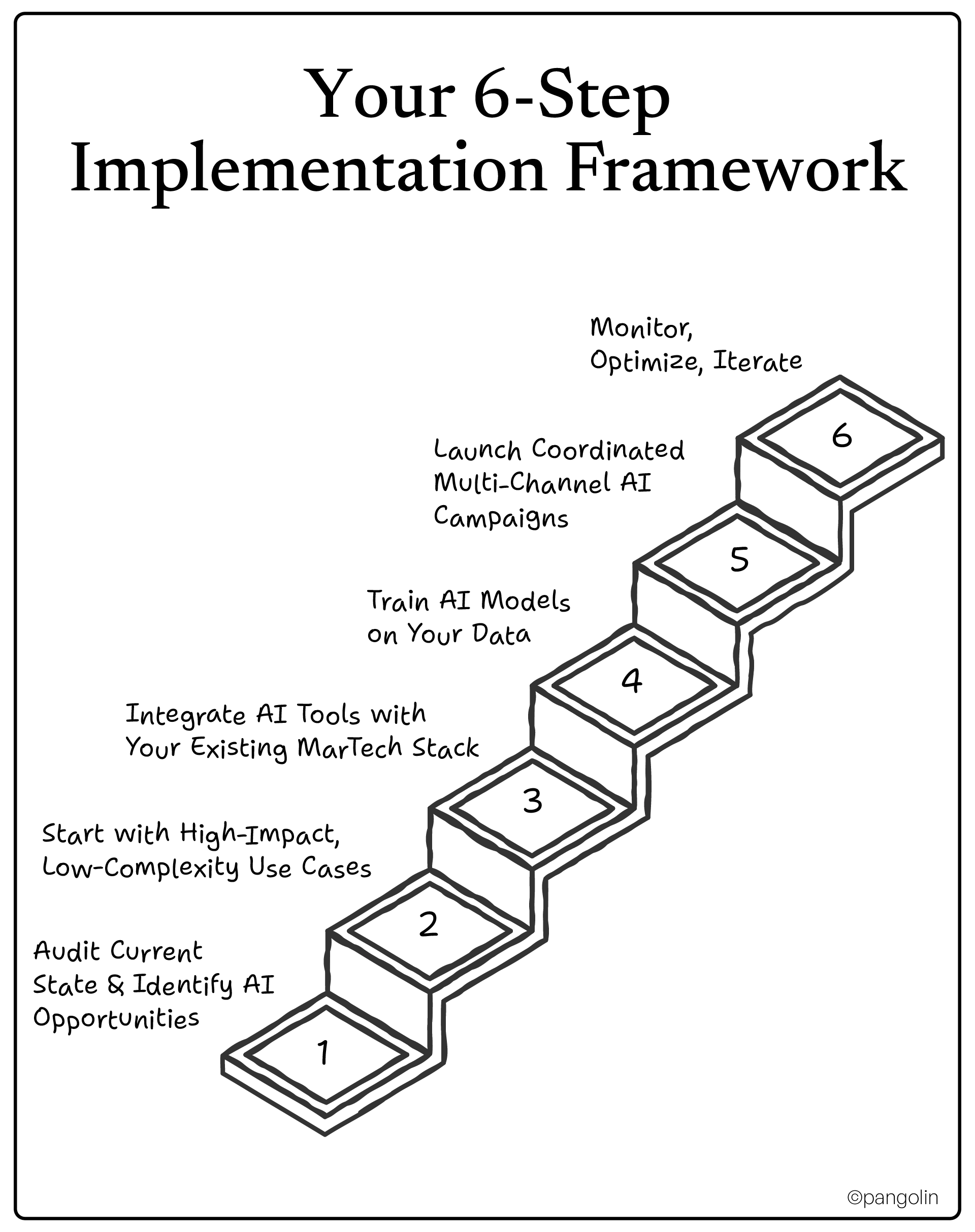
Start with reality, not aspiration.
Map existing channels and workflows: List every channel you're active on, email, LinkedIn, Google Ads, website, webinars, events, content. Document how each operates today.
Identify manual bottlenecks: Where does your team waste time on repetitive tasks? Email segmentation? Lead scoring? Social media scheduling? Content creation? These are prime AI candidates.
Assess data quality: AI trained on bad data produces bad results. Review your CRM. Are records clean? Are fields standardized? Do you have enough historical data to train models?
Define success metrics: What does "winning with AI" look like? More qualified leads? Higher conversion rates? Lower cost per acquisition? Faster sales cycles? Pick 3–5 KPIs.
Don't try to automate everything on day one. Start with quick wins that prove AI's value.
Email subject line optimization (Complexity: Low | Impact: Medium): Use AI to test subject lines and predict open rates. Deploy in one week. Measure lift within two weeks.
Chatbot for lead qualification (Complexity: Medium | Impact: High): Install AI chatbot on high-traffic pages (pricing, demo request, homepage). Qualify leads 24/7. See results within 30 days.
Predictive lead scoring (Complexity: Medium | Impact: High): Train AI on historical data (which leads converted?). Score new leads automatically. Sales productivity boost within 60 days.
Dynamic website content (Complexity: Medium | Impact: High): Personalize homepage headlines and CTAs based on industry/firmographics. Increase conversion rates within 45 days.
AI tools that don't integrate create new silos. Avoid that trap.
Prioritize CRM sync: Ensure AI platforms sync bidirectionally with your CRM (Salesforce, HubSpot, Pipedrive). Leads, scoring updates, and engagement data should flow automatically.
Connect email, social, ads: Unified data is critical. LinkedIn Lead Gen Forms → CRM → Email automation → Sales alerts. One flow, no gaps.
Implement tracking pixels: Add LinkedIn Insight Tag, Google Analytics, and marketing automation tracking to your website. AI needs data to optimize.
Build centralized dashboard: Don't force your team to check eight dashboards. Build one unified view showing AI performance across all channels.
AI isn't plug-and-play. It learns from your data.
Feed historical campaign data: Upload past email campaigns, ad performance, lead conversion data. AI identifies patterns humans miss.
Sync customer behavior data: Website visits, email opens, content downloads, demo requests. The more behavior data, the better AI predictions.
Train chatbots on real conversations: Upload FAQs, sales call transcripts, support tickets. AI chatbots learn your product, your voice, your customers.
Refine lead scoring models: Which leads actually closed? Which stalled? AI adjusts scoring criteria based on outcomes, not guesses.
Now orchestrate. Here's what a coordinated campaign looks like:
AI identifies in-market accounts (6Sense, intent data): 200 accounts showing buying signals.
Trigger personalized LinkedIn ads targeting decision-makers at those accounts.
Website visitors see dynamic content about their specific pain points.
Chatbot qualifies leads in real-time, books demos automatically.
AI-powered email nurture for non-converters, sequences adapt based on engagement.
Multi-touch attribution tracks every touchpoint from LinkedIn ad to closed deal.
One prospect journey. Six AI-powered touchpoints. All coordinated.
AI improves with feedback. Don't "set and forget."
Track AI vs. manual benchmarks: Compare AI-generated subject lines against human-written. AI-scored leads vs. manual scoring. AI chatbot conversion vs. forms-only.
A/B test continuously: Test AI content against human content. Test AI timing against fixed schedules. Let data decide winners.
Refine models monthly: As you gather more conversion data, retrain AI models. Scoring accuracy improves. Predictions sharpen.
Scale what works: When a use case proves ROI, expand it. Started with chatbot on pricing page? Add it to product pages, blog posts, resource library.
Let's make this concrete. Here's how a mid-sized IT services firm used AI to launch a new cloud security offering.
The firm uses 6Sense to analyze intent data. AI identifies 200 mid-market healthcare and fintech companies showing high intent, visiting cloud security content, researching competitors, attending industry webinars.
AI triggers LinkedIn Sponsored Content targeting CTOs and IT Directors at those 200 accounts. Ad creative dynamically adjusts, healthcare prospects see HIPAA messaging, fintech prospects see PCI-DSS messaging.
When targeted prospects visit the website, Mutiny changes the homepage headline from "Enterprise Cloud Security" to "HIPAA-Compliant Cloud Security for Healthcare." The CTA shifts from "Learn More" to "See Our Healthcare Case Studies".
Visitors engage with Intercom Fin. The chatbot asks qualifying questions: "What compliance frameworks are you currently managing?" "How many endpoints?" High-fit prospects get routed to sales immediately. Others enter nurture sequences.
Prospects who don't convert immediately enter HubSpot's AI-powered nurture sequence. Emails adapt based on engagement, clicked the compliance guide? Next email sends a HIPAA checklist. Ignored three emails? Switch to re-engagement offer.
Bizible tracks the full journey: LinkedIn ad view → website visit → chatbot interaction → email open → demo request → closed deal. The firm discovers LinkedIn ads don't generate immediate leads, but accounts that engage with ads convert 50% faster. That's insight last-click attribution would miss.
AI isn't magic. It fails when implemented poorly. Here's what to avoid.
The mistake: Buying AI tools because they're trendy, not because they solve specific business problems.
The fix: Start with goals. "We want to reduce lead qualification time by 50%." Then find AI tools that deliver that outcome. Technology should follow strategy, not lead it.
The mistake: Training AI on messy CRM data, duplicates, missing fields, inconsistent formatting.
The fix: Clean your data before implementing AI. Dedupe records. Standardize fields. Validate email addresses. "Garbage in, garbage out" applies doubly to AI.
The mistake: Removing all human oversight. AI generates content, sends emails, qualifies leads, no human review.
The fix: Use AI for speed and scale. Humans maintain quality control. Review AI-generated content. Audit chatbot conversations. Ensure brand voice stays intact.
The mistake: Implementing AI email tools, AI chatbots, AI ad platforms, none of which integrate. New tools, new silos.
The fix: Prioritize AI platforms with native CRM integrations. Unified data is non-negotiable. If tools don't sync, leads fall through cracks.
The mistake: AI personalization that crosses privacy boundaries, tracking without consent, using data for purposes users didn't agree to.
The fix: Ensure GDPR and CCPA compliance. Be transparent about data usage. Provide opt-outs. Privacy violations destroy trust faster than AI can build it.
AI isn't static. Here's where it's headed.
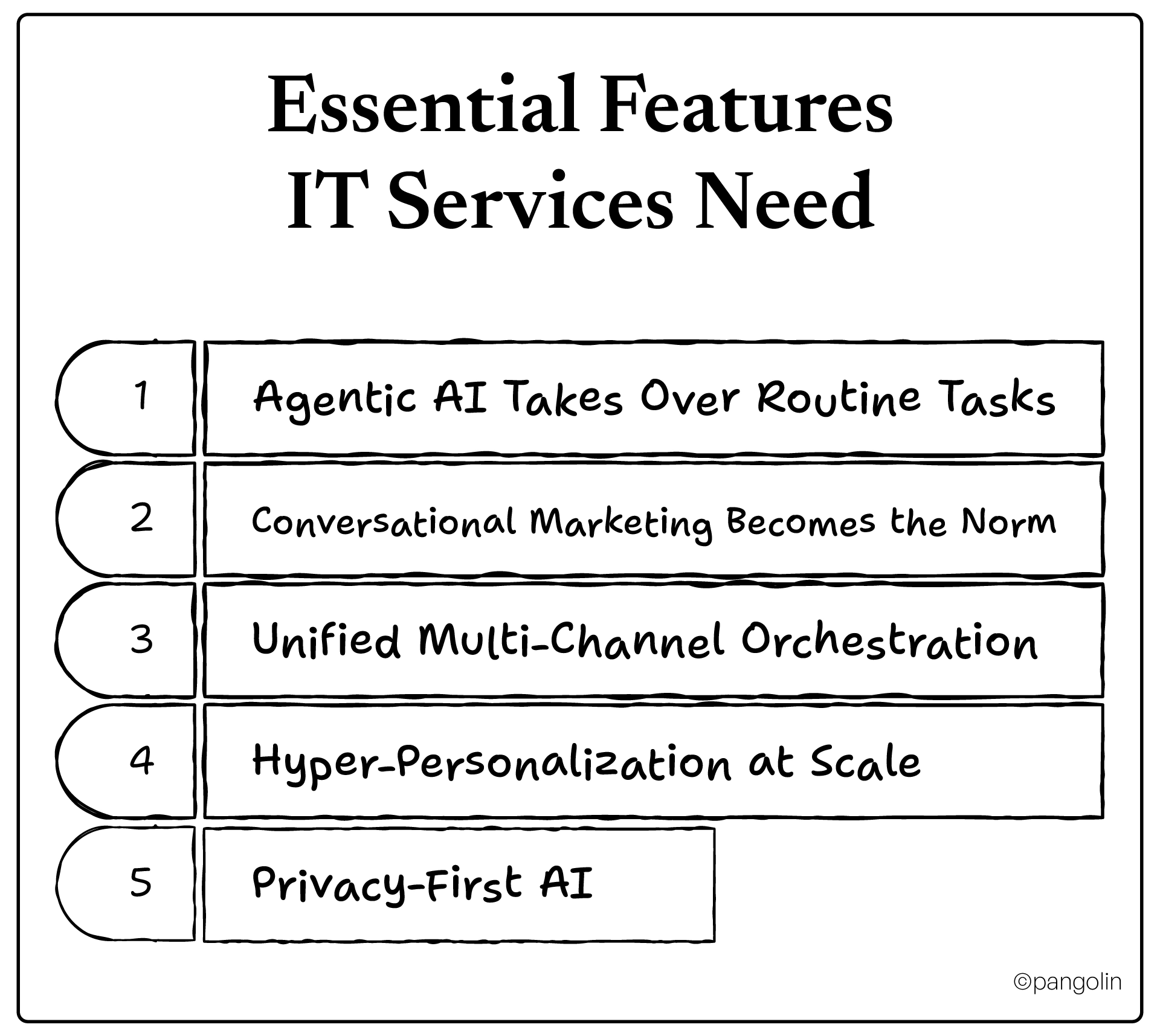
By 2029, autonomous AI agents will execute marketing tasks without human prompting. You won't say, "Create an email campaign for this segment." You'll say, "Increase qualified leads by 20% this quarter," and AI will build the campaigns, test variations, and optimize autonomously.
Gartner predicts 80% of customer service issues will be resolved by AI agents by 2029, no human involved. That's four years away.
AI-powered chatbots, live chat, and interactive content will dominate buyer journeys. Static forms and gated content decline. Real-time conversations guide prospects through the funnel.
Buyers expect consistency across every channel, website, email, LinkedIn, ads, events. AI ensures it. 50%+ of $1M+ B2B deals are already being completed via digital self-service channels. That trend accelerates.
One-to-one experiences become standard. Dynamic landing pages. Personalized email content. Custom product recommendations. AI-generated offers tailored to each prospect's behavior.
As privacy regulations tighten, AI that respects data boundaries while delivering personalization becomes the differentiator. First-party data becomes increasingly valuable. AI maximizes its use.
Stop planning. Start doing. Here's your first month.
It enables them.
Your IT company faces the same challenge every B2B marketer faces: buyers interact with you across 10+ channels, and coordinating those touchpoints manually doesn't scale.
You can't personalize website content for every visitor. You can't score leads in real-time.
You can't nurture thousands of prospects through 6–18 month sales cycles without systematic automation.
AI does all of that, and it does it better than humans ever could.
The ROI is proven: 8× returns from hyper-personalization. 10%+ sales lift. 3–4× higher engagement from multi-channel automation. And 80% of customer service automation within four years.
The leaders in your industry are already implementing AI. They're qualifying leads 24/7 with chatbots. They're personalizing website content in real-time. They're using predictive analytics to target in-market accounts before competitors even know those accounts exist.
The gap between AI-powered marketers and manual marketers is widening every quarter. The question isn't whether you'll adopt AI. It's whether you'll adopt it strategically, with clear use cases, proper integration, and measurable ROI, or reactively, chasing trends and wasting budget.
Start small. Prove value. Scale what works.
ROI timelines unfold in predictable stages, not overnight magic. Month 1 typically delivers 20–30% productivity boosts with 50% reduction in content production time and faster campaign optimization. Month 3 shows up to 70% automation of routine tasks, 15–35% higher conversion rates, and systematic content workflows. Month 6 is when substantial financial ROI materializes, companies report up to 50% revenue growth in AI-optimized channels, 41% decreased cost per acquisition, and 120% increased engagement rates. The key accelerators are quality implementation, good data integration, focusing on high-impact areas first (chatbots, email optimization, lead scoring), and team willingness to adapt workflows. Marketing teams implementing AI tools often see first measurable returns within weeks, not months or years.
Creating an effective strategy remains the core challenge for 53% of marketers executing multi-channel plans. Many brands struggle with fragmented data across platforms, social media, CRM, analytics tools, preventing AI from delivering accurate personalization. Without unified customer data, AI-powered marketing becomes inaccurate and misses opportunities. The second major challenge is maintaining consistent brand messaging across channels while using AI, crucial for building unified brand identity and customer trust. Other significant hurdles include measuring AI's impact due to inefficient reporting, lack of proper metrics, and time-consuming analysis. The fix: start with data unification, implement centralized dashboards, and ensure AI tools integrate natively with existing CRM and marketing platforms.
AI augments human marketers, it doesn't replace them. AI excels at repetitive, high-volume tasks like data analysis, content generation at scale, automated ad targeting, and real-time campaign optimization. Human marketers bring emotional intelligence, creativity, strategic depth, and brand storytelling that AI can't replicate. Companies using hybrid approaches see the best results: SuperAGI reported 35% increase in sales-qualified leads, 42% higher customer engagement, and 28% reduction in customer acquisition costs by combining AI efficiency with human creativity. AI-powered personalization delivers average 20% sales increases, but only when humans provide strategic direction and quality control. The smart play: use AI for repetitive tasks and data insights, rely on human minds for strategy, emotional storytelling, and maintaining brand voice.
AI trained on messy data produces unreliable results, this is the "garbage in, garbage out" problem. Before implementing AI, ensure your CRM has clean, deduplicated records with standardized field values (industry, company size, job titles). You need sufficient historical data to train AI models, ideally 6–12 months of campaign performance, lead conversion data, and customer behavior tracking. Many brands struggle with data silos, scattered customer information across platforms preventing AI from building unified profiles. The fix: conduct a data audit, clean and standardize records, implement unified tracking across channels, and establish data governance processes before deploying AI tools. Companies with poor data quality typically see 5.9% average ROI on enterprise AI, while those with clean, integrated data see 300% ROI or higher.
Start with high-impact, low-complexity use cases that prove value quickly. AI chatbots for lead qualification deliver results within 30 days, providing 24/7 availability and handling initial screening automatically. Email subject line optimization using AI shows measurable lift within two weeks with minimal implementation complexity. Predictive lead scoring improves sales productivity within 60 days by automatically prioritizing high-potential prospects. Dynamic website content personalization increases conversion rates within 45 days by tailoring headlines and CTAs based on visitor profile. Avoid starting with complex implementations like full ABM orchestration or custom AI model development, these take 6+ months to deliver ROI and require significant technical resources.
Implementation costs vary dramatically by scope. Entry-level AI tools (chatbots, email optimization) start at $49–$100/month and deliver quick wins. Mid-market platforms (HubSpot AI, Ortto) range $500–$2,000/month with comprehensive automation. Enterprise solutions (Salesforce Einstein, Marketo AI) require $2,000–$10,000+/month plus implementation costs. For realistic ROI expectations: companies implementing AI marketing tools can see up to 300% ROI when following best practices. Hyper-personalized AI delivers up to 8× ROI and 10%+ sales lift. However, average ROI on enterprise AI is only 5.9% due to poor implementation, data quality issues, and misaligned expectations. Budget for both technology costs AND change management, realistic timelines are 6–18 months for basic implementations and 2–3 years for comprehensive systems.
For most IT companies, off-the-shelf AI tools deliver better ROI faster than custom development. Pre-built platforms like HubSpot, Salesforce Einstein, and specialized tools (Jasper, Drift, Mutiny) offer proven capabilities with faster implementation, weeks instead of months. Custom AI models require significant data science resources, months of development, ongoing maintenance, and higher risk of failure. However, custom models make sense for enterprise IT companies with unique data advantages, highly specialized use cases, or proprietary algorithms that create competitive differentiation. The hybrid approach works best: start with off-the-shelf tools for quick wins (chatbots, email optimization, lead scoring), then build custom models for strategic differentiators once you've proven AI ROI and built internal capabilities.
AI handles volume and speed, humans maintain brand voice and strategic direction. Implement a human-in-the-loop review process: AI generates first drafts, human editors refine for brand voice, add strategic nuance, and ensure quality. Use AI for content acceleration, not replacement, AI produces blog outlines, email variations, social post ideas, but humans add emotional intelligence and storytelling that resonates. Train AI tools on your brand guidelines and past high-performing content so outputs align with your voice from the start. Avoid "set-and-forget" automation, review AI-generated content regularly and provide feedback to improve outputs over time. Companies that over-automate without human oversight create tone-deaf messaging and brand mishaps. The balance: AI for 80% of the work (research, drafts, variations), humans for 20% (strategy, refinement, quality control).
AI personalization that crosses privacy boundaries destroys trust faster than it builds engagement. Ensure GDPR and CCPA compliance by obtaining explicit consent for data collection and usage, providing transparent privacy policies that explain AI-driven personalization, and offering easy opt-out mechanisms. Avoid using AI to track behavior without consent or personalize using data users didn't explicitly share. The challenge: maintaining effective personalization while respecting privacy. Solution: focus on first-party data (behavioral data users voluntarily provide through interactions with your content) rather than third-party tracking. Privacy-first AI that respects data boundaries while delivering personalization becomes a competitive advantage as regulations tighten. Implement data governance processes ensuring AI tools only access approved data sources and comply with regional privacy laws.

