

In August 2025, scientists discovered something weird: human cells can literally vomit when they're injured. They purge all their damaged machinery, revert to a stem-like state, and rebuild from scratch. It's messy, chaotic, but it's exactly what enables rapid healing.
Your marketing channels right now? They're doing the opposite.
They're accumulating damage, siloed data, fragmented customer journeys, attribution chaos, and never purging the dysfunction. The result: 86% of B2B purchases stall because buyers experience disconnected touchpoints. Your prospects interact with you across 10–11 channels, but if those channels don't coordinate, you're not healing your pipeline, you're hemorrhaging it.
This isn't about adding more channels. It's about orchestrating the ones you have into a system that works together, seamlessly, measurably, and profitably.
Here's your step-by-step framework to build a multi-channel marketing strategy that doesn't just reach B2B IT buyers, it actually converts them.
Let's start with the math.
Multi-channel customers spend 3–4× more than single-channel buyers. Marketing automation across multiple channels delivers 3–4× higher engagement. But here's the problem: 48% of B2B marketers struggle to generate enough leads, and most point to fragmented execution as the culprit.
Your IT buyers aren't linear. They're researching you on Google at 11 PM, checking LinkedIn reviews during lunch, attending your webinar on Thursday, and ghosting your SDR's email on Friday. 67% of their journey happens digitally before they ever talk to a human.
If your channels don't talk to each other, you're invisible during the most critical phase of their decision-making process.
B2B buyers now use 10–11 channels during their purchasing journey, up from just 5 in 2016.
The bar isn't "present on multiple channels." It's "coordinated across all of them."
Multi-channel means you're active on LinkedIn, running Google Ads, sending emails, hosting webinars, but each operates somewhat independently. You're present, but not integrated.
Omnichannel means those channels share data, messaging, and objectives. A prospect downloads your whitepaper, gets a personalized email sequence, sees a retargeting ad referencing the download, and gets a LinkedIn message from your SDR, all coordinated, all contextual.
For B2B IT, integration level drives ROI. The more your channels collaborate, the faster deals move and the higher your conversion rates climb.
You don't need perfection, you need progression. Start multi-channel, evolve toward omnichannel.
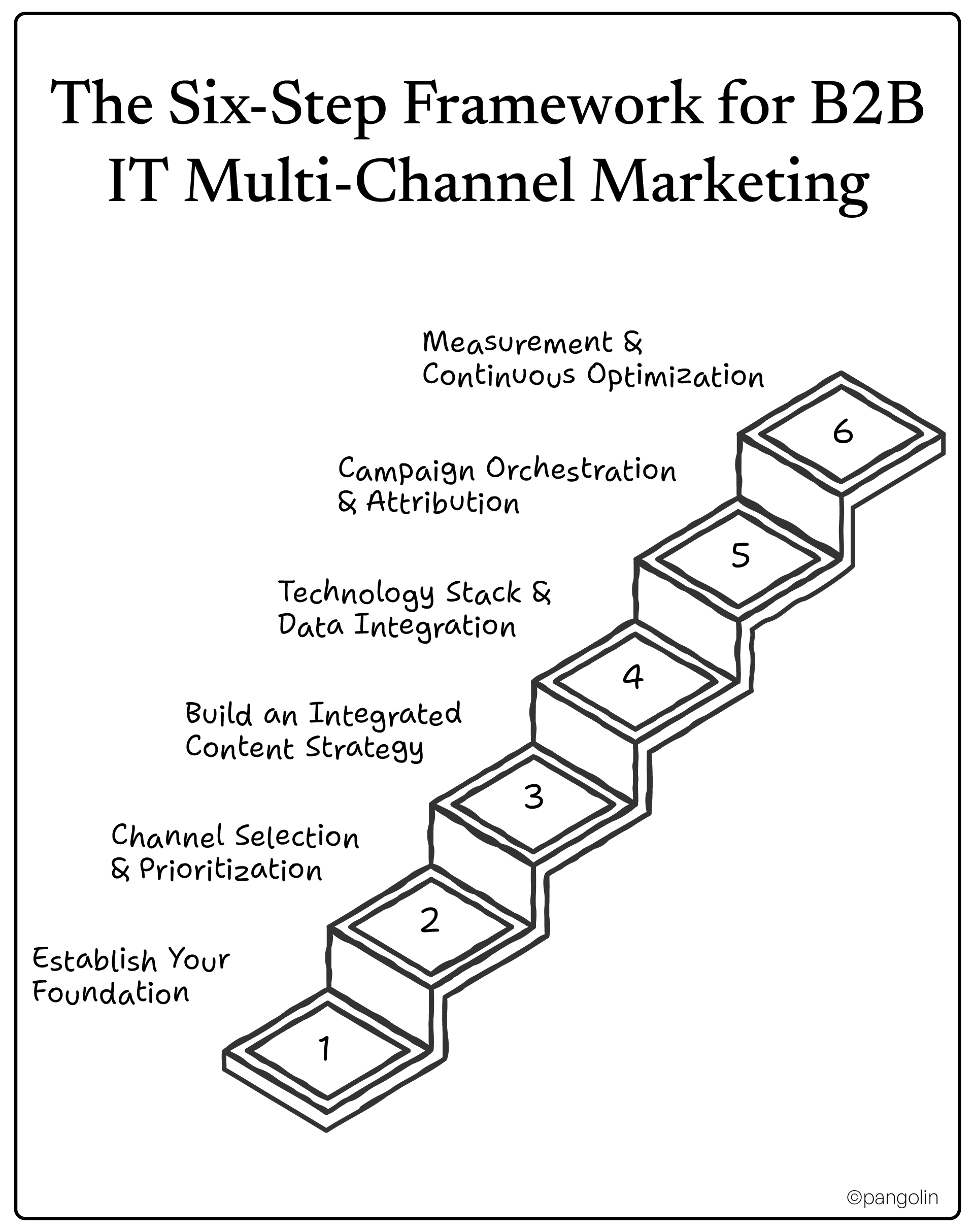
Most marketers jump straight to tactics, "Let's run LinkedIn ads!", without defining what success looks like. That's how you end up with activity theater instead of pipeline impact.
Start here:
What are you actually trying to accomplish? Be specific:
Each objective demands different channel prioritization and content strategies.
B2B IT purchases involve 6–10 stakeholders. You're not marketing to "the CTO." You're marketing to:
Each persona needs different messaging, delivered through different channels.
Your prospects move through five phases:
Each phase has distinct touchpoints. Map them. A LinkedIn ad might work for awareness; a case study works for consideration; a live demo works for decision.
67% of the B2B buyer journey happens digitally before prospects ever contact a vendor.
Not all channels deliver equal ROI. Here's what the data says for B2B IT:
Use these five criteria:
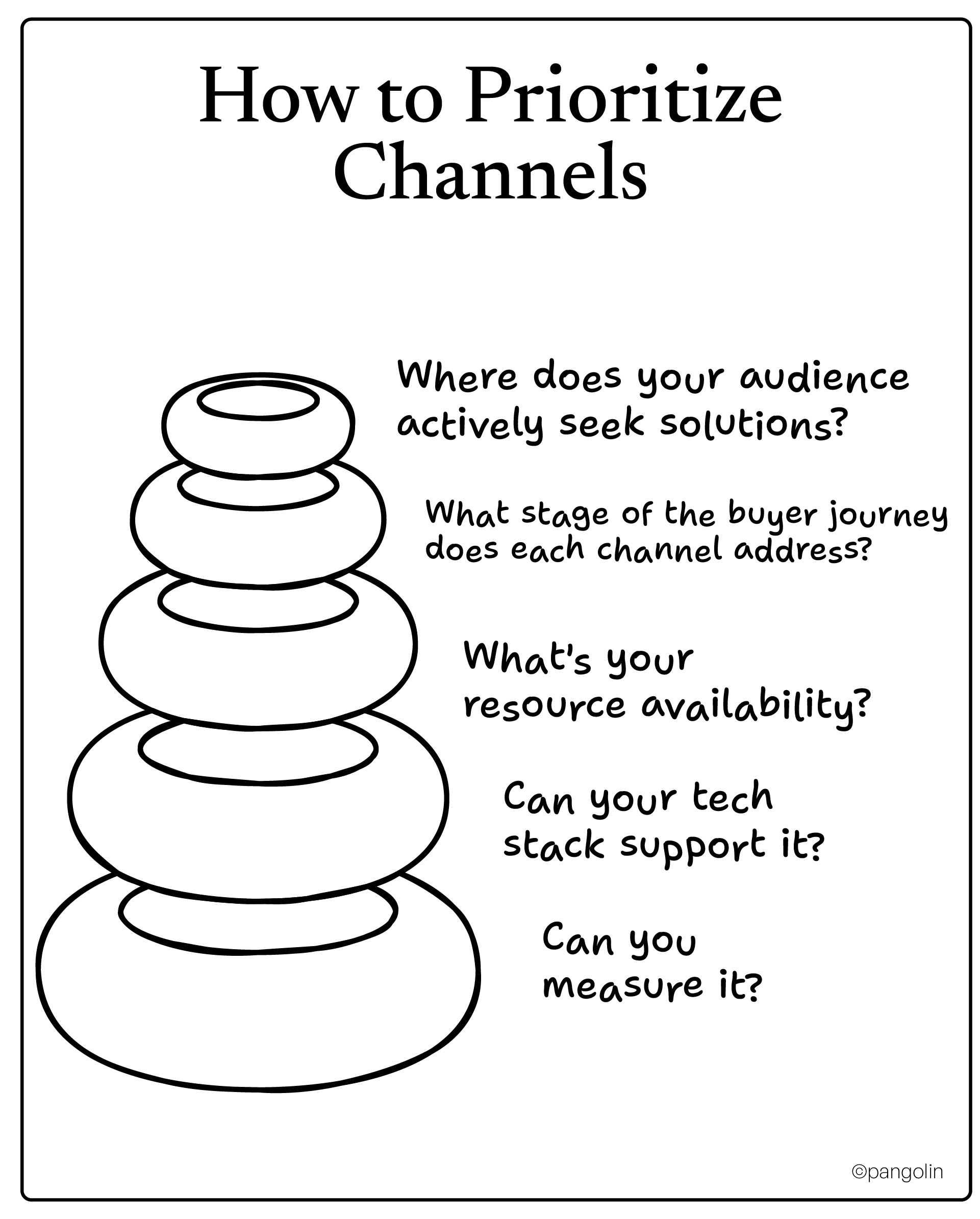
Start with 2–3 high-ROI channels that align with your ICP's behavior. Master them. Then expand.
Multi-channel marketing fails when every channel tells a different story. Your LinkedIn ad promises one thing, your website says another, and your sales deck contradicts both.
Integration starts with unified messaging.
One core asset should fuel multiple channels. Example:
This is content multiplication, not duplication. Same insights, different formats for different contexts.
Not every piece of content works for every persona at every stage.
Your martech stack should enable coordination, not create more fragmentation. Here's what you need:
The biggest multi-channel killer: siloed data. Your email platform doesn't talk to your CRM. Your CRM doesn't sync with your ad platforms. Your attribution tool only sees half the journey.
Fix this:
If a channel can't integrate with your stack, it's not ready for prime time.
The average B2B marketer uses 15+ tools. Most overlap. Audit annually and eliminate redundancies. Your goal isn't "more tools", it's "more integration."
Here's where multi-channel becomes coordinated multi-channel.
Each channel should have its own success metrics that ladder up to overall campaign goals:
You're not optimizing channels in isolation, you're optimizing the system.
Your channels should amplify each other, not compete. If you're launching a new product:
Every channel knows its role. Every touchpoint builds on the last.
Here's the brutal truth: last-click attribution lies to you. It credits the final touchpoint and ignores everything that came before.
Better attribution models:
Start with W-shaped if you're unsure, it balances awareness, consideration, and decision stages.
Multi-touch attribution reveals the hidden value of channels that don't close deals but accelerate them.
You can't optimize what you don't measure. Here's what to track.
These tell you if your strategy is working before revenue shows up:
These tell you if your strategy is profitable:
Don't "set it and forget it", iterate constantly:
Every quarter, ask: What should we do more of, less of, or stop entirely?
Even great frameworks fail if you step on these landmines:
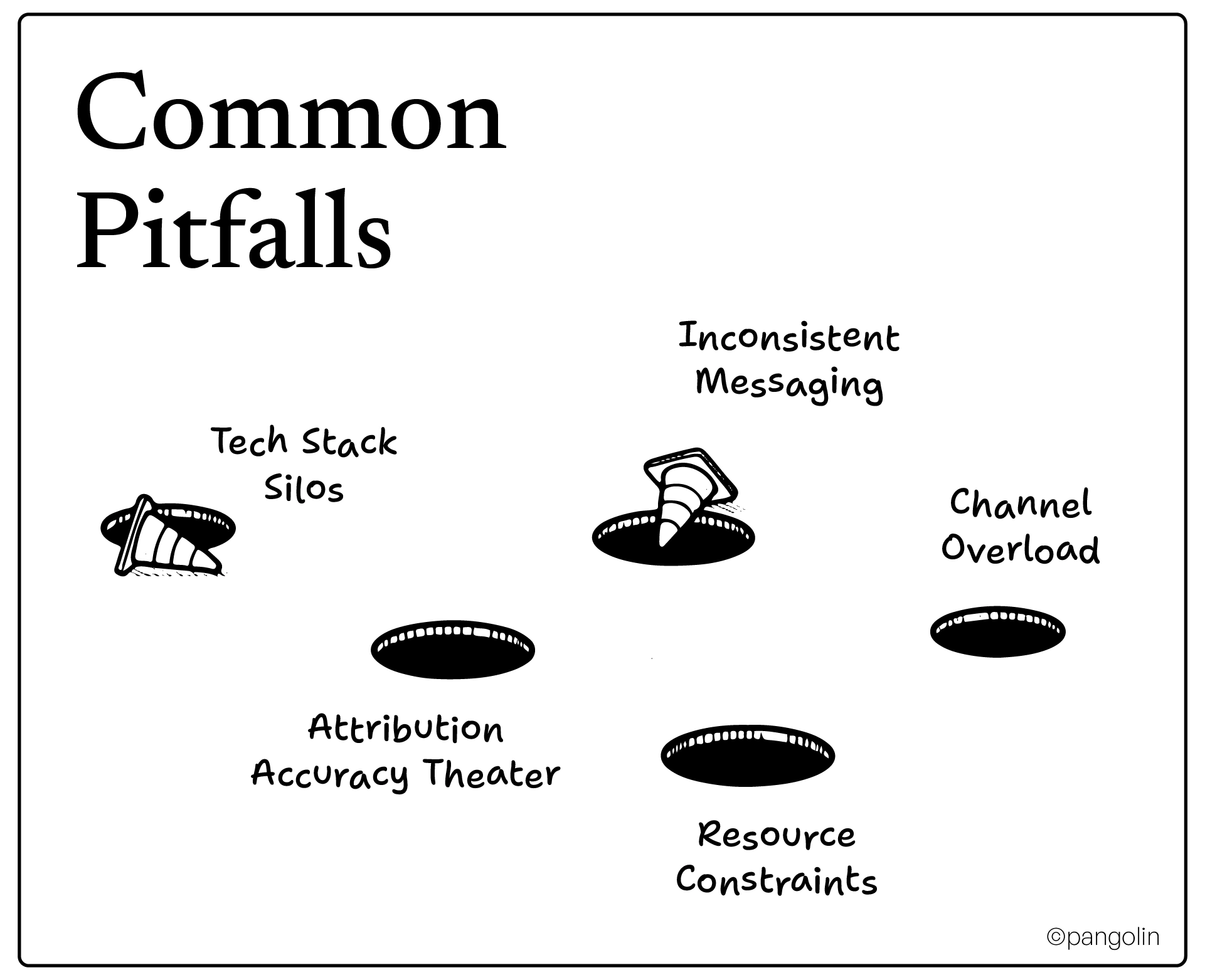
You're tracking clicks and impressions but can't tie them to revenue. Fix: Use multi-touch attribution plus self-reported data (ask leads "How did you hear about us?" on forms).
Your tools don't talk to each other. Data lives in isolated platforms. Fix: Prioritize native integrations. If a tool can't sync with your CRM, reconsider it.
Every channel sounds like a different company. Fix: Create unified brand guidelines and content templates. One voice, many formats.
You're stretched thin trying to execute on 10 channels. Fix: Start with your tightest ICP and 2–3 high-ROI channels. Scale only after you've mastered the fundamentals.
You're everywhere, but nowhere effectively. Fix: Don't try to own every channel. Focus on where your audience actually lives.
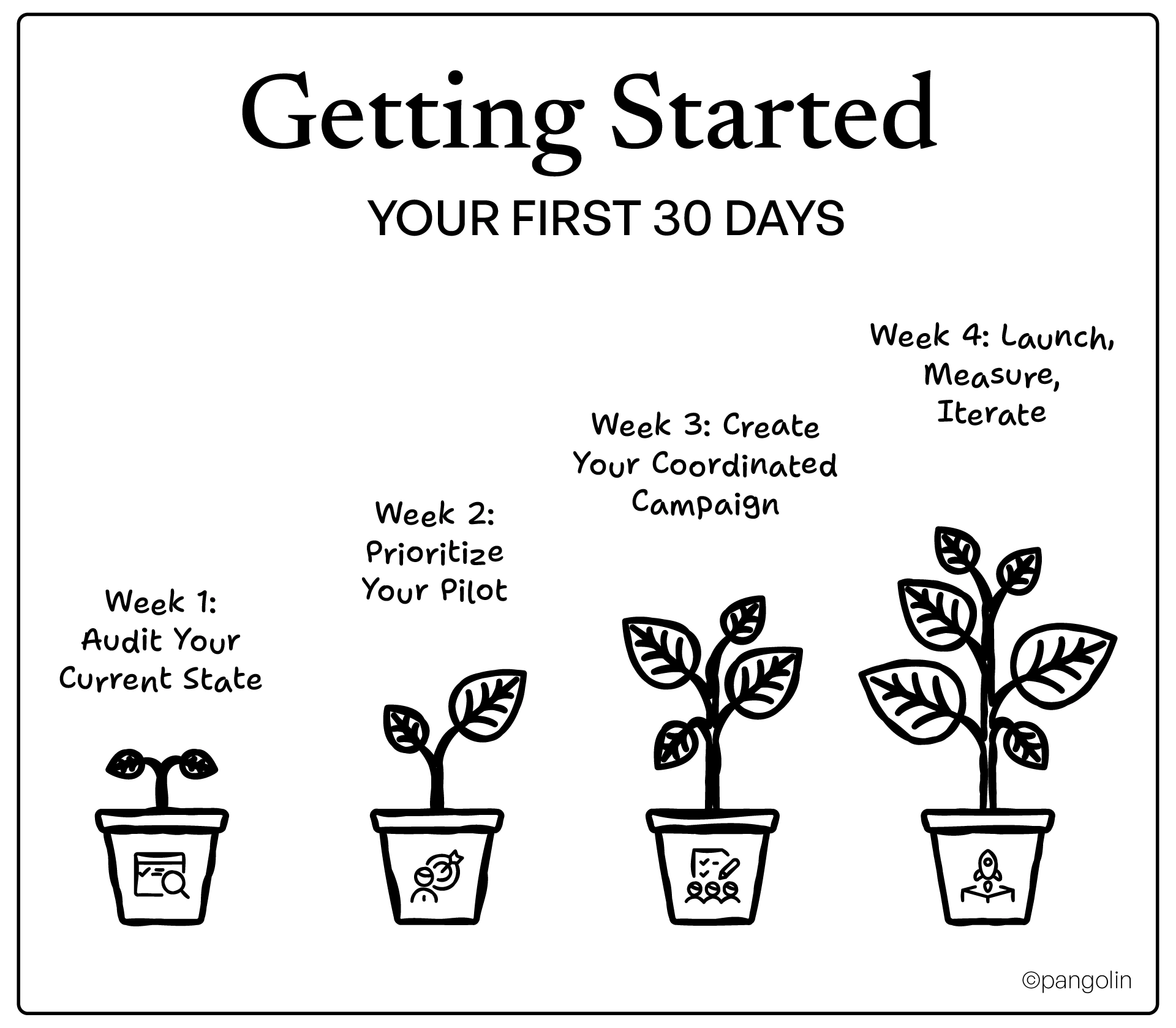
Here's how to move from theory to execution:
Multi-channel marketing isn't about being everywhere. It's about being coordinated everywhere your buyers are.
When your channels work together, when LinkedIn ads lead to gated content, which triggers email nurture, which prompts a sales call, you're not just generating leads. You're building a system that compounds.
The data backs it up: multi-channel customers spend 3–4× more. Multi-channel campaigns drive 3–4× higher engagement. And when you nail the orchestration, you turn fragmented touchpoints into a seamless journey that closes deals.
Your buyers are already using 10–11 channels. The question isn't whether you should go multi-channel, it's whether you're coordinated enough to meet them there.
Start with the framework. Master the fundamentals. Scale what works.
Need help building your multi-channel engine? Pangolin specializes in revenue automation, full-funnel growth marketing, and martech integration for B2B IT companies. We'll help you turn channel chaos into coordinated growth.
Multi-channel marketing means you're active on multiple platforms, LinkedIn, email, webinars, PPC, but each channel operates somewhat independently. Omnichannel marketing integrates those channels so they share data, messaging, and customer context. For example, in a multi-channel approach, your email team might not know a prospect attended your webinar. In an omnichannel approach, that webinar attendee automatically enters a personalized email nurture sequence. For B2B IT companies, omnichannel delivers higher ROI because it creates seamless buyer experiences across touchpoints.
Quality beats quantity. Start with 2–3 high-ROI channels where your ideal customers actively engage. Spreading yourself across 10 channels without proper coordination dilutes your impact and creates inconsistent experiences. The most effective B2B IT channels based on ROI data are speaking engagements (856% ROI), thought leadership SEO (748% ROI), webinars (430% ROI), and email nurture (261% ROI). Choose channels based on where your audience seeks solutions, your budget, and your ability to integrate them with your tech stack.
Use a two-tier approach: leading indicators and lagging indicators. Leading indicators provide early signals, email open rates, website traffic by source, engagement metrics, MQLs, and SQLs. Lagging indicators tie to business outcomes, pipeline generated by channel, customer acquisition cost (CAC), marketing-influenced revenue, win rates by source, and return on marketing investment (ROMI). The most critical step is implementing multi-touch attribution models like W-shaped or data-driven attribution to understand how channels work together, not just in isolation.
Most B2B IT companies should start with W-shaped attribution. This model assigns credit to three critical moments: first touch (awareness), lead creation (consideration), and opportunity creation (decision). It's more accurate than last-click attribution, which ignores the nurturing journey, and more practical than linear attribution, which treats all touchpoints equally. As you mature, consider data-driven attribution that uses machine learning to assign credit based on actual influence. The key is moving beyond last-click, which credits only the final interaction and dramatically undervalues top-of-funnel efforts.
Timeline depends on the channels and objectives. Simple campaigns (email or content-focused) show initial engagement improvements in 4–6 weeks. Multi-channel or ABM campaigns require 8–12 weeks for meaningful pipeline impact. For a complete multi-channel system, expect this progression: 1–2 months for baseline engagement and lead quality improvements, 3–4 months for measurable increases in qualified opportunities and conversion rates, and 6+ months for significant revenue impact and CAC efficiency. The most sustainable growth comes from systematic optimization, not quick tactical wins.
The most common pitfalls are inconsistent branding across channels, poor tech stack integration, and resource overextension. Many B2B IT marketers try to be on every platform instead of focusing on where their audience actually engages. Another mistake is using the same content across all channels without adaptation, a LinkedIn post shouldn't be identical to an email or a webinar script. Additionally, 58% of B2B marketers cite lack of resources as their biggest challenge. The fix: start narrow with your tightest ICP and 2–3 channels, master integration, then scale.
A strategic framework for B2B IT companies allocates 40% to acquisition channels (SEO, PPC, LinkedIn, ABM), 30% to conversion assets (website, landing pages, demo tools), 20% to nurturing systems (content, email automation, CRM), and 10% to analytics and optimization. This shifts based on company maturity, early-stage firms need more acquisition investment, while established companies benefit from greater nurture and analytics spend. Budget also varies by sales cycle length: complex IT purchases with long cycles require more investment in nurturing, while transactional products need higher acquisition spending.
Yes, by focusing resources on targeted channels and niches rather than broad-based spending. Boutique and mid-sized IT firms can outperform larger competitors by dominating specific verticals, leveraging practice-specific SEO, implementing automated lead capture systems, and developing deep subject-matter expertise content. Multi-channel customers spend 3–4× more than single-channel buyers, and coordinated campaigns drive 3–4× higher engagement. The advantage isn't size, it's precision. Target where your ICP actively seeks solutions, master 2–3 channels, and scale from there.
Begin with a 30-day pilot framework. Week 1: Audit your current channels, identify content gaps, and map tech stack integrations. Week 2: Pick 2 high-ROI channels aligned with your ICP's behavior, define one clear objective (e.g., "Generate 100 MQLs in 90 days"), and build a simple attribution model. Week 3: Create one core content asset and adapt it into 3–5 formats for different channels. Week 4: Launch the campaign, track leading indicators daily, and schedule a retrospective to assess performance. Start small, measure rigorously, iterate based on data, then expand

