


Here's some news: Scientists in Germany discovered two fossilized juvenile pterosaurs, named Lucky and Lucky II, caught in a microsecond of history: a tropical storm 150 million years ago (not so lucky after all).
Speaking of fossils, let's talk about your B2B marketing strategies. And the tropical storm you're about to face because budget cuts are cranking up the heat.
Any marketing strategy B2B is a story of timing. It's the difference between rushing headlong into the storm and flowing with a current that creates fertile ground.
If you're a marketing director at an IT services firm, you're in a constant battle for budget, a sales team demanding more "hot leads," and a CEO who wants to see ROI yesterday.
[[divider]]
Here's the counterintuitive truth that changes everything: most IT companies think they have a lead generation problem. They don't.
They have a visibility problem during the "dark funnel": the critical research phase where buyers form their opinions long before they ever contact a vendor.
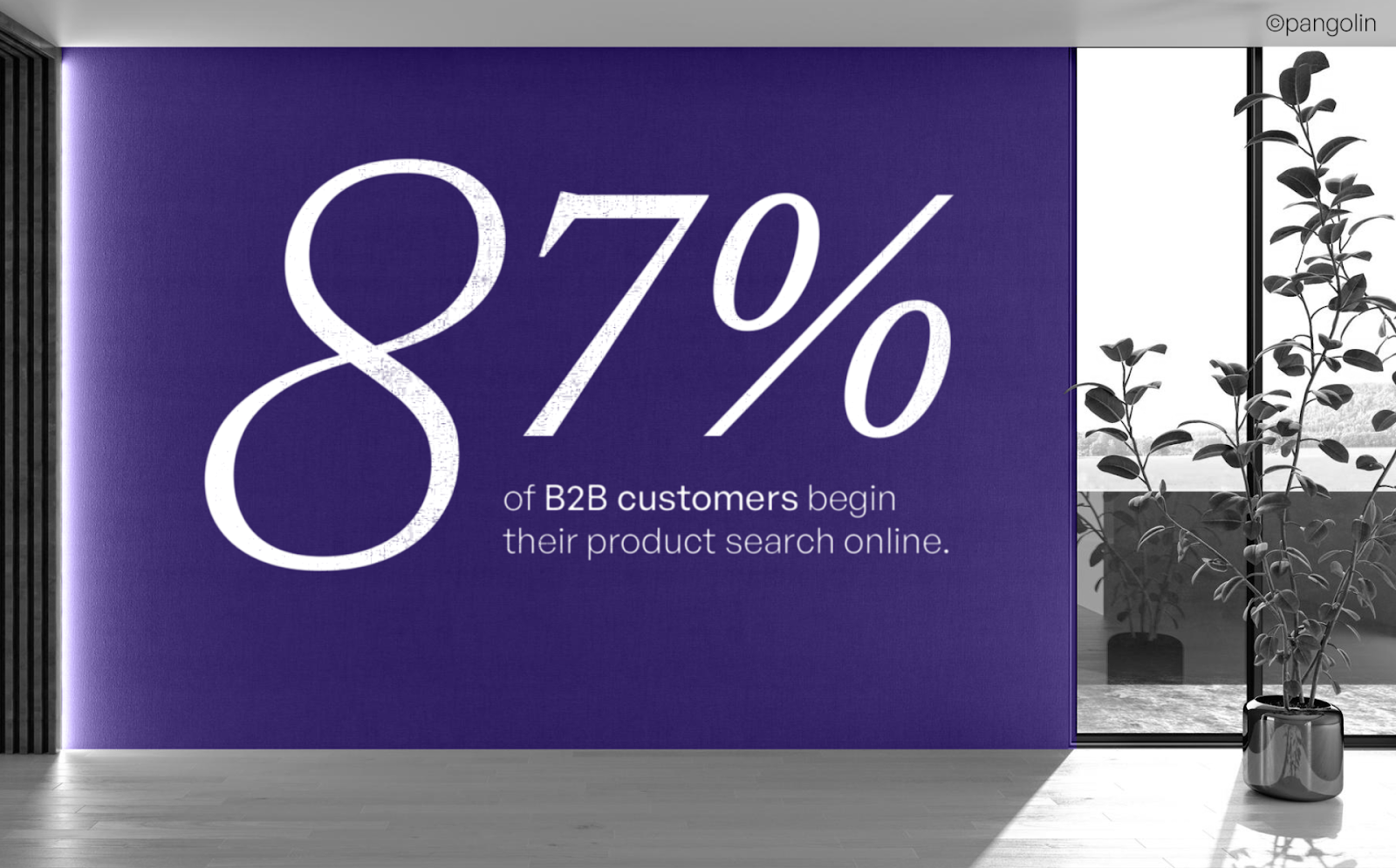
They're reading articles, watching webinars, and asking peers for recommendations. By the time they finally fill out a "Contact Us" form, they have practically finished their journey. Forget about starting it.
They've already eliminated most of your competitors. The question is, were you part of that invisible conversation?
If your B2B business marketing is built around your sales process instead of their learning process, the answer is likely no. Traditional IT marketing is heavy on feature lists and technical specs, and assumes buyers want to be sold to.
But modern IT buyers, who are navigating high-stakes decisions with an average of 5-7 other stakeholders, want to be educated so they can make a confident choice.
You feel like you're generating plenty of activity but not enough qualified pipeline. You're experiencing the disconnect between a straight-line sales strategy and a meandering buyer reality.
The obvious question at this point is: are you going extinct? Luckily you're not the lucky twins.
What if you could build a system that aligns with buyers' natural path?
What if you could become their most trusted resource, long before they even identify as a "lead"?
That's not just better marketing. It's the difference between fighting for every deal and creating a gravity that pulls the right clients toward you.
And it's all built on a simple, four-part framework.
[[divider]]
So, how do you stop being a fossil? You don't need more B2B marketing ideas. You need a system. A framework that stops the frantic scrambling and starts building momentum that actually lasts.
After analyzing hundreds of high-growth IT services firms, we've found they all operate on a simple, four-part system.
Think of it as your riverbed, the foundational structure that directs the flow of all your B2B marketing techniques.
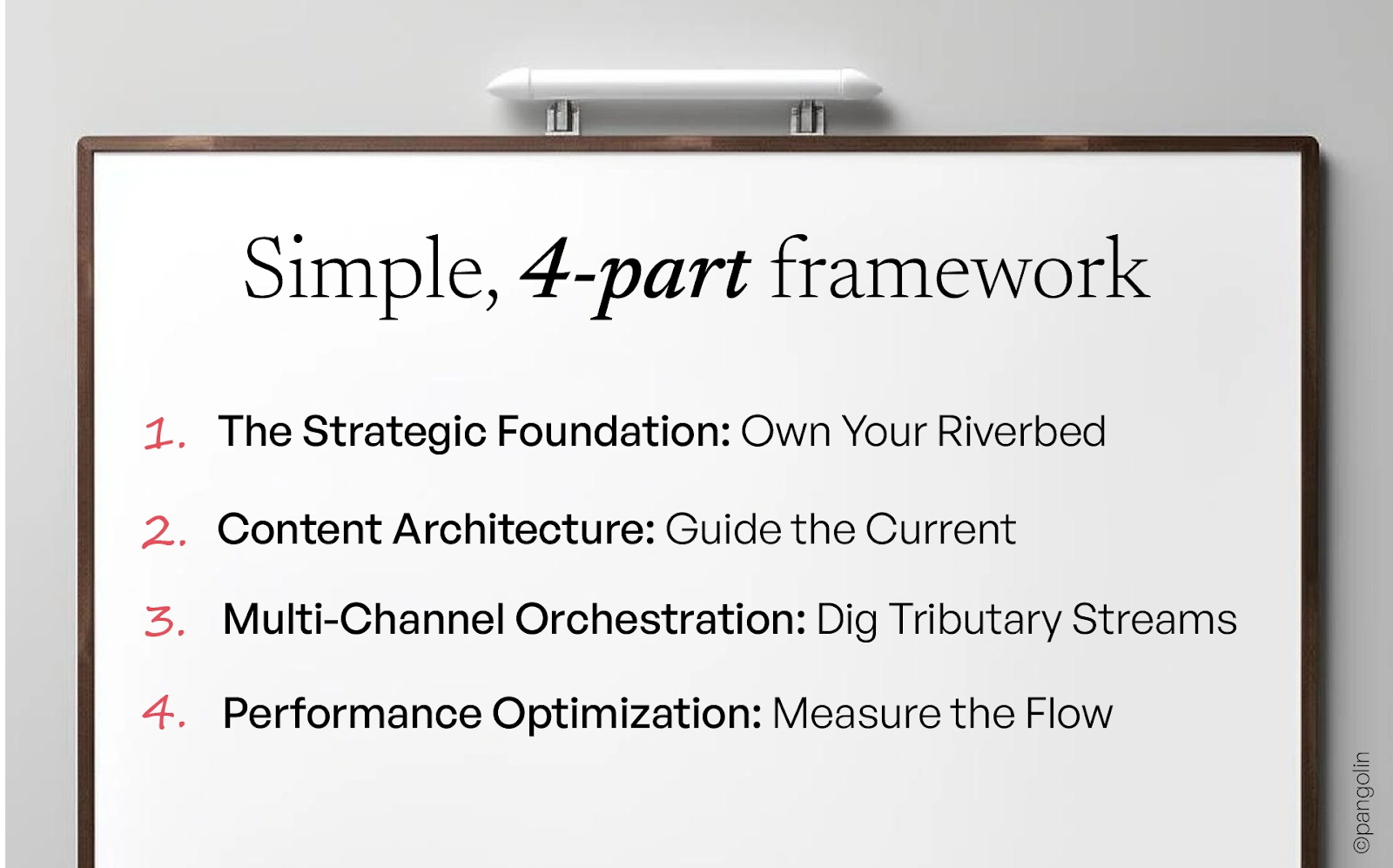
Before you can make it rain with campaigns and content, you need a riverbed: a strong foundation of strategic positioning. It's the answer to the question your buyer is silently asking: "Why should I choose you over every other option, including doing nothing at all?"
Most IT firms are just noise. They compete by saying, "We offer cloud solutions," or "We're a managed services provider."
That's a label, not a position. And labels get compared on price. A real B2B branding strategy is specific and defensible. It's the unique valley only your river flows through.
Instead, try: We eliminate downtime for mid-sized manufacturing firms by migrating their legacy monoliths to microservices on AWS, automating server provisioning with Infrastructure as Code, and upgrading their data storage to Snowflake.
See the difference? We went from a vague promise to a concrete plan. That specificity stops the price fight and starts a real conversation because you sound like you've actually done it before.
You're no longer an IT company. You're THE IT company for that specific world.
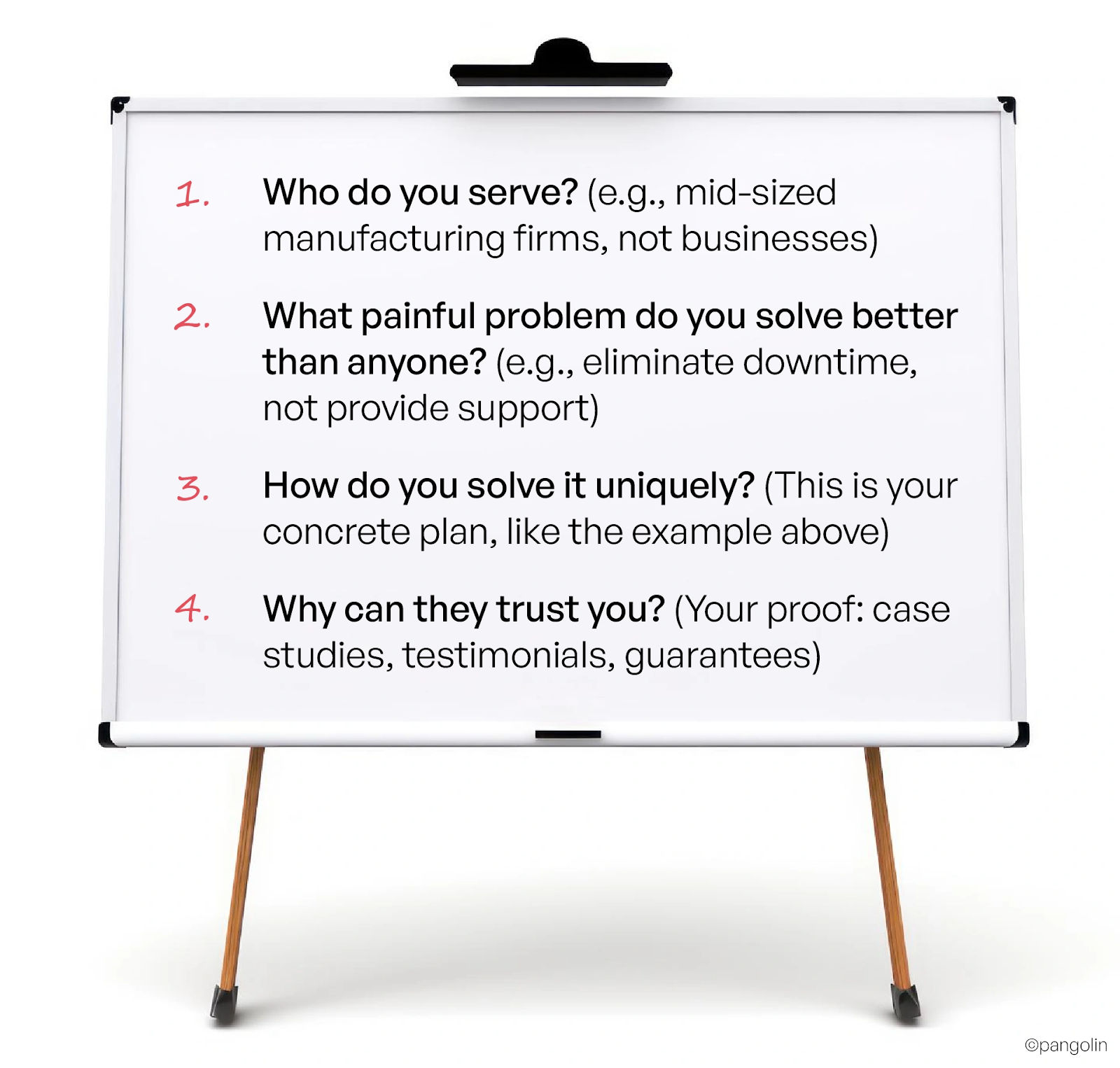
Market leaders don't always have better products, rather they have better positions. A strong one is about truth told plainly and answering four questions with brutal clarity:
Who do you serve? Not "businesses" or "enterprises." Name the exact industry and company size.
What specific problem do you solve? Not "IT challenges." The exact pain point that keeps them up at night.
How are you uniquely qualified? Not "experienced team." Your specific methodology, technology stack, or approach.
What outcome do you deliver? Not "improved efficiency." The measurable business result they can bank on.
Get this right, and everything else gets easier. Sales cycles shorten, deal sizes grow, and marketing for IT services finally feels less like shouting into the void. Without it, you're just another rock in the riverbed.
Think about the last time you made a big, complex purchase. Did you enjoy the aggressive salesperson, or did you appreciate the guide who helped you understand your options?
Your IT buyers are no different. They are navigating a high-stakes decision that could impact their career, and they are drowning in a sea of self-serving content that all sounds the same.
This is where an effective inbound marketing strategy for B2B starts: creating content that educates instead of sells.
At this stage, your buyer has symptoms, but no diagnosis. Their network is slow. Their security feels shaky. They are vaguely aware something is wrong, but they don't know what to call it.
Your job is to be the diagnostician.
Don't: Hit them with a feature sheet about your "next-gen firewall."
Do: Offer a blog post titled, "3 Hidden Reasons Your Network is Lagging (and None Are Your ISP)."
This content doesn't sell. It serves. It builds trust by helping them put a name to their pain.
Now they have a diagnosis. They know they need "cloud migration" or "a zero-trust security model." They are actively researching solutions.
Your job is to be the consultant.
Don't: Send them a generic "About Us" brochure.
Do: Host a webinar on "The 5 Biggest Mistakes to Avoid in Your First Cloud Migration."
This content establishes your expertise. You're not selling a service but teaching them the right way to buy it, which builds immense confidence in your ability to deliver it. This is how B2B services marketing separates leaders from followers.
They have a plan. They know the type of solution they need. Now, they're picking a partner to execute it. This is where your proof matters most.
Your job is to be the trusted referral.
Don't: Just claim you have "proven results."
Do: Show them a detailed case study of how you helped a similar manufacturing firm cut downtime by 90% in six months, complete with a testimonial from their VP of Operations.
This content removes risk. It makes the decision to choose you feel safe and logical. These B2B marketing case studies become your most powerful sales tool.
Each piece of content is a bend in the river, gently guiding them.
A strong river needs tributaries, smaller streams that feed it and make it powerful. Your marketing channels are those streams.
Great content is useless if it sits on a shelf.
B2B IT buyers don't follow a straight line. They jump from a Google search to a LinkedIn post, to a webinar, to a peer review site, to an email from your competitor. Your job is to be present and consistent at every turn, reinforcing the same core message.
Be everywhere that matters to your buyer.
An orchestrated multi-channel approach creates a "surround sound" effect. It builds familiarity and trust because your message is reinforced across different contexts. It works.
Companies with integrated multi-channel strategies report 40-60% higher qualified lead volume and 3-4x higher engagement rates because they meet prospects on their preferred platforms.
Here's a simple, powerful combination for your B2B go to market strategy to start with:

The average B2B sale requires 7-9 touchpoints. A multi-channel strategy creates a current that pulls your buyer forward. This is the core of any B2B growth marketing strategy that actually scales.
A river without gauges is just a pretty stream. It's not a reliable system. The same is true for your marketing strategy for IT services. If you can't measure it, you can't manage it and you certainly can't justify your budget for it.
But here's the trap most IT marketers fall into: they measure the wrong things. They report on website visits, social media likes, and email open rates. These are vanity metrics. They feel good, but they don't pay the bills, and your CEO knows it.
To prove your worth, you have to measure what moves the money. Focus on the metrics that directly connect your B2B service marketing strategy efforts to revenue.

Here are the only ones that truly matter:
When you track these metrics, you stop defending your budget and start having strategic conversations about growth. You can spot leaks in your funnel before they drain your revenue, double down on the channels that work, and confidently tell your CEO, "When we invest a dollar here, we get three dollars back."
This is how you turn your IT services marketing strategy from an expense line into the most predictable revenue engine in your company.
[[divider]]
The foundational system gets you in the game. These advanced plays are how you win it. They separate the leaders from the followers by creating unfair advantages that are hard for competitors to copy.

Stop renting attention from Google. Start owning it.
This isn't about writing more blog posts. It's about having a point of view so sharp it changes how your industry thinks. While your competitors are echoing the same "Top 5 Trends," you should be creating the trend.
Instead of: A blog post on "The Importance of Cybersecurity."
Try: Publishing your firm's annual "State of IT Resilience" report, filled with original data and provocative insights.
It gets cited. It builds authority. It's the difference between joining a conversation and starting it. This is how the best B2B marketing strategies establish market dominance.
The most powerful marketing technique is a room full of your ideal customers talking to each other.
Stop broadcasting at them. Create a space for them. A place where they can share stories, solve problems, and learn from their peers facilitated by you.
Instead of: Another generic webinar.
Try: Launching an invite-only Slack community for CTOs in the manufacturing space. Host monthly, off-the-record roundtables on their biggest challenges.
The goal is to connect. The sales will follow because trust is built into the very fabric of the community.
Your fastest path to new customers is through the companies they already trust.
A partnership ecosystem is an active, revenue-generating machine that turns other companies into your sales force.
Instead of: Hoping for random referrals.
Try: Teaming up with the specific accounting software your legal clients use. Host a joint webinar on "Cybersecurity for Client Billing" and offer a bundled solution.
You're getting a warm introduction from a trusted source, which cuts your sales cycle in half.
While your competitors are stuck in a features war, you can win by changing the conversation entirely.
Buyers don't buy features, they buy outcomes. They buy a result. Your entire business model should reflect that.
Instead of: Selling "24/7 server monitoring."
Try: Selling "a zero-unplanned-downtime guarantee during trading hours."
One is a task. The other is a business transformation. One gets compared on price. The other commands a premium.
When you sell outcomes, you make the competition irrelevant.
[[divider]]
The Grand Canyon wasn't carved by a single, violent flood. It was shaped by the patient, persistent flow of a river over millennia.
Your B2B marketing strategy grows the same way: not through a one-time "big bang" launch, but through steady, focused effort that compounds over time.
Before you can build, you must clear the ground. This phase is about diagnosis and alignment.
At the end of this phase, you won't have more leads. You'll have clarity. And clarity is the foundation of speed.
Now you build the assets that will guide your river's flow. This is where you create the core educational content that will fuel your marketing efforts for the next year.
This is your marketing plan template for IT services in action, building the assets before you need them.
With your foundation laid and your channels carved, it's time to let the water flow.
This phase is about activation and learning. You're getting your message into the market and gathering real-world data.
The system is running. Now, you make it better, faster, and more efficient, week after week.
This is where true growth happens. It's not in the initial launch, but in the relentless, data-driven optimization that follows. It's the patient work of turning a steady stream into an unstoppable force.
[[divider]]
So coming back to Lucky and Lucky II, what does their story tell us?
One way to look at their story is one of extinction. The other way is one of preservation (not the way the Luckys would have wanted to be remembered though).
A moment captured by the slow, patient work of time.
Your B2B marketing strategy is no different.
The frantic chase for quick conversions is a storm that leads to burnout. But a steady, strategic flow, aligned with your buyer's natural journey, creates something that lasts.
You stop chasing prospects. You start attracting the clients who are already looking for you. You become their trusted guide, their obvious choice.
Like a meandering river that carves fertile ground, this approach builds a sustainable system for growth. It turns your marketing from a cost center into the most predictable revenue engine your company has.
The choice is yours: rush into the storm, or build a river that flows for years to come.
Kavya Somani and Aniket Panja are content strategists at Pangolin, where they lead thought leadership and demand-gen initiatives for B2B tech clients. Adhiraj Jadhav and Sohini Some are designers, Adil Abdul and Yugandhar LakshmiNarayana lead UI/UX, while Yuva Priyadarshini and Aniket Singh drive SEO strategy. Deepti Karn managed execution as project lead.
The authors wish to thank Avani Nagwann and Shashank Ayyar for their strategic direction and contributions to this work.

