

The Problem: Most B2B IT companies run siloed marketing - SEO team optimizes keywords, paid team chases clicks, sales rejects 80% of leads. Last-touch attribution credits only the final touchpoint, so companies defund TOFU/MOFU activities that actually build authority and nurture long cycles (6-18 months). Result: 22-35% lower conversions than full-funnel competitors, unreliable pipeline, and no way to prove marketing ROI to skeptical CEOs.
The Solution: Full-funnel orchestrates every touchpoint into an integrated system. TOFU builds authority among future buyers (95% not yet in-market). MOFU nurtures through 6-18 month evaluation with role-specific content (different messages for CTOs vs. CFOs). BOFU closes ready buyers. Sales and marketing align on shared definitions, SLAs, and unified data. Multi-touch attribution shows which activities actually influence revenue, not just which got last-click credit.
The Impact: 22-35% higher conversion rates, 32% revenue growth, 80% of leads converting instead of dying in CRM, CAC reduction 22-28%, pipeline influenced by marketing 30-60% of total. Real example: IT services company shifted budget allocation (30% TOFU / 40% MOFU / 20% BOFU). MQL→SQL conversion jumped 40%, SQL→Customer jumped 20%, total pipeline grew 80% without increased budget.
The Action: Implement multi-touch attribution to see which activities truly drive revenue. Create shared sales/marketing definitions for MQL/SQL. Unify data in a single CRM. Shift budget from BOFU-only to balanced allocation. Build TOFU content for future demand. Automate MOFU nurture sequences by role. Track marketing-influenced pipeline + CAC reduction, not just MQL volume.
California ground squirrels were content eating seeds and nuts until their environment shifted. Suddenly, they needed protein fast.
They didn't just think about hunting differently; they started hunting voles, changing dietary behavior that had defined their species for millennia. Within months, a behavior that seemed impossible became routine.youtube
Your marketing strategy just faced the same environmental shift.
For years, you could generate leads by running campaigns in isolation. Your SEO team optimized for keywords. Your paid team chased clicks. Your sales team accepted anything warm. The last company to touch a prospect got credit, and everyone was happy (or at least satisfied enough).
Then buyers changed.
They self-educate before ever talking to sales (80% now online-first). Buying committees exploded from 3-5 stakeholders to 6-8+. Sales cycles stretched from 6 months to 9+. And your siloed approach - the one that worked perfectly last year - started generating leads that didn't convert and pipeline that didn't close.
Adaptation isn't optional anymore.
This is where most B2B IT marketers get stuck. You're still running BOFU conversion campaigns hoping for TOFU awareness results. Sales is still drowning in unqualified leads. And nobody can prove which marketing activities actually drive revenue.
The companies winning right now? They've adapted.
They're using full-funnel strategies that orchestrate every touchpoint into an integrated system. And the data is unambiguous: they're seeing 22-35% higher conversion rates, 32% faster revenue growth, and 80% of their leads actually converting instead of dying in the CRM.
You don't need a complete rebuild. You need a systematic approach to the integrated funnel that actually works for B2B IT services.
Let's walk through it.
Here's what almost nobody talks about: Your analytics platform is lying to you.
A prospect visits your blog (touchpoint 1). Clicks a LinkedIn ad (touchpoint 2). Downloads a case study (touchpoint 3). Attends your webinar (touchpoint 4). Reads your pricing page (touchpoint 5). Requests a demo (touchpoint 6). Finally converts to a customer (touchpoint 7).
Your analytics credits Google Ads (touchpoint 5) with the entire conversion. Zero credit to the blog, LinkedIn, case study, or webinar that built trust over 6 months.
This is called last-touch attribution. And it's systematically killing your marketing ROI.
Why? Because B2B buying journeys average 9.5 touchpoints. You're crediting 1 and ignoring 8. You're defunding the activities that actually warm prospects and over-investing in bottom-funnel conversion tactics that work only when demand already exists.
The result: You look at your analytics, see that paid search has the highest ROI, and pour 70% of next year's budget into ads nobody clicks because they've never heard of you.
This is why IBM spent 18 months unraveling their marketing mess. They had 2,800 campaigns running simultaneously, 40 separate digital asset management platforms, and siloed data that prevented anyone from seeing the complete customer journey. Their marketers couldn't connect touchpoints across events, websites, emails, and ads so they couldn't optimize anything.
Then they fixed it.
They integrated their data, implemented unified journey mapping, and moved from last-touch to multi-touch attribution. The result? They shifted budget to activities that actually drove long-term pipeline instead of quick clicks. And pipeline generation accelerated significantly.
This is the invisible problem sitting in your analytics right now. You just don't see it because your last-touch model makes the numbers look fine.
Full-funnel marketing is simple in concept: Create an integrated system where every touchpoint works in concert, rather than channels optimizing for isolated metrics.
Here's what most people miss: It's not about adding more tactics. It's about orchestrating existing tactics into a coherent journey.
Here's the uncomfortable truth: 95% of your ideal customer profile isn't actively in-market right now.
They're not searching for "IT managed services" or "cloud migration consulting." They're reading industry news, attending conferences, and scrolling LinkedIn during lunch. But they're definitely not looking to buy.
Most companies see this as a problem. "If they're not looking, why would we invest in content for them?"
The companies winning see this as an opportunity.
TOFU isn't about capturing demand that exists today. It's about building authority for demand that will exist in 12 months.
When that prospect does need your services, you're already in their mental map. You're the expert they read during their research phase. You're the company they'll compare others against.
Consider what SAP did. Instead of chasing hot leads immediately, they invested heavily in thought leadership—podcasts, webinars, industry reports that targeted business decision-makers far from purchase. The result?
They didn't chase leads. They built authority. The leads chased them.
SAP's approach was different. Their content was deeply educational, served the buyer's problem, and happened to position their solutions as obvious answers. No hard sell. Just authority.
The prospect just realized they have a problem. Maybe their current infrastructure is causing daily headaches. Maybe budget approval is happening this quarter. Maybe they're actively comparing solutions.
They're not ready to talk to sales. But they are ready to research intensively and they're researching with 5-7 colleagues in their organization.
MOFU is where you move from "you're interesting" to "you're credible" to "you're obviously the right choice."
Here's what IBM discovered: Siloed data meant their marketers couldn't connect a customer's email engagement, webinar attendance, and website visits. So they couldn't personalize based on where prospects actually were in their journey.
The fix: Unified data that allowed behavioral triggers. When a prospect with a CTO-level job title downloaded a technical whitepaper, they automatically entered an email sequence written for technical buyers. When a CFO visited the pricing page, different nurture sequences.
Content Types That Actually Work:
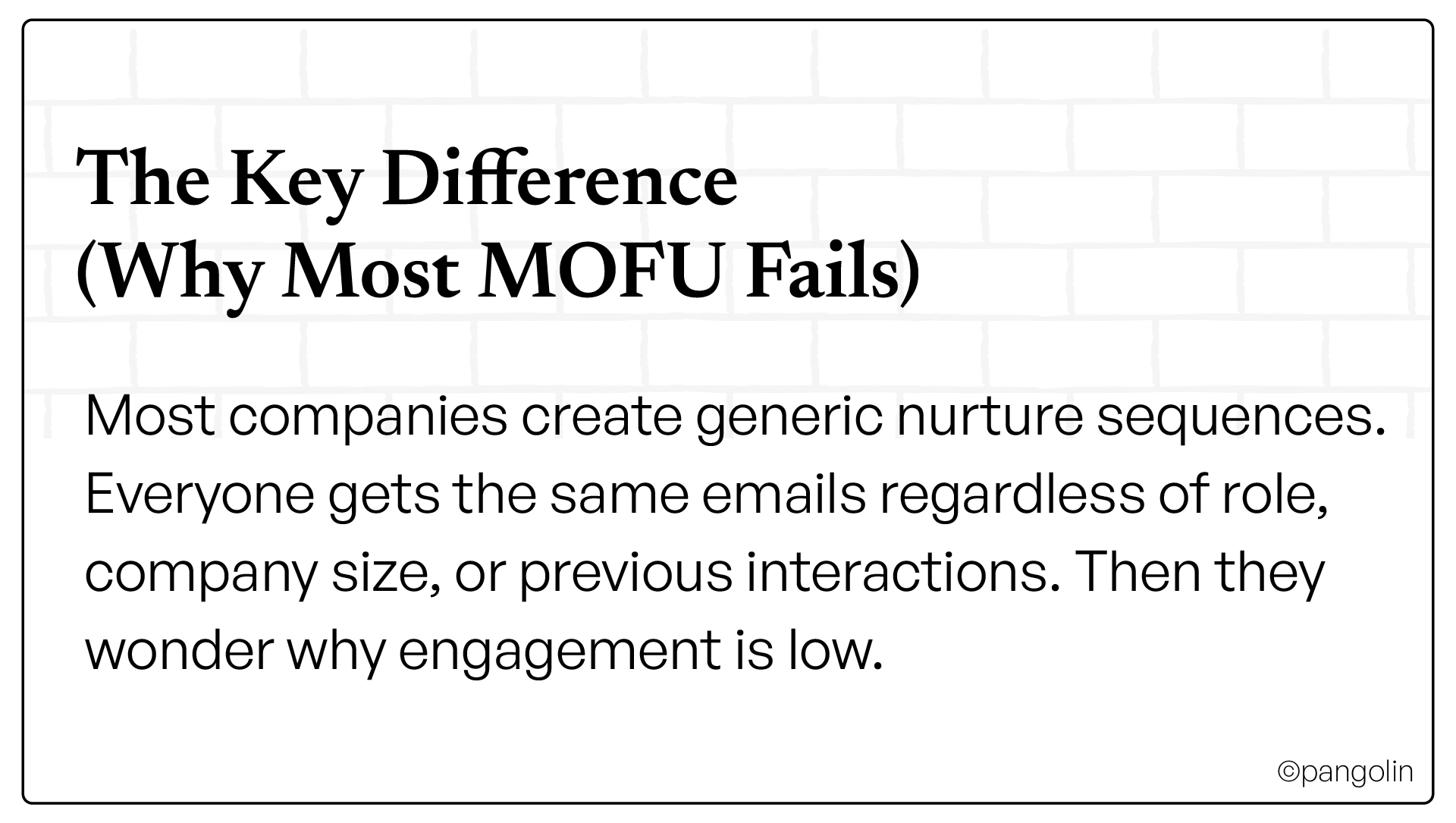
The companies winning create role-specific nurture. CTOs see technical depth. CFOs see financial impact. VP Operations see risk mitigation. Same product, completely different narratives.
The buying committee has narrowed to 2-3 finalist vendors. They're asking for free trials, pricing, and contract terms.
They're ready to buy. They just need final validation to pick you over competitors.
BOFU should be the easiest part of your funnel. If you've executed TOFU and MOFU correctly, BOFU is just removing final objections.
But most companies spend 70% of their budget here. Why? Because it's the only part that converts immediately. Everything else takes 6-12 months to pay off.
Content Types That Work:
You've probably seen this metric somewhere: Aligned sales/marketing teams achieve 32% higher revenue growth.
This number gets thrown around a lot. What people don't explain is why it's true.
It's not because alignment feels good. It's because misaligned teams waste 80% of leads. Every MQL your marketing generates that sales won't work is budget you literally flushed.
A B2B IT services company generating 100 MQLs per month with an 80% waste rate is really only getting 20 qualified leads working their sales process. If you could reduce waste to 20%, you're suddenly getting 80 qualified leads—4x the pipeline—without spending a dollar more on marketing.
That's where the 32% revenue growth comes from.
Here is the 4 step system to bridge the gap between sales and marketing teams, here it is.
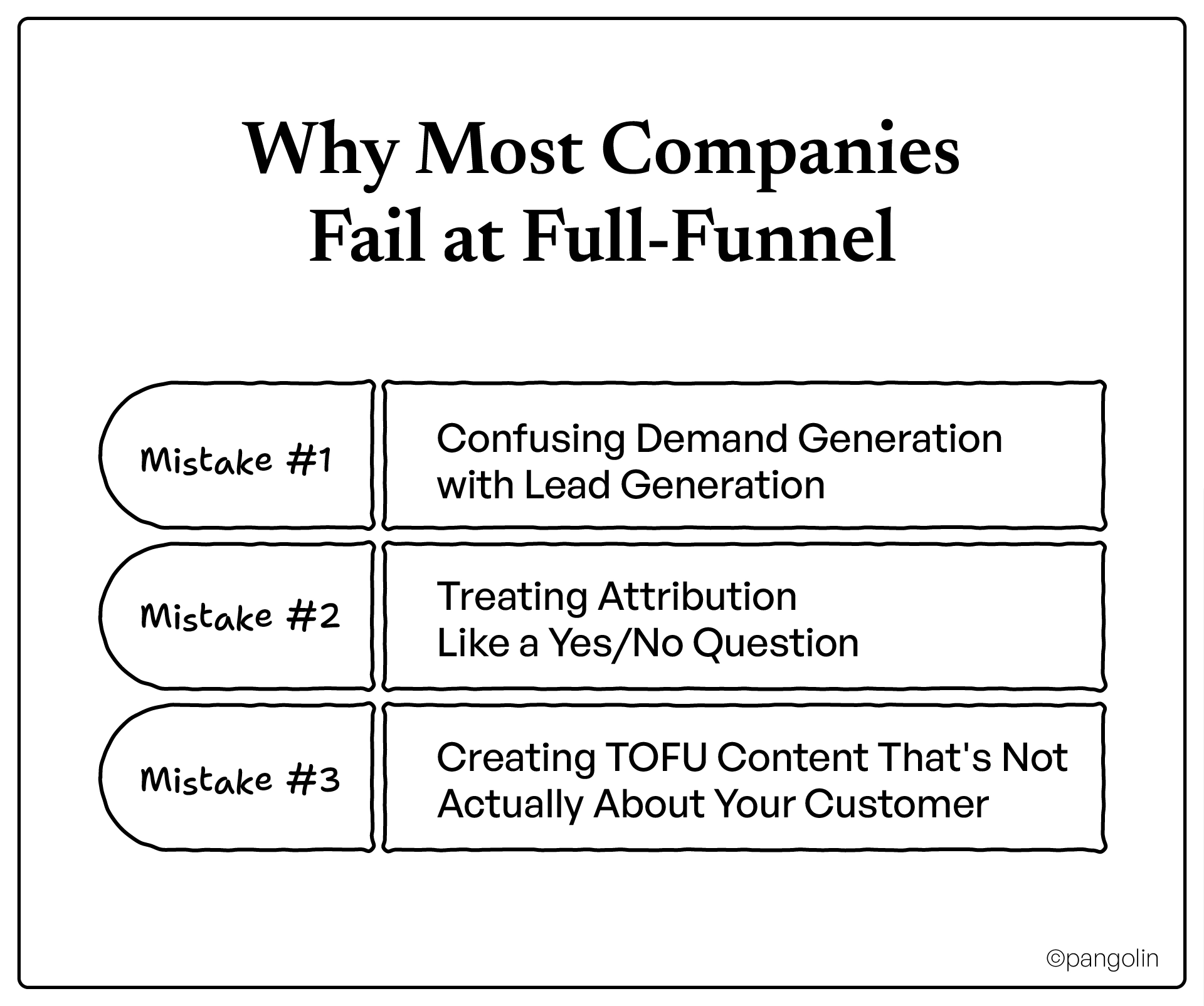
Demand generation = building broad awareness among 95% not yet ready to buy
Lead generation = capturing contact info from people showing interest
Most companies optimize for lead gen only. "How many leads can we generate?" They treat demand gen as a luxury.
Then they wonder why the pipeline is unreliable.
Real demand gen builds awareness among future buyers before they're actively looking. When they do go in-market, you're already top-of-mind. SAP's podcast strategy was to demand gen building authority among 22,000 business leaders who may not buy for 18 months. But when they do, SAP is who they think of.
Most teams ask: "Which channel gets credit for this conversion?"
Wrong question.
Better question: "Which activities influenced this conversion, and in what order did they occur?"
These are different things. Last-touch attribution answers the first question (and gets it wrong). Multi-touch attribution answers the second (and informs budget allocation).
A prospect may have:
Last-touch gives 100% credit to paid search. Multi-touch allocates credit across all 6 activities based on their actual influence.
Which model prevents you from defunding the blog that started the whole journey? Multi-touch.
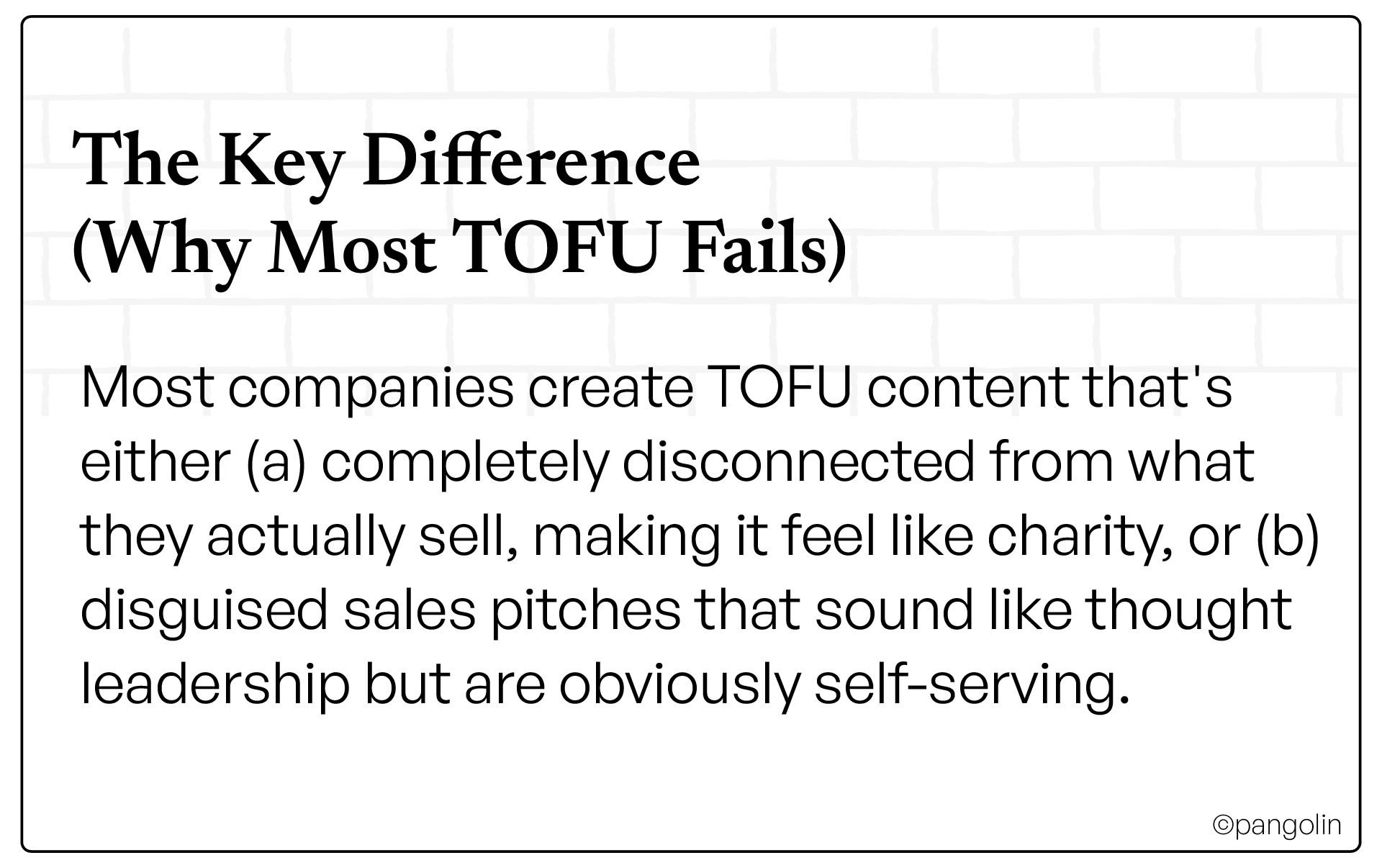
Some companies create TOFU content that's either:
Neither works.
Real TOFU content addresses your customer's actual problem in genuine depth. A cloud migration company might write "Why 47% of Cloud Migrations Fail (And What Actually Prevents Them)." Not because they're trying to sell migration services. But because cloud migration is their customer's reality, and the customer wants to understand it.
The positioning of your solution is implicit, not explicit.
Your marketing isn't broken because you're running the wrong tactics. It's broken because those tactics aren't working together.
You're running TOFU content that doesn't feed MOFU. MOFU campaigns that don't move prospects to BOFU. BOFU campaigns that convert at high rates but have nowhere to send prospects because TOFU/MOFU aren't generating pipeline.
Meanwhile, your last-touch attribution is telling you to double down on bottom-funnel spending while defunding the activities that actually build demand.
Full-funnel marketing fixes this by orchestrating every touchpoint into an integrated system:
TOFU builds authority among future buyers. MOFU nurtures them through a 6-18 month evaluation. BOFU closes the ready-to-buy. Sales and marketing align on definitions and share accountability. Attribution data guides budget allocation. Results compound over 3-12 months.
22-35% higher conversion rates. 32% faster revenue growth. 80% lead conversion instead of waste.
This isn't complicated. But it is systematic. And it requires:
The California ground squirrels adapted to a new environment by changing behavior. Your marketing needs to do the same.
Adapt or get left behind. The companies winning right now already have.
At Pangolin Marketing, we specialize in orchestrating full-funnel strategies for B2B IT services companies. We handle the strategic complexity - integrating brand, demand, and conversion into unified systems that scale.
We've helped IT services companies achieve measurable transformations: CAC reductions of 22-28%, conversion rate lifts of 22-35%, and pipeline-influenced growth of 30-60%.
If your current approach isn't compounding, let's talk about what full-funnel could look like for your business.
1. What's the Difference Between Full-Funnel Marketing and Traditional Lead Generation?
Full-funnel marketing orchestrates every touchpoint into an integrated system—from TOFU awareness through MOFU nurture to BOFU conversion. Traditional lead generation focuses only on capturing contacts, typically in BOFU.
Lead generation asks "How many leads?" Full-funnel asks "Which activities drive revenue?" A prospect may visit your blog (TOFU), engage with emails (MOFU), then convert from a paid ad (BOFU). Last-touch attribution credits the ad. Full-funnel recognizes all three influenced the deal.
2. How Do I Prove My Full-Funnel Marketing ROI to My CEO?
Most CEOs only understand bottom-line revenue. Full-funnel ROI looks different: measure pipeline-influenced revenue, not just direct conversions.
Track which marketing activities appear in the customer journey before deals close. If 60% of your revenue touched marketing at some point (blog, email, webinar, ad), that's 60% marketing-influenced pipeline.
Use multi-touch attribution to credit all activities, not just the last click. When you show your CEO that the blog post from 6 months ago influenced 40% of current deals (because it warmed prospects before they evaluated vendors), suddenly TOFU investment looks smart.
3. Why Is Sales/Marketing Alignment Critical for Full-Funnel Success?
Misaligned teams waste 80% of leads. Your marketing generates 100 MQLs monthly. Sales works 20 (rejecting 80 as "garbage"). Revenue suffers. Both teams blame each other.
Alignment happens when you share definitions: What qualifies as an MQL? What makes an SQL? When do you actually hand off to sales?
Then implement SLAs: Marketing commits to X qualified leads monthly. Sales commits to contacting within 4 hours and nurturing for minimum 5 touches before disqualifying. Unified CRM data shows both teams the same pipeline.
4. How Much Budget Should I Allocate to TOFU vs. MOFU vs. BOFU?
Most companies spend 70% BOFU / 20% MOFU / 10% TOFU. This creates boom-bust cycles—great when prospects are ready, starved when they're not.
Winning companies use: 30-40% TOFU / 40-50% MOFU / 10-20% BOFU.
Why? With 6-18 month IT services sales cycles, most prospects are in MOFU right now, actively evaluating. They need role-specific nurture (CTOs want technical depth; CFOs want ROI). TOFU builds future demand. BOFU closes ready buyers.
5. What's the Best Attribution Model for B2B IT Services?
Last-touch attribution credits only the final touchpoint before conversion (usually a paid ad or sales call). This underfunds TOFU/MOFU activities that actually warm prospects.
For IT services with long cycles, use position-based (U-shaped) attribution first: 40% credit to first touchpoint (shows which awareness channels work), 40% to last (conversion channels), 20% to middle (nurture channels).
6. How Long Does It Take to See Results From Full-Funnel Marketing?
TOFU investments take 6-12 months to pay off because they're building future demand. BOFU shows results in 60-90 days. Expect a mixed timeline.
Month 1-3: Small traction. You're building foundation, creating content, setting up automation. Nothing dramatic.
Month 3-6: Patterns emerge. MOFU email sequences warming prospects. TOFU content ranking for keywords. BOFU conversions are improving. Pipeline starting to compound.
Month 6-12: Full impact. TOFU content now drives traffic consistently. MOFU nurture sequences moving prospects to sales. BOFU conversions are accelerating. Revenue growth becomes visible.

