Focus on lead quality over quantity to stop wasting sales hours and marketing budget.
Use the QUALIFY framework to systematically score, track, and nurture leads.
Align sales and marketing with a clear Service Level Agreement (SLA) to eliminate friction.
Track digital body language (like pricing page visits) to identify true buying intent.
Avoid the five common "Lead Quality Killers" like scoring on demographics alone and ignoring the buying committee.
Implement the 90-day action plan to create sustainable, long-term improvements.
Hidden deep in Africa was a natural marvel no one anticipated: the largest land mammal migration on Earth. Six million antelope make this incredible journey every year across South Sudan and Ethiopia, twice the size of the famous Serengeti migration.
This massive, vital phenomenon went completely undetected for years. Which reminds us of IT services. Because in IT services marketing, your best leads, your biggest opportunities, might be out there right now, hidden in plain sight, waiting for you to spot and nurture them.
Which brings us to a story: the $47,000 lead that never closed.
An MSP spent months chasing what looked like the perfect lead. Decision-makers were involved, the budget was in place, and everything looked set for a win. Then nothing. The “decision-maker” turned out to be an intern doing market research.
If you’re exhausted chasing leads that go nowhere, you’re not alone. This post is your guide to finding and focusing on the leads that actually move the needle.
Here’s a hard truth: poor lead quality is a hidden tax on your business. Chasing unqualified prospects costs B2B companies dearly, not just in wasted ad spend, but in sales hours that could have been spent on deals that actually close.
The main culprits?
Volume Vanity: Counting leads instead of qualified opportunities. Too many marketers celebrate raw lead numbers without looking at who actually converts.
Spray & Pray: Marketing too broadly and generically, attracting bargain hunters rather than real buyers.
Handoff Chaos: When marketing and sales aren’t aligned, good leads get lost and bad leads consume resources.
Why "Good Enough" Leads Are Costing You a Fortune
That story about the intern isn't just a one-off anecdote. It's a symptom of a problem that costs B2B companies a fortune in wasted effort. While you might not see it on a balance sheet, the cost is real. It's the hundreds of hours your top salesperson spends chasing a dead end instead of closing a real deal. It’s the team morale that dips every time another "great lead" goes cold.
It’s the market share you’re quietly losing to competitors who have this figured out.
This silent drain on your resources usually comes from three villains you might recognize:
The MQL Mirage (Volume Vanity): We all know "Dashboard Dave." He loves seeing that MQL chart go up and to the right. But the revenue chart is flat. He's celebrating activity, not results, and the whole team is paying the price for it.
The Wide Net Trap (Spray & Pray): This is the classic "we can help everyone" approach. But when you market to everyone, you connect with no one. You get leads looking for the cheapest, quickest fix, not the high-value partners you actually want.
The Great Divide (Handoff Chaos): Marketing generates leads and throws them over the wall. Sales complains they're junk. Sound familiar? That’s not a growth engine; it's a relay race where everyone keeps dropping the baton.
The Game Has Changed. Have You?
Why is fixing this so critical right now? Because your buyers have changed.
The modern B2B buyer is more skeptical, more informed, and more committee-driven than ever before. They complete over 70% of their research before they even think about talking to a salesperson. They don't want a pitch; they want an expert who understands their specific problem.
In this environment, wasting time on low-quality leads isn't just inefficient, it's a death sentence for growth. While you're busy explaining your services to an intern, your competitor is already having a strategic conversation with the real decision-maker.
The good news? There's a system to fix this. A proven way to stop hunting for needles in a haystack and start attracting the needles directly to you.
Let me tell you about a company we'll call "ApexTech Solutions"
A mid-sized IT services firm navigating the post-2024 landscape. Two years ago, their sales process was straightforward. Today, it’s a marathon.
The buyer journey has fundamentally changed.
The sales cycle is longer than ever: We're seeing evaluation periods stretch to 18 months or more.
The buying committee has grown: A single deal now involves an average of nearly seven stakeholders, each with their own questions, concerns, and veto power.
Expertise is non-negotiable: Buyers complete most of their research independently. By the time they talk to you, they don’t want a sales pitch; they expect a consultation with an expert.
This shift puts immense pressure on companies still using outdated lead generation playbooks. If your marketing is still focused on generating a high volume of generic leads, you're bringing a knife to a gunfight. You're getting stuck in endless conversations with junior employees while your competitors are building relationships with the C-suite.
The stakes are crystal clear: adapt your approach to lead quality, or resign yourself to competing on price.
But there’s a practical, straightforward way forward. It’s a system designed specifically for the unique challenges of IT services marketing.
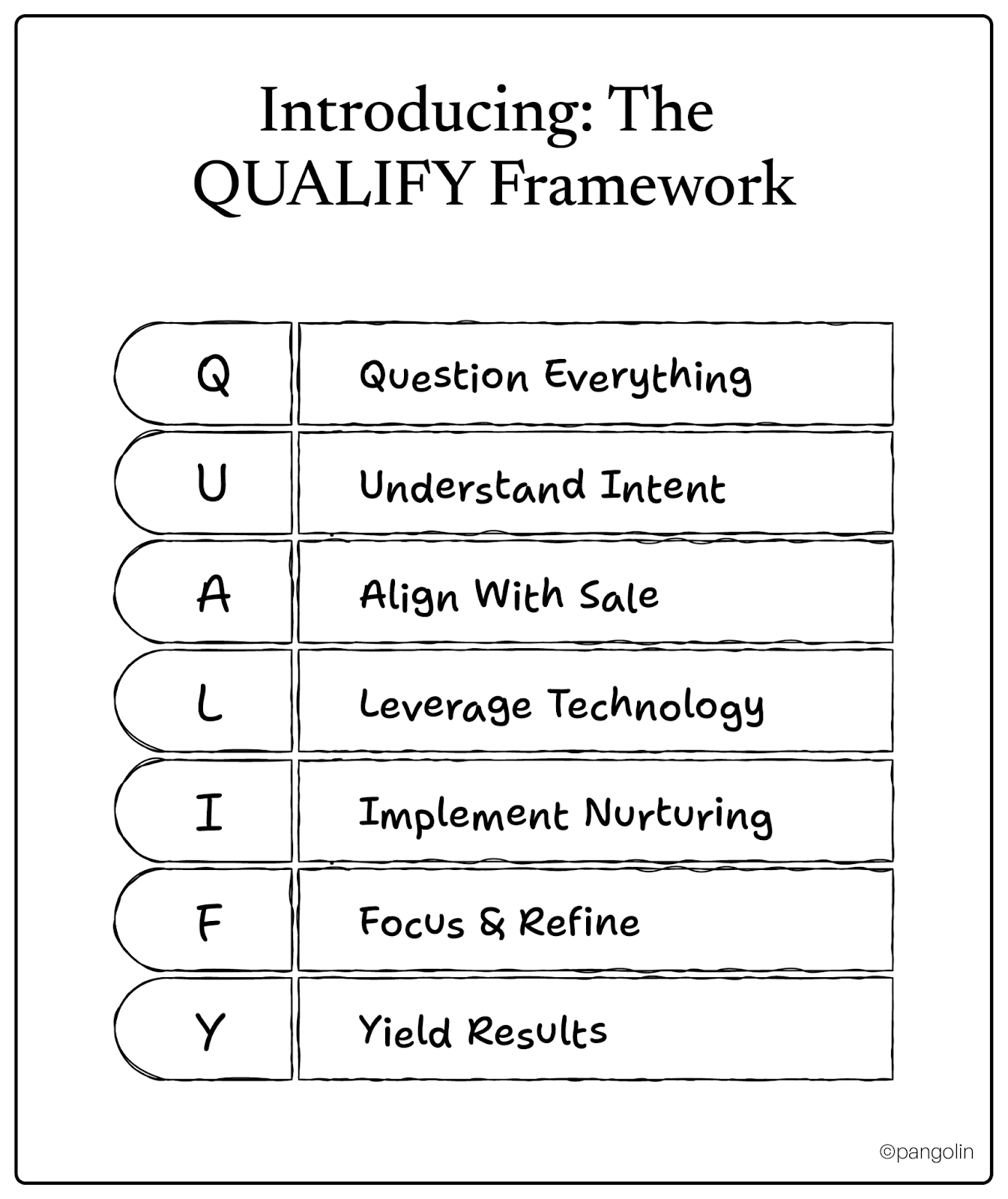
Introducing: The QUALIFY Framework
Forget complex, theoretical models. The QUALIFY framework is a simple, memorable, and actionable system for transforming your lead quality. It’s not about working harder; it’s about working smarter.
Here’s a quick look at how it works:
Q – Question Everything: Move beyond outdated lead scoring models like BANT. It's time to dig deeper.
U – Understand Intent: Learn to read the digital body language of your prospects to spot true buying signals.
A – Align With Sales: Build a seamless handoff process that ensures no high-value lead ever falls through the cracks.
L – Leverage Technology: Use automation and AI to qualify leads at scale, freeing up your team for high-value activities.
I – Implement Nurturing: Create personalized, multi-touch journeys that build trust over long sales cycles.
F – Focus & Refine: Use data to continuously improve your targeting and eliminate sources of low-quality leads.
Y – Yield Results: Focus on the metrics that actually matter, pipeline, revenue, and ROI, and hold your teams accountable.
In the next sections, we’ll unpack each step of this framework, giving you the exact strategies and tools you need to turn your lead generation from a costly liability into your company’s most powerful growth asset.
The QUALIFY Method: Your System for Better Leads
Alright, let's get into the nuts and bolts. The QUALIFY framework isn't just theory; it's a practical, step-by-step system to stop wasting time and start attracting high-value clients.
First things first: throw out the dusty old BANT (Budget, Authority, Need, Timeline) checklist. It’s a relic from a different era. Today’s buyers don’t fit into neat little boxes.
Instead, use a more intelligent, 3-tier scoring system that looks at the whole picture:
Fit (The Right DNA): Does this company look like your ideal customer? Think industry, company size, and potential budget. This is your first filter.
Engagement (Their Digital Body Language): Are they just window-shopping, or are they leaning in? Track their content downloads, webinar attendance, and how often they visit your site.
Intent (The "Tell Me More" Signals): This is where they raise their hand. Are they visiting your pricing page? Requesting a demo? Asking specific questions in a chat? These are high-value actions.
This layered approach helps you instantly see the difference between a curious browser and a serious buyer, so your sales team only engages with prospects who are actually worth their time.
U – Understand Intent (Behavioral Signals)
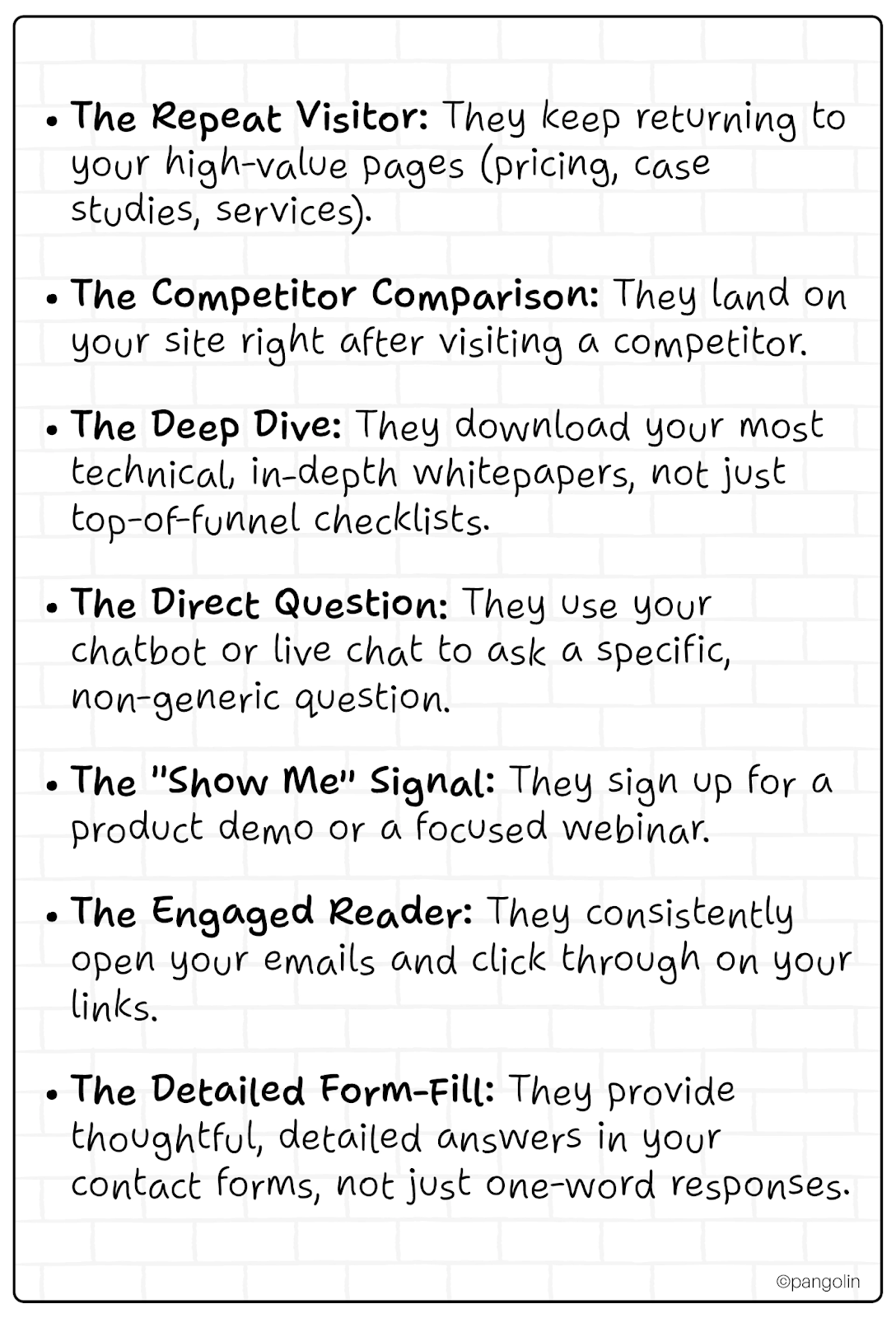
Not all clicks are created equal. You need to learn to spot the digital breadcrumbs that signal real buying intent. Here are seven behaviors that scream "I'm ready to talk":
Tracking these behaviors in your CRM and marketing automation platform is like giving your sales team a crystal ball.
A – Align With Sales (Handoff Optimization)
The gap between marketing and sales is where great leads go to die. The QUALIFY method closes that gap with a simple 3-step handoff process:
Define "Sales-Ready": Create a lead score threshold that both teams agree on. A lead isn’t handed off until it hits that score.
Automate the Handoff: Once a lead hits the score, it's automatically assigned to a specific rep in the CRM with all its history and context. No more leads sitting in a generic inbox.
Create a Feedback Loop: Sales must provide feedback on lead quality directly in the CRM. This data is gold, it helps marketing continuously refine its targeting.
Wrap this process in a clear Service Level Agreement (SLA). Marketing agrees to deliver a certain number of qualified leads, and sales agrees to follow up within a specific timeframe. No more finger-pointing.
L – Leverage Technology (Automation & Tools)
Your tech stack should be a force multiplier, not a frustrating cost center. You don’t need a dozen different tools. You just need the right ones, working together:
A flexible CRM: To track every interaction and customize your lead scoring.
Marketing Automation: To run your nurture sequences and track engagement at scale.
AI-Powered Insights: Tools that can help predict fit and intent, giving you an extra edge.
The goal of automation isn't to replace humans; it's to handle the repetitive tasks of qualification so your team can focus on what they do best: building relationships and closing deals.
I – Implement Nurturing (Multi-Touch Sequences)
IT services deals are a marathon, not a sprint. Your nurturing sequences need to reflect that. A generic, one-size-fits-all email blast won't cut it.
Instead, build a 5-touch sequence designed for the long haul:
The Value Prop: An initial touchpoint that clearly articulates the problem you solve.
The Educational Insight: Share a piece of high-value content (a guide, a webinar) tailored to their persona.
The Social Proof: A case study or testimonial that shows how you've helped a similar company.
The "Live" Interaction: An invitation to a low-pressure event, like a webinar or an "ask me anything" session.
The Personalized Nudge: A direct but helpful follow-up that references their activity and offers a consultation.
Remember to map your content to different stakeholders. The CFO cares about ROI, while the IT Director cares about integration and security. Your nurturing needs to speak to both.
F – Focus & Refine (Continuous Optimization)
Your lead qualification system is a living thing. It needs regular check-ups. Implement a monthly optimization routine where you review:
Lead-to-Opportunity Conversion Rates: Where are the best leads coming from?
Engagement Scores: What content is resonating the most?
Sales Feedback: What are the common reasons for disqualification?
Use this data to make small, continuous improvements. A tiny tweak to your lead scoring or a change in your email subject lines can have a massive impact over time.
Y – Yield Results (Measurement & Scaling)
Finally, you need to measure what actually matters. Forget vanity metrics. Focus on the numbers that translate directly to revenue:
Lead-to-Opportunity Conversion Rate: Aim for a benchmark of 15% or higher.
Opportunity-to-Deal Conversion Rate: A healthy rate here is over 10%.
Sales Cycle Length: Is your process speeding things up or slowing them down?
Customer Lifetime Value (LTV) by Lead Source: Find out which channels deliver your most profitable customers.
Once you know what's working, double down. Put more resources into the channels and tactics that deliver high-quality leads, and ruthlessly cut what isn't delivering ROI. This is how you build a predictable, scalable growth engine.
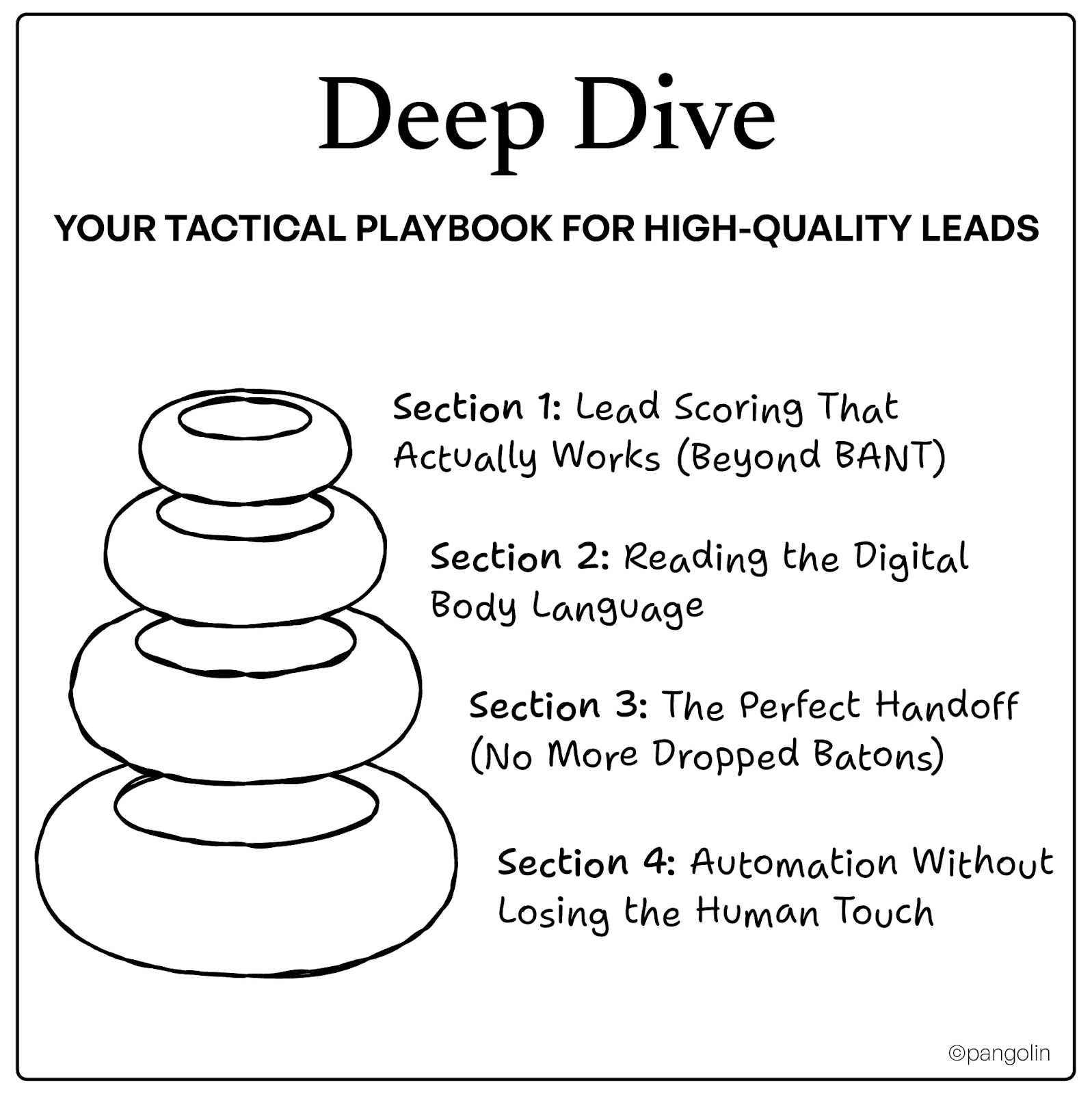
Deep Dive: Your Tactical Playbook for High-Quality Leads
Theory is great, but results come from action. Here’s a tactical look at how successful IT service providers are using the QUALIFY framework to stop chasing junk leads and start closing high-value deals.
Section 1: Lead Scoring That Actually Works (Beyond BANT)
The old BANT model is broken because it asks questions your buyer often can't answer yet. Does a prospect have a "Need" for a service they don't even know exists? Is the "Authority" one person, or a committee of seven?
It’s time for a smarter model.
Let's look at "MSP Innovators," a client who transformed their lead quality. They ditched BANT and built a 100-point scoring system based on three pillars:
Pillar 1: Firmographic Fit (40 points): Does this lead match our Ideal Customer Profile (ICP)?
Company Size: (e.g., 50-250 employees) = +15 points
Tech Stack: (e.g., Uses Microsoft 365) = +10 points
Pillar 2: Engagement Score (40 points): How interested are they in what we have to say?
Pricing Page Visit: +10 points
Webinar Attendee: +10 points
Case Study Download: +5 points per download
Email Click: +2 points per click
Pillar 3: Intent Signals (20 points): Are they raising their hand?
"Contact Us" or "Demo Request" Form: +20 points (Instant Sales-Ready)
Your Action Plan:
Define Your ICP: Get ridiculously specific about who your best customers are.
Assign Points: Use historical data. Which actions and attributes correlate with your best-closed deals? Weight them accordingly.
Set a Threshold: MSP Innovators set their "Sales-Ready" threshold at 75 points. Anyone below that score stays in marketing's nurturing sequences.
Section 2: Reading the Digital Body Language
Your website is your digital showroom, and every click tells a story. You just need to learn how to read it.
Serious Buyer Signals:
They binge-watch your case studies like a Netflix series.
They visit your pricing page more than once in a week.
They use your ROI calculator.
They look at the "About Us" and "Team" pages (they're checking out who they'll be working with).
Tire-Kicker Red Flags:
They only visit your blog and never your service pages.
They use a personal email address (e.g., @gmail.com) in forms.
They download one top-of-funnel asset and disappear forever.
Their company name is "asdf."
Technology Integration: Tools like HubSpot, Marketo, or ActiveCampaign can track this automatically. Set up workflows to increase a lead's score and notify a rep when they hit a certain threshold of "Serious Buyer" activity.
Section 3: The Perfect Handoff (No More Dropped Batons)
The handoff from marketing to sales should be a seamless, automated process, not a daily negotiation.
The Perfect Handoff Email Template: When a lead hits the 75-point threshold, your system should automatically send this to the assigned sales rep: Subject: New Sales-Ready Lead: [Lead Name] from [Company Name] Lead Score: 82 Key Actions:
Visited Pricing Page (3 times)
Downloaded "Cybersecurity for Finance" Whitepaper
Attended "Cloud Migration" Webinar
CRM Link: [Link to lead record] Next Step: Follow up within 4 hours as per our SLA.
Timing Protocol: The 4-Hour Rule. Studies show that contacting a lead within the first few hours increases conversion rates exponentially. Your SLA should mandate this.
The Feedback Loop: Make it easy for sales to give feedback. Add a single dropdown field in your CRM: "Disqualification Reason" (e.g., "Not a Decision-Maker," "Went with Competitor," "No Budget"). This data is pure gold for marketing to refine their targeting.
Section 4: Automation Without Losing the Human Touch
Automation should free you up for human connection, not replace it.
Workflow Examples:
The "Welcome Mat" Sequence: For new blog subscribers. A 3-email sequence that offers your best-performing content. Goal: Build trust and encourage deeper engagement.
The "Problem-Aware" Sequence: For leads who download a specific whitepaper. A 4-email sequence that expands on the problem and introduces your solution. Goal: Move them from problem-aware to solution-aware.
The "Re-Engagement" Sequence: For old, cold leads. A 2-email sequence with a compelling new case study or a special offer. Goal: Bring them back into the fold.
Personalization at Scale: Use personalization tokens beyond just [First Name]. Use [Company Name] in the subject line. Use dynamic content blocks in your emails that show different case studies based on the lead's industry.
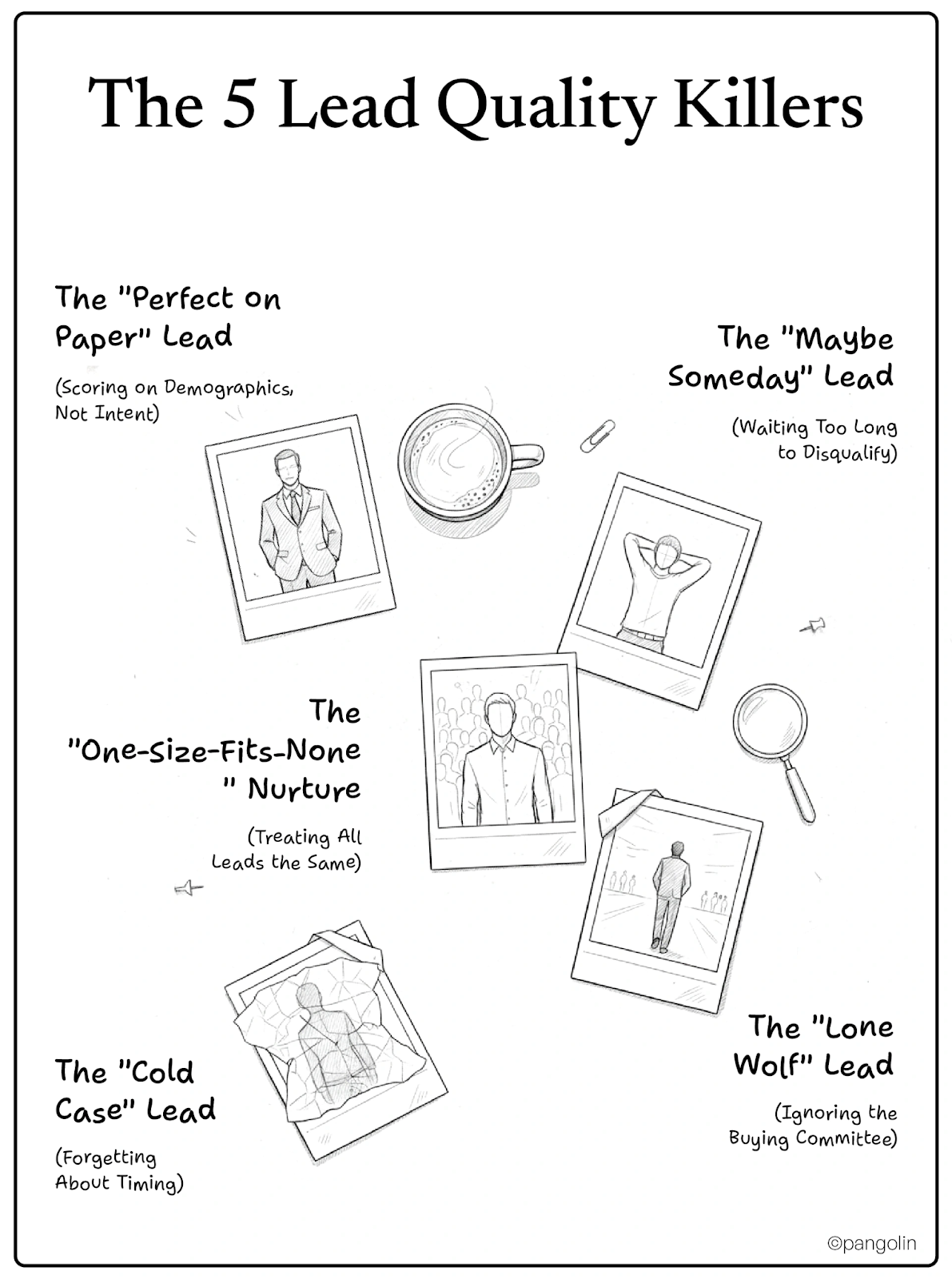
The 5 Lead Quality Killers (And How to Stop Them Cold)
Even with the best intentions, it's easy to fall into traps that silently sabotage your lead quality. Think of this as your field guide to the most common pitfalls. If you can spot them and sidestep them, you'll be miles ahead of the competition.
1. The "Perfect on Paper" Lead (Scoring on Demographics, Not Intent)
The Problem: Your team gets excited about a lead from a Fortune 500 company, only to find out it was a low-level employee just browsing. You focused on who they are, not what they did.
Why It Happens: It’s easy. Checking a box for "company size" or "job title" is simpler than tracking nuanced digital behavior.
How to Fix It: Your lead score must be a blend of Fit + Intent. A great-fit company with zero intent is a cold lead. A less-than-perfect fit company showing massive buying intent is a hot lead. Intent is the accelerator.
Quick Tip: Create a separate "Intent Score" in your CRM. Set a rule that no lead gets passed to sales unless their Intent Score is above a specific threshold, no matter how good their demographic fit is.
2. The "Maybe Someday" Lead (Waiting Too Long to Disqualify)
The Problem: Your pipeline is clogged with leads that haven't engaged in six months. Your sales team keeps them "just in case," wasting mental energy and follow-up time.
Why It Happens: FOMO (Fear Of Missing Out). No one wants to be the one who deleted a lead that could have turned into a deal.
How to Fix It: Create a clear "Disqualification Protocol." If a lead hasn't opened an email, visited the site, or responded in 90 days, they are automatically moved to a "cold/disqualified" list. They can always re-enter the pipeline if they show new intent.
Quick Tip: Automate it. Create a workflow in your marketing automation platform that automatically disqualifies leads who go dark for a set period. It takes the emotion out of it.
3. The "One-Size-Fits-None" Nurture (Treating All Leads the Same)
The Problem: You send the same five nurturing emails to the CEO and the IT intern. The CEO finds them too basic, and the intern finds them irrelevant. You've connected with no one.
Why It Happens: It's easier. Building one generic email sequence takes less time than creating multiple, personalized tracks.
How to Fix It: Segment your audience and create different nurture tracks for your key personas. The content that resonates with a CFO (ROI, TCO) is completely different from what an IT Director wants to see (integration, security, implementation).
Quick Tip: Start simple. Create just two nurture tracks: one for "Business & Finance" personas and one for "Technical" personas. That alone will dramatically increase your relevance.
4. The "Cold Case" Lead (Forgetting About Timing)
The Problem: A sales rep follows up on a lead who downloaded a whitepaper four months ago. The lead has already moved on and barely remembers your company.
Why It Happens: Most lead scoring models are cumulative. They don't account for the fact that a lead's intent fades over time.
How to Fix It: Your lead score needs "score decay." Actions taken in the last 7 days should be worth more than actions taken 90 days ago.
Quick Tip: Create a "Hot List" dashboard for your sales team that only shows leads who have taken a high-intent action in the past 48 hours. This focuses their energy where it matters most.
5. The "Lone Wolf" Lead (Ignoring the Buying Committee)
The Problem: Your salesperson has a great relationship with the IT Manager, but the CFO, who they've never spoken to, shuts down the deal over budget concerns.
Why It Happens: It's natural to focus on your single point of contact. It's hard work to identify and engage an entire committee.
How to Fix It: Think in terms of accounts, not just leads. When a lead from a target company comes in, marketing's job isn't done. They should actively work to identify and engage other potential stakeholders within that account.
Quick Tip: When a lead comes in from a high-value account, use LinkedIn Sales Navigator to identify 3-5 other relevant contacts at that company. Add them to a targeted LinkedIn ad campaign and a separate, high-level email nurture track.
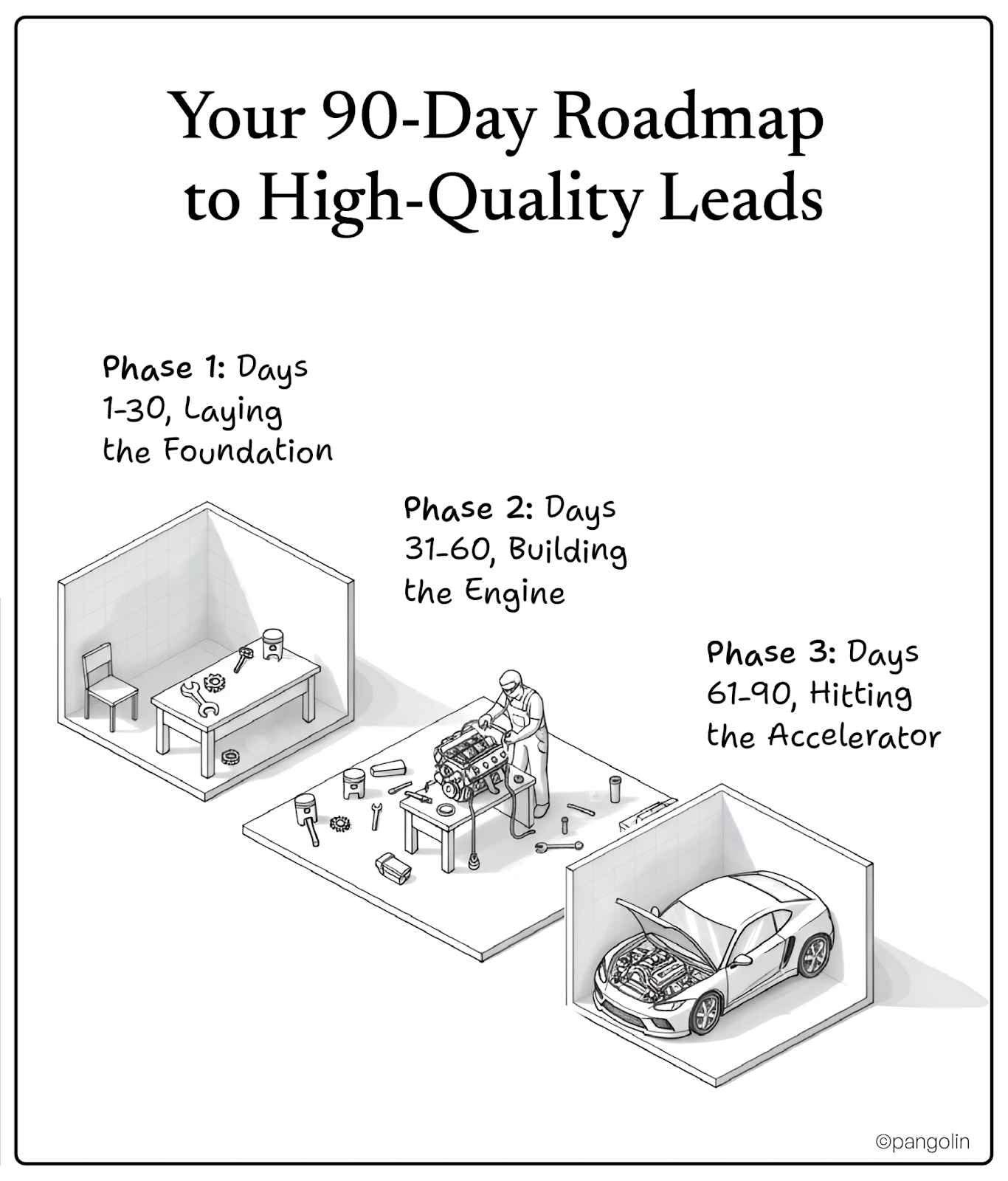
Your 90-Day Roadmap to High-Quality Leads
Theory is easy. Execution is everything. But transforming your lead quality doesn't require you to boil the ocean. It's a journey you can tackle in a focused, 90-day sprint. Here’s a practical, phase-by-phase roadmap to turn your lead generation from a source of frustration into a predictable revenue engine.
Phase 1: Days 1-30, Laying the Foundation
The Goal: Stop the bleeding. In this first month, you're not trying to build a perfect system. You're trying to get your house in order, establish a baseline, and get sales and marketing speaking the same language for the first time.
Your Key Actions:
Conduct a Lead Quality Audit: Pull the last six months of data. What percentage of "leads" became opportunities? What percentage closed? Be brutally honest about where your process is broken.
Build Your V1 Lead Scoring Model: Don't aim for perfection. Use the 3-pillar model (Fit, Engagement, Intent) and make your best-educated guess on point values. You will refine this later.
Hold the "Peace Summit": Get marketing and sales leaders in a room for a 2-hour workshop. The only goal is to agree on a written definition of a "Sales-Ready Lead."
Deliverable at Day 30: A one-page Service Level Agreement (SLA), signed by both the head of marketing and sales, that defines a qualified lead and sets a target for follow-up time.
Success Metric: You'll have your single most important number: your baseline lead-to-opportunity conversion rate. Thisis the number you're going to beat.
Common Roadblock & How to Solve It:
Roadblock: Sales says they're "too busy" for a workshop.
Solution: Don't call it a "marketing meeting." Frame it as a "Revenue Acceleration & Pipeline Planning" session. Show them the data on how much time they're wasting on bad leads.
Phase 2: Days 31-60, Building the Engine
The Goal: Move from manual and reactive to automated and proactive. This is where you start building the machine that will work for you 24/7.
Your Key Actions:
Deploy Behavioral Tracking: Set up tracking for your key intent signals (pricing page visits, etc.) in your marketing automation platform.
Launch Your First Nurture Sequences: Don't try to build a dozen. Build just two: one for your most important "Technical" persona and one for your most important "Business" persona.
Automate the Handoff: Create the workflow that automatically assigns a lead to a sales rep and sends the "Perfect Handoff Email" the second a lead hits your "Sales-Ready" score.
Deliverable at Day 60: Your first two automated nurture sequences are live, and the sales handoff process is 100% automated.
Success Metric: An increase in the Sales Accepted Lead (SAL) rate. This is the percentage of leads that sales accepts without immediately disqualifying them. It's the ultimate measure of trust between the two teams.
Common Roadblock & How to Solve It:
Roadblock: You realize you don't have enough content for your nurture sequences.
Solution: Don't create new content. Repurpose. Turn that long webinar into 5 short video clips. Transcribe that podcast into a blog post. Package those three related blog posts into a "starter kit" PDF.
Phase 3: Days 61-90, Hitting the Accelerator
The Goal: Optimize and scale. You've built the engine; now it's time to tune it for maximum performance and pour fuel on the fire.
Your Key Actions:
Refine Your Lead Scoring: You now have 60 days of new data. Analyze which leads closed and adjust your scoring model. Which actions actually predicted a closed deal? Give those actions more points.
Analyze Channel Performance: Dig into your analytics. Is LinkedIn delivering high-quality leads that close? Double your budget there. Is that niche publication sending you tire-kickers? Cut it.
Plan Your Next 90 Days: This isn't a one-and-done project. It's the new way you operate. Use your findings to plan your next round of improvements.
Deliverable at Day 90: A "Lead Quality Performance" dashboard that you can share with leadership, showing the clear ROI of your efforts, and a data-backed plan for the next quarter.
Success Metric: You're now focused on the metrics that matter to the CEO: a measurable increase in sales pipeline velocity (how fast deals move through the funnel) and customer lifetime value.
Common Roadblock & How to Solve It:
Roadblock: As you scale automation, things start to feel impersonal.
Solution: Automate tasks, not relationships. Use automation to identify the hot leads, but then trigger a task for a human to send a truly personalized video message or a handwritten note. Use technology to enable human connection at scale.
From Quantity to Quality: The Transformation Story
Remember that Great Nile Migration we talked about at the beginning? Those six million antelope move in a massive, coordinated flow. It’s a vivid example that true success comes not from sheer numbers, but from direction, harmony, and focus.
The same is true for IT services marketing. For years, the default strategy has been to chase the most leads possible, a scattergun approach that burns time, budget, and morale without delivering sustainable growth.
The companies winning today have flipped that script. They stopped chasing quantity and started mastering quality.
By refining their lead scoring, understanding true buying signals, and finally aligning their sales and marketing teams, they’ve transformed their lead generation from a chaotic mess into a finely tuned revenue engine. They’ve built predictable sales pipelines, shortened their sales cycles, and are now winning bigger deals with less effort.
Picture it: your sales team spending their days in strategic conversations with leads who are not only qualified but are genuinely eager to talk. Your marketing campaigns are no longer fishing for any lead that bites but are precision-targeted to attract the exact prospects who will become your most profitable, long-term customers.
This future isn’t a fantasy. It’s smarter, more efficient, and infinitely more rewarding.
Because the companies winning in IT services aren’t the ones generating the most leads. They’re the ones generating the right leads.
FAQs
1. What's the difference between lead generation and lead quality?
Lead generation is the process of attracting potential customers (leads) into your funnel. Lead quality is the measure of how likely those leads are to become profitable, long-term customers. A great strategy focuses not just on getting more leads, but on getting the right leads.
2. How long does it take to see an improvement in lead quality?
You can see initial improvements within the first 30-60 days by implementing a basic lead scoring model and better aligning your sales and marketing teams. Significant, system-wide improvements that impact revenue typically become clear within 90-180 days as you optimize your nurturing and targeting based on real data.
3. What's the single most important metric for measuring lead quality?
While there are many useful metrics, the most important is the Lead-to-Opportunity Conversion Rate. This number tells you what percentage of the leads your marketing team generates are actually considered valid, pursuable opportunities by your sales team. It's the ultimate measure of alignment and quality.
4. My sales team says all our marketing leads are junk. Where do I start?
Start with a "Peace Summit." Get marketing and sales leaders in a room and facilitate a workshop with one goal: to create a written, mutually agreed-upon definition of a "Sales-Ready Lead." This single step, which forms the basis of your Service Level Agreement (SLA), can resolve a huge amount of the friction between the two teams.
5. I'm a small MSP. Isn't all this automation and scoring too complex for me?
Not at all. You don't need a massive, expensive tech stack to start. You can implement basic lead scoring and simple 3-step email nurture sequences in affordable tools like HubSpot Starter or ActiveCampaign. The principles are more important than the platform. Start simple, prove the ROI, and then scale your technology as you grow.
6. How do I get buy-in from leadership to invest in improving lead quality?
Frame it in terms they understand: cost and revenue. Calculate the "Cost of Doing Nothing" by estimating how many hours your sales team wastes each month on bad leads. Then, project the potential revenue increase from even a small 2-3% improvement in your lead-to-customer conversion rate. Presenting it as a clear ROI-driven initiative, not a "marketing project," is key to getting buy-in.