


The Problem: Small IT services teams (2-5 people) are spread across 8-10 marketing channels simultaneously, executing each at 30-40% quality and getting mediocre results. They pick channels randomly—based on CEO suggestions, competitor actions, or "marketing best practices" without framework or prioritization. The result: no channel gets proper attention, no channel delivers ROI, team is exhausted, leadership cuts budget, and the cycle repeats.
The Solution: Use the Bullseye Framework to prioritize ruthlessly. Inner Circle (3 core channels for IT services): Email (3,600% ROI), SEO (748% ROI), LinkedIn (229% ROI)—all proven for IT buying committees and 6-18 month sales cycles. Middle Circle (1-2 supporting channels): Webinars + retargeting to amplify core channels without derailing focus. Outer Circle (1 experimental channel): Test new opportunities for 90 days; graduate to middle circle only if results prove value. Skip Facebook (87% ROI, wrong audience), TikTok (entertainment-focused, not IT research), and generic brand awareness.
The Impact: 3 people executing 4 channels at 75% quality delivers 2x better results than 3 people spread across 8 channels at 30% quality. Resource allocation: Inner circle 50-60% effort, middle circle 25-35% effort, outer circle 10-15% effort (experiment, not commitment). Budget split: Email 25%, SEO 25%, LinkedIn 25%, webinars/retargeting 15%, tools 10% = $350K+ ROI on $100K spend. Team morale improves; CEO sees focused strategy paying off; marketing gets credibility.
The Action: Run the channel prioritization checklist this week: (1) Identify inner circle (3 channels reaching your IT buyers); (2) Pick middle circle (1-2 supporting channels); (3) Choose outer circle (1 experimental); (4) Kill channels outside bullseye; (5) Create 90-day test plan with specific metrics; (6) Have the CEO conversation with ROI data. Use the decision framework to defend choices: "Email delivers $36-40 per $1 spent. Facebook delivers $0.87. We're allocating resources where our IT buyers actually research." After 90 days, measure results and adjust.
In 2024, scientists made a surprising discovery: dogs can form mental images.
A dog hears "tennis ball" and creates a picture in its mind. When researchers showed the dog a different object, it was visibly confused - the mental image didn't match reality. The dog had to reconcile what it imagined with what it actually saw.
Your small marketing team is experiencing the same confusion.
You imagine you should be on LinkedIn, email, SEO, webinars, events, PPC, content marketing, YouTube, podcasts, TikTok, and whatever new platform just launched. You've formed a mental image of "a marketing team that does everything."
Then reality hits. You're 3 people. Not 30. You can't execute 10 channels well. You're executing them all terribly. Sales ignores your leads. Pipeline misses. Leadership cuts your budget. You burn out.
The confusion isn't stupidity. It's prioritization without a framework.
Most small IT services teams pick channels the same way: gut feel, trends, CEO suggestions, or "what competitors do." Then they spread thin, excelling nowhere, overwhelming everywhere.
But here's what separates the winning small teams from the exhausted ones: they've reconciled the mental image (what marketing "should" do) with reality (what 3 people can actually execute). They picked 3-4 channels, focused ruthlessly, and now they're winning.
The result: higher ROI per dollar spent, faster results, team morale that isn't in freefall, and leadership that actually trusts marketing.
Let's walk through how to do this without losing your mind.
Here's the equation most small IT services marketing teams use:
More channels = More coverage = More leads = Better results
Wrong on every count.
The math that actually matters:
The principle: Excellence compounds; mediocrity spreads and dilutes.
When you do one channel at 65% quality, you get 65% of that channel's ROI. Email at 65% = still 2,340% ROI (65% of 3,600%).
When you do email at 30% + LinkedIn at 30% + SEO at 30% + PPC at 30%, you get:
Compare that to:
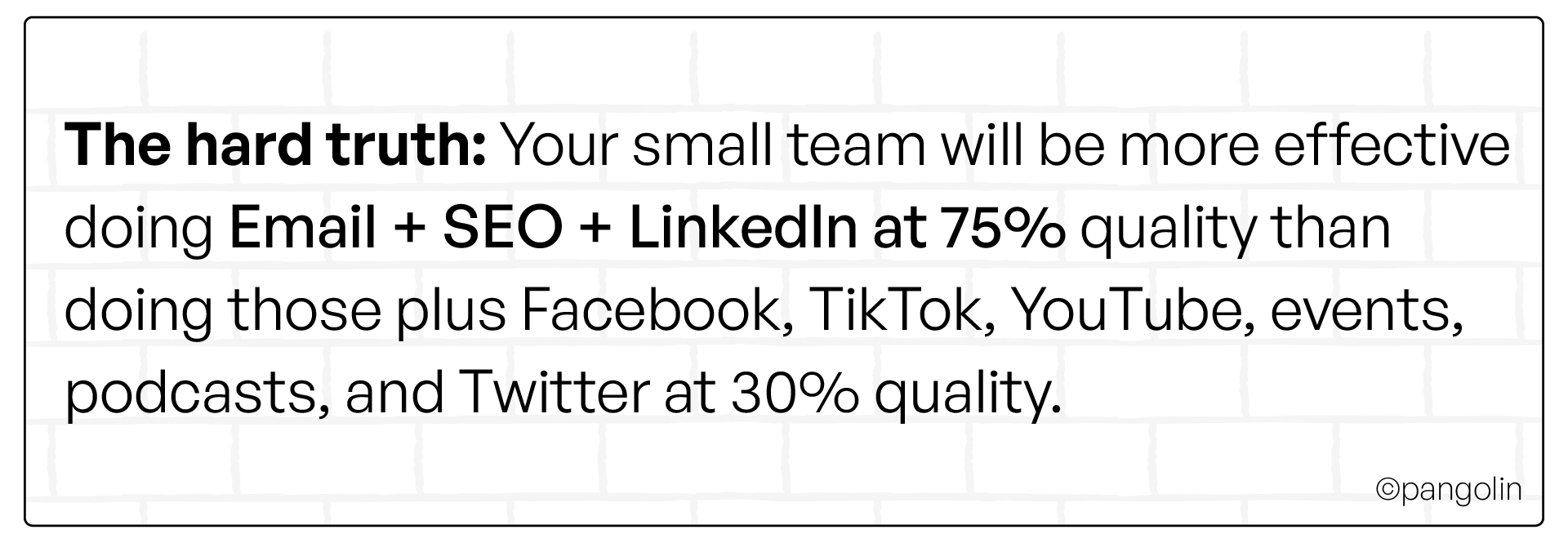
You get 2x the results with 1/2 the channels.
But small teams don't do this. Why? Because it feels risky. Leaving channels untouched feels like leaving money on the table. Focusing on 3-4 channels feels like "not doing enough marketing."
Before you pick channels, you need to understand: Not all channels reach IT buyers equally. And IT buyers aren't like other B2B buyers.
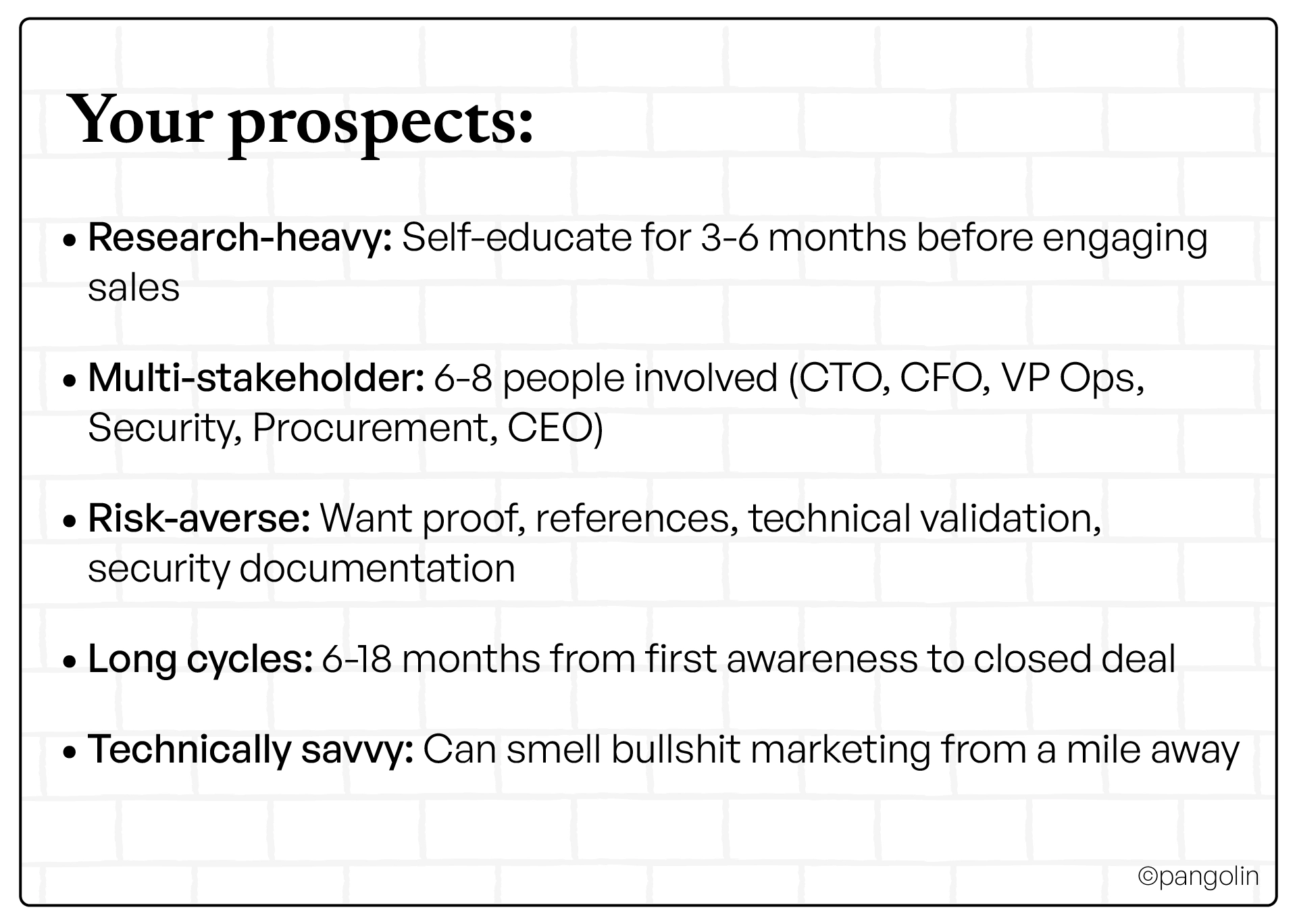
This means:
Facebook/Instagram/TikTok: Wrong audience (your prospects aren't shopping impulse buys on social). Skip these. 87-229% ROI but 0% relevance for IT services buying.
Email: Right audience (nurtures prospects through long evaluation). High ROI (3,600%). Critical for IT buying cycles. Focus here.
SEO/Content: Right audience (self-educating researchers finding you via Google/search). High ROI (748%). Long-term play (9-month breakeven) but compounds massively. Essential.
LinkedIn: Right audience (IT decision-makers actively researching). Strong ROI (229% organic, 192% paid). Multi-stakeholder reach (target by role). Core channel.
Webinars: Right audience (technical deep-dives for evaluators). Strong ROI (430%). Aligns with IT buying (proof + education). High-value tactic.
PPC/Google Ads: Right audience (high-intent searchers). Lower ROI (36%) but fastest results (4-month breakeven). Good for retargeting website visitors. Bottom-of-funnel only.
The implication: For IT services specifically, you have 4-5 core channels that work. Facebook, TikTok, random brand awareness, these aren't in the consideration set.
Your small team doesn't need to be everywhere. You need to be effective where IT buyers actually are.
How do you choose which 3-4 channels to focus on? The Bullseye Framework.
Imagine a target with three concentric circles:
Inner Circle (Core Channels): 50-60% of effort/budget
Middle Circle (Support Channels): 25-35% of effort/budget
Outer Circle (Experiment): 10-15% of effort/budget
What stays outside: Channels that don't reach your IT buyers or misalign with buying behavior. Facebook for B2B IT? Outside the bullseye entirely.
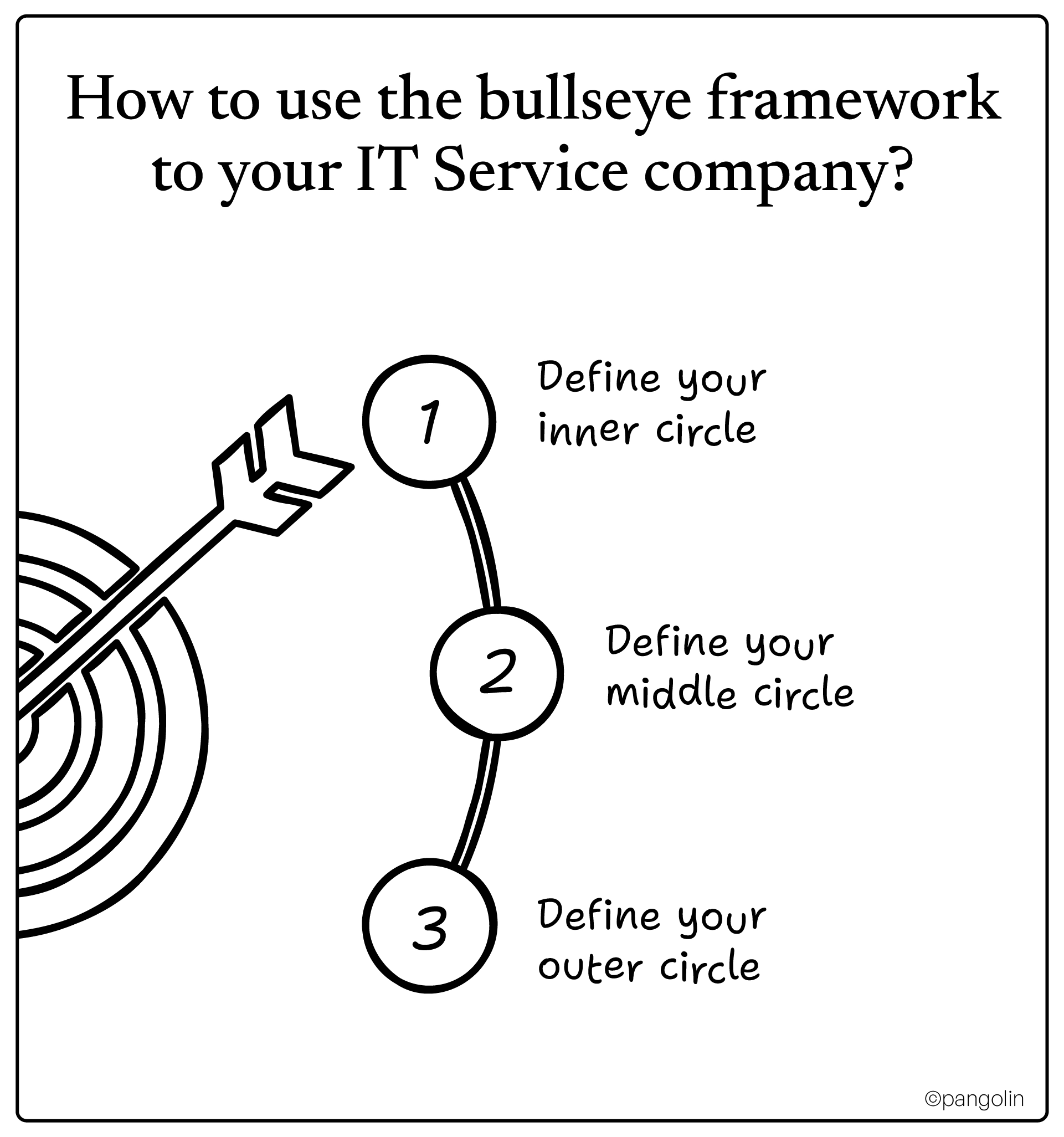
Ask these questions:
Inner Circle = Email + SEO + LinkedIn (for most IT services companies)
What amplifies your core channels without derailing focus?
For most IT services with 3 people: Pick 1-2 of these. (Webinars + retargeting is more executable than webinars + events + PPC for small teams.)
Middle Circle = Webinars + Retargeting (for most IT services companies with small teams)
What might work but isn't proven yet?
Test, measure, decide to scale or abandon. Don't commit a budget here until proven.
Outer Circle = Pick 1, test for 90 days, measure results.
Picking 4 channels instead of 8 isn't just about focus. It's about ROI.
Why? Email works because:
For a 3-person team: Email is the workhorse. Pick a tool (HubSpot, ActiveCampaign, Klaviyo), build 3-4 nurture sequences, and let automation work.
Why? SEO works because:
For a 3-person team: You need 1 person doing SEO. (5-10 blog posts/month, keyword research, basic link building). Slow to start (9 months), massive over time.
Why? LinkedIn works for IT services because:
For a 3-person team: Mix organic (2-3 posts/week) + paid (targeted campaigns to high-value accounts). Medium effort, strong ROI.
Facebook/Instagram: 87% ROI, but wrong audience for B2B IT. Skip it.
TikTok: Young audience, entertainment-focused. Your IT CTO isn't researching managed services on TikTok. Skip it.
Broad YouTube channel: High production burden (1-2 videos/week minimum), unclear ROI for small team, not core to IT buying. Skip it initially. (Consider webinars instead.)
Twitter/X: Lower engagement from IT decision-makers than LinkedIn. Requires constant posting. Not worth it for small teams.
Trade shows/Events: High cost, unpredictable ROI, requires travel. Test 1 event; don't commit until proven.
Let's get practical about resource allocation.
If you have $100K annual marketing budget and 3-4 people:
This works. 3 people, focused execution, realistic budget allocation, strong ROI.
Use this to pick your bullseye circles:
Inner Circle Selection:
☐ Where do IT decision-makers in our vertical actually research?
☐ Which channels have proven ROI for B2B IT services? (Email, SEO, LinkedIn)
☐ Which can 1-2 of our team members execute at 70%+ quality?
☐ Which align with our 6-18 month sales cycle?
☐ Can we start seeing results in 4-9 months?
→ Pick 3 channels. Stop there.
Middle Circle Selection:
☐ Which 1-2 channels amplify our inner circle without derailing focus?
☐ Can we execute these at 60%+ quality with 0.5-1 FTE?
☐ Do IT buyers use these channels?
☐ Can we allocate 25-35% budget/effort?
→ Pick 1-2 channels. Commit for 6 months.
Outer Circle Decisions:
☐ What's one channel we're curious about but not sure about?
☐ Can we allocate 10-15% budget and test for 90 days?
☐ What's our decision criteria? (If X metric achieved, graduate to middle circle)
→ Pick 1 channel. Test, don't commit.
What to Kill (The Hard Part):
☐ Which channels are we currently on but getting mediocre results?
☐ Which channels don't reach our IT buyers?
☐ Which channels require effort we don't have?
☐ Which can we honestly stop doing without guilt?
→ Make list of channels to stop. Document why. Get leadership alignment.
Don't pick channels and abandon them. Run 90-day tests.
Months 1-3: Inner Circle Testing
Month 4 Analysis: Did channels hit targets?
Months 4-6: Middle Circle Testing
Month 7 Decision: Did middle circle move the needle?
Months 7-9: Outer Circle Testing
Month 10 Decision: Did experiment work?
The point: Don't pick channels forever. Test, measure, adjust.astute+1
Your small IT services team doesn't need 10 channels. You need 3-4 channels executed with excellence.
The bullseye framework:
The ROI reality:
The resource reality:
The permission you need: It's okay to not be on every platform. It's okay to say no to your CEO. It's okay to kill channels that aren't working.
Excellence beats breadth every single time.
Focus on 3-4 channels. Do them at 75% quality. Watch your results improve, your team's sanity return, and your leadership start trusting marketing again.
That's how small teams win.
At Pangolin Marketing, we work exclusively with small IT services teams navigating channel decisions. We help you pick the right 3-4 channels, execute with focus, and measure what actually matters.
We've helped teams go from "doing everything poorly" to "doing 4 things excellently" and watch their lead quality and team morale improve simultaneously.
If your team is spread too thin and you need help prioritizing, let's talk about which channels make sense for your business.
1. How Many Marketing Channels Should a Small Team Actually Focus On?
For a small IT services team (2-5 people), focus on 3-4 channels maximum. Trying to excel at more channels spreads your team too thin, resulting in mediocre execution across the board. One person doing 3 channels at 75% quality delivers better ROI than 3 people attempting 10 channels at 30% quality each. The bullseye framework recommends: inner circle (3 core channels like email, SEO, LinkedIn), middle circle (1-2 supporting channels like webinars), outer circle (1 experimental channel to test). Excellence beats breadth.
2. Which Channels Deliver the Best ROI for IT Services Companies?
Email leads with 3,600% ROI ($36-$40 per $1 spent), followed by SEO at 748% ROI with a 9-month breakeven, and LinkedIn at 229% ROI (organic). These three work best for IT services because IT buyers self-educate via search and LinkedIn, and email nurtures through long 6-18 month cycles. Avoid Facebook (87% ROI, wrong audience), TikTok (not for IT research), and generic brand awareness channels. For most IT services teams, email + SEO + LinkedIn form the core strategy.
3. What Should We Stop Doing to Focus Better?
Audit which channels you're currently on but getting mediocre results from. For IT services specifically, deprioritize or eliminate: Facebook/Instagram (wrong demographic), TikTok (entertainment-focused), generic YouTube channels (high production burden), Twitter (low IT buyer engagement), and broad event sponsorships (unpredictable ROI). Use this decision framework: Does this channel reach IT decision-makers? Does it deliver proven ROI? Can we execute it well with our resources? If "no" to any question, stop doing it. Document why you're stopping; get CEO alignment to avoid "why did we quit?"
4. How Do We Handle Our CEO Who Wants Us on Every Platform?
Use data to defend your choices. When CEO asks about TikTok, respond: "Our IT buyers (CTOs, CFOs, average age 42-55) don't research on TikTok. Email delivers 3,600% ROI vs. TikTok's unknown ROI. We're allocating resources where our actual customers research." Show results: "Last quarter we were on 8 channels, got 50 leads, closed 2 deals. This quarter we're focused on 4 channels, got 40 leads, closed 6 deals. Higher quality, better results." Frame it as ROI optimization, not avoiding work.
5.What's a Realistic 90-Day Test to Prove Channel Effectiveness?
For each channel, set specific targets for 90 days: Email (40+ signups, 5%+ SQL conversion, 20%+ engagement); SEO (5,000 organic visits, 100+ leads); LinkedIn (50+ profile visits, 100+ engagement, 10+ SQLs); Webinars (100+ attendees, 30% attendance, 15% SQL conversion). After 90 days, analyze results: Did all channels hit targets? Keep and scale. Did some miss? Shift budget from underperformers to top performers. Did experiments fail? Stop and reallocate. Run quarterly testing cycles; don't pick channels forever.

