


Stumpy, a ring-tailed lemur in Scotland, just turned 39: the oldest lemur in captivity. In lemur years? That's seriously ancient. He's outlived his peers, witnessed the world change, and has 11 kids and 25 grandkids to prove it.
Guess what's even older? Your SEO strategy.
You think you're doing everything right: publishing content, optimizing keywords, building backlinks. The same tired playbook.
Old can be gold, sure. But when it comes to SEO for IT companies, this old routine won't help you outlive your competition.
Here's the hard truth: your biggest SEO competitor isn't another IT services company. It's Amazon Web Services.
While you're fighting for scraps on page two of Google, giants like AWS, Microsoft Azure, and Google Cloud are carpet-bombing the internet with authoritative content answering every question a buyer could ask. They've built content empires through tutorials, whitepapers, and certifications that have completely shifted the SEO landscape.
That means the traditional SEO playbook, the one generic agencies pitch is broken for IT services. Competing on broad keywords like "cloud services" or "managed IT"? Now you're up against billion-dollar budgets.
And that's a fight you can't win.
To survive and thrive, you need a new approach: sidestep the giants. Target the specific, high-intent problems your prospects actually care about.
Stop playing their game. Start playing yours.
Here's the reality check: most IT services firms do rank for keywords, but those keywords rarely turn clicks into clients. Why? Because generic terms like "managed IT services" or "IT support Chicago" invite nothing but a race to the bottom on price.
Research shows that 73% of IT services leads generated through SEO never convert into clients. That's almost three out of four. If your SEO for technology companies isn't converting, it's not working.
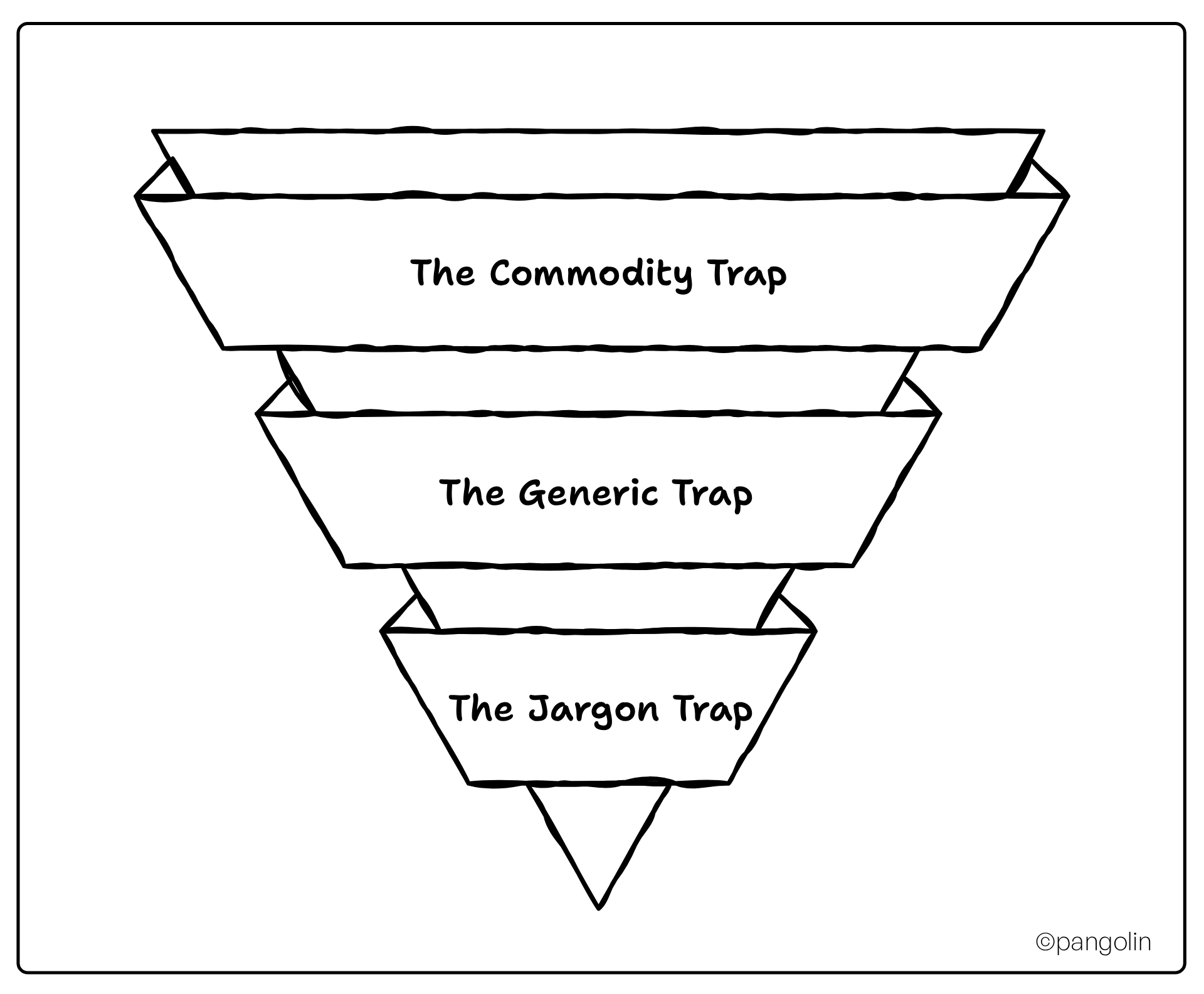
So, what's going wrong? There are three deadly SEO traps that IT companies fall into:
Example: "IT support Chicago" triggers price-shopping and vague leads, while "prevent ransomware attacks Chicago" signals urgent business pain, leading to more qualified prospects.
Spoiler: The latter wins every time.
Next, we'll dive into how the IT services search landscape evolved in 2025 and why you need a fresh SEO playbook to win.
Forget what you knew about the buyer journey. In 2025, the game has completely changed.
First, it's not just the IT guy anymore. A full 65% of IT purchase decisions now involve non-technical buyers. The CFO, the Head of Ops, the CEO, they're all in the room, and they all search differently. While your IT contact is looking for "network uptime monitoring tools," the CFO is searching for "IT budget optimization strategies." If you're only talking to the techie, you're invisible to the person signing the check.
AI has fundamentally disrupted search behavior. Google's AI Overviews now dominate search results, giving users answers directly on the results page. Your website isn't the destination anymore; it's just one of many options. Zero-click searches account for nearly 60% of all searches in 2025, meaning prospects get their answer without ever clicking through to your site.
And that AI is driving a seismic shift. Voice search is exploding, favoring natural, conversational questions. People don't say, "endpoint security software"; they ask, "How do I protect my business from malware?" If your SEO for tech companies content isn't written to answer direct questions, it won't be found.
Here's how this plays out in the real world. An MSP we work with was getting plenty of traffic for "network monitoring" but no real leads. They were attracting tire-kickers, not decision-makers. We helped them pivot their entire content strategy to focus on the real business pain: "avoiding costly downtime." The result? A 40% spike in qualified leads in under 90 days.
The old rules are dead. In the next section, we'll hand you the new playbook.
So, how do you win this new game? You stop playing by the old rules and build a system designed for how IT services are actually bought and sold in 2025.
It's not about finding magic keywords. It's about building a Three-Tier Keyword Architecture that maps directly to your multi-stakeholder buying committee.
Here's how it works:
This is the C-suite, the CEO, CFO, and COO. They don't care about tech specs; they care about business problems. They search for things like "cybersecurity risk assessment" or "cloud migration strategy".
Your Content for Them: Strategic guides, ROI calculators, and assessment tools that speak the language of revenue, risk, and competitive advantage.
This is your IT Manager or Director. They're solution-aware and need to vet the technical details. They search for things like "Office 365 migration checklist" or "HIPAA compliance requirements".
Your Content for Them: In-depth implementation guides, vendor comparison frameworks, and detailed checklists that make them look smart and prepared.
This is where the buying committee comes together to make a final decision. They're comparing you against your competitors with searches like "best managed IT services in [your city]" or "enterprise IT support pricing".
Your Content for Them: Crystal-clear capability overviews, powerful client testimonials, and transparent process documentation that builds trust and removes friction.
This entire framework for SEO for software companies and IT services is built on three simple principles:
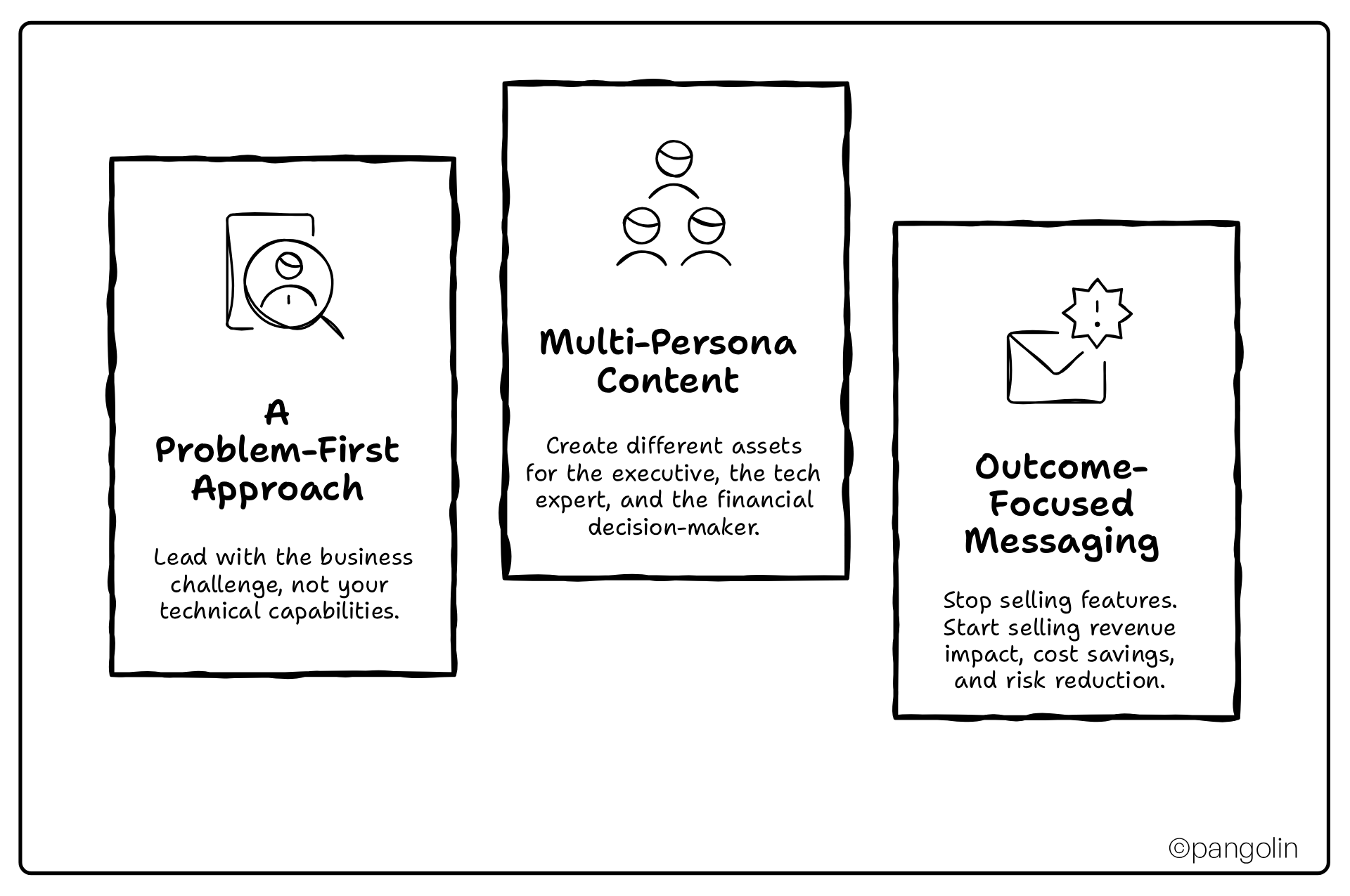
This isn't just theory. It's a revenue-generating machine. In the next section, we'll give you the step-by-step, 90-day roadmap to build it.
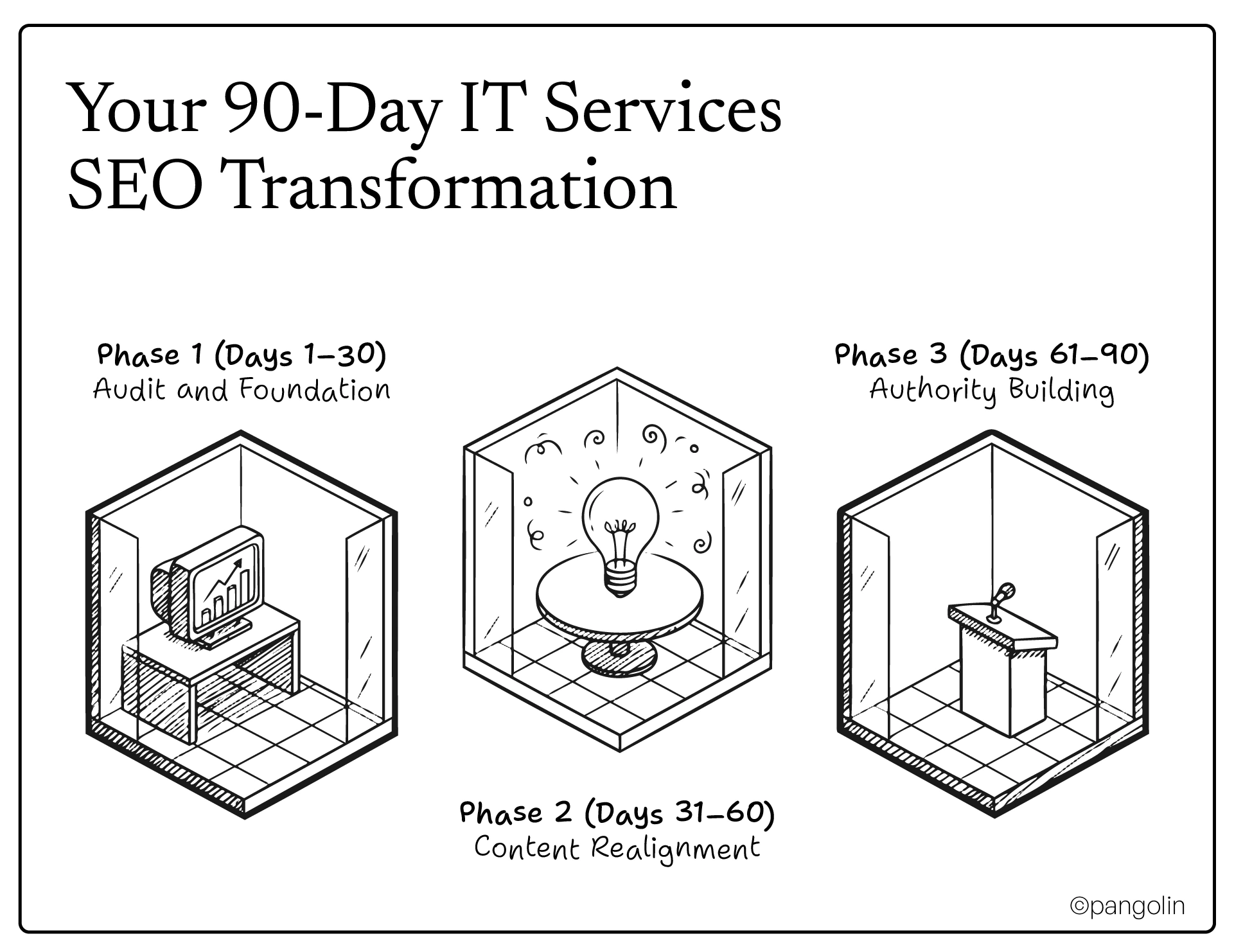
This isn't a wish list; it's a battle plan. You can radically transform your lead quality and pipeline in the next 90 days. Here's the roadmap for tech company SEO success.
First, stop shooting yourself in the foot. Run a keyword cannibalization audit to see if multiple pages on your site are fighting for the same terms. You can't win if you're competing against yourself. Next, do a competitor gap analysis, but don't just look at their keywords. Ask: what business problems are they solving with their content? Find their blind spots and own them.
Finally, get your technical house in order. Core Web Vitals are no longer optional. Make sure your site is fast, mobile-friendly, and clean.
Now it's time to rebuild. Map every piece of content to a specific buyer persona. The CFO needs an ROI calculator, not a technical whitepaper. Your service pages need a complete overhaul. Rewrite them to focus on business outcomes, not feature lists.
And start developing case studies with real, measurable results. Nothing builds trust faster than proof.
This is where you pull away from the pack. Start publishing industry-specific thought leadership. If you serve the legal industry, write about data security for law firms. Dominate your local market with hyper-local SEO targeting your key enterprise hubs.
And if you have partners, create content that highlights your partner ecosystem, amplifying your reach and credibility.
Forget tracking vanity metrics like traffic and rankings. The only numbers that matter are your cost per qualified consultation and your marketing-influenced pipeline.
This isn't a "set it and forget it" strategy. It's an active, revenue-focused system. In the next section, we'll dive deeper into the metrics that truly define success.
Let's be honest: your current SEO dashboard is probably a sea of vanity metrics. Traffic is up, rankings are climbing, but your pipeline is flat. It's time to stop chasing numbers that don't move the needle and start tracking what really matters for technology company SEO.
Here are the four metrics that separate a cost-center SEO strategy from a revenue-generating machine:
B2B companies with mature SEO programs track average session duration (benchmark: 3:36), bounce rate (benchmark: 39%), and visitor-to-lead conversion rate (benchmark: 1.8%). These engagement metrics reveal whether your content resonates with the right audience.
This is how you connect your SEO activities to actual closed deals. By using attribution models built for long B2B sales cycles and ROI frameworks that measure against lifetime customer value, you can finally prove the real business impact of your marketing efforts.
Get this right, and SEO stops being a line item expense and starts being your most powerful growth engine. But before you get there, you have to avoid the common traps that sink most IT services companies. We'll cover those next.
Knowledge is knowing what to do. Wisdom is knowing what not to do. Let's talk about the five expensive SEO blunders that quietly drain marketing budgets and kill growth.
Here's a real-world story. An MSP we know spent $50,000 on an aggressive SEO campaign targeting "managed services" keywords. Their traffic skyrocketed. Their rankings were incredible. And their pipeline was bone dry. They were attracting an audience of price-shopping, low-intent browsers.
We helped them pivot. They stopped talking about themselves and started talking about their clients' problems. They built a content hub around "IT security compliance for the healthcare industry." It was a smaller audience, but it was the right audience. The result? A 70% increase in qualified leads in six months, and they cut their marketing spend by a third.
Avoid these traps, and your SEO budget will stop being a cost center and start being a growth driver. Now, let's look at how to take your strategy to the next level.
Once you've stopped the bleeding and built a solid foundation, it's time to go on the offensive. This is where you stop just playing the game and start writing the rules.
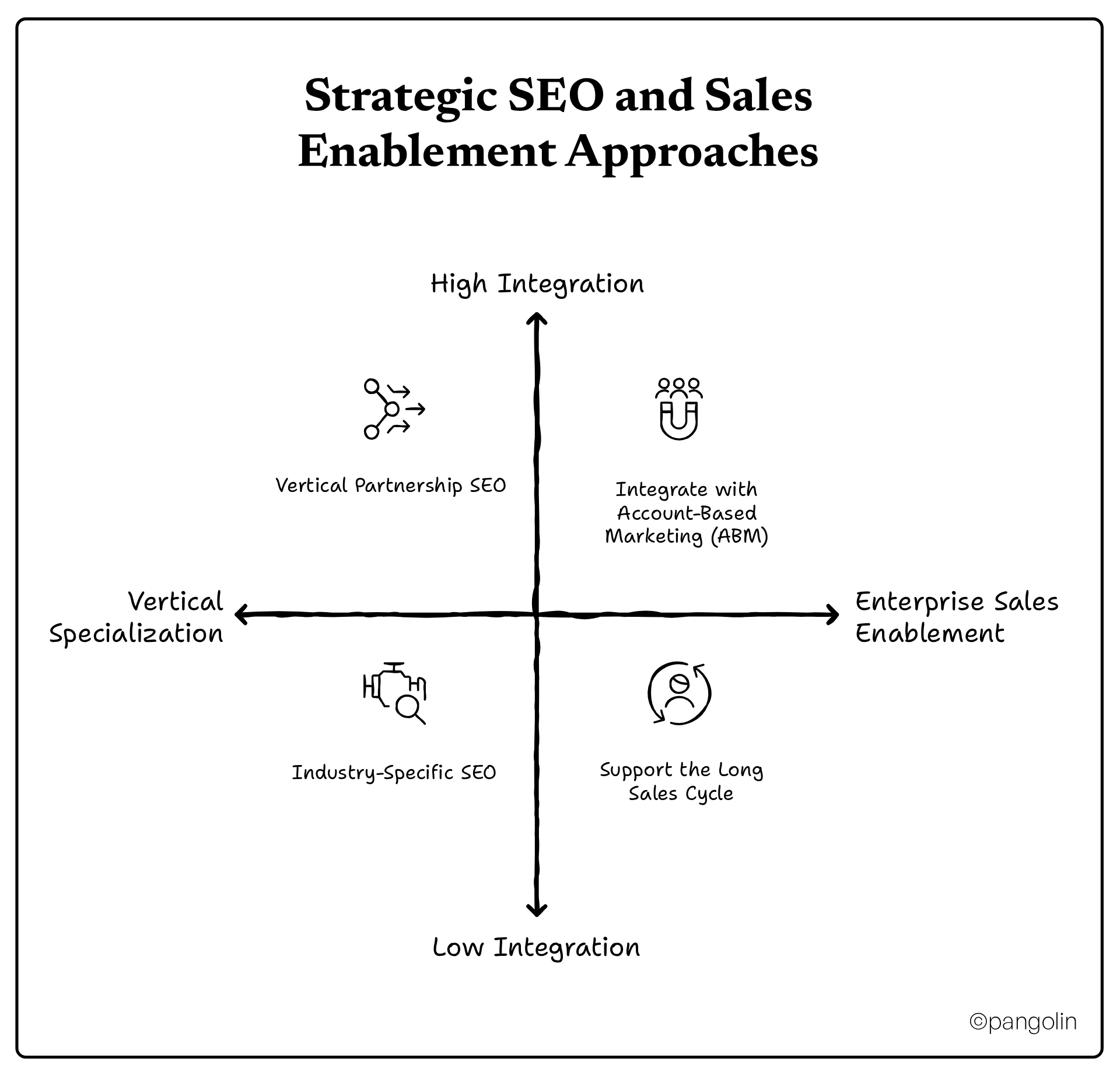
The fastest way to become a category leader is to own a niche. Stop trying to be the best IT services company and start striving to be the only IT services company for a specific industry.
Your SEO content shouldn't just generate leads; it should help you close them.
This is where SEO evolves from a marketing tactic into a core business strategy. It stops being about traffic and starts being about market dominance. Now, let's bring it all home.
This isn't just a new strategy; it's a response to a fundamental market shift. The clock is ticking, and the IT services landscape is evolving at a pace that will leave stragglers behind.
Here's what's creating the urgency:
This sounds intimidating, but there's a massive silver lining.
The vast majority of your competitors are still using the outdated SEO playbook we talked about earlier. They're stuck in the past, competing on commodity keywords and measuring the wrong metrics. This creates a powerful first-mover advantage for you.
By adopting a modern, revenue-focused SEO strategy now, you can:
The window to establish yourself as a leader in the new IT services landscape is open right now. But it's closing fast. You can either seize this opportunity or spend the next five years explaining to your board why your pipeline is shrinking.
Now, let's talk about what you're going to do about it.
You're at a crossroads.
You can continue fighting for scraps, competing on commodity keywords that attract price-shoppers and tire-kickers. Or you can make the decision to become the obvious choice for the high-value prospects you actually want to work with.
The choice is yours.
If you're ready to stop competing and start owning your market, here are your next steps:
Your ideal clients are out there right now, searching for solutions to their most painful business problems. They're just not finding you.
Let's fix that.
SEO (Search Engine Optimization) improves your website's visibility in search engines like Google. For IT services companies, SEO is crucial because it attracts qualified leads actively searching for IT solutions, reducing reliance on expensive cold outreach. Companies with mature SEO programs see 748% ROI over three years and cut customer acquisition costs by 28%.
SEO for IT companies must address multi-stakeholder buying committees where 65% of purchase decisions involve non-technical buyers like CFOs and CEOs. It requires balancing technical and business content for personas with different search behaviors, navigating 6-18 month sales cycles, and competing against billion-dollar tech giants for commodity keywords. Success depends on problem-focused content over feature lists.
The five deadly mistakes: competing on generic commodity keywords that trigger price shopping, using technical jargon that doesn't match actual search intent, ignoring local SEO despite 70% of clients being regional, focusing on backlink quantity over authority quality, and measuring vanity metrics like rankings instead of revenue-driving KPIs like cost per qualified consultation.
Focus on a three-tier keyword architecture targeting executives (business outcomes), technical evaluators (implementation details), and decision-stage buyers (vendor comparisons). Optimize for AI-powered search and zero-click results, which now account for 60% of searches. Implement vertical specialization, hyper-local targeting, and problem-first content that answers conversational queries.
Beyond traffic, track cost per qualified consultation, lead-to-client conversion rate by service line (benchmark: 1.8%), sales cycle velocity, and marketing-influenced pipeline value. Monitor average session duration (benchmark: 3:36), bounce rate (benchmark: 39%), and SEO ROI (benchmark: 748% over 3 years). Use multi-touch attribution to connect content touchpoints to closed deals.
Most IT services decisions are made locally or regionally, with 70% of enterprise clients within a 100-mile radius. Local SEO captures nearby high-intent leads through geo-specific keywords, Google Business Profile optimization, and location landing pages. It's particularly effective for compliance-driven industries like healthcare and finance where proximity matters for audits and on-site support.
AI powers Google's AI Overviews and zero-click searches that dominate 60% of search results, meaning buyers get answers without clicking through to your site. Voice search adoption is accelerating, favoring conversational queries like "How do I protect my business from malware?" over keyword phrases. Technology company SEO must adapt with structured FAQ content, natural language optimization, and original data that AI can't replicate.
Develop persona-specific content for each funnel stage: strategic guides and ROI calculators for C-suite executives, technical implementation guides and comparison frameworks for IT managers, and case studies with proof for decision committees. Use nurturing sequences to deliver relevant content over 6-18 months, integrate SEO insights with ABM campaigns, and create sales enablement tools like battlecards that help close deals faster.
High-performing content types include problem-solving how-to guides targeting long-tail keywords, case studies with measurable results, honest comparison pages building trust, FAQ pages optimized for "People Also Ask" features, industry-specific thought leadership with original data, ROI calculators providing personalized value, and local landing pages for "near me" searches. Video tutorials and webinars drive 89% marketer adoption for demonstrating technical expertise.
Track marketing-qualified leads (MQLs) from organic search, MQL-to-SQL conversion rate (benchmark: 20-40%), cost per lead by channel, lead velocity rate (10-20% month-over-month growth target), sales-accepted lead rate (75%+ indicates alignment), and time-to-first-contact (under 1 hour for inbound). Monitor keyword rankings for autofill transactional terms (10% year-over-year growth), organic traffic growth (47% annual benchmark), and multi-touch attribution showing content influence on closed deals.
Generative Engine Optimization (GEO) for AI-powered search visibility, conversational content answering natural language queries, E-E-A-T (Experience, Expertise, Authoritativeness, Trustworthiness) signals through original research and author credentials, Core Web Vitals 2.0 for technical performance, topic clusters over individual keywords, and vertical specialization for industry-specific dominance. Zero-click optimization with featured snippets, voice search targeting, and first-party data strategies are critical as privacy regulations tighten.

