

In 2007, Netflix CEO Reed Hastings walked into the boardroom with a plan to destroy his own profitable business. DVD rentals were working, revenue climbing, customers happy, logistics humming. But Hastings wanted to bet everything on streaming, a technology most consumers didn't want yet. Wall Street thought he was insane. Seven years later, Netflix became a $300B+ entertainment empire that redefined an industry.
The SEO vs PPC debate for IT services isn't much different.
Most marketing directors stick with PPC because it's safe and predictable. But the IT services companies dominating lead generation in 2025 made the Netflix bet years ago, they invested in SEO when it felt premature. Now they're generating 2.1% conversion rates while PPC limps along at 1.0%, and they're doing it without paying for every single click.
Here's what seven years of industry data reveals about which channel actually delivers better leads for IT services companies, and why the answer isn't what most VPs of Marketing think.
Not all leads are created equal. A hundred PPC clicks might fill your CRM, but if only one converts to a qualified opportunity while SEO delivers two or three from the same volume, you're burning money.
The numbers are stark. SEO converts at 2.1% for B2B SaaS companies versus PPC's 1.0%. In financial services, the gap widens to 7.3x, SEO converts at seven times the rate of paid ads. Manufacturing and distribution see a 3x advantage for organic leads.
But conversion rates only tell half the story.
Organic leads convert to Sales Qualified Opportunities at 2-3x higher rates than paid ad leads. They make 47% larger purchases when nurtured properly and convert 23% faster through the sales cycle. For IT services companies with average deal sizes of $50K-$500K and sales cycles stretching 2.5 months, that quality difference compounds into millions.
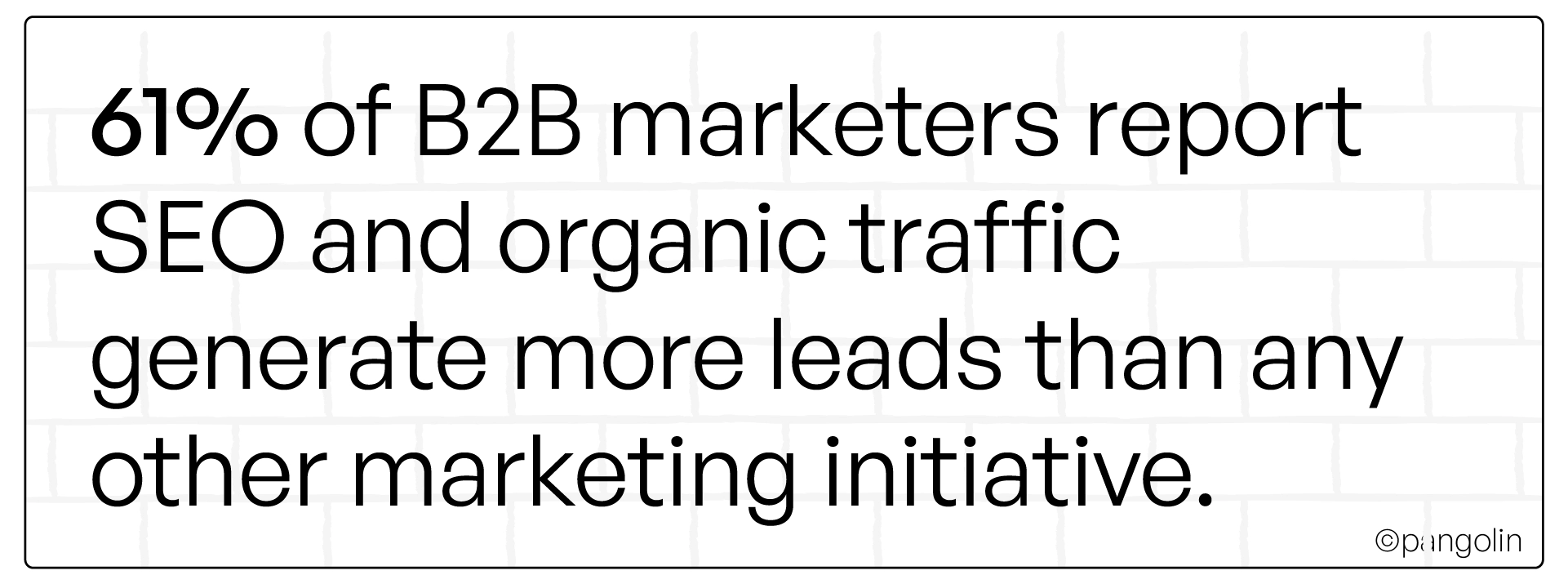
Here's why: IT services buyers don't impulse-purchase. They research extensively, spending 45% of their time gathering information before ever engaging a salesperson. Six to ten stakeholders scrutinize every decision. Technical evaluators, procurement teams, and executives all need different validation signals.
High organic rankings signal industry leadership. You don't game your way to page one for "cloud migration services" or "managed security operations", you earn it through demonstrated expertise. When a CTO researching solutions sees your comprehensive guide ranking #1, that's third-party validation Google provides for free.
Paid ads? Anyone with a credit card can run those. The "Sponsored" label tells technical buyers exactly what they're looking at: marketing. And after $84 billion lost globally to ad fraud in 2023, B2B buyers have learned to trust organic results more than paid placements.
The concrete example: A B2B SaaS company generating 100 leads monthly from SEO (2.1% conversion) gets 2-3 qualified opportunities. The same 100 leads from PPC (1.0% conversion) yields just one. Over twelve months, that's 24-36 opportunities versus 12, literally double the pipeline from identical lead volume.
For an IT services company with a $200K average deal size and 30% close rate, that quality gap represents $1.4M to $2.16M in additional revenue from the higher-quality channel. Same traffic. Different results.
[[divider]]
Marketing directors obsess over cost-per-lead because it's easy to measure. But in IT services, where customer acquisition costs range from $600-$900, focusing on CPL misses the forest for the trees.
Let's compare total cost of ownership over three years.
PPC delivers immediate results. Launch campaigns Monday, get clicks Tuesday, leads by Friday. That speed is intoxicating, and expensive. Average B2B SaaS CAC sits at $536, but competitive IT services markets push that to $600-$900.
SEO requires patience. Three to six months before meaningful traction. Content investment, technical optimization, link building, all upfront costs with delayed returns. For a marketing director staring at quarterly MQL targets, this feels like career suicide.
But here's what changes after month six.
PPC costs never decrease. Competition drives up CPCs. Ad fatigue requires creative refreshes. Platform algorithm changes tank performance overnight. You pay for every click, forever. Studies show PPC reaches peak efficiency at 6-12 months, then effectiveness declines.
SEO compounds. Content ranking on page one in month eight keeps ranking in month twenty-four, no additional cost per visitor. Your per-lead cost drops as organic traffic grows while investment stabilizes. The asset appreciates while you sleep.
Real numbers from a commercial insurance firm with a $250K annual budget:
SEO Investment:
PPC Investment:
That's 4.4x more profit from SEO with the same budget. The compounding returns explain why 75% of B2B companies stop paid campaigns within six months, not because PPC doesn't work, but because it can't economically sustain companies with 3-12 month sales cycles.
Click fraud eats 22% of online ad spend, that's $84 billion globally in 2023 just vanishing into bot farms and competitor sabotage. Your CRM fills with fake leads that waste sales engineering time on discovery calls with no-shows.
Low-quality leads carry operational costs too. Sales teams spending 30 minutes qualifying a PPC lead that never had budget versus closing an SEO lead that researched you for weeks, that labor cost never appears in your CPL spreadsheet.
SEO has upfront content costs, sure. But there's no marginal cost per visitor once you rank. No click fraud. No bidding wars. No algorithm changes that double your CAC overnight.
[[divider]]
PPC's speed advantage is real. It's also temporary. And for most IT services companies, speed solves the wrong problem.
CMO tenure in tech is at its lowest point in a decade. New marketing directors feel immediate pressure to prove value, and PPC delivers that dopamine hit of "activity", campaigns running, dashboards populating, leads flowing.
But activity isn't progress when those leads convert at half the rate of organic and require twice the sales engineering time to qualify.
B2B tech sales cycles average 2.5 months. They've increased 25% over the past five years as buying committees expanded to 6-10 stakeholders. The median B2B sale requires 7-9 touchpoints before conversion.
You're optimizing for 90-day results in a 7-9 month buyer journey. It's like training for a marathon by running sprints.
Let's be clear: PPC has legitimate use cases in IT services marketing.
Product launches requiring immediate visibility in a specific launch window, you can't wait six months for SEO traction when your conference keynote is in eight weeks.
Event promotion for webinars, user conferences, or trade shows with fixed dates demands immediate reach.
Testing new positioning before committing six months to an SEO content strategy, PPC lets you validate messaging and keyword demand with $5K instead of $50K.
Emergency pipeline gaps when you're staring at a $2M shortfall and need anything that converts in the next 45 days to save the quarter.
Competitive defense on branded terms where competitors are siphoning your hard-earned awareness by bidding on your company name.
These are tactical applications. They're not strategies.
If you're building a sustainable IT services business with enterprise customers, long sales cycles, and complex buying committees, SEO isn't optional, it's the foundation.
Long-term market leadership requires demonstrating expertise through comprehensive content that ranks for every question your buyers ask at every stage of their journey.
Trust with technical decision-makers doesn't come from ads. CTOs evaluating managed security services read whitepapers, compare architecture approaches, and verify expertise before ever filling out a contact form.
Enterprise sales with 6+ month cycles give you time to nurture leads through educational content. The companies winning these deals show up in organic search at every micro-moment of the research phase.
Sustainable growth without ad dependency means your pipeline doesn't collapse when economic downturns force budget cuts. SEO is the asset that keeps producing when PPC budgets get slashed.
63% of leads not ready to buy initially do convert with proper nurturing.
The bridge strategy? Use PPC to fill immediate needs while SEO compounds in the background. By month 6-9, organic traffic starts carrying load. By month 12, it dominates. By year two, PPC becomes a supporting player instead of the hero you're betting the business on.
[[divider]]
IT services aren't impulse buys. A company doesn't wake up Monday and sign a $200K managed services contract by Friday because they saw a clever ad.
The stakes are too high. Implementation complexity requires proof of capability. Security and compliance demand demonstrated expertise. Long-term partnerships need trust foundations. Reference checks favor established thought leaders.
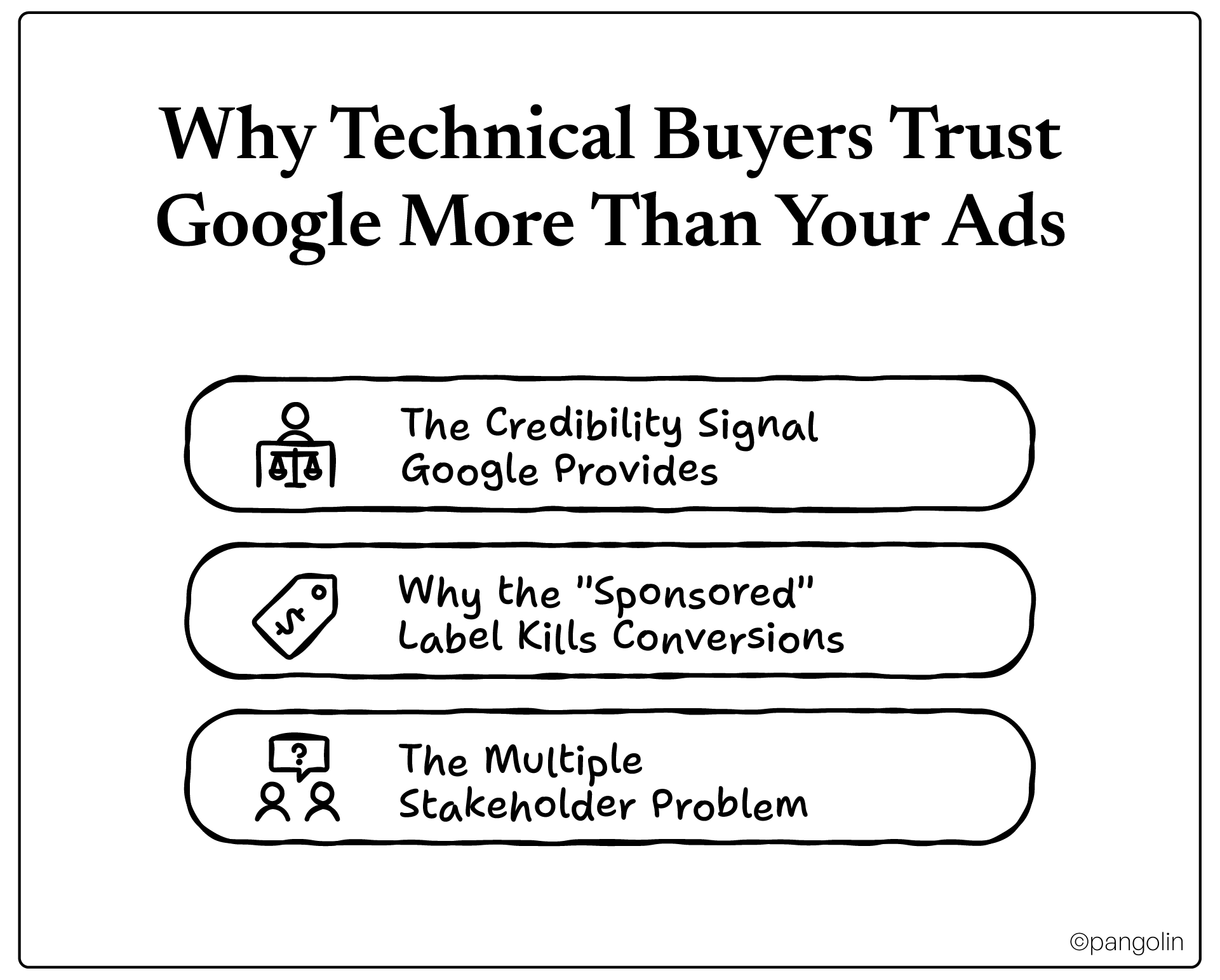
When your content ranks #1 for "enterprise cloud migration strategy," Google is vouching for you to the tune of algorithmic confidence built on 200+ ranking factors.
That ranking means:
You didn't pay for that endorsement. You earned it.
44% of B2B buyers trust impartial third-party content more than vendor information. The "Sponsored" label tells them exactly what they're looking at: paid vendor messaging.
Technical buyers, the CTOs, VPs of Engineering, Security Directors evaluating your services, have been trained by years of mediocre ads to distrust paid placements. They scroll past the sponsored listings looking for organic results precisely because ranking signals credibility that can't be bought.
This skepticism has data behind it. 76% of buyers expect brands to understand their unique needs and preferences. Generic PPC ad copy optimized for click-through rates doesn't demonstrate understanding, it demonstrates marketing.
Your SEO content addressing the specific technical architecture questions a CTO is researching at 11pm on a Tuesday? That demonstrates understanding. That builds trust.
Remember those 6-10 stakeholders in every B2B tech deal? They have different information needs:
One PPC ad can't serve all three. But a comprehensive content ecosystem, ranking for technical implementation questions, ROI calculators, case study searches, and competitive comparisons, meets each stakeholder where they are.
That's how you build consensus across a buying committee. Not with a 90-character ad headline, but with systematically answering every question every stakeholder asks at every stage of their research.
[[divider]]
The best IT services marketing strategies don't pick SEO vs PPC. They use both strategically, with clear roles for each channel.
The recommended budget allocation: 75% SEO, 25% PPC.
That 3:1 ratio reflects which channel builds sustainable lead generation and which provides tactical support.
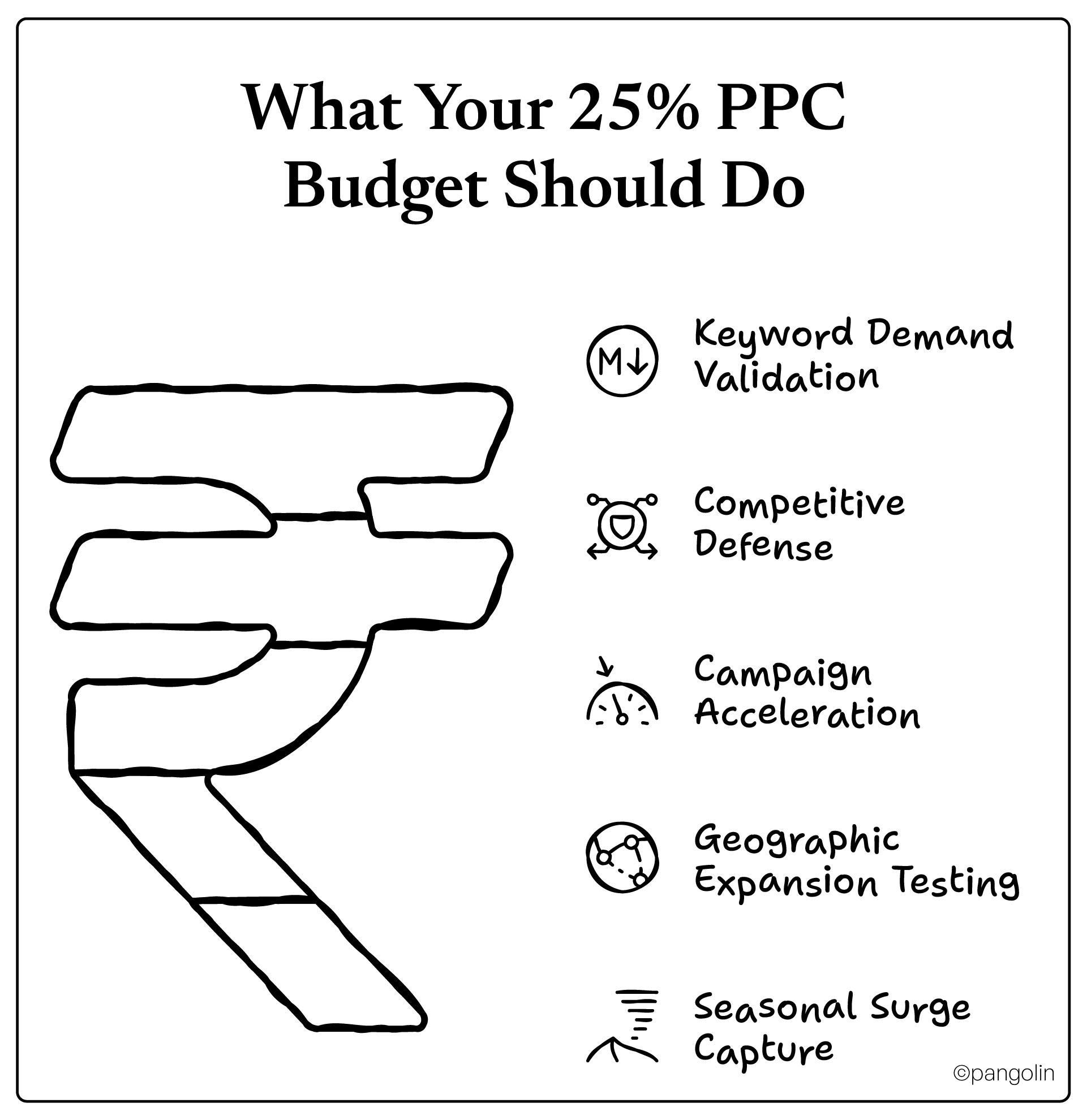
Before investing six months building SEO content around "AI-powered network monitoring," spend $2K testing demand in PPC. If no one clicks at $3 CPC with compelling copy, you just saved yourself from a content strategy dead-end.
When competitors bid on your branded terms, your organic #1 ranking isn't enough. They're stealing awareness you paid to build. A small branded PPC budget (often <$1K/month) protects that investment.
Product launch at RSA Conference in eight weeks? You need immediate visibility while your SEO content compounds. PPC bridges that gap without depending on it forever.
Thinking about entering the Nordic market for managed services? PPC tests demand, messaging, and competitive intensity for $5-10K before committing to building regional SEO presence.
Year-end budget flushes, Q1 strategic planning season, post-breach security spend spikes, PPC captures demand surges your SEO might not have content ready for.
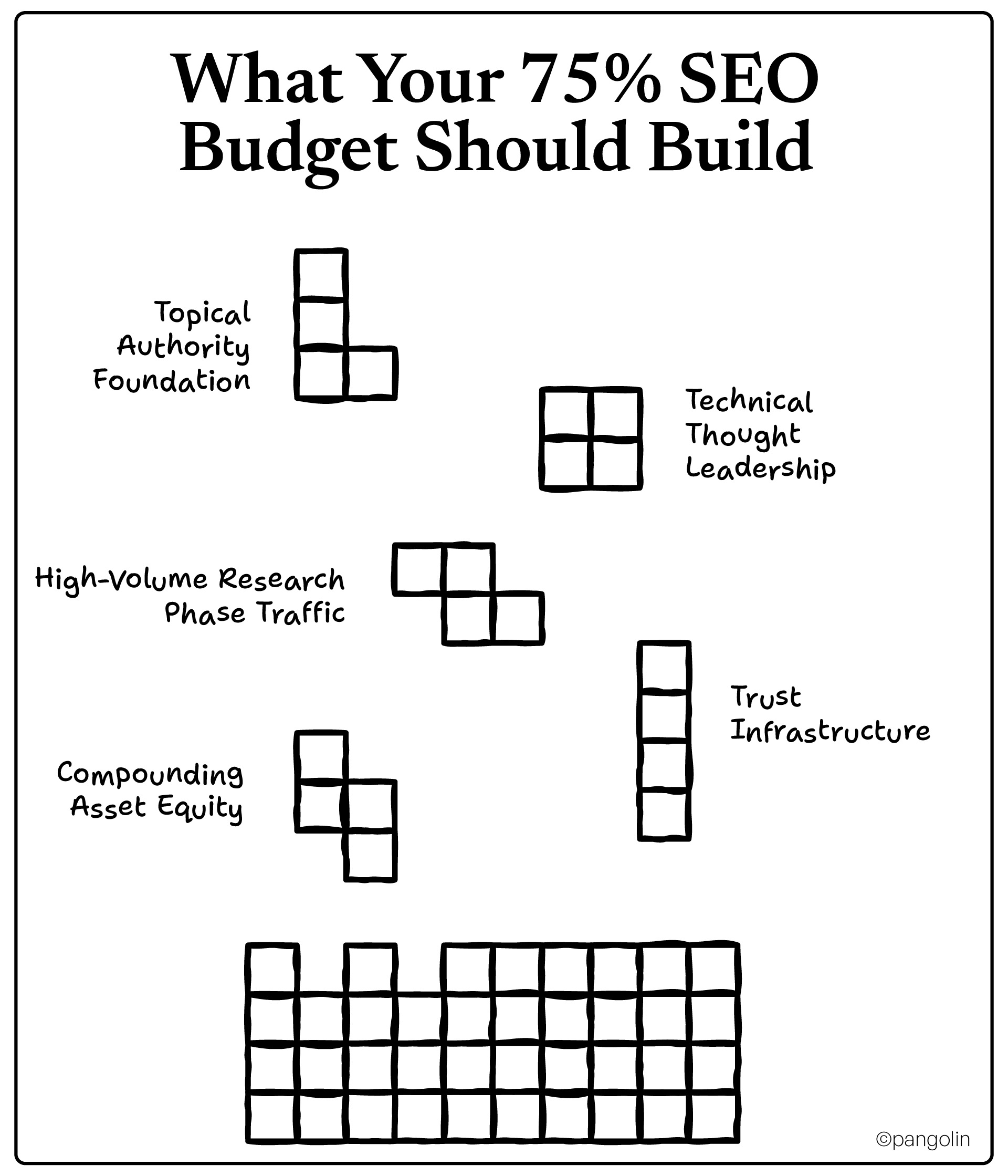
Comprehensive content hubs answering every question your buyers ask. Not blog posts, architectural guides, comparison frameworks, ROI calculators, implementation roadmaps, security compliance checklists.
Demonstrate expertise that differentiates you from commodity providers. Show the technical depth that resonates with evaluators and the business outcomes that sell executives.
Capture buyers in month one of their 6-9 month journey. When they're researching "managed SIEM vs SOC" and haven't formed vendor shortlists yet, you're establishing expertise before competitors even know they exist.
Content ranking in month twelve keeps generating leads in month thirty-six with no additional spend. That compounding return is what makes SEO ROI impossible to beat at scale.
Case studies, client testimonials, technical certifications, security compliance documentation, all the trust signals buying committees require. These pages don't generate high traffic but convert browsers into bookers.
The channels amplify each other when integrated properly:
Companies using integrated multi-channel automation create 3-4x higher engagement than single-channel approaches.
Your budget split should evolve as SEO compounds:
Months 1-6: 40% SEO, 60% PPC (Bridge the immediate gap)
Months 7-12: 60% SEO, 40% PPC (Transition period as organic builds)
Year 2+: 75% SEO, 25% PPC (Sustainable long-term model)
This progression acknowledges reality: you can't go zero-to-hero in SEO overnight, and you can't afford to depend on PPC forever. The winning strategy transitions from paid to organic dominance over 12-18 months.
[[divider]]
Your timeline, budget, and pipeline pressure dictate the right mix. Here's how to decide.
Primary Strategy: PPC (70-80% of budget)
Secondary Strategy: SEO foundation building (20-30%)
When this applies: Quarter-end gap, new CMO with 90-day prove-it timeline, emergency cash flow needs, sudden competitor pressure.
What to expect: Higher CAC, lower lead quality, immediate results that stop when budget stops. You're renting attention, not building assets.
Next move: Use this 90-day sprint to buy time while simultaneously laying SEO foundation. Don't depend on PPC long-term.
Primary Strategy: PPC for demand validation (50%)
Secondary Strategy: SEO foundation building (50%)
When this applies: Testing new vertical, geographic expansion, product line extension, unproven positioning.
What to expect: Fast market intelligence on keyword demand, messaging resonance, competitive intensity. PPC tells you if the opportunity is real before committing six months to SEO.
Next move: If PPC validates demand, shift to 75/25 SEO-dominant model. If it doesn't, you just saved yourself from a costly mistake.
Primary Strategy: SEO (75%)
Secondary Strategy: PPC for tactical uses (25%)
When this applies: You've been in business 3+ years, have existing customer base, can afford 6-9 month investment horizon, compete on expertise not price.
What to expect: 6-9 month ramp period before momentum, declining per-lead costs over time, sustainable pipeline that survives budget cuts, compounding ROI that makes PPC look expensive by comparison.
Next move: This is the long-term winning formula. Stay disciplined through the ramp period and you'll build an unfair advantage competitors can't easily replicate.
Primary Strategy: Balanced approach (60% SEO, 40% PPC)
Secondary Strategy: Aggressive content production and competitive term bidding
When this applies: Well-funded competitor launched, market leader expanding into your niche, multiple competitors ranking above you, losing deals to better-positioned alternatives.
What to expect: Dual visibility across SERPs defends market position. PPC blocks competitors from stealing your awareness while SEO builds long-term rankings they can't easily displace.
Next move: Once you've stabilized competitive position (6-12 months), transition to 75/25 sustainable model.
Don't rely solely on PPC if:
Don't rely solely on SEO if:
[[divider]]
SEO delivers 2x the conversion rate and 4-5x the long-term ROI of PPC for IT services, but only if you can survive the 3-6 month ramp period.
That's the Netflix decision Reed Hastings faced in 2007. Streaming would eventually dominate entertainment, but the transition period was painful, expensive, and required conviction when everyone said stick with what works.
Most IT services marketing directors choose the safe option. Keep running PPC because it's predictable. Justify the declining efficiency with "at least we're getting leads." Watch CAC creep up 15-20% annually while competitors building SEO moats pull further ahead.
The companies dominating lead generation in 2025 made a different choice. They allocated 75% to SEO when it felt premature. They suffered through the 6-9 month trough when PPC was producing and SEO wasn't. They trusted compound interest over rental fees.
Now they're generating 2.1% conversion rates while PPC companies limp along at 1.0%. They're producing leads at a fraction of the cost. Their pipeline survives budget cuts. Their rankings compound while competitors burn cash.
The question isn't "which is better?" The question is whether you're willing to make the long-term bet when the short-term option is sitting right there, comfortable and familiar.
Start with three honest answers:
If you can wait, if quality matters, and if expertise is your differentiator, SEO isn't optional. It's your only path to sustainable competitive advantage.
If you can't wait, quality is secondary to volume, and price is your game, PPC makes sense as a primary strategy. Just know you're in a race where the finish line keeps moving and the entry fee keeps rising.
The IT services companies still debating SEO vs PPC in 2026 will be the ones watching competitors with mature content ecosystems close deals they never even knew existed.
Because by the time everyone agrees SEO is smart, the advantage is gone.
Kavya Somani and Aniket Panja authored this guide. Design by Adhiraj Jadhav and Sohini Some, UI/UX by Adil Abdul and Yugandhar LakshmiNarayana, SEO by Yuva Priyadarshini and Aniket Singh. Deepti Karn led project execution.
With thanks to Avani Nagwann and Shashank Ayyar for strategic guidance.

