


Download the Cannibalization Compass here.
“Salt the rasam harder. That’ll fix it.”
My aunt can taste a half-degree error in her rasam. If the flavour felt even one percent off, she’d go full Michelin-mode.
A pinch of salt, two extra seconds of simmer, maybe sacrifice a lemon to the flavour gods.
But she never doubted the recipe itself, only the ratios.
After all, the problem couldn’t be the whole system… right? right?
This is an instinct I see a lot in ITES leadership today. When margins start tightening or pricing pressure rises and the default reaction is operational fine-tuning.
“Let’s trim the bench. Fix the pyramid. Reshuffle a few resources”.
After all, the base model has worked for two decades. Why change the core?
But what if the problem isn’t the ratios?
GenAI isn’t just helping us do the same work faster. It’s quietly changing what counts as work. Tasks that took 40 hours now take four. Or none. So the “hours sold = value delivered” logic is breaking.
That’s why we built the AI Cannibalization Compass.
It locates your most vulnerable lanes and it forces you to ask:
Which of my own services should I retire before the market forces me to?
So if your hours are disappearing but your pricing hasn’t moved, salting it harder won’t help.
You need a new map.
You probably already know where the cracks are. What you might not know is how fast those cracks widen. Or which parts of your revenue model they’ll take down first.
So the point isn’t to panic. It’s to get clear. It’s to ask:
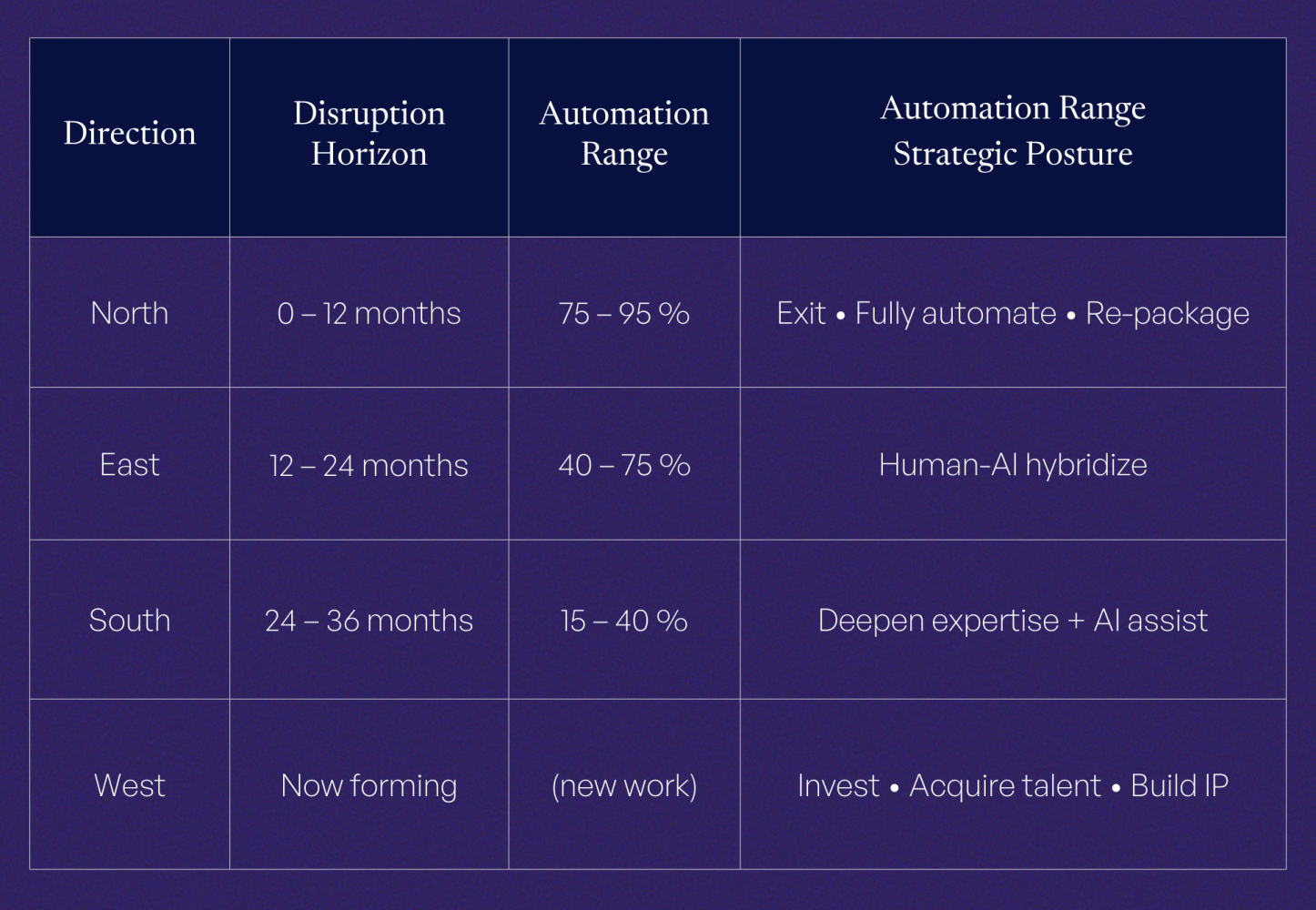
Timeline: Next 12 months Risk: 75–95 % of effort
What belongs here?
Invoice and KYC form ingestion, first-level help-desk tickets, manual QA regressions, rule-based claims adjudication, templated report builds, basic content moderation.
What’s changing?
The proof is already public. A large-scale healthcare company freed 15,000 staff-hours a month and turned the tech into “Document Ops” at $0.14 a file.
What can you do?
So If 30–40 % of your revenue still depends on this work, you have three doors:
Door 1: Offer a 12-month, fixed-fee path out. You control the timeline and keep goodwill.
Door 2: Keep the lane but charge per document, per reset, per claim. Pocket the efficiency dividend instead of giving it back as a discount.
Door 3: Stay on as the caretaker who keeps the bots accurate, compliant, and running smoothly and charge for that oversight.
Because once a client can compare two dashboards (one human, one automated) they’ll pick the faster, cheaper lane unless you’ve already shown them why the smarter lane still has your name on it.
Timeline: 12–24 months Risk: 40–75 % of effort
What belongs here?
All the mid-complexity work that still needs brains (but far fewer than before)
What’s changing?
What can you do?
So If 40–50 % of revenue still lives here there are two ways to turn the shift to your advantage
1. Build an AI-Ops Guild. Keep the lane, but sell it as “AI-draft, human-verified.” A small crew of prompt engineers, model trainers and governance leads tunes prompts, watches drift, and signs off edge cases.
Clients pay a service retainer for speed plus a margin for guaranteed quality.
2. Monetise the Data Moat. Your proprietary assets labelled case files, industry ontologies, historical ticket logs can make a generic model un-copyably smart. Wrap those datasets behind an API or subscription.
Both tracks share a rule: you stop invoicing for minutes worked and start charging for certainty delivered.
Timeline: 24–36 months Risk: 15–40 %
What belongs here?
Domain-specific strategy consulting, complex solution design, industry compliance services, strategic vendor governance, digital-transformation advisory, custom analytics modelling.
Why does this lane still hold its price?
What can you do?
There are mainly two ways to deepen your moat in this quadrant:
Timeline: Now forming Revenue today: <10 % (Growth: 200–300 % CAGR)
What belongs here?
AI model governance and compliance, LLM fine-tuning and prompt engineering, AI-human workflow design, output quality assurance, synthetic-data generation, responsible-AI consulting, AI‐legacy integration.
Basically any service born because AI itself is messy and high-stakes.
Why is it exploding?
Picture this: One U.S. hospital pays Cognizant a million dollars a year for a synthetic-data vault, while JP Morgan tacks a 0.2 % fee onto every internal LLM call to cover bias audits.
So “Safe and explainable” already carries a clear price tag (and it’s climbing).
How can you claim your stakes?
Once you’ve walked the circle, the conversation changes to closing the gap between aspiration and action.
Here’s a 6 point checklist to get you started:
I know this isn’t easy.
No leader wants to dismantle the very service lines that built their reputation, team, and revenue.
But sometimes, retiring what has served its purpose so the organisation (and the people in it) can move toward work that still creates unmistakable value.
We’ve helped firms walk this transition through brand, delivery, pricing, GTM, and service innovation.
So if this sparked a few uncomfortable but necessary questions, and you’re wondering what to do next, I’d be glad to help you think it through.
P.S. We have one other tool to help you plan your next move:

