

AI isn’t just changing how services are delivered. It’s changing what counts as value.
This 9-block canvas is designed for founders and COOs asking the hard question:
“Are we still structurally set up to win in a world where intelligence is ambient?”
Use it to:
[Download the AI Transformation Canvas Template]
There’s something disorienting about watching the work you’ve known begin to unrecognize itself.
Ask any founder what keeps them up. Odds are it’s the holy KPI trio: How fast is the pipeline moving? Are seats maxed out? Is margin holding?
For ages, those answers doubled as proof that everything was fine, growth was on track.
But growth in the AI age, we’re discovering, can be a hall of mirrors. When anyone with an API key can spin up “capacity,” the scoreboard stops measuring the game.
Billing hours cease to map to value. Headcount ceases to map to capability. And a more elemental question arises:
Who are we when the thing we’ve always sold is no longer scarce?
This is almost like an identity re-evaluation disguised as a tech upgrade. If you look closely, you’ll see two businesses living inside the same balance sheet:
The first earned trust by promising more. The second will earn trust by promising what only you can know.
Bridging them is not a matter of plugging in an LLM. It is a matter of rethinking the story you tell the market and the incentives you set for your teams.
The Canvas is made to surface these tensions.
So treat it as a place to re-negotiate what the company is for and to decide how it stays unmistakably itself.
Because the real question isn’t: How do we integrate more AI?
It’s: What are we still irreplaceably here to do?
And: What must change for that answer to remain true five years from now?
(P.S If this stings, good - It might be the only evidence you still care about the craft that made the company worth building in the first place)
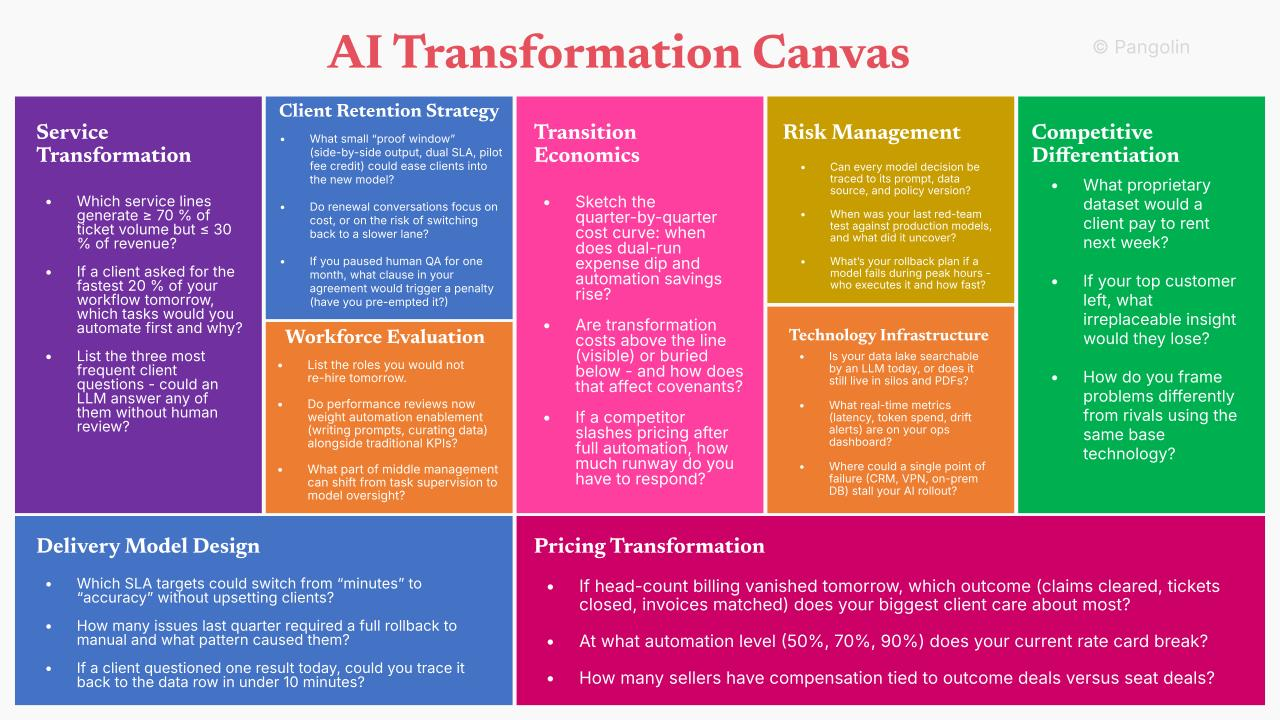
This canvas has nine interconnected areas. Each one addresses a critical decision point in the shift from human-heavy outsourcing to AI-augmented service delivery.
[Download the AI Transformation Canvas Template]
This block captures the moment a service stops being measured in human hours and starts being measured in outcomes. A claims-processing BPO in the U.S. recently pointed an LLM at low-complexity files and let adjudicators handle only the disputed 18 percent.
Think about it, the cycle time shortened, yes but the work itself has a new shape.
“Resolution” replaced “hours” as the unit of work.
Now every downstream dashboard (utilisation, billing, even talent mix) has to adjust itself around that contour.
Transformation lands twice: once in your ops centre, then in a client’s comfort zone.
A European legal-process outsourcer paired AI and human reviews side-by-side for a single quarter. They let general counsel watch accuracy converge before switching the old lane off.
Now, retention isn’t a game of discounts or a rewards program anymore, it’s showing buyers the future and the fallback in the same frame so trust has room to travel.
Yesterday’s delivery floor was a long row of headsets defined by calls per hour, tickets per shift, adherence to a script. Automation has cleared that terrain.
What remains is a smaller, more specialized field where two breeds of talent matter:
Productivity is no longer tallied in interactions handled but in uncertainty reduced and compensation follows that axes.
If services are the ‘what,’ this is the ‘how.’ Picture this:
Every technician fix is logged back into the knowledge base tightening the model’s certainty on future calls.
See how the flow feels less like a conveyor belt and more like air-traffic control with every layer making the next smarter? Exactly.
The invoice can’t keep its old language when the input that created it has vanished.
The moment a workflow is priced per claim or per detected anomaly, the conversation shifts from “hours saved” to “errors avoided” and “tokens used.”
That’s where the margin hides: in the gap between what the AI costs to run and what the clean, accurate outcome is worth to your client.
Data that once lived in silos now sits in a single vector store the model can search instantly. Deployments used to mean weekly code drops. Now, they’re one-click pipelines that roll prompts or model versions forward (and back) in minutes.
That’s why smart teams treat AI models like plug-and-play parts. If token costs rise or a better model comes out, they switch quickly (often in days, not months) without missing their SLAs.
Everyone has access to the same models, what sets you apart is what the model does with your data.
Ten years of labeled cases, a compliance playbook, a way of solving problems others haven’t thought of. The moat tends to be how uniquely you understand (and structure) work and a way of framing problems the open web can’t copy
So algorithms level the field but proprietary context tilts it back.
Automation bends the P&L before it lifts it. Running manual and automated workflows side-by-side costs extra for a short spell, but expenses drop sharply once the manual lane is shut.
Boards that see the curve mapped in advance treat the trench as an investment phase. Those who don’t, often panic too early and lose momentum right when it’s starting to pay off.
Governance used to be a quarterly QA sample and a post-mortem if something failed. As AI takes over more decisions, the real risk isn’t just failure, its opacity.
Clients want to know not just what happened, but why.
That’s why modern systems track every step: the prompt, the model’s response, and any human overrides. The ability to explain decisions has become part of the product itself.
Walk the canvas like you’d walk a factory floor: one block at a time, noting where the old logic still drives decisions and where the new logic wants to break through.
Start with the block that feels most urgent and wherever the tension already shows then follow the knock-on effects to the neighbouring squares.
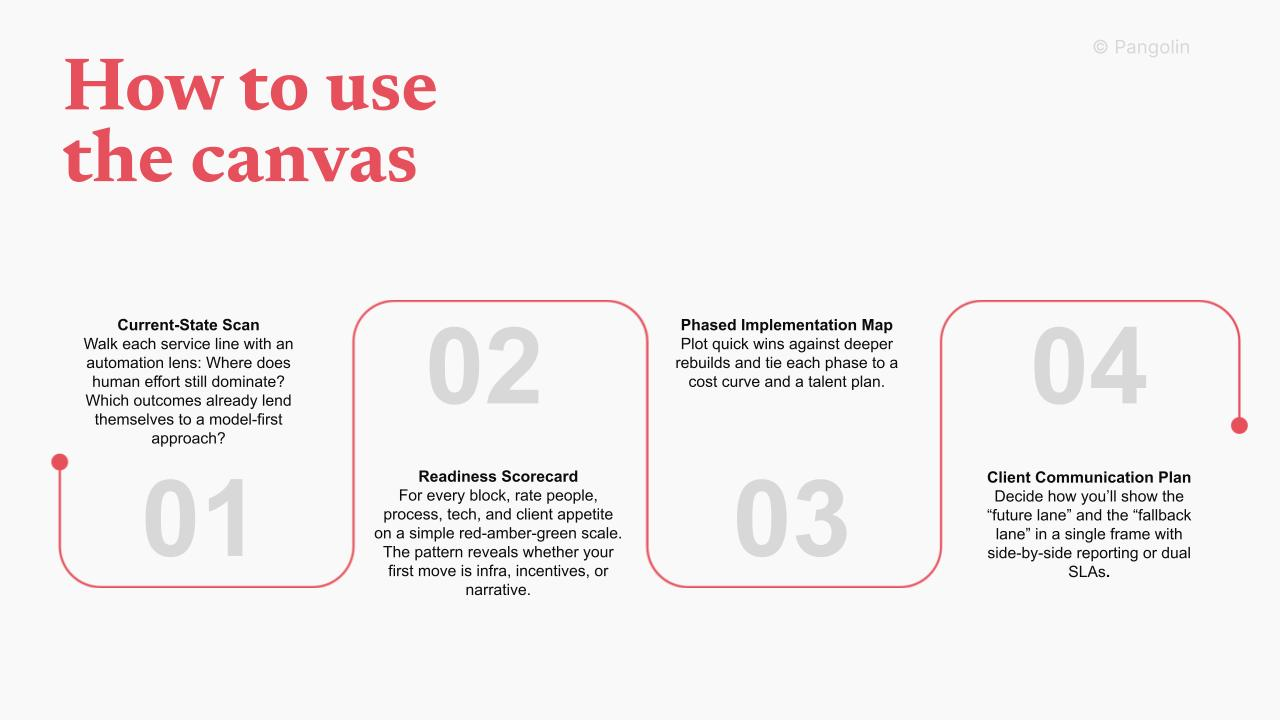
The goal isn’t to fill every box overnight. But you do need to know where you are and whether your service structure, go-to-market logic, and pricing model still equip you to win.
Chances are you will discover your service model isn’t fully broken, just mis-aligned with the market that now exists. A few deliberate moves often bring the whole system back into sync.
If you’d like another pair of eyes as you map the gaps, feel free to reach out.

