


Imagine seeing in the dark. Not with bulky goggles, but with a simple pair of contact lenses. Just this month, scientists announced they've done it, developing lenses that grant the wearer the ability to see in the infrared spectrum.
It's a power that was previously unimaginable. And you know who needs it most?
The thousands of IT services companies marketing themselves into invisibility. Their messaging is so indistinguishable, they might as well be operating in complete darkness.
That's no way to navigate a market that's not just crowded, but growing at over 9% annually to a staggering $1.5 trillion. In this fiercely competitive space, "differentiating your company" is a primary business challenge.
Most firms are stuck describing the same services: managed IT, cloud migration, cybersecurity, and with the exact same language. They have become a commodity, lost in a sea of sameness.
But what if you could give your company that infrared vision? The power to see opportunities others miss and cut through the noise with crystal-clear clarity?
The difference between an invisible IT vendor and a recognized industry leader is the quality of their story and the strategic frameworks they use to tell it.
In this playbook, we're handing you the operational frameworks to build that story. By the time you finish this post, you'll have five proven, step-by-step models to transform a generic IT firm into a respected, sought-after thought leader using thought leadership marketing.
It's time to stop competing and start owning your category.
So, why do so many brilliant IT companies sound so... bland? They've fallen into the Commodity Trap. It's a place where expertise gets lost in a fog of buzzwords like "synergy," "robust solutions," and "digital transformation." When everyone says the same thing, buyers can't tell the difference between a world-class cybersecurity firm and a two-person team working out of a garage. The only differentiator left is price, and that's a race to the bottom nobody wins.
This is a direct threat to your pipeline and your career. Think about the last time you bought a high-stakes B2B service. Did you go with the company that just listed its features, or the one that taught you something new, challenged your assumptions, and showed you a better way forward?
Decision-makers are drowning in generic content, and they are desperate for a lifeline. According to a 2025 Edelman-LinkedIn report, 60% of C-suite executives are willing to pay a premium to work with a company that produces strong thought leadership content.
And an incredible 75% have explored services they weren't even considering after engaging with compelling, insightful content.
Without it, you're invisible to them. The real costs are piling up every quarter:
Here's the sticky truth that should be on every marketing manager's whiteboard: Poor-quality thought leadership can actively harm a company's reputation. But high-quality, authentic insight builds trust and creates demand. It's the difference between chasing leads and having them chase you. The rest of this guide will show you how to build the systems to make that happen.
Alright, let's get our hands dirty. The first framework in your playbook is the E.X.P.E.R.T. Methodology. It's a five-step process designed to systematically build your authority from the ground up using a thought leadership strategy. Think of it as a repeatable recipe for creating influence. No more guessing what to write about or hoping your content lands. This is your assembly line for thought leadership.
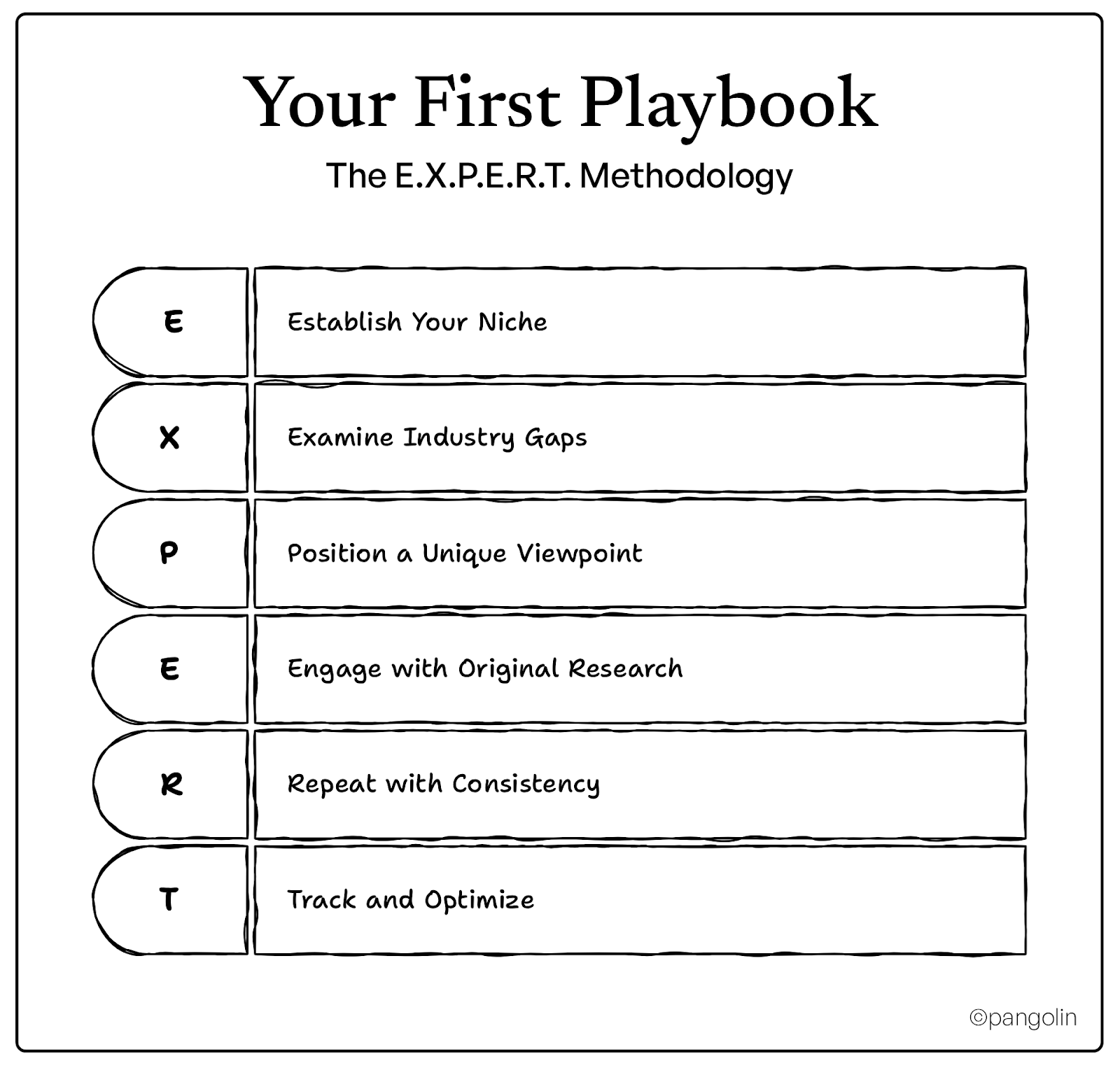
Most IT companies want to be everything to everyone. The result? They're nothing to anyone. Thought leadership starts with focus. You can't be the leading voice in "technology"; you can be the leading voice in "AI-driven threat detection for mid-market fintechs."
Once you have your niche, your job is to become its chief investigator. What are the unanswered questions? The common frustrations? The outdated "best practices" that everyone follows but no one questions?
This is where you stop reporting on the conversation and start leading it. A unique viewpoint isn't just an opinion; it's a new way of seeing the world, backed by your expertise. This is the "contrarian" element of thought leadership, challenging accepted norms with evidence.
Nothing builds credibility faster than original data in thought leadership content marketing. You don't need a massive budget. You can create powerful research by surveying your existing customers, analyzing public data sets in a new way, or even compiling and curating statistics from other sources into a single, valuable report.
A single great article makes you interesting for a day. A consistent stream of valuable content makes you an authority for years. This is about being prolific, the relentless, reliable source of insight for your niche.
Thought leadership isn't art; it's a business strategy. And like any strategy, it needs to be measured. But don't get lost in vanity metrics like 'likes' or 'shares'. Focus on metrics that signal real engagement and business impact.
Okay, you have your niche and your unique viewpoint. Now, what do you actually create? A blog post? A whitepaper? A viral TikTok dance about server maintenance? (Please don't do that last one.)
This is where most marketing managers get stuck. They create content randomly, with no unifying strategy. The result is a messy patchwork of ideas that fails to build authority. To avoid this, you need the Content Authority Pie. Think of it as your blueprint for structuring content in a way that systematically builds trust and influence using what is thought leadership content best practices.
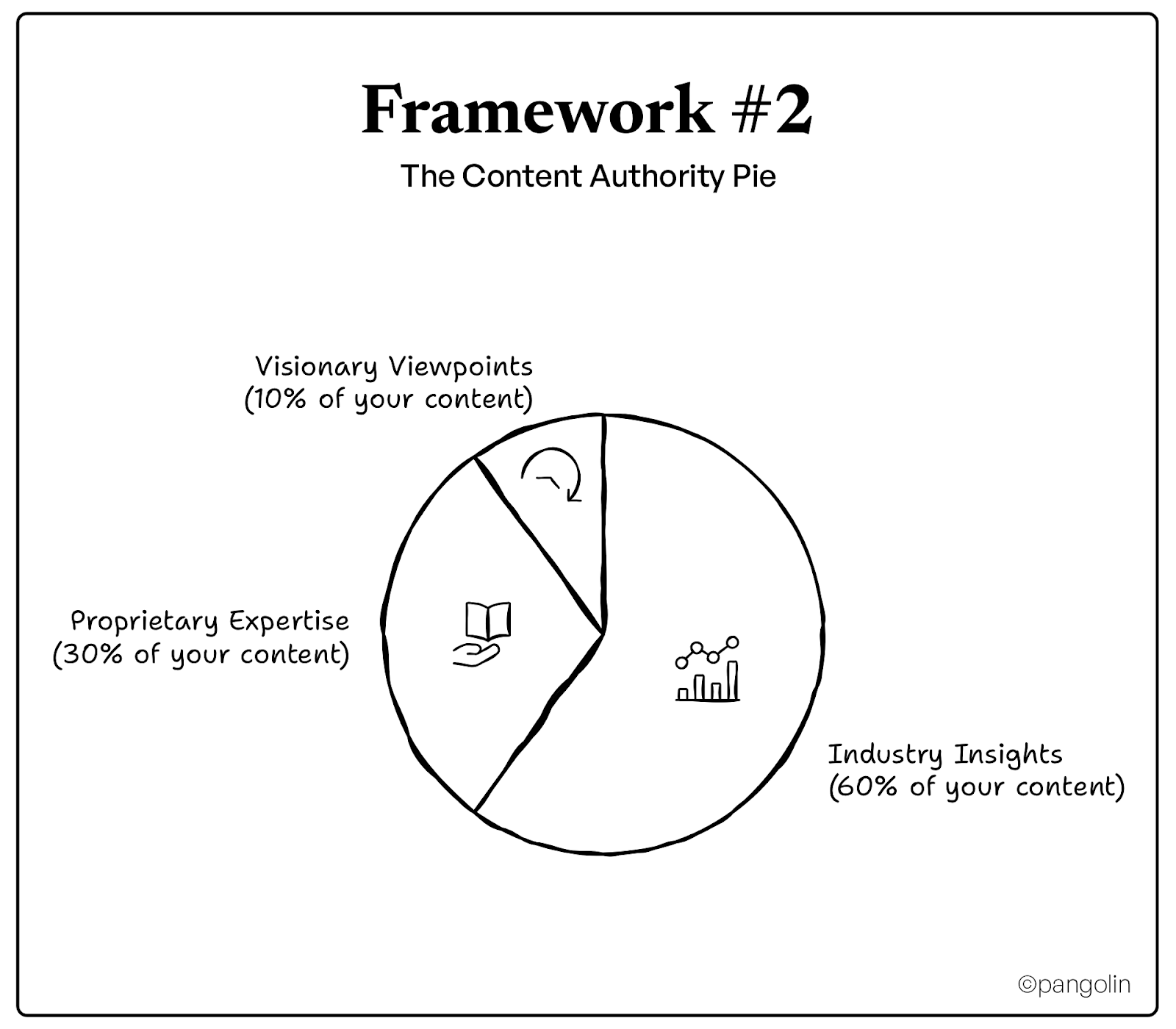
The pie is divided into three portions, each with a specific job to do:
This is the first portion of your pie. It's where you prove you're a reliable, informed participant in your industry. This content is accessible, easy to consume, and designed to attract a wide audience within your niche.
This is the meaty middle of the pie. Here, you stop commenting on the news and start making news. This is where you package your unique viewpoint, your secret sauce, into distinct, ownable intellectual property.
This is the sharp, attention-grabbing portion of your pie. This is where you make bold predictions, take a controversial stand, and challenge the fundamental assumptions of your industry. This content isn't for everyone, and that's the point. It's for the people who want to know what's next.
The magic happens when you connect the levels. Use your Foundation content to create a curiosity gap that pulls people toward your Expertise content.
For example, a Level 1 blog post titled "3 Common Mistakes in Data Backup" could end with: "But even if you avoid these mistakes, most backup strategies are still doomed to fail because they ignore one critical principle. In our latest guide, we reveal our proprietary 'Active Recovery' framework that guarantees uptime."
You've provided immediate value, but you've also opened a gap between what they know and what they need to know. You're not just creating content; you're architecting a journey from casual reader to committed lead.
You can have the best thought leadership strategy in the world, but if your message doesn't connect, you're just shouting into the void. This is where many IT companies stumble. They get so wrapped up in the technical details that they forget they're selling to human beings.
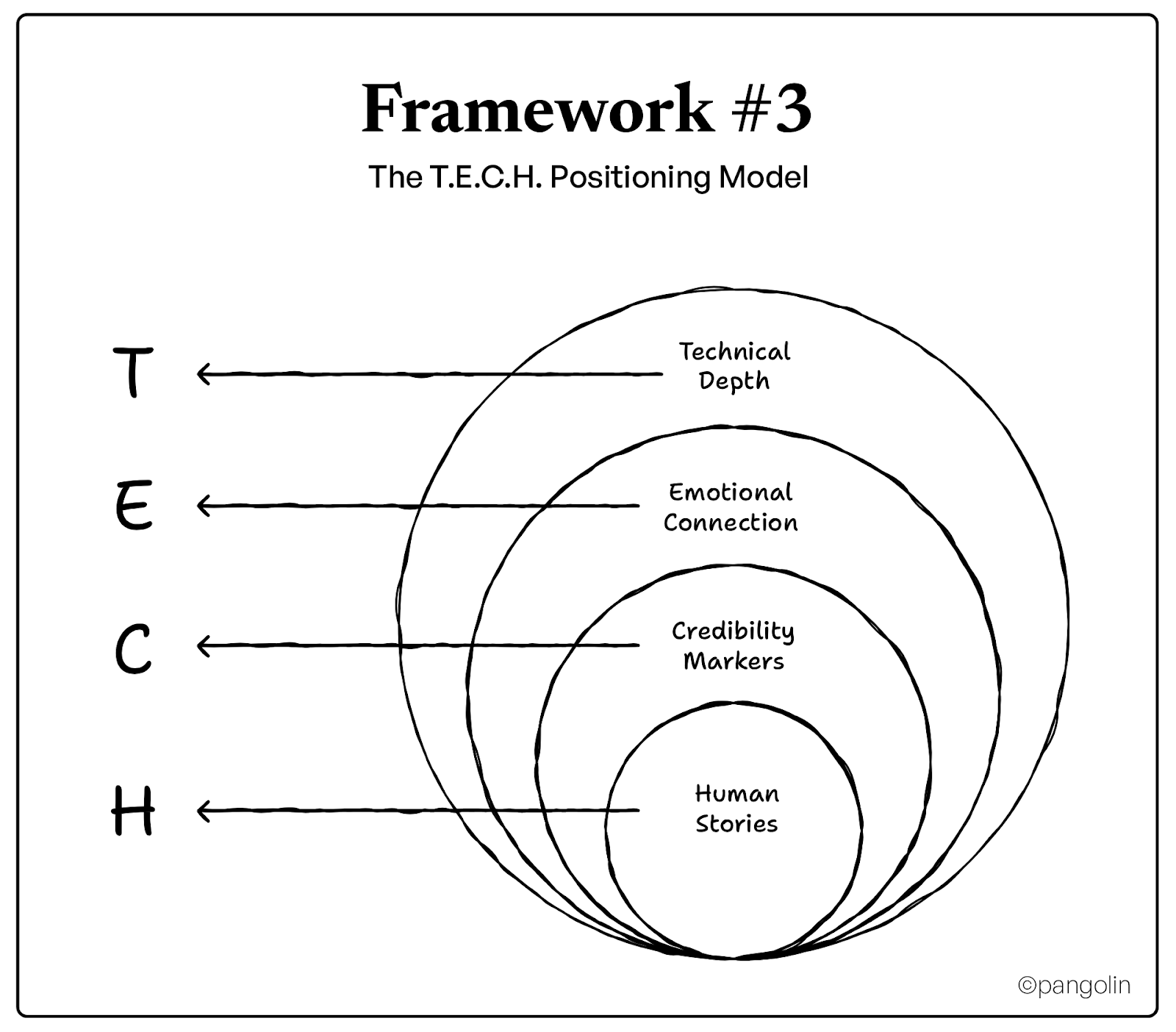
The T.E.C.H. Positioning Model is your quality control checklist for content marketing and thought leadership. Before any piece of content goes out, whether it's a blog post, a sales deck, or a LinkedIn update, run it through this four-part filter. It ensures your message is not only smart and credible but also emotionally resonant and memorable.
This is your permission to play. You're an IT services company, so you need to demonstrate deep technical expertise. This is about showing, not just telling. Go beyond surface-level explanations and provide specific, concrete details that prove you know your stuff.
Here's the secret most tech companies miss: nobody buys technology. They buy outcomes. They buy the relief of a problem solved, the pride of a successful project, or the security of a protected business. Your marketing needs to connect your technical solution to a fundamental human emotion.
Trust isn't given; it's earned. In a market full of bold claims, you need to provide concrete proof that you can deliver on your promises. These are the trust signals that turn a skeptical prospect into a confident buyer.
Facts tell, but stories sell. This is the most crucial part of the model and the one most deeply rooted in the Heath Brothers' work. A story is a "simulation" for the brain, allowing the listener to experience the journey from problem to solution. A well-told client story is the ultimate credibility marker because it's relatable, memorable, and emotionally compelling.
Strategy decks are nice. Action is better. For a marketing manager under pressure, a year-long plan can feel like a fantasy. You need results you can show your CEO by the end of the quarter. That's why the 90-Day Thought Leadership Sprint is your new best friend. It's a focused, intense burst of activity designed to create visible momentum and deliver measurable results, fast using thought leadership marketing strategy principles.
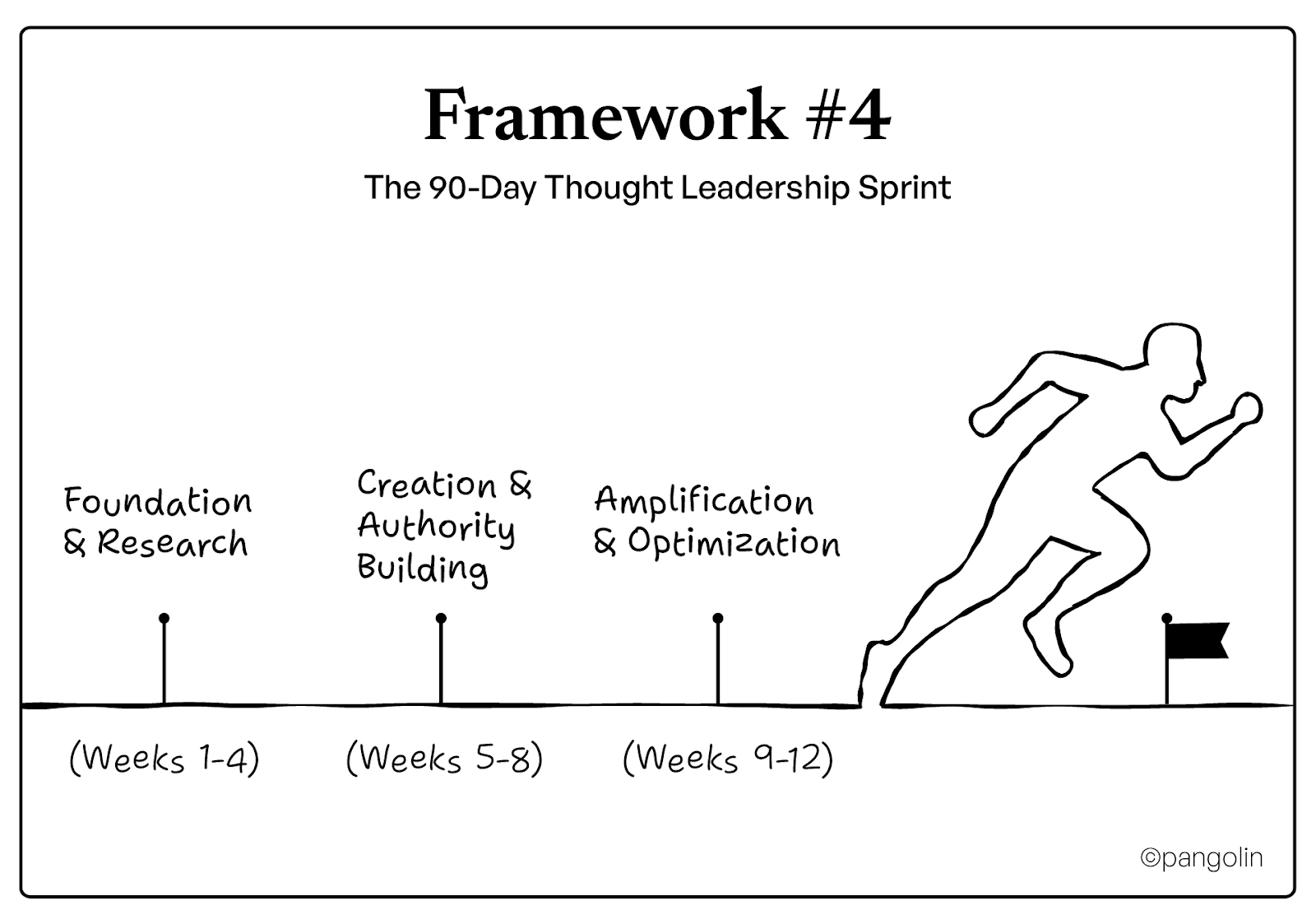
Forget boiling the ocean. The goal of this sprint is to pick one priority use case and execute it flawlessly. Here's your month-by-month game plan.
This month is all about loading the cannon. You're not creating content yet; you're gathering the intelligence that will make your content unstoppable.
Now it's time to fire the cannon. This month is about creating a high-value asset and starting to build your external authority.
You've built the asset; now it's time to make sure the right people see it. This month is all about distribution and measurement.
Quick Win Tactic for the Overwhelmed Marketer: Can't commit to a full 90-day sprint? Start with one SME interview. Record it, get it transcribed, and pull out the 3 most interesting insights. Turn those insights into three separate LinkedIn posts. You've just created a week's worth of valuable content in under an hour.
"This is all great," you might be thinking, "but my CEO doesn't care about 'owning the conversation.' She cares about revenue."
You're right. And for too long, marketers have shied away from measuring the ROI of thought leadership, treating it as a "soft" initiative. But that's a career-limiting mistake. If you can't prove your value in dollars and cents, your budget will always be the first on the chopping block.
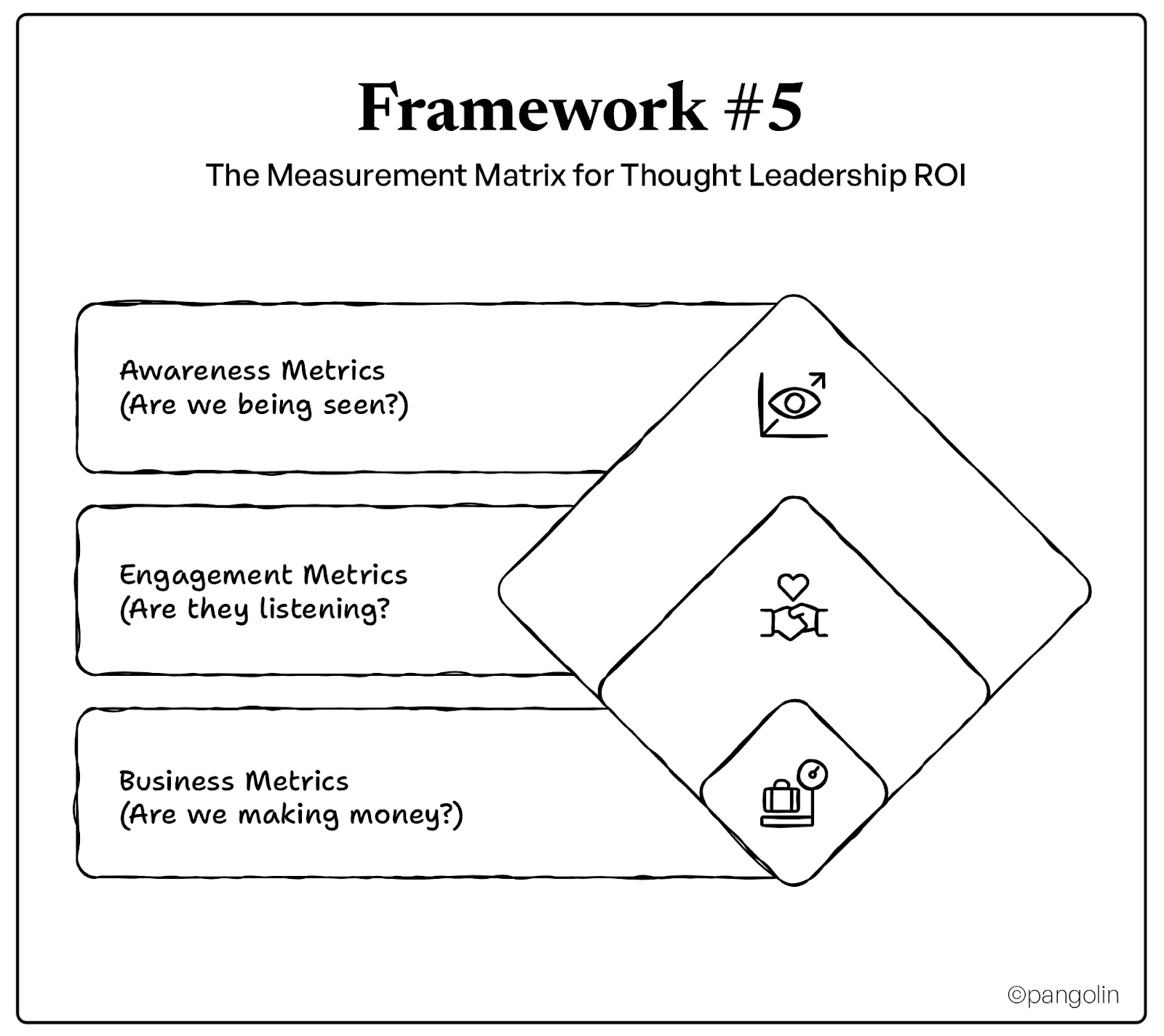
The Measurement Matrix is your antidote to vague reporting. It's a simple, three-tiered framework that connects your content efforts directly to business outcomes, allowing you to tell a compelling story of impact from the top of the funnel all the way to the bottom line.
This is the top-level view. These metrics tell you if your content is breaking through the noise and reaching your target audience. They are leading indicators of influence.
What to track:
The Story it Tells: "Our thought leadership on 'AI in legal tech' has improved our search ranking from page 4 to page 1, and our share of voice on this topic has increased by 30% this quarter."
This is where you measure if your content is actually resonating. A million views don't matter if everyone bounces after three seconds. These metrics prove your audience finds your content valuable.
What to track:
The Story it Tells: "Our new guide on data privacy generated 150 MQLs this month, and the average reader spent over 6 minutes on the page, indicating high engagement with our unique viewpoint."
This is the holy grail. These are the metrics that make your CEO sit up and take notice. They connect your content directly to revenue and business growth.
What to track:
The Story it Tells: "This quarter, our thought leadership content influenced 35% of the total sales pipeline, and we found that deals involving our content had a 15% higher average deal size and closed 20% faster."
Monthly: Review your Awareness and Engagement metrics. Are you on track? What needs to be optimized?
Quarterly: Review all three tiers, with a special focus on the Business Metrics. This is your high-level report for the leadership team.
By using this matrix, you're no longer just a "content creator." You're a strategic growth driver, and you have the numbers to prove it.
You now have the frameworks to build a powerful thought leadership engine. But even the best engine can seize up if you're not careful. This journey is littered with traps that can waste your time, alienate your audience, and damage your brand's reputation.
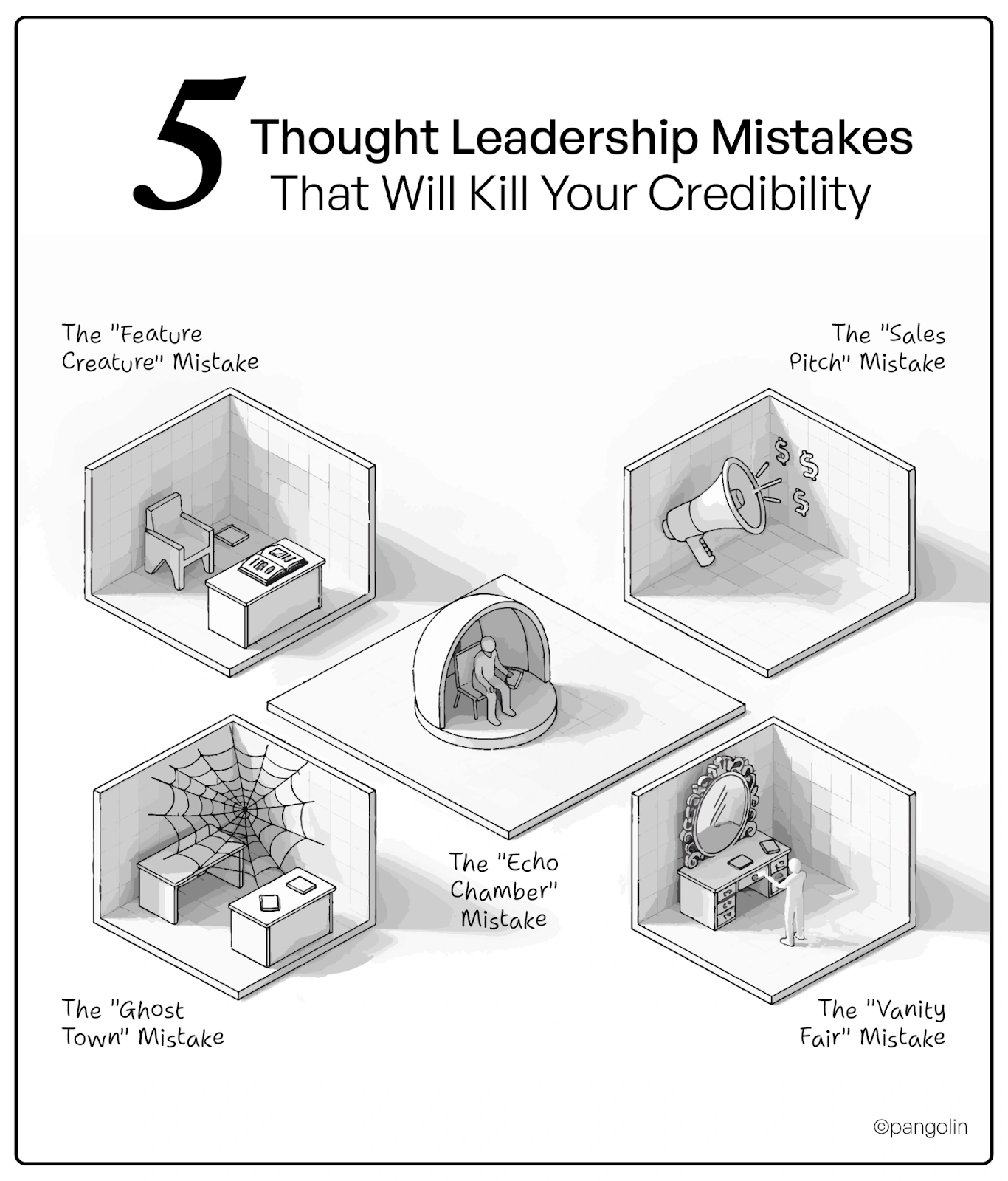
Think of this as your pre-mortem. By knowing what can go wrong, you can steer clear of these five fatal mistakes.
You see it everywhere: IT content that reads like a technical manual. It's a classic case of being too close to the product.
You publish three great articles in one week, then... silence for two months. This feast-or-famine approach kills momentum and signals unreliability.
You create content based entirely on what you think is interesting, without ever validating it with your audience.
Your "thought leadership" piece is just a thinly veiled sales pitch for your latest service. Your audience can smell a commission a mile away, and they'll tune you out instantly.
You proudly report a spike in website traffic and social media 'likes' to your CEO, who responds with, "So what?"
Reading is one thing. Doing is another. This entire playbook is designed for action, and there's no better time to start than right now. The following is a simple, 30-day action plan to launch your thought leadership program using what is thought leadership in marketing principles. It's designed to be realistic for a busy marketing manager. The goal here isn't perfection; it's momentum.
This week is about getting your bearings and drawing a map. You're moving from observing to planning.
This is the engine room. It's two weeks of focused creation and outreach.
Week 2: Develop Your Authority Piece. Work with your chosen SME to outline and create your main content asset. Don't aim for a 50-page ebook. A well-researched 8-page guide or a 30-minute webinar script is perfect. Focus on delivering immense value on one specific topic.
Week 3: Outreach & Foundation. While your authority piece is being finalized, shift your focus.
This is launch week. It's time to share your work and see what the market thinks.
You've just completed a journey from being a tactical marketing executor to becoming a strategic thought leader within your IT services space. You now have proven frameworks and actionable plans that transform how your company tells its story and connects with your audience's deepest needs using thought leadership content marketing strategies.
The question isn't whether your company has expertise worth sharing, it almost certainly does. The question is whether you have the systems in place to communicate that expertise effectively and consistently, to turn it into influence and, ultimately, revenue.
At Pangolin, we don't just build brands; we build market leaders who own their categories. Your transformation from marketing manager to thought leader is exactly the kind of game-changing shift we enable every day.
So, what's next? Dive into the frameworks, implement the sprint, track your progress, and never stop refining your story. Because the market isn't waiting.
Remember: The best way to predict the future is to invent it.
Content marketing answers your audience's questions; thought leadership teaches them to ask new, better questions. While all thought leadership is content, not all content is thought leadership. It moves beyond simply being helpful to providing a unique, provocative viewpoint that challenges the status quo and positions your company as a true leader, not just a knowledgeable vendor. Research shows 60% of C-suite executives pay a premium for companies producing strong thought leadership content.
Start small and focused using the 90-Day Sprint framework to focus on one niche and one flagship piece of content. Leverage your internal experts, an hour-long interview with a senior engineer can be turned into a month's worth of content. Thought leadership is a game of insight, not budget. A superior idea will always beat a superior ad spend. Record SME interviews, transcribe them, and extract 3-5 key insights to repurpose across multiple formats.
Make it easy for them. Show them the direct impact their expertise can have on generating high-quality leads that make their own work more interesting. Don't ask them to write articles. Instead, schedule a 30-minute recorded interview and do the rest of the work yourself, transcribing, editing, and packaging their insights into content. Show them the finished product to build enthusiasm and trust for the next one. Position their participation as personal brand building that enhances their industry reputation.
Speak their language: the language of revenue. Use the Measurement Matrix to connect your efforts to business metrics. Frame your plan with clear objectives, like "Our goal is to increase pipeline influence by 15% this quarter". Present thought leadership not as a "marketing expense" but as a strategic investment in building a defensible brand asset that lowers customer acquisition costs and increases deal size over time. Companies with strong thought leadership see 75% of prospects explore services they weren't initially considering.
Don't compete; differentiate. Find the gaps in their content. Are they overly technical? Be the one who translates complexity into business value. Are they focused on large enterprises? Own the mid-market segment. Your unique angle is your advantage. A fresh perspective is always more interesting than a stale, established one. Use the E.X.P.E.R.T. Methodology to systematically identify white space where your perspective can dominate.
You can see leading indicators (Awareness and Engagement metrics) within the first 90 days of a focused sprint. However, influencing major business metrics like sales cycle length and deal size is a long-term play. Expect to see a measurable impact on the pipeline within 6-9 months of consistent, high-quality effort. This is about building a reputation, and reputations aren't built overnight. Companies tracking ROI report 748% returns over three years from mature thought leadership programs.
Yes. In fact, it can be more powerful. Thought leadership that showcases the expertise of your entire team, your engineers, your project managers, your support staff, is often more authentic and credible than content from a single, polished executive. It demonstrates that expertise is embedded in the DNA of your company, not just in one person. Distributed thought leadership also scales better and survives leadership transitions.
Key principles include consistency over volume, unique viewpoint over consensus thinking, value delivery before selling, data-driven storytelling, and multi-stakeholder engagement. Successful thought leadership marketing capitalizes on white space with fresh perspectives, builds trust through executive and SME authenticity, measures progress with attribution to outcomes, and maintains concise, mobile-friendly formats. The 90/10 rule applies: 90% educational value, 10% promotional content.
Start with the E.X.P.E.R.T. Methodology: establish a niche vertical, examine industry gaps through sales team insights, position a unique contrarian viewpoint, engage with original research or data, repeat with consistent publishing cadence, and track revenue-focused metrics. Use the Content Authority Pie to balance 60% foundational insights, 30% proprietary expertise, and 10% visionary viewpoints. Implement through a 90-day sprint focusing on one flagship asset supported by derivative content across multiple channels.
IT services face intense commoditization where 73% of leads never convert due to generic positioning. Thought leadership differentiates firms by demonstrating strategic advisory capabilities beyond technical execution. Research shows 60% of C-suite executives pay premiums for strong thought leadership, and 75% explore new services after engaging with compelling content. For IT services with long 6-18 month sales cycles, thought leadership nurtures prospects, shortens sales velocity, and positions firms as category leaders commanding premium pricing.
Common challenges include SME time constraints, inconsistent publishing due to resource limitations, measuring ROI beyond vanity metrics, balancing technical depth with accessibility, and differentiating in crowded markets. Additional obstacles: translating technical expertise into business outcomes, maintaining consistency without dedicated content teams, proving attribution to revenue, and avoiding the "sales pitch" trap that undermines credibility. Solutions include recorded SME interviews for efficiency, 90-day sprints for focus, and the Measurement Matrix for business metric tracking.
Beyond leads, thought leadership drives premium pricing power through perceived expertise, shortens sales cycles via pre-established credibility, improves competitive win rates particularly against larger firms, attracts top technical talent who want to work for recognized innovators, and creates partnership opportunities with complementary vendors. It also reduces price sensitivity in negotiations, generates speaking and media opportunities for brand amplification, builds defensible intellectual property, and creates a compounding authority asset that appreciates over time.
LinkedIn dominates for B2B IT thought leadership with executive reach and professional targeting capabilities. Combine with industry-specific publications for credibility, company blog for SEO and owned audience building, email newsletters for nurturing engaged contacts, webinars for deep-dive expertise demonstration, and podcast guest appearances for extended reach. Second-tier channels include YouTube for technical tutorials, Medium for cross-posting reach, Twitter/X for real-time industry commentary, and partner ecosystems for co-marketing. Prioritize channels where your target stakeholders actively consume industry insights.

