


Before the late 1800s, the value of art was judged by how closely it could resemble reality.
A good painting was one where the apple looked like an apple. The trees didn't misbehave. The shadows fell exactly where they should.
The more invisible the artist was in their art, the better.
Then along came Van Gogh.
He looked at the night sky and didn't just see stars. He saw movement. Tension. Longing.
He didn't paint what was there. He painted how it felt to look at it.
And just like that, the rules changed.
Art stopped being about how well you could replicate the world. Perspective became the product.
That same shift is now happening in IT and knowledge services.
For a long time, the process was clear: Start with a brief → collect the data → clean and analyse it → interpret it → deliver insight.
The client paid for the outcome. The value lived downstream.
GenAI turns that chronology on its head.
The most forward-thinking service firms don't start with the problem. They start with the architecture. They've already trained the model. They've curated their datasets. They've built validation systems and pattern recognition tools.
So by the time the brief arrives, the perspective is already in place.
In other words, the work begins with a solution looking for its closest problem match, not the other way around.
The engine has seen the problem before or something close to it, and can move fast, confidently, and at scale.
Value is now in the system that shaped the answer before the question was ever asked.
That's what this Value Chain Inversion Flow Map is designed to unpack. Where value used to live. Where it's going. And what firms need to do to keep up.
When the heavy lifting happens up front inside the model architecture and its proprietary data, what's left downstream is largely incremental:
Analysis becomes a model-generated first draft that humans only refine. Insight decks are templated narratives the engine can populate on demand. Strategy recommendations emerge from proven playbooks that adjust for context rather than being invented each time.
Because these downstream tasks are faster and easier to replicate, they're already slipping toward commodity pricing.
Clients now see eighty pages of custom analysis as maintenance work, not magic.
The margin has migrated to three upstream assets:
Architecture: A flexible model stack that can be fine-tuned quickly and governed at scale. Curated data: Proprietary corpora that make the model uniquely accurate in your clients' domains. Validation rails: Automated guard-rails that certify outputs and keep regulators and boards comfortable.
Own these layers and you gain leverage: each dollar spent refining the asset lowers future delivery cost and raises defensibility.
For leadership teams, the question is no longer "How many analysts do we need?" but "Which repeatable solutions can we invest in once and monetise many times?"
Concretely, that means:
Asset audits: Identify data sets and code modules that can be productised. Pricing pilots: Shift at least one legacy service line from time-and-materials to access-plus-outcome. Talent redeployment: Move skilled analysts into roles that curate libraries, train models, and govern quality, rather than craft one-off reports. Client reframing: Lead with, "Here's the pre-built accelerator we start from," not "Here's the blank slate we'll fill in."
Firms that make this pivot will compound value every time the engine meets a new brief. Firms that stay reactive will watch their highest-margin work, like those carefully shaded apples, fade into background detail.
What Has Changed and Why It Matters
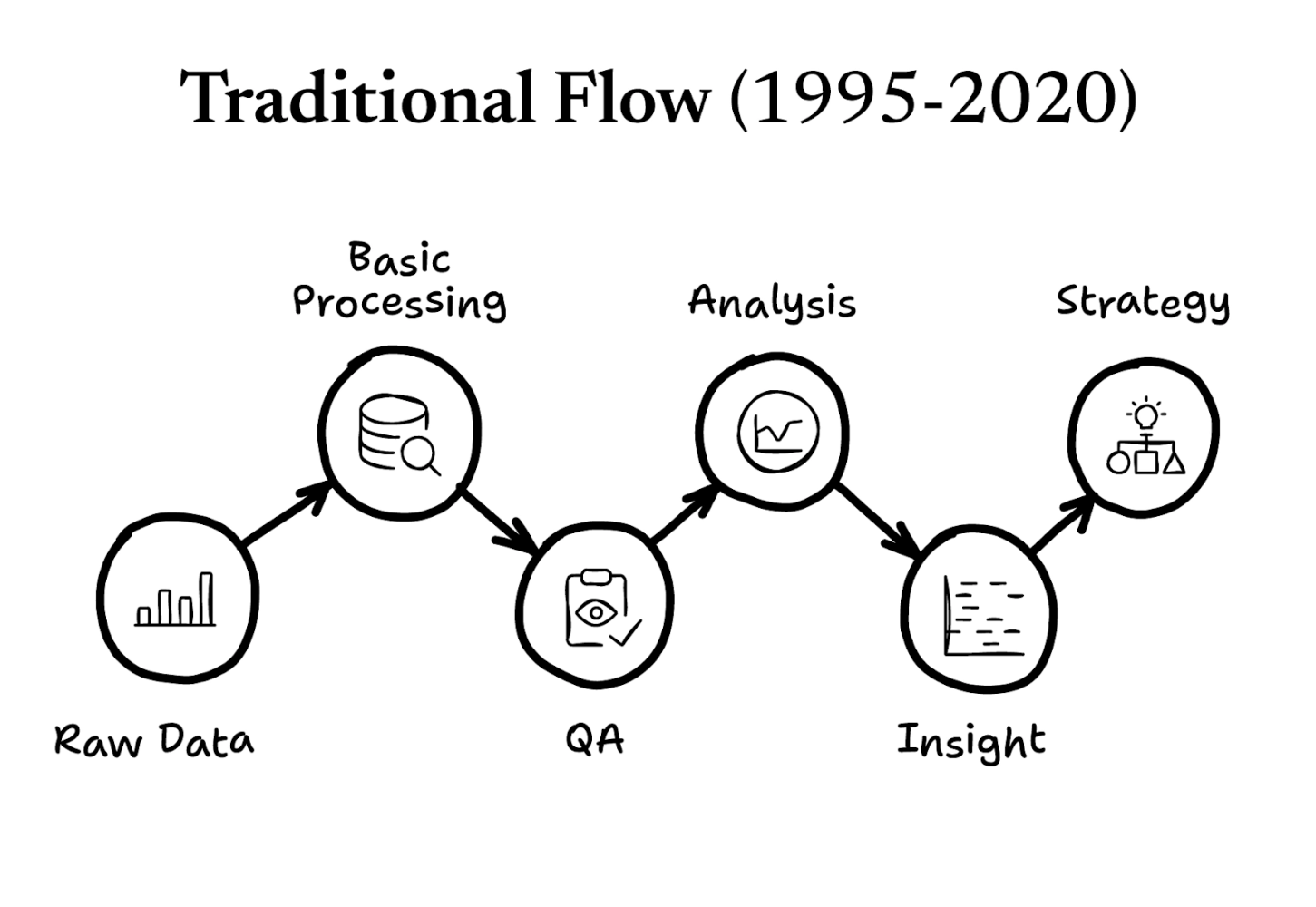
Margin accumulated as you moved right, because labour, time and expertise compounded.
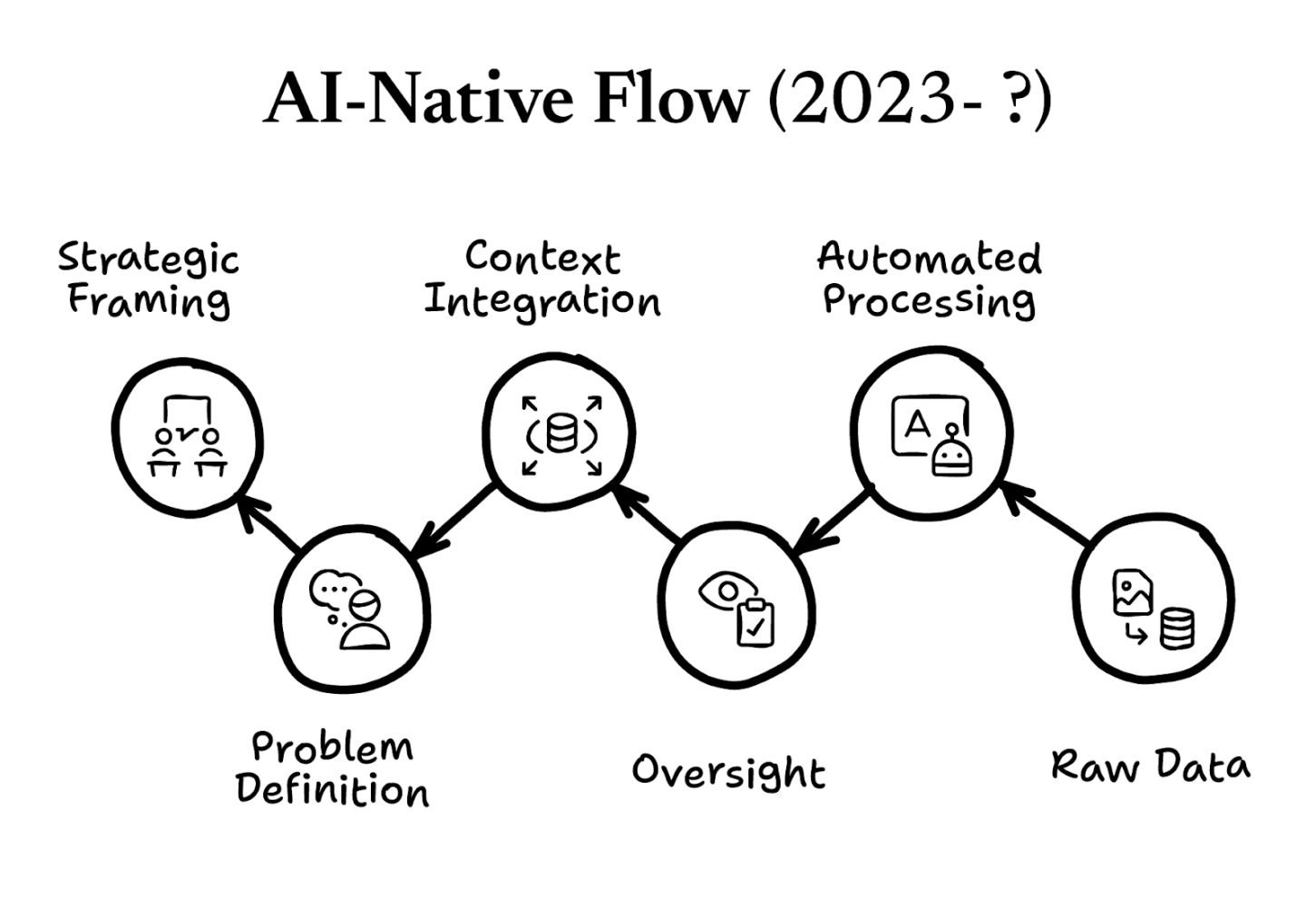
Now margin accumulates as you move left, because judgment, risk and relevance compound before a single row is processed.
Start of chain: systems, perspective, reusability.
The question now isn't "how good are your people?"
It's "how early does your perspective kick in?"
If you're still building your business around reacting, interpreting, and polishing, your best work is arriving too late.
Traditional Value Flow (Problem → Solution)
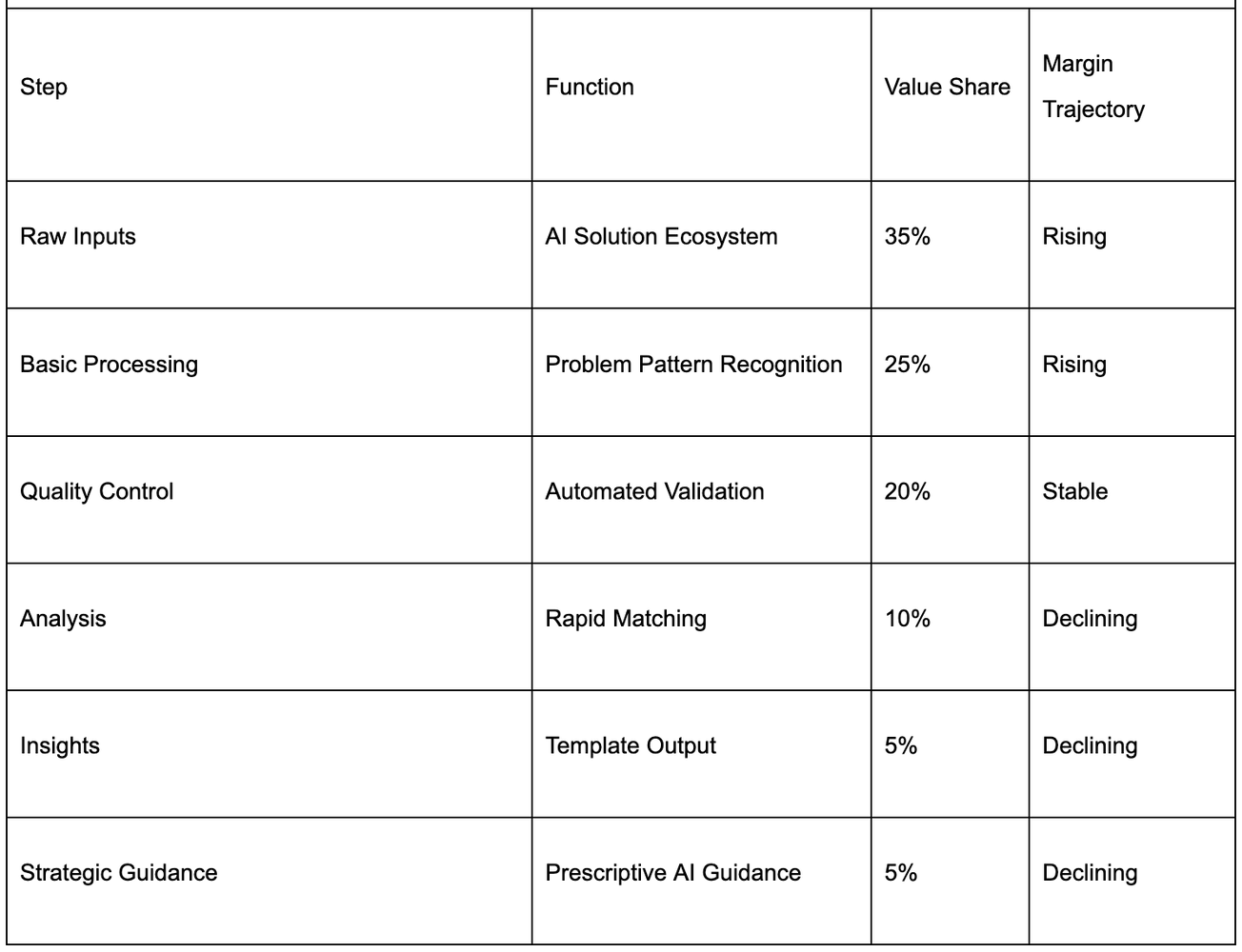
AI-Inverted Value Flow (Solution → Problem)
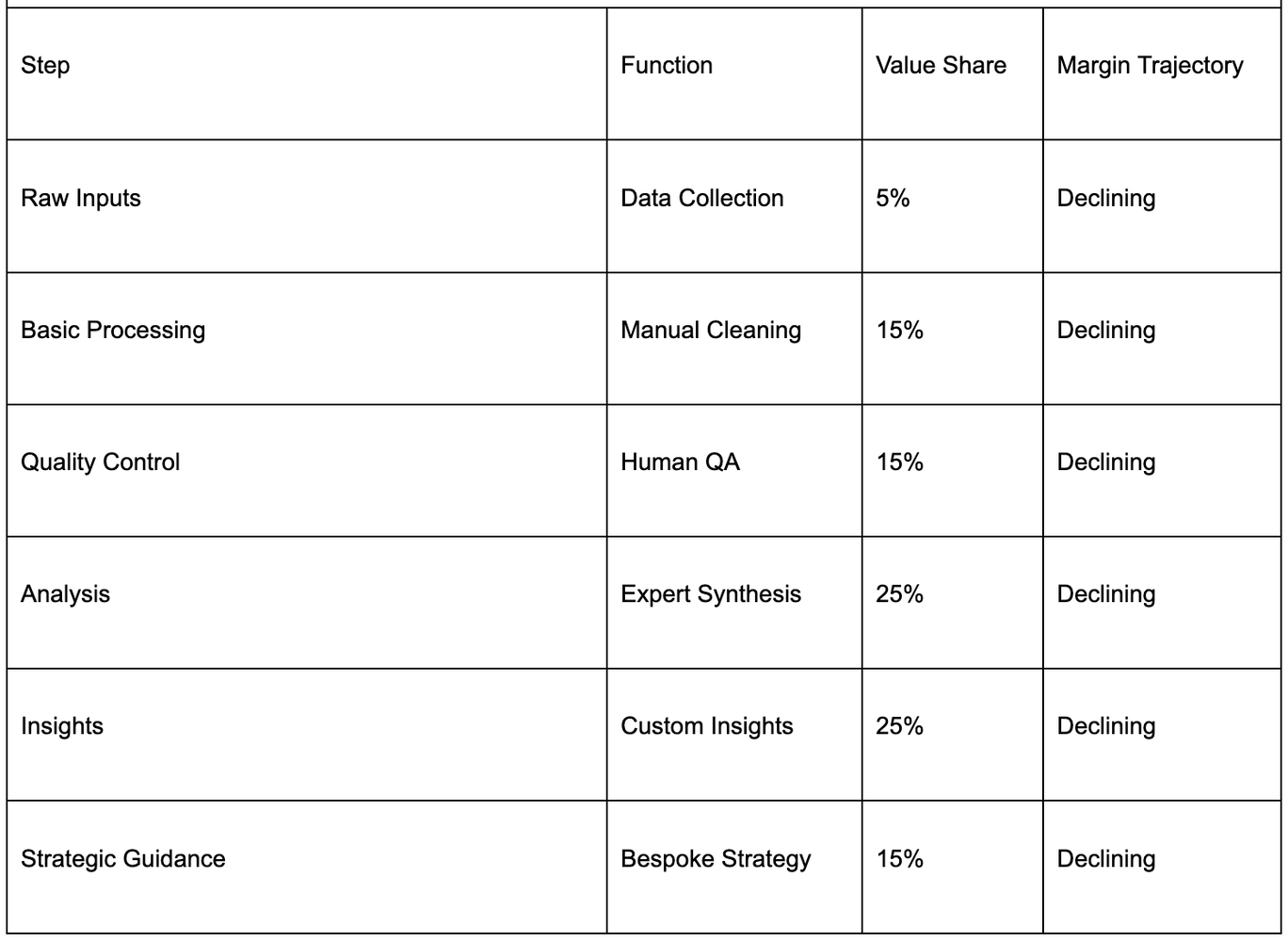
The numbers tell the story -
Upstream value creation (Steps 1-3)
1. Raw inputs jumped from 5% to 35%, a 700% increase, because having pre-built AI solutions becomes the core asset.
2. Basic processing rose from 15% to 25% as AI pattern recognition that identifies problems commands premium.
3. Quality control climbed from 15% to 20% as automated validation of solution-problem fit requires specialized skills.
Downstream value erosion (Steps 4-6)
1. Analysis dropped from 25% to 10%, a 60% decrease, as rapid automated matching replaces custom work.
2. Insights plummeted from 25% to 5%, an 80% reduction, as template insights from AI reduce per-unit value.
3. Strategic guidance fell from 15% to 5%, a 67% decline, as prescriptive AI guidance commoditizes strategy.
Five years ago, Indian LPOs charged premium rates for document review. In Q1 2025, a single GenAI platform processed 1.7 million documents for a Fortune 50 litigation in 36 hours at 6% of last year's cost.
Outcome: four vendors lost 40% of their review revenue. The winning firm earned margin not on "documents per hour," but on how it framed the search terms and risk hypotheses for the model.
When execution costs asymptotically approach zero, the market stops paying for labour and starts paying for judgment.
This is what the Value Chain Inversion Flow Map is built to show: where your services sit today, where value is migrating, and how to move upstream before your margins do.
The firms that are adapting to this shift aren't just reacting faster. They're changing where the work begins. They're investing in reusable assets: data pipelines, AI models, validation frameworks, internal taxonomies, toolkits that encode their perspective up front.
They've stopped treating every problem as a clean slate, because they've already seen the patterns. And they've built systems to recognise them.
Refer to the map. Redraw the chain. Start sooner.

