


In January 2015, a 22-year-old Australian marketer named Matthew Carpenter launched a website with one ridiculous premise: mail your enemies envelopes stuffed with glitter.
The craft world's version of herpes would explode everywhere in their car, on their desk, embedded in their carpet for years.
The website went live on a Monday. Within 24 hours, it racked up 1.3 million visits and 300,000 social media mentions. Carpenter made thousands of dollars before the week ended.
Just ten days later, he sold the entire operation for $85,000 to an entrepreneur in Georgia who turned it into a six-figure annual business.
Here's what's wild: Carpenter spent almost nothing on marketing. No ads. No fancy website. Just a brutally simple idea that people had to talk about.
Meanwhile, 63% of IT companies are failing.
Not because their technology is bad.
Not because they lack talented engineers.
They're failing because nobody knows they exist. While glitter bombs go viral, sophisticated IT firms with genuinely transformative solutions are stuck sending cold emails that get ignored and running LinkedIn ads that burn budgets without moving the revenue needle.
The difference? Ship Your Enemies Glitter had demand generation baked into its DNA: it was simple, unexpected, and impossible not to share.
Most IT companies have the opposite problem: complex offerings, predictable positioning, and zero systematic approach to creating demand.
This blog will show you how to build a demand generation plan that works for IT companies, one that doesn't rely on going viral but on engineering a predictable system that turns strangers into qualified leads and leads into revenue.
Let's get this straight from the jump: demand generation isn't lead generation with a fancy new name.
Lead generation is about capturing existing demand. Someone already wants what you're selling, you just need to get their contact info. Demand generation is about creating long-term interest and awareness, educating buyers throughout their entire journey, not just when they're ready to buy.
For IT companies, this distinction matters more than you think.
Your sales cycles average 6-8 months.
You're not selling widgets.
You're selling complex technical transformations that involve multiple stakeholders, an average of 7 people in companies with 100-500 employees.
These buyers need an average of 28.87 touchpoints before they'll close.
And here's the kicker: 70-80% of B2B buyers complete their research before they ever talk to your sales team.
Think about that. By the time a prospect raises their hand, they've already decided whether you're on their shortlist.
If you weren't part of their invisible buying journey. If you didn't educate them months ago when they first started researching, you've already lost.
This is why demand generation matters. You can't just capture demand. You have to create it, months before buyers are ready to talk.
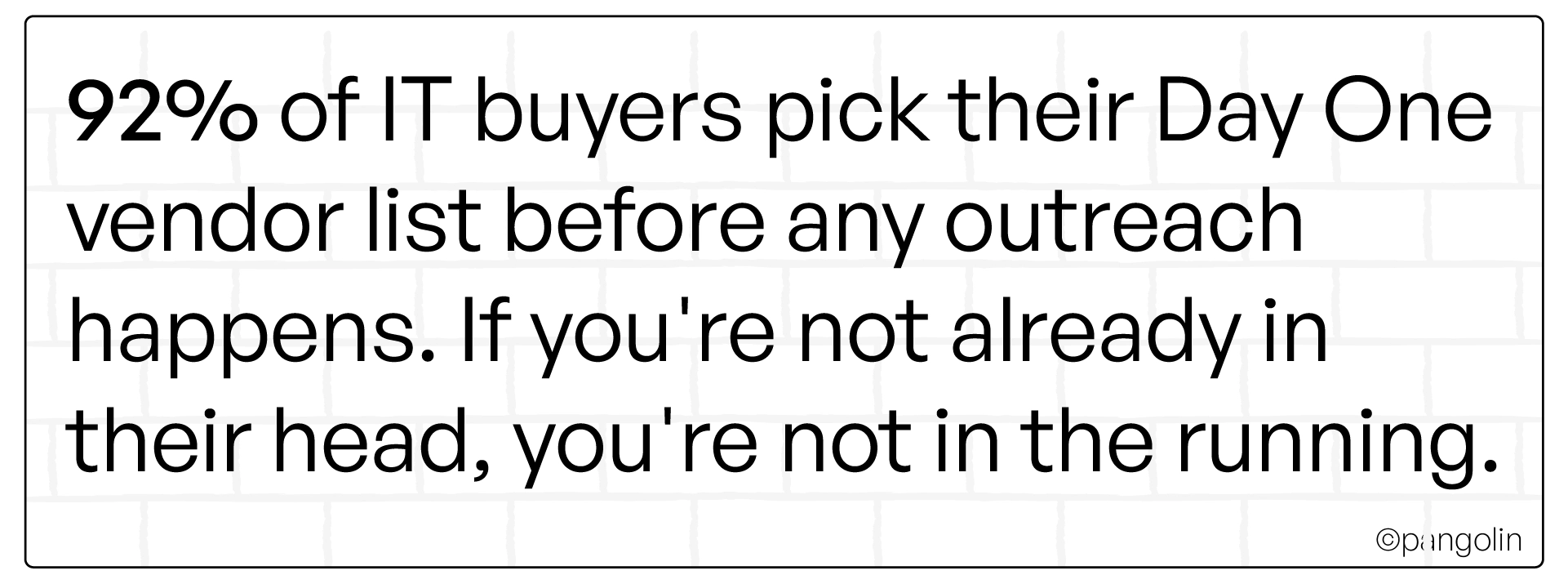
"92% of IT buyers pick their Day One vendor list before any outreach happens. If you're not already in their head, you're not in the running."
Here's what we see constantly:
No unified strategy. IT companies run ad-hoc campaigns—a webinar here, a LinkedIn campaign there, maybe some SEO. Nothing connects. There's no system, just a collection of tactics that work one quarter and flop the next.
Wrong audience targeting. You're going after "IT decision-makers" instead of drilling down to specific personas with specific pain points. Your messaging is generic because your targeting is generic.
Over-reliance on paid ads. You pump money into Google and LinkedIn ads, hoping to buy your way to leads. But IT buyers want education, not sales pitches. 93% of B2B buyers prefer educational content over promotional messaging.
Content that doesn't educate. Your whitepapers are product brochures in disguise. Your blog posts are keyword-stuffed SEO plays. Nothing actually helps buyers solve problems or understand complex technical concepts.
Sales and marketing live on different planets. Marketing generates leads, sales says they're garbage. Sales complains about the pipeline, marketing says they delivered MQLs. Nobody's measuring what matters: revenue.
These problems are actively killing your growth.
[[divider]]
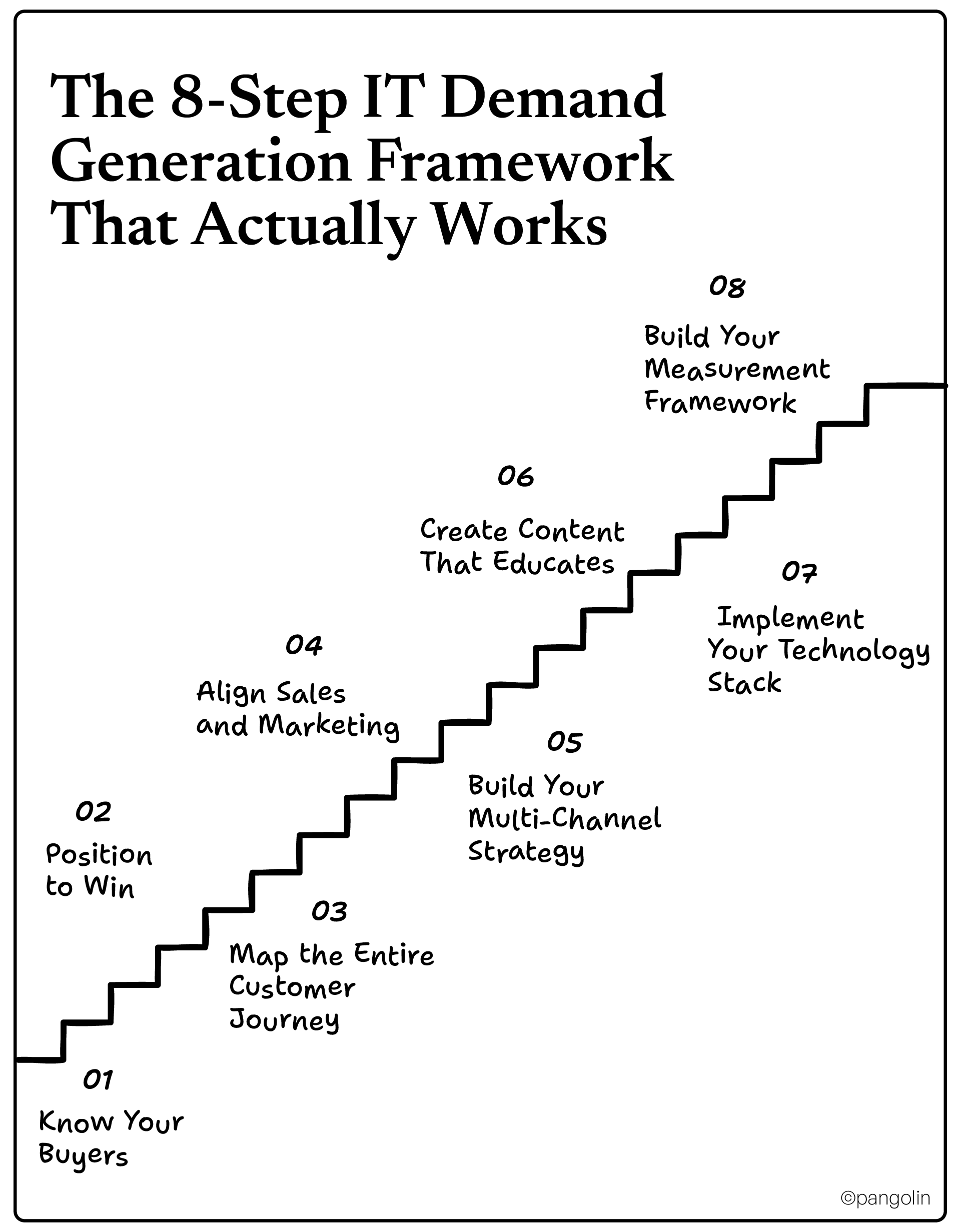
Let's build a system. A genuine demand generation engine that creates a predictable pipeline.
Skip the generic B2B buyer persona fluff. You need a forensic-level understanding of your ideal customers.
Map your Ideal Customer Profile (ICP) with precision:
Build detailed buyer personas for each stakeholder:
You're not selling to one person. You're selling to the CTO who cares about technical architecture, the CFO who cares about ROI, the operations lead who cares about implementation timelines, and the procurement team who cares about contract terms.
Each persona needs its own content, its own messaging, its own journey.
Research like your business depends on it (because it does):
This isn't a one-week project. This is continuous. Your best IT companies obsess over understanding buyers.
Here's a hard truth: you're probably positioning yourself as a commodity.
IT services are facing 45-65% automation displacement risk. Margins are eroding. Buyers see you as interchangeable with dozens of other vendors. You're competing on price, which means you're already losing.
Break out of the commodity trap:
Stop being a "resource provider." Become a "problem solver." Don't sell hours and bodies. Sell outcomes and transformations.
Develop vertical specialization. Instead of serving "all IT needs," dominate a specific niche like FinTech compliance automation, healthcare data interoperability, manufacturing IoT integration. Specialist positioning commands premium pricing.
Build your AI augmentation narrative. Every IT buyer is thinking about AI. Show them how you're leading. Position around AI-enabled services, not AI-threatened services.
Create proprietary frameworks and methodologies. Give your approach a name. Make it teachable. Make it defensible. This is how consultancies differentiate, you can too.
Your positioning is the foundation. Get this wrong, and everything else crumbles.
Most IT companies obsess over bottom-funnel tactics: demos, free trials, pricing pages. They ignore the 70% of the buyer journey that happens before anyone talks to sales.
Build your full-funnel map:
Top of Funnel (TOFU): Awareness & Education
Your buyers are just realizing they have a problem. They're not ready to evaluate vendors. They're trying to understand what's even possible.
What they need:
What they're NOT ready for: Product demos, pricing discussions, or sales calls.
Middle of Funnel (MOFU): Consideration & Evaluation
Now they understand the problem. They're building a business case. They're comparing approaches (not yet comparing vendors).
What they need:
Bottom of Funnel (BOFU): Decision & Purchase
They're ready to evaluate vendors. They have a shortlist (hopefully you're on it). They need to justify the decision internally.
What they need:
Critical insight: You need content and tactics for ALL stages. Most IT companies have plenty of bottom-funnel assets and almost nothing for the top and middle.
This isn't optional. Sales-marketing misalignment is consistently cited as a top reason demand generation fails.
Build your alignment framework:
Create shared definitions. What's a Marketing Qualified Lead (MQL)? What's a Sales Qualified Lead (SQL)? What makes a lead ready for sales outreach? If marketing and sales define these differently, you're dead in the water.
Establish clear handoff protocols. When does a lead move from marketing to sales? What information does sales need? What's the SLA for sales follow-up? Document it. Enforce it.
Set shared KPIs. Marketing shouldn't be measured on MQLs while sales is measured on revenue. Both teams need pipeline contribution metrics. Both teams need revenue targets.
Build feedback loops. Weekly or bi-weekly meetings where sales tells marketing what's working (and what's not). Use closed-loop reporting: track which marketing channels produce customers, not just leads.
Bitter pill time: If your CEO says "marketing and sales should figure it out," your demand generation plan is doomed. This needs executive sponsorship and enforcement.
Here's what actually works for IT companies in 2025, backed by data:
Content Marketing & Thought Leadership: 47% Most Effective
This is your foundation. 83% of B2B marketers say content marketing helps generate demand and leads. 73% say it's crucial for demand generation strategies.
Your content engine should include:
Events & Webinars: 38% Most Effective
IT buyers want to learn. Webinars let you educate at scale while capturing intent data.
Run monthly webinars on topics your buyers care about. Make them genuinely educational—if they feel like sales pitches, attendance and engagement tank.
Paid Social (LinkedIn): 38% Most Effective
LinkedIn is where IT buyers live. But here's the trick: don't use LinkedIn ads to generate direct conversions. Use them to amplify your best content and build awareness.
Target specific job titles at specific company sizes in specific industries. Send them to educational content, not demo request forms.
Email Marketing: 80% of B2B Marketers Find It Most Successful
Email isn't dead. It's your most reliable channel for nurturing leads through long sales cycles.
Build segmented nurture tracks for each persona and each funnel stage. Someone who downloaded a top-funnel guide needs different follow-up than someone who attended a product demo.
Account-Based Marketing (ABM): The Secret Weapon
For high-value accounts (especially enterprise), ABM outperforms everything else. 87% of B2B marketers say ABM delivers higher ROI than other marketing investments. Companies implementing ABM see 208% increase in marketing-generated revenue.
Your ABM approach:
The channel mix matters. One channel isn't enough. You need orchestrated, multi-channel campaigns that hit buyers wherever they are.
Content is your demand generation fuel. But most IT content is garbage like keyword-stuffed blog posts, self-promotional whitepapers, and product brochures disguised as guides.
Here's what works:
TOFU Content:
MOFU Content:
BOFU Content:
Content Matrix Approach: Map specific content assets to each buyer journey stage AND each stakeholder persona. Your CTO needs different content than your CFO at every stage.
Critical success factor: 93% of B2B buyers want educational content, not sales pitches. If your content doesn't genuinely help buyers solve problems, it's just advertising in disguise.
You need technology to scale demand generation. But here's the trap: tools without strategy just automate chaos.
Your essential stack:
Marketing Automation Platform
HubSpot, Marketo, Pardot, or similar. This is your engine—email nurturing, lead scoring, campaign automation.
ROI expectations: Average 544% ROI or $5.44 for every $1 spent. 76% of companies see ROI within a year.
Benefits:
CRM Integration
Your marketing automation must sync seamlessly with your CRM (Salesforce, HubSpot CRM, Zoho, Pipedrive). This is non-negotiable for sales-marketing alignment.
Lead Scoring & Grading
Automatically score leads based on behavior (content consumed, pages visited, emails opened) and demographic fit (company size, industry, title).
This prevents sales from wasting time on unqualified leads and ensures hot leads get immediate attention.
Analytics & Attribution
Google Analytics, marketing attribution software, data visualization tools (Tableau, Looker, Power BI).
You need to know which channels drive revenue, not just traffic. Multi-touch attribution shows the full buyer journey.
Intent Data Tools
Bombora, 6sense, or similar platforms that show which accounts are actively researching topics related to your solution.
This lets you reach out when buyers are in-market, not randomly.
Implementation reality check: Start simple. Too many IT companies buy expensive martech stacks and never use 80% of the features. Master the basics: email automation, lead scoring, CRM integration before you add advanced tools.
If you're not measuring results, you're not doing demand generation. You're doing marketing theater.
Here's your three-tier metrics system:
Tier 1: Revenue Impact (What Leadership Actually Cares About)
Tier 2: Pipeline Metrics (What Sales and Marketing Should Track Together)
Tier 3: Early Engagement Metrics (What Indicates Future Success)
Benchmarks to track against:
Reality check: You won't have perfect attribution data. Long sales cycles and multiple touchpoints make this messy. That's okay. Track directional trends. Focus on improving conversion rates at each stage. Measure progress, not perfection.
[[divider]]
Now let's talk about what makes demand generation different for IT companies. These aren't "nice to have" additions. These are make-or-break differentiators.
If you're selling to enterprise IT buyers, ABM isn't optional—it's how you win.revnew+2
The ABM advantage is staggering:
Your 2025 ABM approach:my-outreach
Use intent data for real-time account intelligence. Know when your target accounts are researching relevant topics. Time your outreach when they're in-market, not randomly.
Implement AI-powered account selection and scoring. Let machine learning identify which accounts match your best customers and which are most likely to buy.
Build dynamic targeting based on buying stage. Accounts in awareness need different messaging than accounts in evaluation.
Orchestrate multi-channel campaigns. Hit target accounts on LinkedIn, through email, with direct mail, at events—coordinated, not random.
ABM reality: This is resource-intensive. Start with your top 20-50 accounts. Nail the approach. Then scale.
Here's your balancing act: IT buyers need technical depth to trust you, but too much complexity scares away business decision-makers.
Your content strategy needs layers:
For technical evaluators (CTOs, architects, engineers):
For business sponsors (CEOs, CFOs, COOs):
For implementation leads (project managers, operations):
The secret: Create modular content that lets each stakeholder dive as deep as they want. Executive summaries for business buyers. Technical appendices for engineers. Let readers choose their depth.
Most IT companies make this mistake: they optimize one part of the funnel while ignoring the rest.
You pump money into top-funnel awareness but have no nurturing strategy. Leads go cold.
Or you build amazing bottom-funnel conversion tactics but have no top-funnel awareness. Nobody knows you exist.
Full-funnel thinking prevents lead leakage:
Every stage feeds the next. Break one link, and the whole chain fails.
The full-funnel advantage: Pangolin clients see 2-3x improvements in funnel efficiency because we integrate all stages instead of optimizing them in isolation.
Let's cut through the vanity metrics and focus on what drives business outcomes.
Lead volume: Total number of leads generated (but don't obsess over this, quality matters more than quantity)
Lead quality: Percentage of leads that match your ICP criteria
Conversion rate: Percentage of visitors who complete desired actions (form fills, content downloads, demo requests)
Page views and time on page: Are people actually reading your content?
Content downloads: How many people want your in-depth assets?
Video watch time: For technical explainers and demos
Webinar attendance and engagement: Registration vs. show-up rate, Q&A participation
Pipeline growth rate: Is your pipeline expanding month-over-month?
Marketing influence on deals: What percentage of closed deals touched marketing content?
Average deal size: Are you attracting high-value opportunities?
Sales cycle length: Are you shortening time-to-close?
Customer Lifetime Value (CLV): Long-term revenue per customer
Return on Investment (ROI): Revenue generated divided by marketing spend
Marketing-attributed revenue: Direct revenue from marketing-sourced deals
Customer Acquisition Cost (CAC): Total marketing and sales cost divided by customers acquired
The measurement trap: Don't wait for "perfect" attribution. Start tracking directional trends. Measure what you can, estimate what you can't, and focus on continuous improvement.
[[divider]]
Let's talk about where IT companies screw this up. Not to scare you, but to save you months of wasted time and budget.
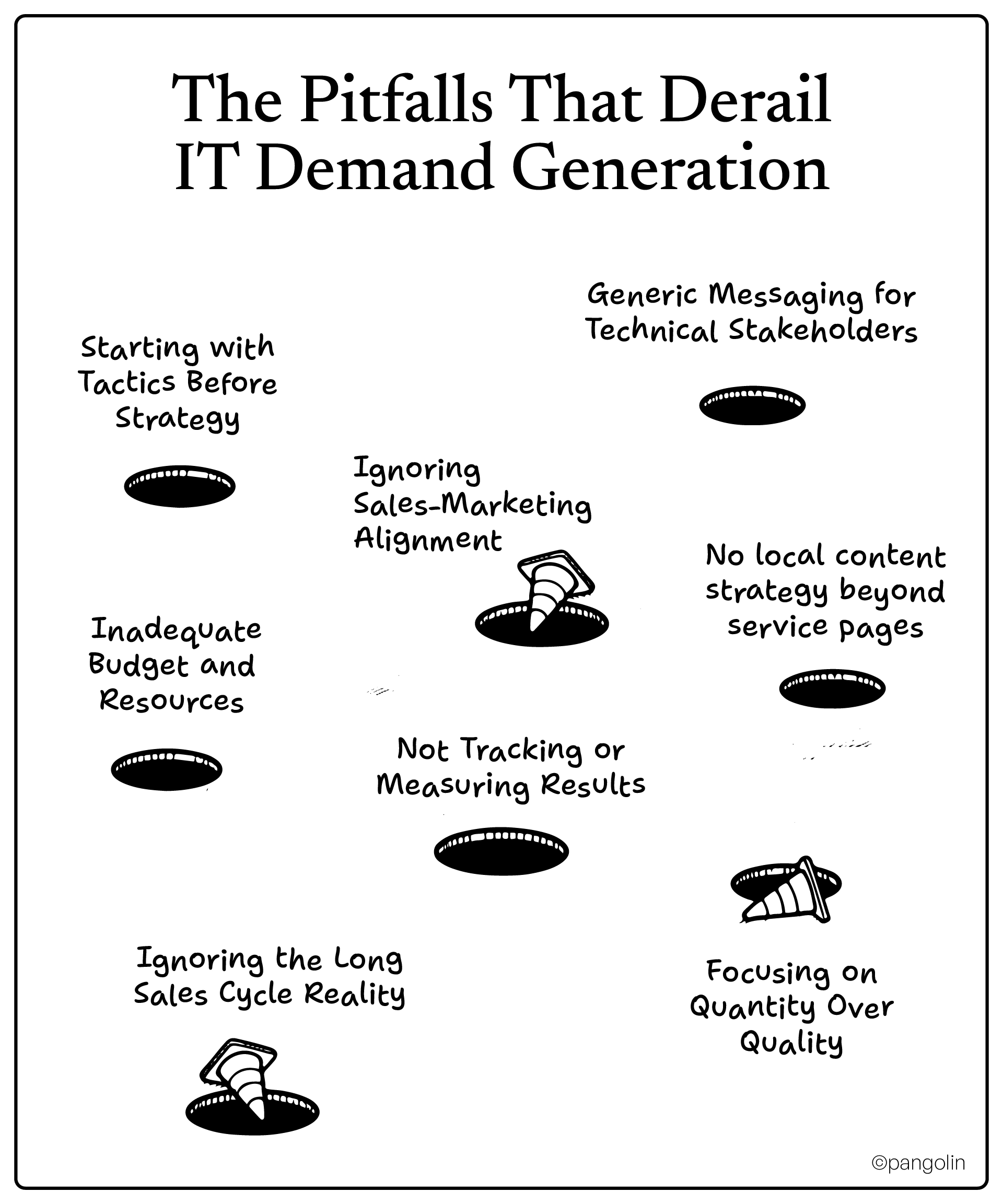
You see a competitor crushing it on LinkedIn, so you dump the budget into LinkedIn ads. You hear podcasts are hot, so you start one. You launch campaigns without understanding your buyer journey, your positioning, or your measurement framework.
The fix: Strategy first, tactics second. Complete Steps 1-3 of this framework before you touch any marketing channels. Know your ICP. Nail your positioning. Map the buyer journey. Then choose tactics.
Marketing generates leads. Sales says they're garbage. Sales complain about pipelines. Marketing says they delivered MQLs. Round and round it goes, while revenue stagnates.
The fix: Force alignment from day one. Shared definitions. Shared KPIs. Weekly sync meetings. Closed-loop reporting. Executive sponsorship to enforce it.
Your messaging sounds like every other IT vendor: "We help companies scale." "We provide innovative solutions." "We're a trusted partner." None of this means anything.
The fix: Develop role-based, pain-specific messaging. What keeps your CTO up at night? What metrics does your CFO care about? What obstacles do your operations lead face? Speak to specific problems, not generic platitudes.
Budget is the #1 challenge for demand gen professionals. You're asked to "do more with less" while competitors outspend you. You can't compete on every channel, so you spread the budget thin and dominate nowhere.
The fix: Prioritize ruthlessly. Pick 2-3 channels where your buyers actually are. Master those. Ignore the rest until you're winning where you're focused. Quality beats quantity.
You're running campaigns but have no idea what's working. Attribution is a mess. You can't tell leadership which channels drive revenue. When budget review comes, you're defending spending with vague metrics like "engagement" and "brand awareness".
The fix: Implement your measurement framework from day one. Set baseline metrics. Track conversion rates at each funnel stage. Use UTM parameters. Build dashboards. Only 52% of companies measure ABM ROI effectively—don't be in that group.
You're obsessed with MQL volume. "We generated 500 leads this month!" But sales can't reach anyone. Nothing closes. You're measuring the wrong things.
The fix: Implement lead scoring. Track MQL-to-SQL conversion rates. Measure SQLs, not just MQLs. Track which leads become customers, not just which leads fill out forms. Quality trumps quantity, always.
You launch campaigns expecting immediate results. When nothing closes in 30 days, you panic and change strategy. But B2B tech buying cycles average 10-13 months. IT services average 6-8 months. You're abandoning strategies before they have time to work.
The fix: Build extended nurturing programs. Accept that most leads need months of touchpoints before they're ready to buy (average 28.87 touchpoints). Measure early indicators: content engagement, email open rates, webinar attendance while waiting for revenue results.
[[divider]]
The landscape is shifting fast. Here's what's working now.
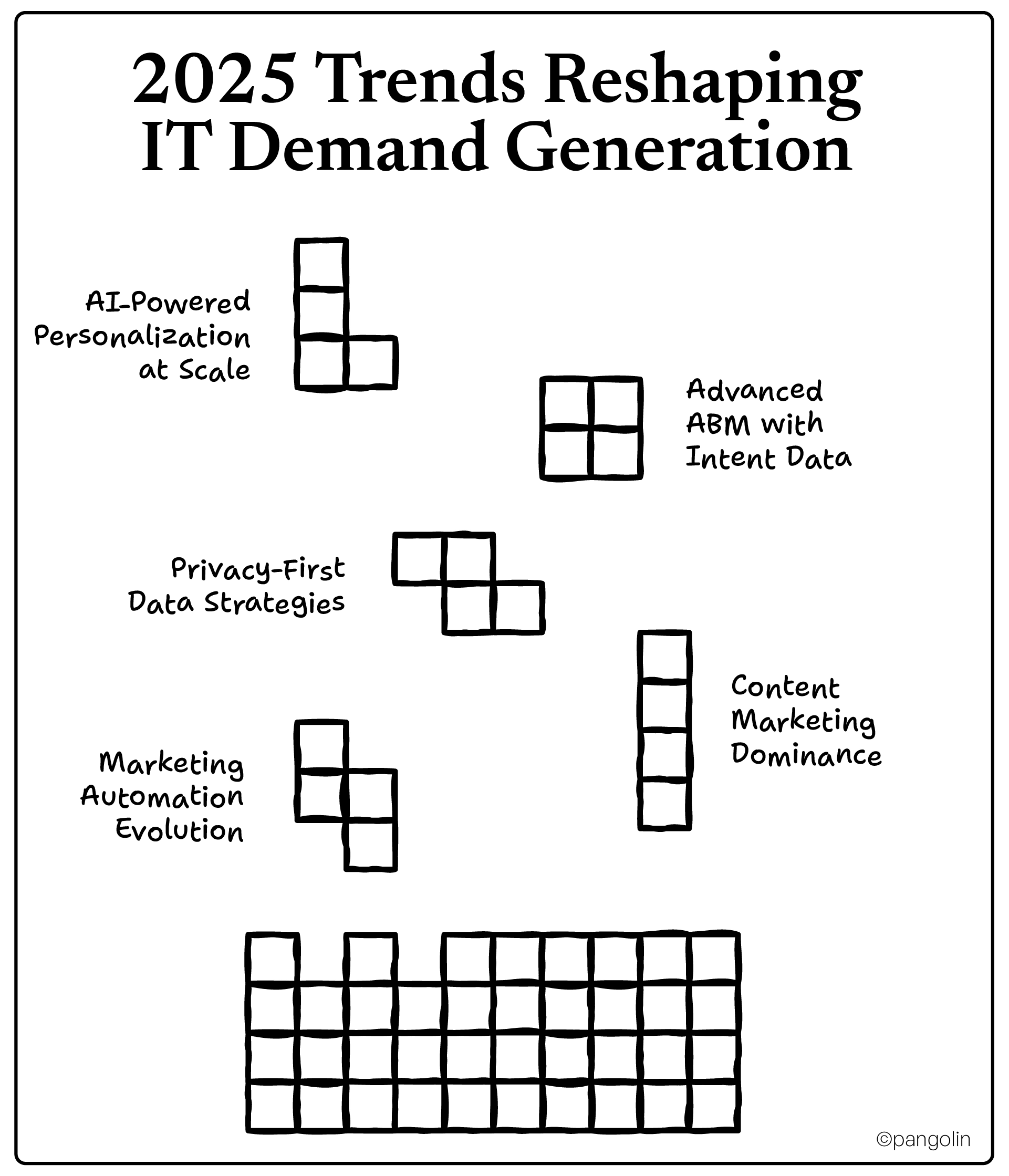
AI lets you personalize content, emails, and campaigns for thousands of prospects—something impossible manually.
What's working:
The stat that matters: 52% of customers switch due to lack of personalization. Generic campaigns lose to personalized ones every time.
ABM is evolving from static account lists to dynamic, real-time targeting based on buyer behavior.
What's working:
The ROI: 97% of marketers report higher ROI with ABM than other tactics.
GDPR, CCPA, and other privacy regulations are forcing IT companies to rethink data collection.
What's working:
The reality: Privacy regulations are tightening. Companies that build trust through transparency will win.
Content remains the most effective demand generation tactic.
The numbers:
What's working in 2025:
Automation is becoming smarter, more integrated, and more accessible.
The ROI is undeniable:
What's working:
[[divider]]
Enough theory. Let's build your plan.
Week 1-2: Discovery
Week 3-4: Strategy Development
Week 5-6: Journey Mapping
Week 7-8: Campaign Architecture
Week 9-10: Initial Launch
Week 11-12: Monitor & Optimize
30-60 days: Baseline improvements in engagement metrics (email open rates, content downloads, website traffic from ICP)
90-180 days: Measurable increases in qualified opportunities and conversion rates
6+ months: Significant impact on revenue and pipeline velocity
Reality check: Demand generation is a compound-growth engine. Early results are modest. Sustained effort produces exponential returns. Don't expect overnight miracles, but don't underestimate long-term impact.
[[divider]]
Remember Matthew Carpenter and his glitter bombs? He stumbled into viral success with a ridiculous idea. It worked because it was simple, unexpected, and impossible not to share: classic word-of-mouth gold.
But you're not selling glitter bombs. You're selling sophisticated IT solutions that require education, trust-building, and months-long sales cycles. You can't rely on going viral. You need a system.
The reality is stark: 63% of IT startups fail, and 68% of B2B businesses struggle with lead generation. Meanwhile, 70% of the buyer journey happens before vendor contact, and buyers require nearly 29 touchpoints before they'll close.
You can't wing this. You need systematic demand generation.
The opportunity is massive for those who get it right:
Your path forward is clear:
The goal isn't more leads. It's a predictable pipeline that fuels sustainable growth.
Start with the 8-step framework. Implement your 90-day plan. Remember that demand generation is a compound-growth engine, early results are modest, but sustained effort produces exponential returns.
Most importantly, understand this: systematic demand generation isn't an experiment or a side project. It's how IT companies survive and thrive in 2025.
The companies that crack this code will dominate their markets. The ones that don't will become cautionary tales.
Which will you be?
Ready to build your demand generation engine? Pangolin specializes in helping IT companies break out of the commodity trap and build predictable pipelines. We've helped clients achieve 20X lead increases, 68% drops in cost-per-lead, and 122% conversion lifts. Get in touch to discuss your demand generation strategy.
Kavya Somani and Aniket Panja are the writers behind Pangolin's Edge content strategy, focusing on IT services and SaaS marketing. The design team with Adhiraj Jadhav and Sohini Some translated insights into visual narratives. Adil Abdul and Yugandhar LakshmiNarayana led interface design and user flows, while Yuva Priyadarshini and Aniket Singh ensured technical SEO and organic reach. Project coordination was managed by Deepti Karn.
The team extends thanks to Avani Nagwann and co-founder Shashank Ayyar for their strategic input and editorial oversight.

