Email, SEO, and content marketing drive the highest ROI in B2B IT—master these before expanding to other channels.
Cost per lead for IT services is high ($501 on average), so focus on quality over quantity and track actual business impact.
Start with goals, work backward from sales targets, and tie every dollar to revenue contribution.
Flexible budgets win—plan for quarterly reviews and reserve 10-20% for experiments and market changes.
Prove ROI with pipeline metrics, revenue attribution, and clear data—this is what gets budgets approved by CFOs.
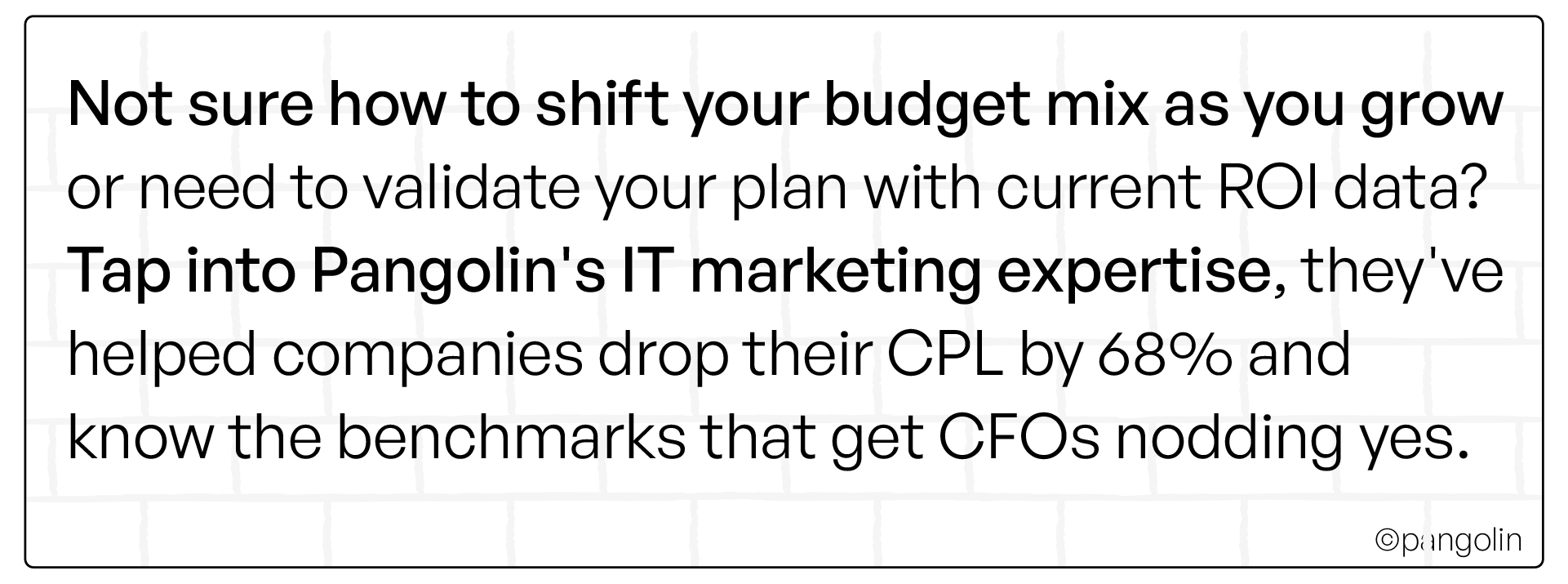
Pangolin's IT budgeting frameworks have dropped CPL by 68% for clients and can help structure your plan for approval.
Budgeting for IT Services Marketing Campaigns: The CFO-Proof Guide
In 2016, two Texas entrepreneurs, Riad Bekhit and Alex Craig, launched a service letting people mail custom messages written on actual potatoes. Yes, potatoes.
They called it Potato Parcel, and the internet lost its mind. Appeared on Shark Tank. Secured Kevin O'Leary's investment. Shipped over 70,000 potatoes. Hit $700,000 in annual revenue.
Here's what's crazy: they knew exactly how much each potato cost to source, ship, and personalize. They calculated customer acquisition costs down to the cent. They tracked ROI on every marketing channel. A joke business built on root vegetables had more financial rigor than most IT services companies.
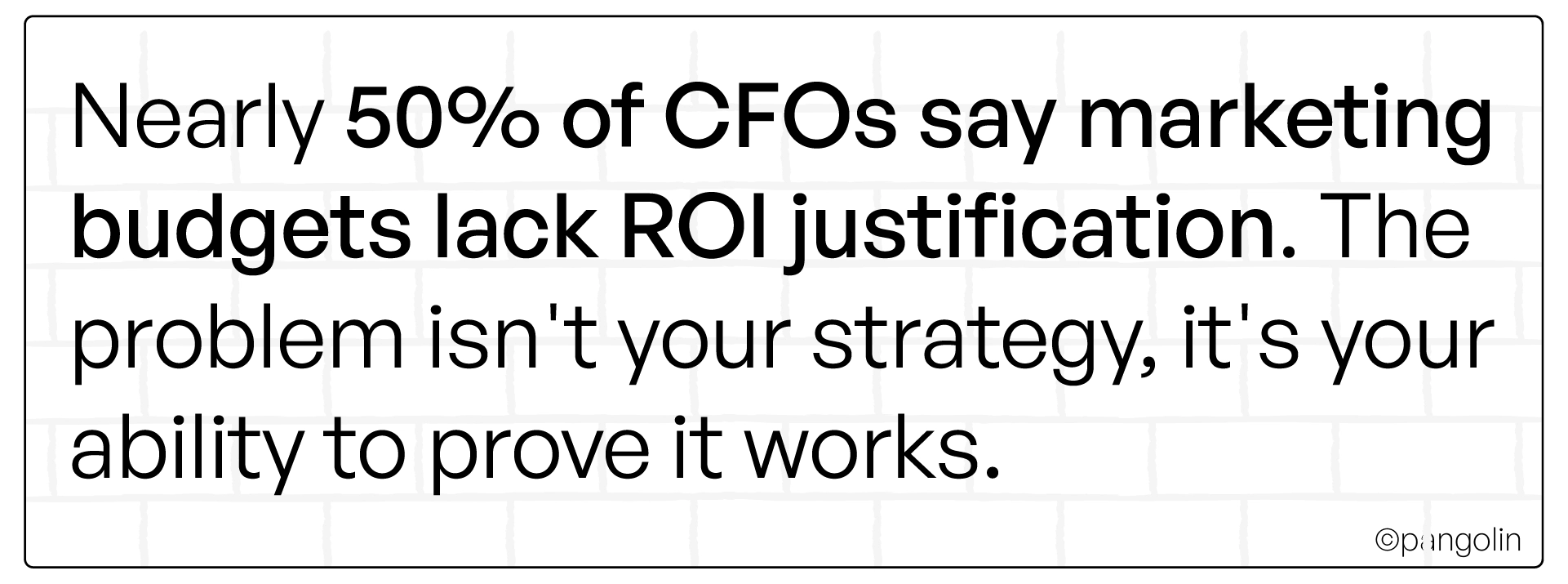
Meanwhile, 59% of IT marketing leaders say they don't have enough budget to execute their strategy. They're managing multi-million-dollar companies but can't prove marketing ROI to skeptical CFOs. Budget proposals get rejected because they lack the data backing that a potato business nailed on day one.
If a company mailing customized potatoes can master marketing budgeting, so can you.
This guide shows you how with exact benchmarks, channel allocations, and the frameworks to get your budget approved by even the toughest CFO.
[[divider]]
The Budget Reality: Why Most IT Marketing Leaders Are Under-Resourced
Let's start with the numbers that explain why you're here.
59% of CMOs don't have enough budget to execute their strategy. Not "would like more", don't have enough. Marketing budgets have flatlined at 7.7% of revenue (down from 9.1% peak), while expectations keep climbing.
Only 23% of CEOs believe marketing delivers measurable ROI. Think about that. Three-quarters of your leadership team are skeptical that your budget generates value.
64% of marketing leaders can't track the financial impact of their activities. Attribution is a nightmare. Sales cycles span 6-8 months. Multiple stakeholders complicate tracking. You know marketing works, but proving it? Different story.
51% of B2B marketing leaders must rationalize budgets monthly. Not annually. Not quarterly. Monthly defense of every dollar.
The result? Marketing becomes a cost center to minimize instead of a growth driver to invest in. You're stuck justifying spend rather than optimizing for results.
This guide fixes that.
[[divider]]
What You Should Actually Spend (Industry Benchmarks That Matter)
Stop guessing. Here's what IT companies actually allocate to marketing.
By Industry Average
B2B Services Overall: 7.7-9.4% of revenue
IT/Managed Services: 8.5-8.7%
Tech Software/SaaS: 9.16%
Marketing Budget Increase 2025: Up to 9.4% (from 7.7% in 2024)
By Company Stage
The startup-to-mature spectrum changes everything:
Early-Stage (Startup): 40-50% of revenue—aggressive acquisition mode
Budget based on data, not tradition. Your CFO will respect it. Your pipeline will reflect it.
Need help building your IT services marketing budget? Pangolin has helped clients achieve 68% drops in CPL and 28% lower CAC through data-driven budget optimization. Let's talk about yours.
FAQs
1. What % of revenue should IT firms spend on marketing?
2. What channels offer the highest ROI in B2B IT?
3. How should I split my marketing budget across the funnel?
4. What's a good cost per lead (CPL) for IT services?