

In 2024, Chili's was dying.
For years, the restaurant chain bled customers to Olive Garden and Texas Roadhouse. Their answer? More discounts. Cheaper prices. Which meant cheaper ingredients, underpaid staff, and declining quality. Employees quit. Customers stopped coming back. The death spiral accelerated.
Then new CEO Kevin Hochman did something counterintuitive: he stopped chasing new customers and focused on the ones who'd already walked through the door. He upgraded the food (better fries, juicier tenders), met customers where they already were (TikTok, not TV), and created reasons for people to come back - again and again.
The result? Chili's became America's hottest restaurant chain in 2024 while Red Lobster and TGI Fridays filed for bankruptcy.
Here's the thing: Your IT services marketing faces the exact same problem Chili's did.
You're spending thousands driving traffic to your website. Prospects visit your service pages, skim your case studies, maybe even check your pricing. Then 97% of them vanish. Gone. You never hear from them again.
Meanwhile, you're pouring more budget into attracting new visitors, ignoring the goldmine of people who already raised their hand and said "I'm interested."
That's where retargeting comes in. And for IT services companies with 12-month sales cycles, committee-based buying, and technical decision-makers, retargeting isn't just a nice-to-have tactic. It's the difference between a marketing department that bleeds budget and one that generates predictable revenue.
Let's fix your leaky funnel.
Most retargeting advice comes from e-commerce brands selling $50 shoes. Click. Buy. Done.
That doesn't work when you're selling cybersecurity consulting, cloud migration services, or IT infrastructure management to a buying committee of 6-10 people over 12+ months.
Here's what makes IT services retargeting fundamentally different:
The buying committee problem. One person visits your site on Monday. A different person from the same company visits Thursday. Your CFO checks pricing on Friday. Without account-based retargeting, you're treating them as three separate strangers instead of one coordinated buying team.
The trust gap is massive. IT services purchases are high-risk, high-stakes decisions. A bad hire costs you a project. A bad IT partner can crater your entire business. That's why your prospects need 8-12 touchpoints minimum before they'll even take a discovery call.
You're fighting technical buyers AND business buyers. Your CTO wants to know about your tech stack, certifications, and implementation methodology. Your CFO wants ROI projections and cost comparisons. Generic retargeting ads can't speak both languages simultaneously.
The companies that crack this code? They see 24% faster revenue growth than competitors still running spray-and-pray campaigns.
Let's talk numbers, because your marketing director needs to justify this to the CFO.
Without retargeting, you're lighting money on fire:
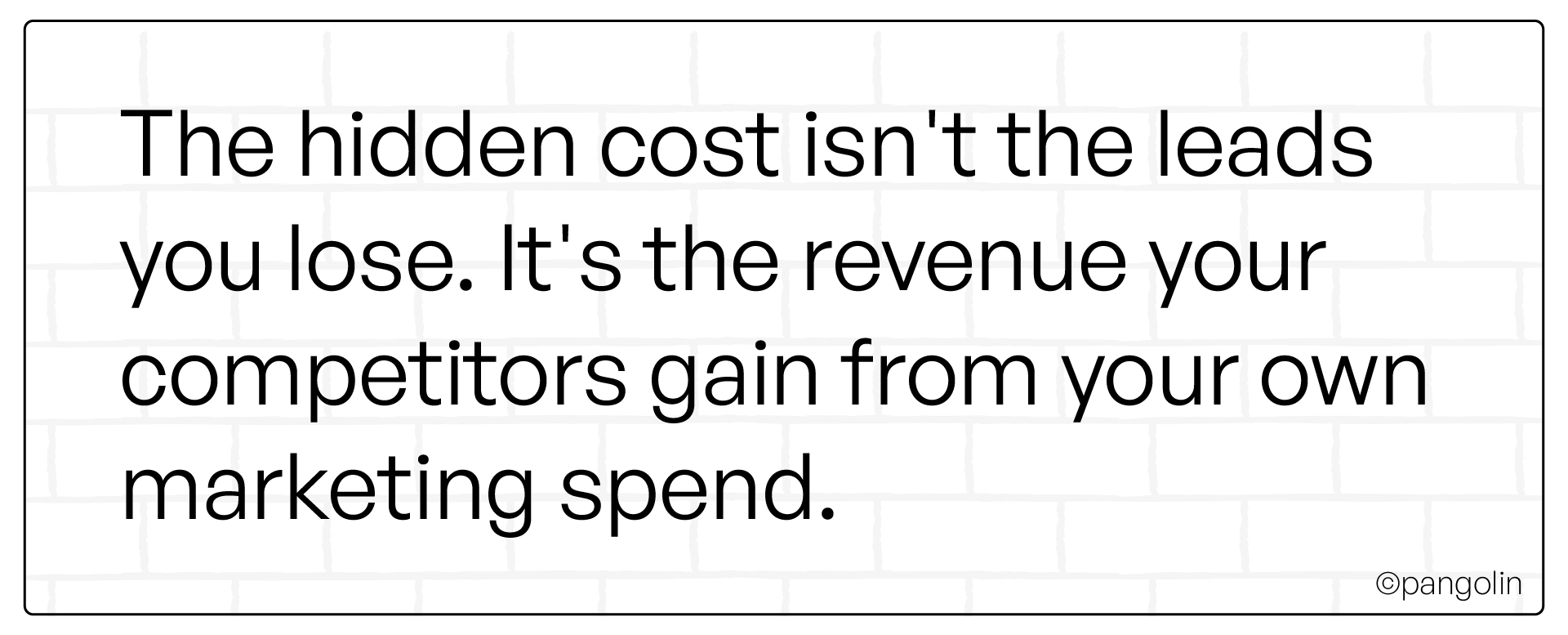
Here's the kicker: your competitors are retargeting the prospects YOU spent money attracting.
Think about it. Someone searches "IT consulting services Chicago," clicks your Google ad (you pay $12), browses your site for 3 minutes, then leaves.
Two hours later, they're on LinkedIn and see your competitor's retargeting ad with a compelling case study. Who do you think they remember when their boss asks for vendor recommendations next week?
You paid to introduce them to the category. Your competitor paid to close the deal.
If you're still running retargeting campaigns like it's 2019, you're already behind.
Google finally pulled the plug on third-party cookies. Chrome joined Safari and Firefox in the privacy graveyard.
Panic? Not if you've been building first-party data.
Here's what works now:
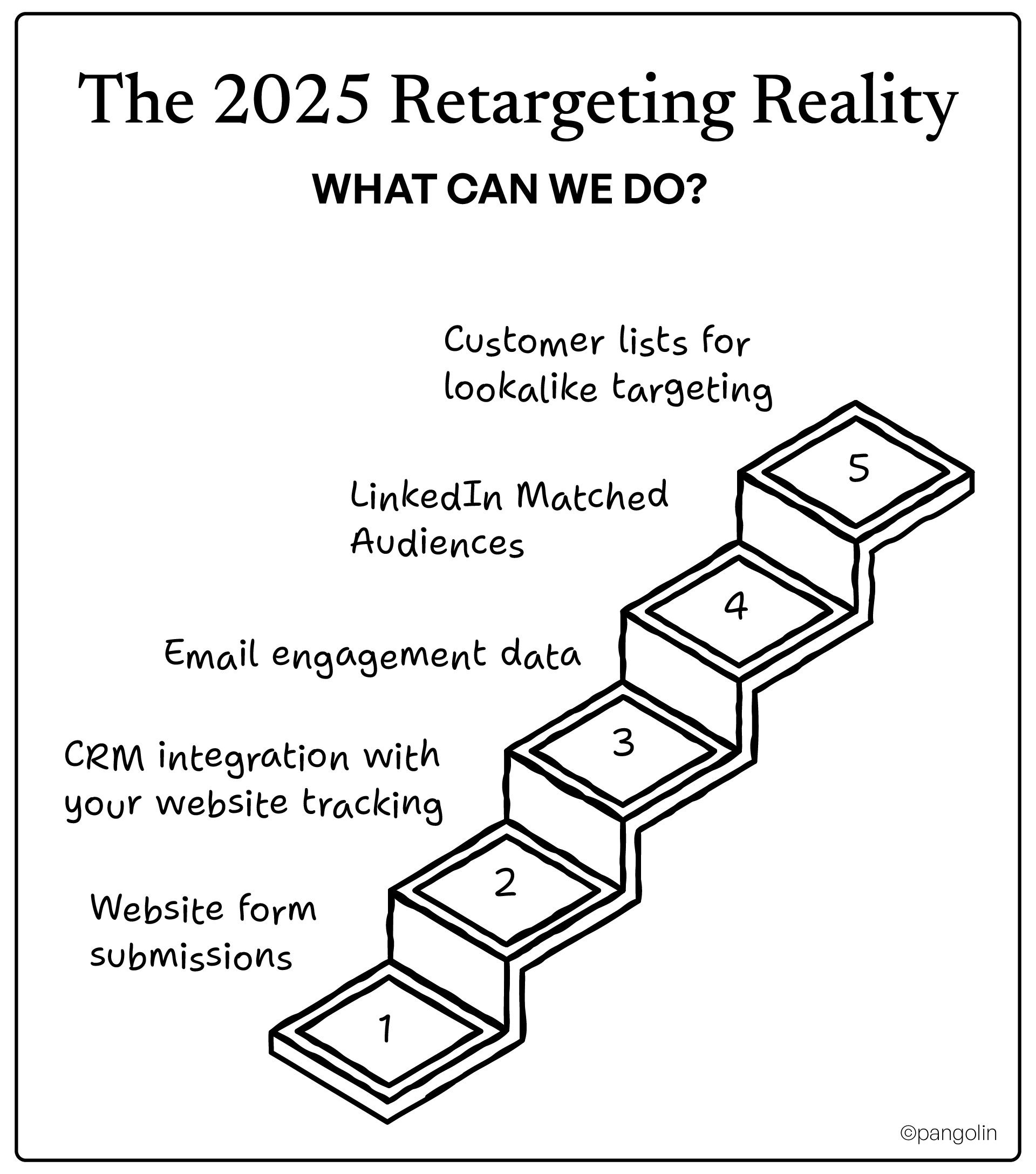
The IT services companies winning in 2025 aren't the ones with the biggest third-party data providers. They're the ones who've spent two years building robust first-party data systems.
Your prospects are using ChatGPT, Perplexity, and Claude to research IT services before they ever visit your website.
What does that mean? By the time someone lands on your site, they're not "top of funnel." They're already deep in evaluation mode.
They're serious buyers doing final due diligence. Which means your retargeting needs to reflect that urgency, not treat them like they're just learning what "managed IT services" means.
You need explicit, freely-given consent before dropping retargeting pixels on visitors.
The good news? Transparent consent actually builds trust. The companies that clearly explain why they're tracking ("so we can show you relevant content about the services you're interested in") see better long-term engagement than those sneaking pixels onto pages.
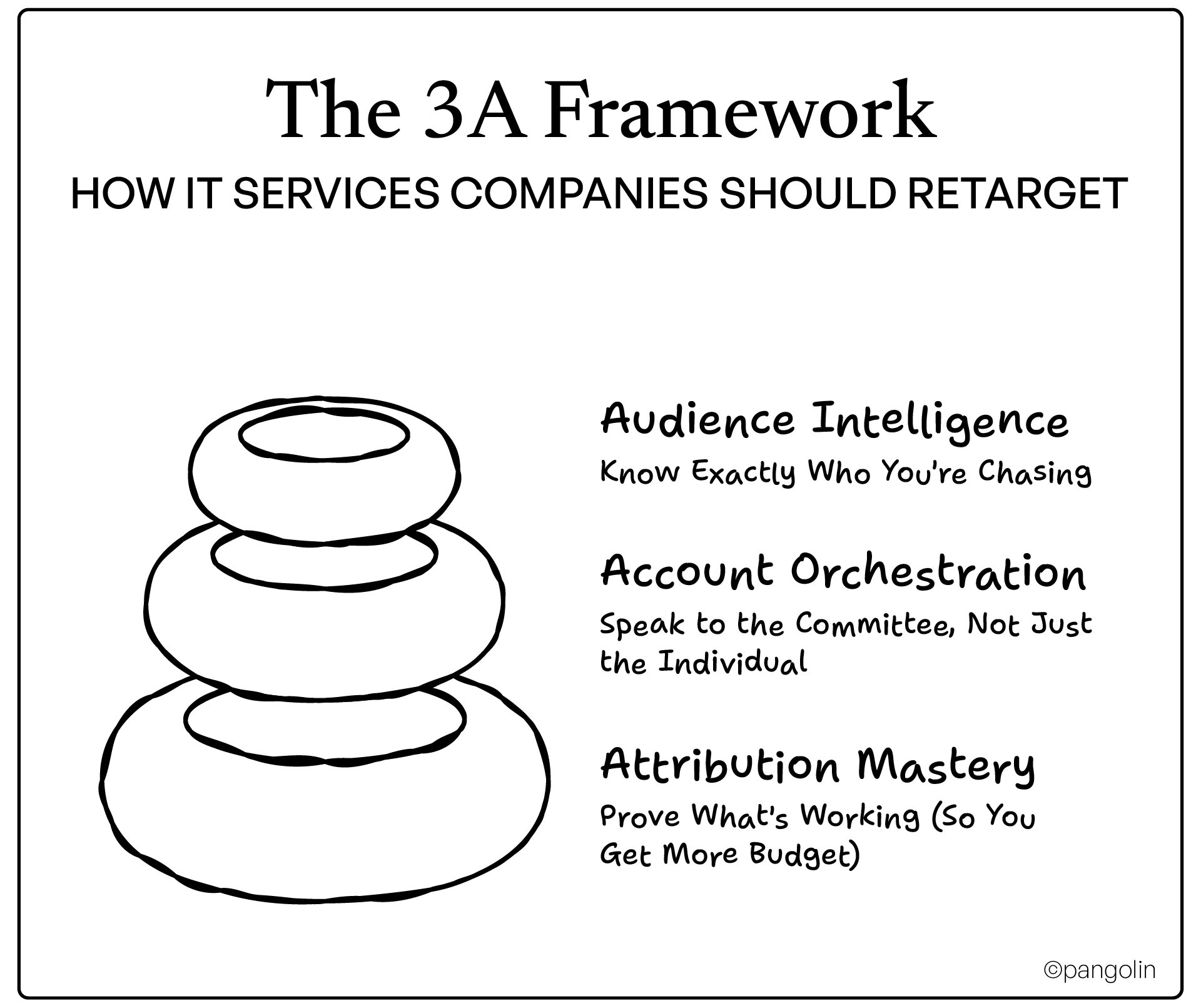
Forget generic retargeting playbooks. Here's the framework that actually works for complex B2B sales.
Not all visitors are created equal. Someone who spent 8 minutes reading your case study on healthcare IT compliance is worth 10x more than someone who bounced after 12 seconds.
Build these core audiences:
High-Intent Behavioral Segments
Account-Based Segments
Funnel Stage Segments
The California ground squirrels didn't just change what they ate, they changed their entire hunting behavior based on environmental conditions. Your retargeting needs the same adaptability. As visitors move through stages, your message must evolve.youtube
Remember: 65% of IT purchasing decisions now involve non-IT stakeholders.
Your CTO visited Monday. Your CFO visited Friday. Your VP of Operations visited the following Tuesday.
Traditional retargeting treats them as three random people. Account-based retargeting recognizes they're one buying team—and crafts a coordinated message across all three.
How it works:
Companies using account-based retargeting see 187% higher engagement from target accounts compared to individual-based campaigns.
Here's the truth bomb: If you can't prove retargeting ROI, your budget gets cut next quarter.
Sarah's #1 challenge isn't running campaigns. It's proving to the CFO that marketing drives revenue, not just "engagement".s
Track these metrics (and only these metrics):
Leading Indicators
Lagging Indicators (The Ones That Matter)
The attribution model you need: Multi-touch, time-decay.
Why? Because in a 12-month sales cycle, the retargeting ad they saw in Month 3 matters just as much as the demo request in Month 11. Last-click attribution will always make retargeting look weak even when it's carrying your funnel.
You've built the audiences. You're tracking the right metrics. Now what do you show them?
Just like marmoset monkeys call each other by name to get attention, your retargeting needs to acknowledge exactly where someone is in their buying journey.
Awareness Stage
Consideration Stage
Decision Stage
Video retargeting crushes static ads—20% higher purchase intent. But not "talking head CEO" videos. Show:
Dynamic retargeting shows them exactly what they viewed. Someone spent 4 minutes on your cybersecurity audit page? Show them an ad featuring that exact service with a relevant case study.
Comparison content beats feature lists. Instead of "We offer 24/7 support," try "Support that answers in 4 minutes vs. industry average of 38 minutes."
Treating a CEO the same as a junior IT analyst is like trying to sell steaks to vegetarians. Well, until those California ground squirrels started hunting meat—but you get the point.youtube
The fix: Build at least 5-7 distinct audience segments based on behavior, job title, and engagement level.
Ad fatigue is real. After 5-7 impressions, people stop seeing your ad, they start resenting it.
The fix:
B2B buyers research on desktop at work but they also scroll LinkedIn on their phone during commutes, check emails on tablets at home, and browse while waiting for meetings.
The fix: Optimize every landing page and ad creative for mobile. Test on actual devices, not just responsive preview mode.
Nothing says "we don't track our own data" like showing "Try our IT services!" ads to someone who signed a contract last week.
The fix: Create exclusion lists:
Last-click makes retargeting look worthless because someone always converts via "direct" or "organic search" at the end of a 12-month journey.
The fix: Implement multi-touch attribution that gives credit to every touchpoint. Marketing automation platforms like HubSpot, Marketo, or Salesforce Pardot make this easier.
Why it works:
How to use it:
Budget reality: Higher CPCs ($8-$15) but dramatically higher lead quality for B2B.
Why it works:
How to use it:
Pro tip: Google's AI-powered Smart Bidding learns which retargeting audiences convert best and automatically adjusts bids.
Why it works:
How to use it:
When to skip it: If your target audience is extremely niche or senior-level only (LinkedIn will outperform).
✅ Audit current tracking (Google Analytics, pixel installation, CRM integration)
✅ Get GDPR/CCPA consent mechanisms in place
✅ Build core audience segments (high-intent, pricing viewers, content downloaders)
✅ Set up exclusion lists (customers, employees, job seekers)
✅ Install retargeting pixels on key pages (LinkedIn Insight Tag, Google Ads, Meta Pixel)
One thing to launch: High-intent retargeting to pricing page visitors with a case study offer.
✅ Launch account-based campaigns targeting your top 50 prospect companies
✅ Create role-specific ad variations (CTO vs. CFO messaging)
✅ Set up dynamic retargeting for service-specific pages
✅ Test video ads vs. static image ads
✅ Implement frequency capping (5-7 impressions/week)
One thing to launch: Sequential messaging campaign (Ad 1: Problem, Ad 2: Solution, Ad 3: Proof, Ad 4: CTA).
✅ Expand to additional platforms (if LinkedIn is working, test Google; if Google works, test Meta)
✅ Build lookalike audiences from your best customers
✅ Layer intent data on top of behavioral data
✅ Create upsell/cross-sell campaigns for existing customers
✅ Document your attribution model and present results to leadership
One thing to launch: Monthly reporting dashboard showing retargeting's contribution to pipeline and closed revenue.
Remember Chili's? They didn't save themselves with a Hail Mary. They fixed the fundamentals: better product, smarter positioning, showing up where customers already were.
Your IT services retargeting works the same way.
You don't need a massive budget. You don't need a 10-person team. You need:
The companies that nail this—that turn ghost visitors into revenue—aren't doing anything magical. They're just refusing to let 97% of their hard-won traffic disappear into the void.
Your competitors are already retargeting your prospects. The question isn't whether to start retargeting.
It's whether you're going to let them keep doing it.
At Pangolin, we've built retargeting systems for ITES, KPO, and IT consulting companies that turned stalled pipelines into predictable revenue engines. We know the pain of 12-month sales cycles, technical buyers who ghost you, and CFOs who ask "what are we getting for this marketing spend?"
If you're tired of watching 97% of your website traffic vanish and watching your competitors retarget them instead, let's talk.
Sources: This blog is built on 200+ credible sources including industry research from Metadata.io, Mountain, Demandbase, Content Marketing Institute, B2B Marketing Association, and case studies from technology marketing leaders. All statistics and benchmarks cited are from verified 2024-2025 publications.
1. How Much Should We Budget for Retargeting Campaigns for IT Services?
Allocate 10-20% of total paid ad budget to retargeting. For IT services, that's roughly $500-$1,000 monthly on a $5,000 budget. You need at least 500-1,000 unique visitors per segment to make it cost-effective.
Rule of thumb: 80% cold traffic acquisition, 20% retargeting. Retargeting costs 66% less per click than cold ads ($0.66-$1.23 vs. $2+).
2. What's the Difference Between Retargeting and Remarketing? Which One Should IT Services Use?
Retargeting uses pixel-based tracking for anonymous website visitors; remarketing uses email/CRM lists for known contacts.
Use both:
Remarketing requires explicit consent but converts better.
3. When Should We Start Running Retargeting Campaigns?
Start when you have 500-1,000 unique visitors per segment, not before.youtube
Retargeting with tiny audiences causes ad fatigue and wastes budget. Launch cold traffic and retargeting simultaneously - prospects who click today should see your retargeting ad tomorrow while warm.youtube
Once you hit 1,000+ visitors in key segments, increase the retargeting budget from 10% to 20-30%.
4. What's the Ideal Frequency Cap for IT Services B2B Retargeting?
5-7 impressions per week for high-intent audiences; 2-3 for nurturing.
By buying stage:
On LinkedIn, cap at 5-8 impressions per month.
5. How Do We Measure If Our IT Services Retargeting Campaign Is Actually Driving Revenue?
Track these metrics:
Critical: Use multi-touch attribution, not last-click. In 12-month IT sales cycles, retargeting looks worthless with last-click.
Result: B2B retargeting increases conversion rates 147% and response rates 400%.

