

In 1996, Pepsi launched a loyalty campaign that became a legend for all the wrong reasons.
The TV ad was simply collecting "Pepsi Points" to get cool stuff.
A t-shirt was 75 points, a leather jacket was 1,450 points and at the very end, the ad showed a military-grade Harrier Fighter Jet landing outside a high school. The text on screen read: Harrier Fighter Jet: 7,000,000 Points.
Pepsi’s executives thought it was a funny joke. John Leonard, a 21-year-old business student, thought it was an offer.
He did the math. Buying the points would cost about $700,000, the jet was worth $32 million.
He raised the money, sent the check, and demanded his jet but Pepsi refused. John sued.
The case dragged into court, made headlines and eventually became a Netflix documentary called Pepsi, Where’s My Jet?
The judge ruled it was clearly a joke. John walked away jet-less.
Why does this story matter to a B2B leader in 2025?
Because it is the perfect example of the Loyalty Gap, the massive disconnect between what the boardroom thinks a program is (fun, engaging, rewarding) and what the user actually experiences (confusing, transactional, broken).
In the B2B world, you might be promising something equally undeliverable which is loyalty in exchange for pennies.
If your dashboard shows 30,000 members but your sales team says "nobody uses the app," you have a Harrier Jet problem. You have built a program that looks great on slides but fails on the ground.
This is the first and most dangerous mistake in B2B loyalty confusing enrollment with engagement.
The unfortunate truth is that 77% of B2B loyalty programs fail within two years because the program is built on a foundation of misaligned metrics that measure activity instead of impact.
[[divider]]
To understand why B2B loyalty programs fail at scale, you have to first understand who they are designed for.
Most loyalty programs are built in boardrooms by people who have never spent a day in the field. They optimize for quarterly revenue goals and dashboard metrics, treat partners like transaction processors instead of professionals.
This disconnect creates what Pangolin Marketing calls The Loyalty Gap which is the massive space between what leadership believes is happening and what trade partners actually experience.
Trade partners live in a different world than the one described in strategy decks.
An electrician manages 5–6 job sites a day. His phone battery hits 2% by noon, the site WiFi barely works, and there’s no quiet corner to fill out long forms. He trusts dealer recommendations and WhatsApp messages from peers far more than apps. He needs instant gratification, WhatsApp-first communication, and proof from someone he trusts that your program delivers real value.
Like the electrician, a painter works from 7 a.m. to 6 p.m. with limited digital literacy and follows contractor instructions because he can’t afford friction. A mechanic handles 10–15 jobs daily with razor-thin margins and a small retailer keeps his shop open 12 hours a day while juggling multiple brands and constant working-capital stress.
These are not abstract personas. These are real people with real constraints, motivations, and skepticism born from years of failed schemes. When they encounter your loyalty program, they are exhausted, distracted, and suspicious.
Meanwhile, in the boardroom, a different narrative plays out.
"We have 30,000 members and 75% awareness. The program is successful."
"Our dashboard shows high enrollment metrics."
"The redemption catalog has 100 SKUs. Partners have a choice."
"Monthly SMS campaigns keep them engaged."
These are the stories leadership tells itself. They are supported by vanity metrics that look impressive in PowerPoint but hide a more troubling reality. Large pools of registered but mostly inactive users. Enrollment rates that don’t translate to adoption. First-action rates often below 30%, where habits never form, generic reward catalogs with hard-to-reach thresholds, and programs that feel dead between quarterly campaigns.
Research from India and the Middle East confirms this gap.
The loyalty market in India will reach $6.40 billion by 2029, yet 71% of members have never redeemed a reward and 56% cannot remember the benefits of programs they joined. Regional data from Southeast Asia mirrors India with high mobile penetration but low engagement without personalization.
In the Middle East, consumers are enrolled in 11 to 12 programs on average but actively engage with only 1 to 3.
The pattern is identical everywhere, showing high enrollment meets low active participation. Brands are celebrating activity while their partners are quietly churning.
[[divider]]
This is where Pangolin Marketing's analysis gets specific. We have audited dozens of channel loyalty programs across India, the Middle East, and Southeast Asia.
7 mistakes appear repeatedly, and they tend to compound each other.
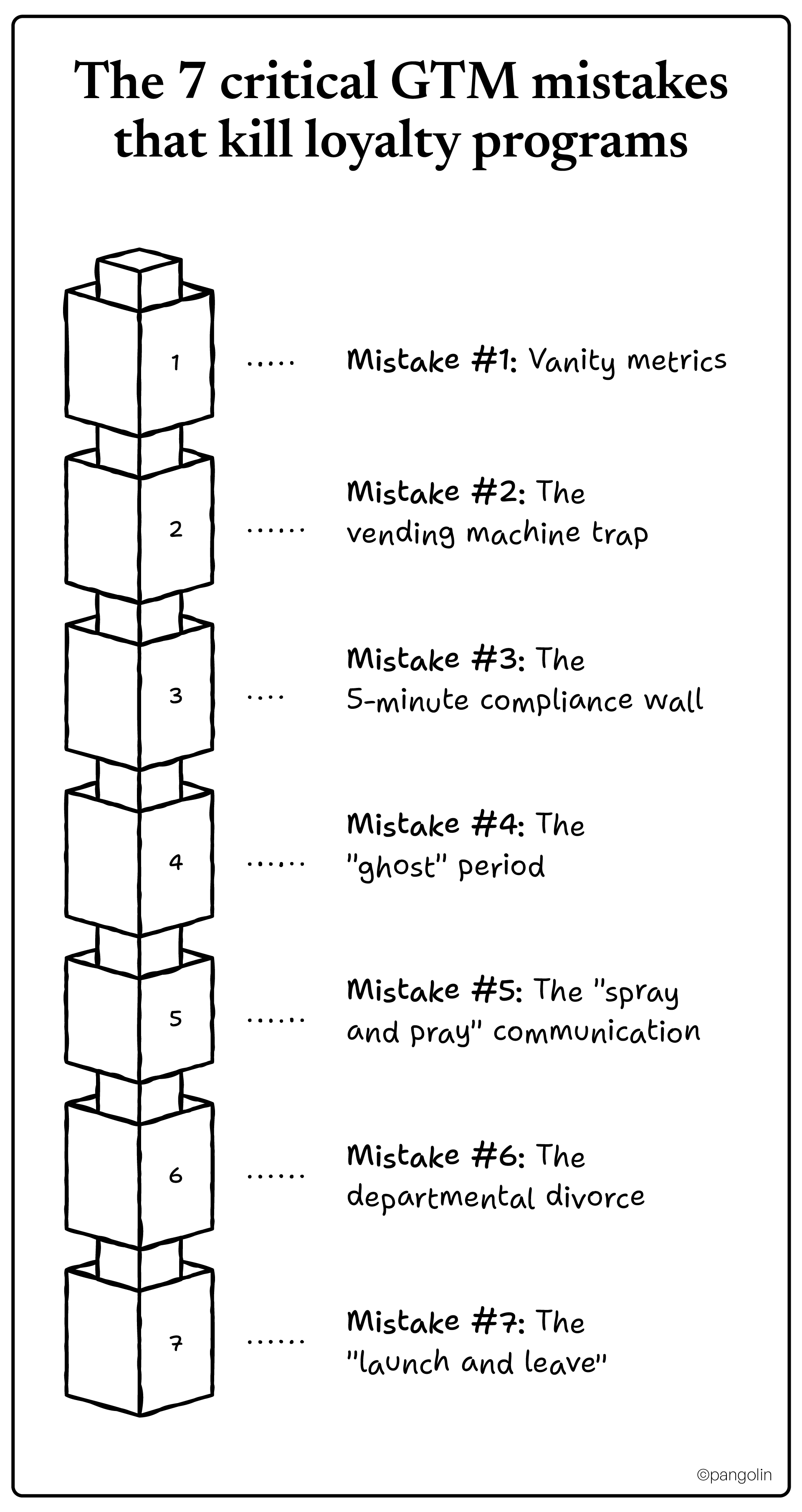
The False Victory: You measure success by total signups. Month 1 hits 50,000, month 2 hits 75,000 and leadership celebrates.
The Hidden Truth: Only 30% of those members take any action within seven days. By day 30, that number barely moves, and you have built a database of the inactive.
When you optimize for enrollment, you create perverse incentives.
The Fix:
This transforms how you think about success. You stop celebrating launch parties and start diagnosing where partners drop off.
The Assumption: If we give them 3% cashback, they stay loyal. If a competitor offers 4%, we offer 5%.
The Reality: You have built a commodity and trained your partners to be mercenaries.
This is the fundamental design flaw in most B2B programs. When your entire value proposition is points for purchases, you have created a vending machine.
Insert Invoice. Get Cash. The switching cost is zero.
The moment a competitor offers slightly better credit terms or loose payment conditions, your "loyal" partner is gone.
Why would they stay? You never gave them a reason beyond money.
Merkle's research found that emotional brand attachment drives 43% of business value while features and price together account for only 20%.
In trade channels, emotionally engaged partners demonstrate 82% higher retention rates. Their Net Promoter Scores climb above 50, while transactional programs languish at 30–40. Customer lifetime value multiplies 2–3x. Why? Because emotionally loyal partners become advocates, they refer peers without incentives, defend your brand during competitive attacks, and willingly push premium products.
The Fix: Move from Transactional to Emotional Loyalty.
Instead of just offering cash, offer status. Create tier systems where partners climb from Bronze to Silver to Gold to Platinum. Make the badges real. An electrician should be able to display his "Pro Tier" certification at job sites to signal competence to customers. A mechanic should value the training that comes with higher tiers because it makes him better at his job, not just richer.
Castrol FastScan enrolled over 150,000 mechanics by solving their actual cash flow stress. They reduced payment cycles from 60 to 90 days down to minutes, sending cash directly to bank accounts via IMPS. Average daily transactions exceed 100,000 with INR 6 crores reimbursed monthly. But Castrol did something more important by treating mechanics like professionals who needed financial inclusion and digital upskilling, not just reward points.
Bosch eXtra built a tiered system where the real stickiness comes from training modules and technical support at each level. Silver members get basic access, Gold unlocks premium support, and Platinum members shape product development. Those tier badges become status symbols that signal competence to customers.
Asian Paints Colour Academy trained 156,000 painters across 18 regions with a 40% engagement rate. The real stickiness came not from points but from skill development that painters could monetize immediately. A painter who completed the academy training could command higher rates from customers because he demonstrated superior color knowledge and technique.
These programs work because they address the actual unmet need which is respect, growth, and status.
The Situation: An electrician sees your QR code, he is interested and he downloads the app.
What Happens Next: The app asks for PAN card, Aadhaar verification, bank details, GST number, photo of workshop.
The Outcome: He closes the app and never opens it again.
Research shows that 50 to 60% of interested partners drop off between noticing a program and completing onboarding. They are rejecting programs that do not respect their time or context.
The electrician is on a construction site with limited battery and patchy connectivity, his hands are dusty, and does not have his documents in his pocket. The app crashes during form submission. By the time he could theoretically complete the KYC, he has mentally moved on to seven other things.
The Fix: Progressive Profiling.
Lower the barrier to entry dramatically. Let partners sign up with just a mobile number and OTP. Let them scan their first coupon immediately and see the points hit their wallet in real time. When they want to redeem the money, not just accumulate points, then ask for the heavy KYC documents. By that point, they have ₹2,000 in their wallet. Now they are motivated.
Under 5 minutes to signup on a low-end Android phone with patchy internet. That is the test. If your onboarding fails that test, 60% of your potential base will never enter the funnel.
The Timeline:
The Data: Research shows that 78% of members abandon programs when redemption thresholds are too high or rewards take too long to arrive.
This is the "Ten-Day Death" that kills engagement at scale. The gap between action and reward destroys momentum and trust. If there is no immediate response to the partner's action, they assume the system is broken.
The Fix: The First Win Rule.
Every new user must get a tangible "win" within their first 24 hours. This could be a welcome bonus of ₹50, a first-scan multiplier that doubles their points, or just an exciting animation confirming the action worked. The goal is to prove the system functions and rewards are real.
This is behavioral science, not opinion. Humans need instant gratification to form habits. A small reward immediately is 10 times more powerful than a large reward six months away.
The Campaign: "Double Points this Diwali! Scan any coupon and earn 2x."
Who It Works For: Maybe the retailer who scans high-volume transactions.
Who It Doesn't: The electrician who scans one invoice per week. The contractor managing projects. The painter earned daily cash wages.
Most programs send the same message to their entire database because that is operationally easiest. It is also why engagement is so uniformly terrible.
A mechanic does not respond to messaging about "Working Capital Optimization." A retailer does not care about "Skill Certification." Different personas have different drivers.
Electricians need instant gratification, WhatsApp-first communication, and peer endorsement. Painters need visible status, cash rewards, and training in their language. Mechanics need technical training, family health benefits, and genuine parts confidence. Retailers need margin support, credit flexibility, and co-op marketing funds.
The Fix: Persona-Led GTM.
Segment your database by partner type and job-site reality. Create different campaign narratives for each. For retailers, talk about margin expansion and credit. For mechanics, talk about technical mastery and family security. For electricians, talk about professional status and earning power.
This is operationally more complex than mass campaigns. But it is the difference between engagement rates of 15% and engagement rates of 50%.
Your loyalty program has 7 common leaks. Where is yours breaking?
Most B2B brands lose partners at the exact same stage transitions. The question is where.
Discover the diagnostic model that exposes every gap between boardroom expectations and ground reality.
[Download "From Cashback to Community" Whitepaper]
What Happens:
The distributor's sales rep, who is the person who actually explains the program to retailers has not been trained. He thinks it is complicated so he doesn't pitch it or he actively discourages it: "Don't bother with that app, the points never come. Let me just give you a direct discount instead."
The Result: Even the best-designed program dies in the field.
The Fix: Align Everyone on "What's In It For Me."
Sales reps need to earn shadow points or commissions for every partner they activate. They should have the power to award instant bonus points to close a deal. Marketing must treat loyalty as a tool for their success, not as a separate initiative. Tech must optimize for low-end devices and patchy networks because that is the real context. Finance must model ROI beyond vanity metrics to include retention, CLV lift, and advocacy impact.
This is a cross-functional operating model, not a marketing project.
Month 1 begins with a big launch - high budgets, high energy, banners everywhere, and strong member growth.
Month 2 still carries momentum with new campaigns and active field engagement.
Month 3 will be torn banners and expired offers signal decay. A partner opens the app, finds stale content, and never returns.
The Data: Most programs are treated like projects with clear endpoints. Once the launch is over, teams move on. By Month 4, the program is already losing relevance and feels abandoned.
The Fix: Always-on orchestration.
Treat loyalty like a media channel that requires consistent, fresh content. Monthly themes (Safety Month, Upskill Month, Festive Promotions), weekly nudges and automated WhatsApp triggers, regional activations, leadership spotlights, partner success stories, and community interactions. A program that never feels idle becomes a habit that never breaks.
The app must feel alive every time someone opens it.
[[divider]]
The seven mistakes above are symptomatic. The deeper issue is that most brands do not have a diagnostic tool to identify exactly where their program is leaking.
Pangolin Marketing developed the Ground Truth Framework specifically for this purpose. It breaks the partner journey into 6 stages and analyzes each through 4 reality lenses.
1. Unseen: Partner has not meaningfully heard of the program.
2. Noticed: Partner has heard "points milte hain" but cannot explain the benefit.
3. Onboarded: Partner has signed up technically but is confused about next steps.
4. Earning: Partner is using regularly but sees it as purely transactional.
5. Belonging: Partner sees the program as part of their professional identity.
6. Leading: Partner is actively recruiting peers and shaping your market.
For each stage, you examine:
Research shows healthy programs hit these targets by stage:
Most programs underperform on all of these metrics. The diagnostic framework helps identify which stage-transition is the bottleneck.
[[divider]]
Here is where most brands fail again. They think emotional loyalty is a marketing campaign.
It is not. It is an operating model.

Successful programs require cross-functional alignment that most manufacturers lack:
This is why specialist partners like Pangolin exist. We bridge the gap between diagnosis and execution by:
[[divider]]
Every B2B manufacturer faces a fork:
Path A (The Commoditization Loop): Keep increasing cashback, fight price wars, treat partners like data points and watch margins shrink.
Path B (The Community Moat): Accept that points are just the entry ticket, build a genuine community, create identity and belonging and offer learning, respect, and status that competitors cannot buy.
The path to be taken is quite obvious.
[[divider]]
Your loyalty program is either leaking partners or compounding loyalty with every interaction.
There is no middle ground.
The question is not whether you need to fix your program. The question is whether you know exactly where it is breaking.
[Download the Pangolin Ground Truth Framework Worksheet] to audit your program's 6 critical stages. Identify where your partners are dropping off. Understand which gaps will give you the biggest ROI when fixed.
From there, we can move from diagnosis to movement.
Pangolin Marketing specializes in GTM strategy, community-building systems, and cross-functional alignment for B2B brands across India, the Middle East, and Southeast Asia. We have helped dozens of manufacturers transform loyalty programs from cost centers into growth engines. We do this by connecting boardroom strategy to ground reality.

