
Welcome back to The Kitchen. This edition has a shoe company, a gazelle, and a spreadsheet you'll wish you'd filled out sooner.
[Download the editable audit template]
In April, a shoe company announced it was done making shoes.
Allbirds, the wool sneaker brand every tech founder wore in 2019, went public at a $4.1 billion valuation in 2021 and then spent four years watching that number shrink. This spring it sold the entire footwear business for $39 million and announced it would become NewBird AI, a GPU infrastructure provider. The stock jumped more than 600% on the teaser. By June the name had changed again, this time to Smartbird, and the new CEO, hired out of AWS, was asked what she made of the sneakers. She told Business Insider she's more of a high heels person.
Nobody involved has explained what a sneaker company knows about running GPU clusters. So far, the market hasn't needed them to.
You could file this under stock market comedy, and mostly I do. But a version of the same story is running in B2B, and that one is not funny, because the public market is close to the last buyer still paying a premium for the costume. Your buyers, the committee kind, repriced it a while ago.
(For the record: I run a marketing agency. Producing trust signals is the family business. So this is me reporting a crash from inside the building.)
What happened is simple to describe and awkward to sit with. AI collapsed the production cost of every B2B trust signal at roughly the same time: the confident claim, the polished case study, the outbound email that knows your funding round and your alma mater. When something costs nothing to produce, it stops telling the buyer anything, and buyers reacted the way people react to a debased currency. In TrustRadius's 2026 buyer study, 47% said they trust online resources less than they used to, up from 39% a year earlier, and cold email replies drifted from 5.1% down to 3.43% over the same stretch. That's not cynicism, it's repricing.
The repricing is also regressive, which is the part that should bother you. A faker's claims cost nothing, so the faker loses nothing when claims stop working. Your claims sit on top of years of actual delivery, and the market prices both at zero anyway, because from the outside the two read identically. Deflation punishes everyone who paid full price for the truth.
Which leaves the question this edition is about:
If anyone can say it, what's left that only the real thing can afford?
A Thomson's gazelle that spots a cheetah will sometimes do something that looks suicidal. It stops, and it jumps. Straight up, all four legs, again and again, going nowhere. The behavior is called stotting, and biologists argued about it for years, because burning energy in front of a predator seems like the worst possible use of the moment. The argument mostly settled on this: the jump is a message. It says I've seen you, I can afford to waste this, go chase someone slower. Cheetahs tend to read it and move on.
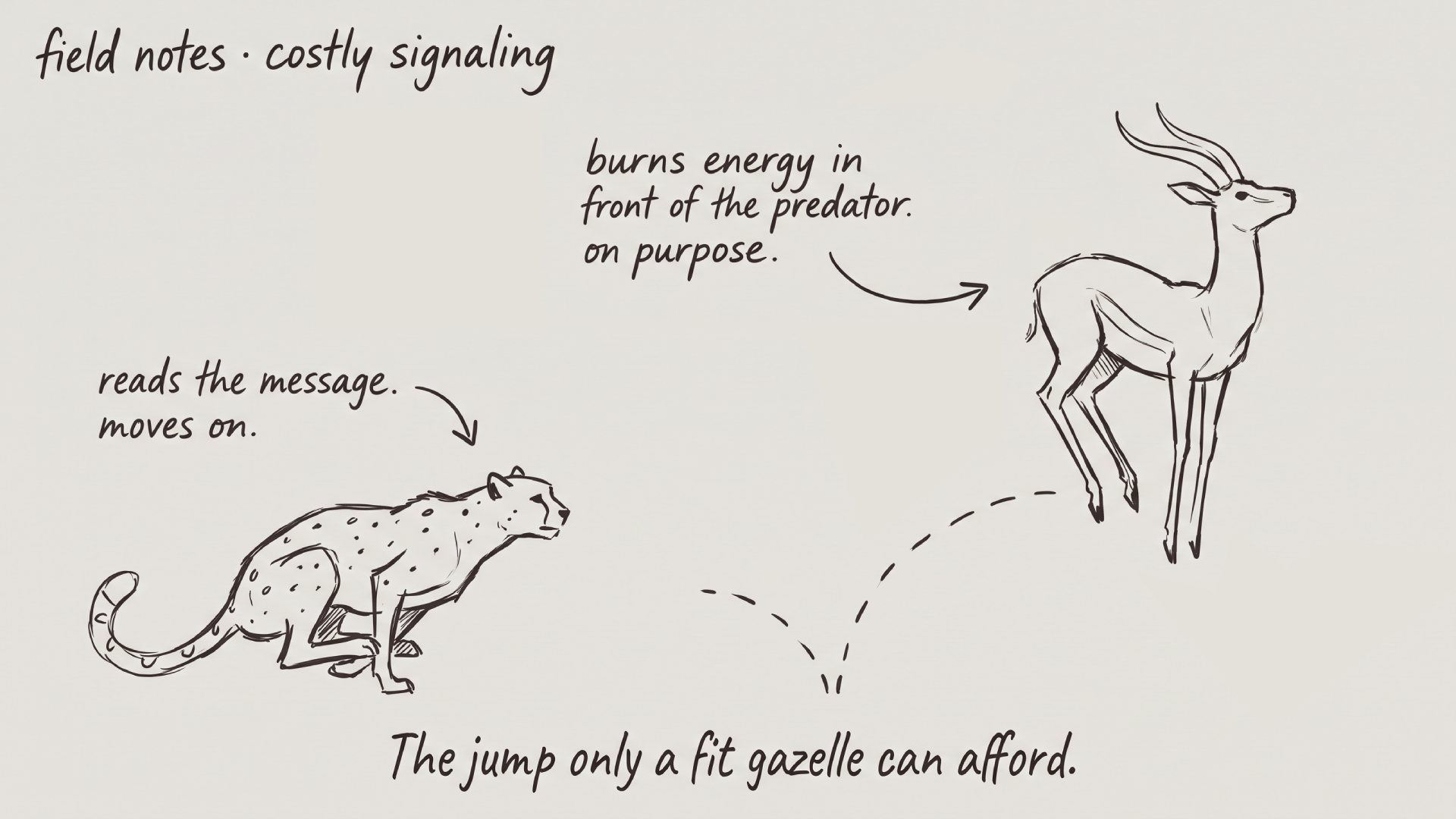
The jump works because it's expensive in a way only a genuinely fit gazelle can survive. A weak one that tries it gets eaten mid-performance. Michael Spence got a Nobel for working out the economics underneath: when talk is free, the only believable signals are the ones a faker couldn't afford to send. His original case was education in job markets. The logic travels.
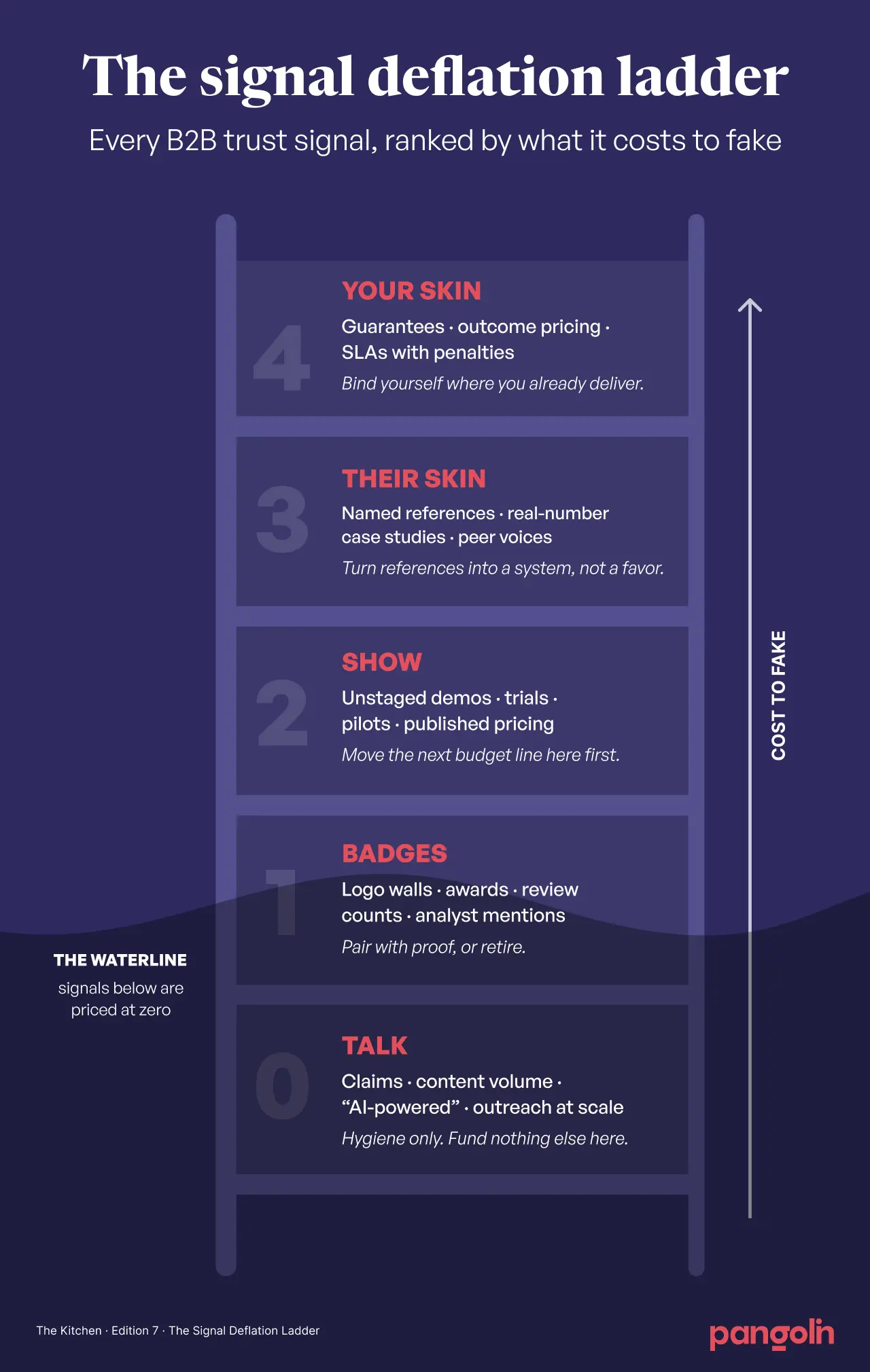
That's what the framework below is built on. Take every trust signal you send, rank it by what it costs to fake, and then draw the deflation in as a waterline rising up the ladder. Signals below the line aren't false. They're just no longer information.
[Download the editable audit template]
Five rungs. The waterline currently sits above the bottom two.
Everything you say about yourself lives here: website claims, thought leadership, the vision slide, personalized outreach at scale. Rung 0 went under completely. Among buyers who use AI to research a purchase, 94% fact-check what it tells them, which turns your claims into raw material for someone else's verification process rather than anything resembling persuasion.
(Full disclosure, since we're here: I draft this newsletter with AI in the loop. That is part of why I stopped expecting the writing alone to earn anyone's trust.)
The right spend at this rung is hygiene. Keep it accurate, keep it cheap, automate it without guilt, and move every rupee of differentiation budget somewhere above the waterline, because nothing down here compounds anymore.
Then there's the trust you borrow: logo walls, award badges, review counts, analyst mentions. These still carry a little information, but only a little, because everyone now knows how they're obtained. Reviews can be farmed. A fair share of awards are pay-to-play. In the same TrustRadius research, analyst reports have fallen to an influence footnote, cited by 13% of buyers, while demos, trials, prior experience and user reviews sit at the top of the list. The workable move is pair or retire: a badge that clicks through to a named human still does quiet work, and a badge that doesn't is decoration.
The first rung above the water. Live demos that aren't staged, free trials, pilots, working tools, published pricing.
The old advice was show, don't tell. The waterline now sits almost exactly on that line, because telling is free and showing still isn't. And showing does cost something, just not mainly cash. Publishing your pricing costs negotiating room. A real sandbox costs you the staged demo. An open roadmap costs you wiggle room a year from now. These signals are cheap in money and expensive in nerve, and the nerve is what buyers are pricing. Transparent pricing has topped the TrustRadius buyer wish list four years running, which ought to embarrass an industry this fond of the word customer-obsessed.
It's fair to ask whether this rung can be faked too. It can, and one company recently found the price. Nate Inc. raised over $42 million on the claim that its shopping app completed purchases through AI. Per the SEC, the automation was essentially nonexistent; contract workers in the Philippines were clicking the buttons behind staged demos, and the founder now faces federal fraud charges carrying up to 20 years each. Faking above the waterline stopped being a marketing decision somewhere in the last two years. It's a matter for prosecutors now.
Named customers, staking their own names: reference calls, case studies with real people and real numbers, your champion's peers showing up in the room. This rung held its value through the deflation for a reason that has nothing to do with production cost. A customer lending you their name is spending their own credibility on you, and nobody does that for a vendor who embarrassed them. AI can draft the case study in seconds; it cannot make your client take the call.
It also matches how deals actually close now. Something like 13 internal voices and 9 outside influencers touch a typical B2B purchase before signature, and rung 0 material does not survive being forwarded up that chain. A peer's voice travels intact. If you want a system here rather than a favor, the mechanics are boring: ask quarterly instead of at renewal panic, make saying yes a ten-minute job, and keep a live list of who's willing to speak, about what, this quarter.
The top rung is the simplest to describe. Guarantees. Outcome-based pricing. SLAs with real penalties. Paid pilots with refund terms. This is the stotting rung: expensive on purpose, and only affordable if you can actually run, which is what keeps it honest. A competitor who fakes a guarantee starts bleeding cash within a quarter. The signal punishes its own counterfeiters, no referee required.
Nobody should live up here across the whole portfolio; the economics don't allow it. What the rung is for is the one commitment that's cheap for you and ruinous for whoever is pretending to be you. Find that one and send it loudly. That commitment is the moat.
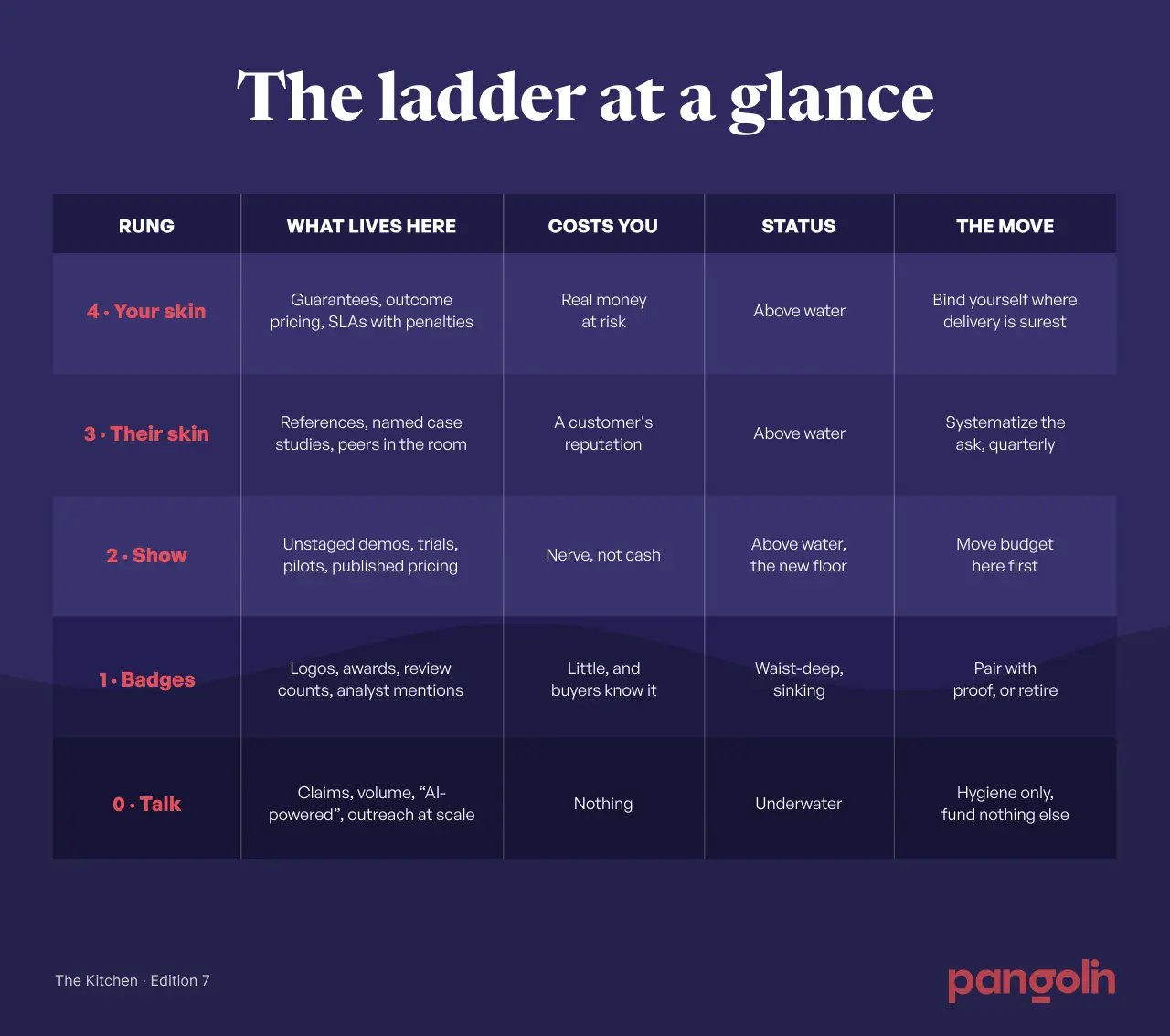
So here we are. Run last quarter's marketing through the ladder and two numbers tend to fall out, neither comfortable.
The first is where the effort went. For most B2B firms, the overwhelming share of activity sits on rungs 0 and 1, underwater, produced faster than ever by the same AI that sank it.
The second is the interesting one. Sitting inside most firms is an inventory of rung 2, 3 and 4 credibility that has been fully earned and never sent. Customers who would take a reference call and have never been asked. Pricing you defend on every single deal and won't publish. Outcomes you hit so consistently you could guarantee them, and don't. You already paid for this credibility, in delivery and results and relationships, and it sits in the vault while the budget buys more of what's underwater.
Gut-check questions, yes or no:
If those were easy to answer, you're rarer than you think. If they weren't, the questions that follow are harder, and the ladder can't answer them for you: which unspent signals go first, in what order, at what risk, and how to say them without it reading as bragging. That's positioning work. The ladder shows you the vault. Deciding what to spend, and how, is a different discipline.
I know this isn't a comfortable audit, and if you've spent years earning proof the market has stopped looking at, some resentment is fair. But the gazelle's move was never really the jump. It was knowing exactly what it could afford that the pretenders couldn't, and doing it in full view, at the moment of scrutiny. Most firms already know what that is for them. They've just never sent it.
If you'd like another pair of eyes while you map your ladder, reach out.
P.S. Two self-serve tools this month: the [Signal Deflation Ladder audit] (the editable spreadsheet version of everything above) and the [AI Vulnerability Calculator] from earlier editions.