
A few years ago, I handed a campaign brief to someone I trusted completely. Smart, experienced, the kind of person who asks the right questions and rarely needs hand-holding.
I said: "You own this."
She nodded. I walked away feeling like an excellent manager. Trusting my team, not micromanaging and respecting autonomy. Practically a TED talk waiting to happen.
Six weeks later, the campaign landed. Technically fine. Decent execution. Nothing on fire.
But it wasn't what I meant. The tone was off. The angle missed. The whole thing felt like a stranger had written it with a reasonable understanding of our brief and zero understanding of why it mattered.
I was frustrated. For about an hour, I was frustrated at her.
Then she told me she had spent the first three weeks googling our competitors every night trying to figure out what I meant by "elevated and credible." She didn't want to ask again because I had already said "you've got this" twice, and asking a third time felt like admitting she wasn't the person I thought she was.
She wasn't failing. She was navigating in the dark with a torch she'd bought herself.
I had given her a destination. I had kept the map.
The context feels so obvious to founders that sharing it starts to feel patronising.
I have lived inside this brand for years. I know why we moved away from a certain tone in 2022. I know which client conversation made us stop leading with features. I know the exact feeling I want someone to walk away with after reading one of our pieces. I know all of this the way you know the layout of your own kitchen at 2 AM automatically, without lights, without thinking.
So when I brief someone, I share the surface. The what. Sometimes the how. Almost never the why. Almost never the "we tried that and it cost us six months." Almost never the accumulated reasoning that lives so deep in my head it doesn't feel like knowledge anymore. It just feels like instinct.
And then I hand it over and say "you own this" and mean it as a compliment.
They receive it as a closed door.
When someone asks for direction and you say "figure it out," you are not building autonomy. You are just transferring anxiety with a smile.
They go quiet. They make decisions. They fill the gaps with their best guess about what you want. They work harder than they should have to. Not on the work itself, but on reverse-engineering you. On asking themselves "what would Avani do here?" instead of "what does this problem actually need?"
Working in the dark does something specific to people. They stop asking for light. Not because the questions go away, but because asking starts to feel like evidence of incompetence. So they figure it out, quietly, in whatever direction makes the most sense to them.
Then you come back three weeks later and tear it apart. And they sit there thinking: I tried to read your mind and I still missed.
I once watched a very talented writer spend two weeks producing a piece in a voice we'd quietly retired eight months ago. Nobody told her. It was like asking someone to cook the family recipe and forgetting to mention that we'd all gone vegetarian.
The work suffers. That's recoverable. The relationship between your confidence in them and their confidence in themselves, that takes longer.
After that campaign, after I sat with the discomfort of realising I was the problem and not the hire, I tried something different.
Same type of project. Different setup.
Before I handed it over, I sat with her for twenty minutes and talked through everything I had been carrying in my head. Why this mattered right now. What we had already tried and abandoned. What "good" actually looked like from my perspective, not in metrics but in the feeling I was chasing. What constraints existed that weren't written anywhere. And then, crucially, where she had complete freedom and where she didn't.
It felt like too much. Like I was over-explaining. Like I was becoming the very person I swore I'd never be, the founder who can't let go.
She came back in three days with something that felt like I had written it myself. Except better, because she had added angles I hadn't thought of. She'd built on the foundation instead of rebuilding it from scratch.
The twenty minutes saved weeks.
The part I could not stop thinking about: she said "this was the first time I felt like I actually knew what I was building."
I had been briefing people for years. I thought I was good at it. I was efficient at it, which is not the same thing. Efficiency gets you to the destination. Good gets you there with someone who understood the journey.
Three things need to travel with the work. Not as a checklist. Just as the difference between a brief that lands and a brief that leaves someone stranded at the airport with no local currency and a phone on 3%.
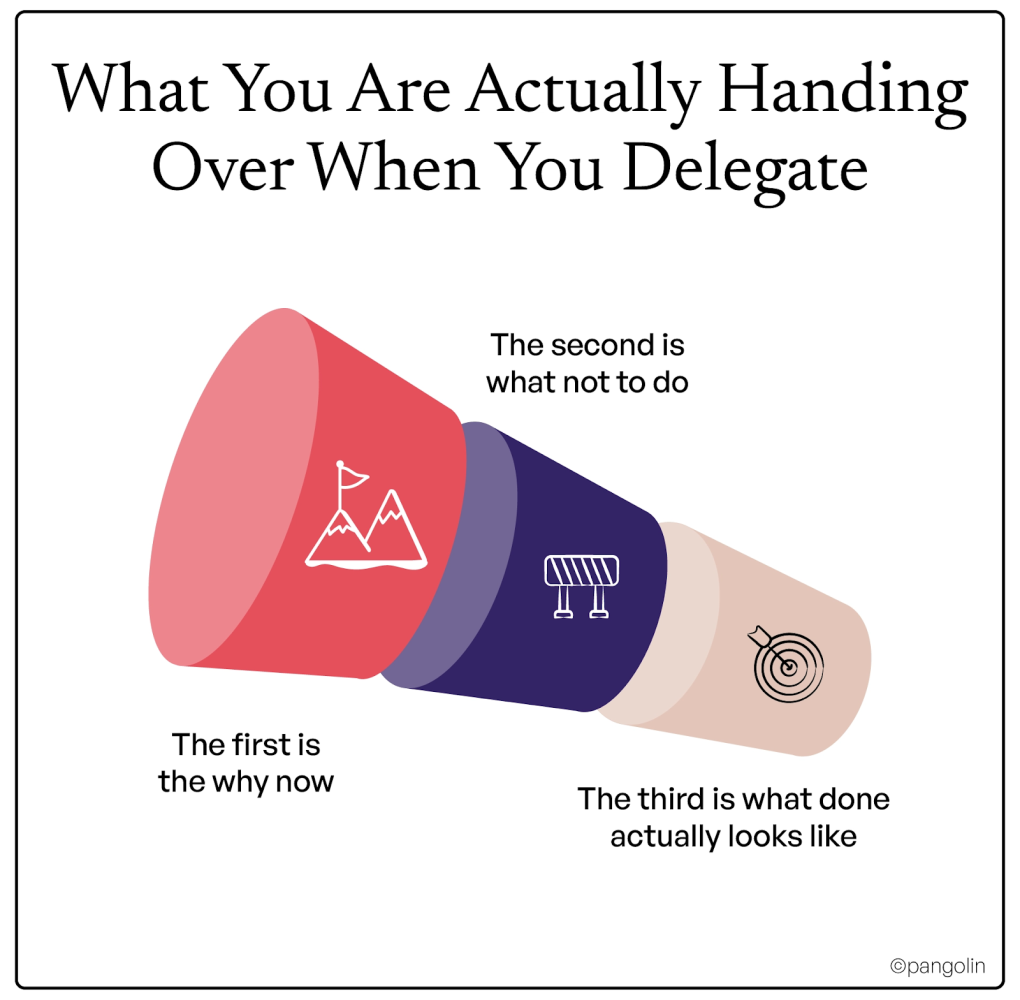
The first is the why now. Not the task description, but the stakes. Why does this matter at this particular moment in this particular company. What happens if it misses. What it unlocks if it lands. People make better micro-decisions all the way through when they know what game they are playing.
The second is what not to do. The failures you have already lived through that they are about to repeat in good faith. The directions that look promising but go nowhere. You have been burned by some of this. They haven't. Don't make them earn the same scars on your company's time. It is the professional equivalent of saying "don't take the highway at 6 PM", obvious to you but invisible to someone new.
The third is what done actually looks like. Not just the metric. The feeling. The specific response you are chasing. "A win is when a cold prospect reads this and thinks we understand their world before we have ever spoken." That is more useful than an open rate target, because it guides every decision between the briefing and the outcome.
None of this is complicated. All of it gets skipped.
Founders are faster than their teams. Not smarter, but faster. We have made the decision a hundred times already. We know where this goes. So we brief in shorthand and call it delegation and then wonder why the output needs three rounds of revision.
The honest version: we skip the brief because slowing down to explain our thinking feels expensive. We think it costs twenty minutes. We forget it saves twenty hours.
But there is something else underneath that took me a while to admit. When you have built something from scratch and lived inside every corner of it, sharing the reasoning is disorienting. It requires you to look at what you know and try to see it the way someone encounters it for the first time. That is cognitively hard. It is much easier to just hand it over and hope.
Hoping is not a brief. It is a brief's sad, optimistic cousin who always shows up without a jacket and is surprised when it rains.
Before you finish any briefing, before you say "you own this" and mean it, ask yourself one thing:
If they execute this perfectly based only on what I just said, will I be happy with the result?
Not "will it be okay." Not "could they make it work." Happy. The way you would be happy if you had done it yourself.
If the answer is anything other than yes, you are not done with the brief.
You have handed someone a task and called it trust. You have given them a destination and kept the map. You have said "you own this" when what you meant was "I can't be bothered to explain this fully and I hope you are good enough to fill the gap."
That is not delegation.
That is disappearing with extra steps.