

The Problem: 75% of traffic from organic; 5% of budget funds it. CPCs rising 15% YoY while budgets stay flat. Teams leave 30-680% efficiency gains on the table.
The Solution: Use 4-scenario framework for reallocation. Rising CPCs: shift 10-15% from paid to organic content; save $1,000-$3,000/month when ranked. Growing organic: shift 15-20% to content/SEO; compound ROI accelerates. Launch mode: 60% paid (validate), 25-30% organic (long-term). Mature market: cut paid on brand keywords (you own organically); keep paid on competitor keywords. Reallocate phased: 5% Month 1, 10% Month 2, final Month 3.
The Impact: Mid-market firm reallocated $100K budget (40% paid → 28%, 10% SEO → 18%). Same budget: 28% pipeline growth, 33% CAC reduction ($720 → $480), $204K annual value. Organic converts 1.7x better than paid.
The Action: Week 1-2 audit ROI/CAC by channel. Week 3-4 get leadership buy-in. Month 1-3 execute phased reallocation. By Month 6: 25-35% pipeline improvement. By Month 12: 30-50% improvement on same budget. Tell CFO: "Same budget, optimized allocation. Organic ROI exceeds paid 1.7x at 12 months."
Netflix started as a DVD rental-by-mail service in 1997.
Their entire business model was built around physical logistics: warehouses, envelopes, return processes. It worked. It made money. Customers liked it.
Then streaming technology emerged.
Most companies would have done what Netflix's competitors did: keep investing in what's working, maybe dabble in streaming as a side experiment. After all, DVD rentals were the proven channel generating revenue today.
Instead, Netflix made a brutal choice. They reallocated their entire business.
They didn't abandon DVDs immediately. They didn't start from zero with streaming. They redirected resources - engineering talent, server investment, content acquisition budget - from the proven channel (DVDs) to the emerging channel (streaming) before the emerging channel had proven itself.
For two years, this looked like a mistake. Streaming was expensive, unreliable, and generated minimal revenue. The safe play would have been to keep the DVD cash cow alive longer.
But Netflix saw something the market hadn't caught up to yet: streaming was the future. And the company that reallocated resources early would own the future.
By 2012, streaming revenue exceeded DVD revenue. By 2023, Netflix had completely eliminated the DVD business and captured 31% of the global streaming market.
Here's what most marketing leaders miss: Your budget allocation is Netflix's DVD business.
You're investing heavily in channels that work today (paid search, PPC) while starving channels that will dominate tomorrow (organic, content). You're optimizing for what's proven rather than what's possible.
And the cost of getting it wrong is massive.
Let's look at a real scenario.
You have a $100K monthly marketing budget. On paper, you're allocating it across channels:
Your CFO thinks this looks reasonable. Balanced across channels. Professional.
But here's what's actually happening:
Month 1 Reality:
Leadership looks at this and thinks: "Paid search is winning. Let's double down."
So Month 2 you shift:
Paid search now generates 250 leads (slight increase). But something odd happens.
Your organic traffic drops 22% because you've starved content creation. Your email engagement drops because you're not nurturing as frequently. Your paid CPCs actually rise 8% because your Quality Scores deteriorated (organic rankings feed into paid ad relevance scores).
By Month 3, you're spending more and getting less. But you can't see why.
Most companies are dramatically underinvesting in organic while overspending on paid, not because organic is bad, but because paid results are visible and immediate while organic results compound invisibly for 6+ months.
The decision-making bias is psychological, not financial.
Your CFO sees:
Decision looks obvious.
But here's what your CFO isn't seeing:
Versus PPC:
Same total revenue for the year. Completely different story when you zoom out to 18+ months.
But most budget reallocation decisions are made by looking at 30-day windows, not 18-month trajectories.
The result? Organic is chronically underfunded relative to its ROI potential, while paid is overfunded relative to its long-term contribution.
Before we talk about fixing your budget, let's diagnose the problem. Four metrics reveal whether you're allocating dollars to high-efficiency or low-efficiency channels:
Email: ~$53 per lead
LinkedIn: ~$380 per lead
Google Search: ~$520 per lead
Content/Organic: Varies ($200-$400 after ramp, but frequently $0 for weeks 1-12 during ranking phase)
What this tells you: If Google Search CPL is $520 while email is $53, you're probably over-allocating to Google and under-allocating to email. Simple math.
But here's the catch: This metric lies if you're not measuring what happens next.
B2B Organic: 2.6% conversion rate
B2B Paid Search: 1.5% conversion rate
B2B Services Organic: 7% conversion rate
B2B Services Paid: 5% conversion rate
What this tells you: Organic converts 1.7x better than paid. But most teams see a 100-lead month from paid and 30-lead month from organic, and conclude paid is better. They're not seeing the 70% better conversion happening downstream.
Higher conversion rate means better customer quality, higher LTV, and lower churn.
Email: $36-$44 return per $1 spent
Organic/Content: $7-$12 return per $1 spent (after 6+ month ramp)
Paid Search: $3-$8 return per $1 spent (ongoing requirement for sustained ROI)
What this tells you: At 12-month window, email and organic outperform paid significantly. But at 30-day window, paid looks better. Your reallocation timeline matters.
Budget allocation: 30-35% to paid search
Traffic allocation: 15-20% from paid search
Reality gap: You're spending 1.7-2.3x more than the channel's traffic contribution
What this tells you: You're overpaying for channel dominance you don't have. The other 75-80% of traffic (mostly organic) is being delivered by 5-10% of budget spend.
This is the #1 sign your budget is misallocated.
Okay, you're convinced something's wrong. Now the hard part: reallocating without crashing your pipeline.
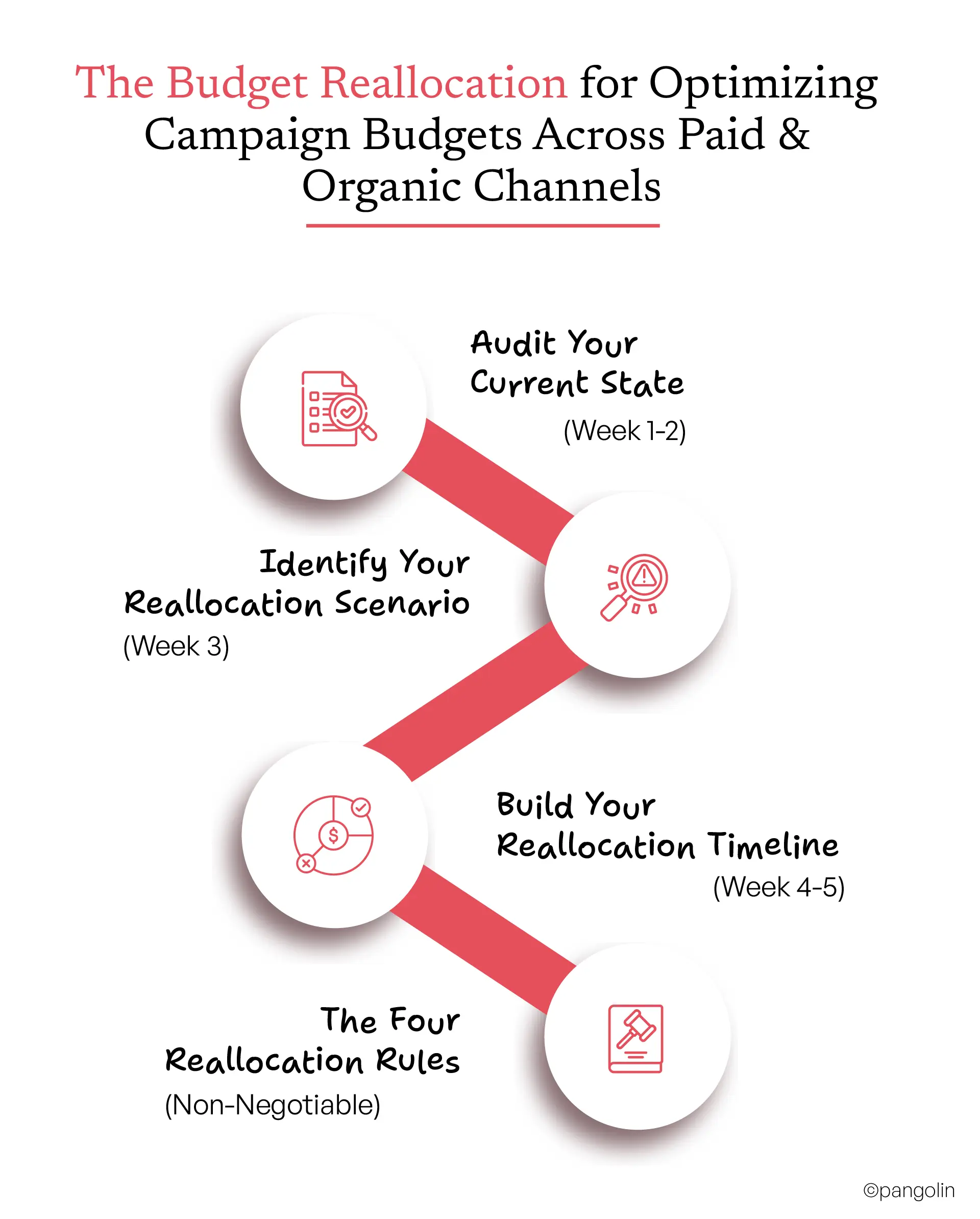
Here's the framework that works:
Pull these numbers:
For each channel, calculate:
Once you see the full picture, the reallocation path becomes obvious.
Action: Reallocate 10-15% from paid search to content + SEO targeting those high-CPC keywords. Create content that ranks for the keyword naturally. When you rank position 1-3 organically, you own that search without CPCs.
Timeline: 4-6 months for ranking; savings compound for 18+ months after that
Financial impact: High-CPC keywords ($5-$15/click) = $1,000-$3,000/month savings once ranked
Action: Shift 15-20% from paid to content + SEO. You're not abandoning paid; you're doubling down on what's working and letting paid maintain existing performance.
Timeline: Immediate; organic ramp accelerates in months 2-4
Financial impact: Content ROI compounds over time; 12-month view shows 30-50% total pipeline improvement
Action: Heavy paid spend (60-70%) to validate market and generate leads. Invest in content/SEO (25-30%) now while paid generates revenue, so organic engines start working for you in 6 months.
Timeline: Month 1-3 paid-heavy; month 4-6 organic starts contributing; month 7-12 organic takes increasing share of lead volume
Financial impact: Fast validation + long-term efficiency; best of both worlds
Action: Reduce paid on brand keywords where organic already dominates (you own those searches). Increase paid on competitor keywords (customer actively shopping competitors). Maintain organic investment to protect your moat.
Timeline: Immediate paid optimization; ongoing organic maintenance
Financial impact: 20-30% reduction in paid spend with same or better lead volume
Don't reallocate all at once. Incremental shifts reduce shock and allow you to course-correct.
Month 1: Test Phase
Month 2: Optimize Phase
Month 3: Scale Phase
Example Timeline:
Current state: 40% paid search, 10% SEO, 30% content, 20% email
Month 1 shift: 40% paid → 35% paid; 10% SEO → 15% SEO (shift $5K/month)
Month 2 shift: 35% paid → 30% paid; 15% SEO → 20% SEO (shift $5K/month)
Month 3 goal state: 30% paid, 20% SEO, 30% content, 20% email
Rationale: Test hypothesis that organic is underinvested; fund hypothesis with data rather than faith
Most teams treat paid and organic like they're in competition. This is the biggest mistake.
In reality, they amplify each other when integrated.
High-converting PPC keywords reveal buyer intent. When you see a keyword generating $8 revenue per $1 spent in ads, you know that keyword has serious demand and high conversion potential.
Create organic content targeting that keyword.
Six months later, you rank for that keyword organically. You're now capturing that same high-intent audience for $0 per click instead of paying for it forever.
Real math:
Outcome: Rank for keyword organically in Month 4. Stop paying for clicks. Generate the same 15 clicks/month for 18+ months at $0 cost. ROI on $3K investment: $38,880+ over the 18-month window.
When you rank organically for a keyword, users see both your organic result AND your paid ad.
Pre-existing familiarity increases click-through rate on the ad (they saw you ranking at top, now they see your ad below it—trust compounds).
Better landing page relevance (you built organic content + paid landing page around the same keyword → consistency → higher Quality Score → lower CPCs).
Real impact:
Same 15 clicks/month. Cost drops from $120 to $72. Savings: $48/month or $576/year ongoing.
Multiply this across 20+ high-value keywords and you're looking at $10K+ annual PPC savings from organic ranking improvements alone.
Organic content attracts visitors. They don't buy immediately; 99% leave without converting.
Email nurturing converts those visitors. They get a sequence of emails educating them.
When they're ready to buy, you retarget with paid ads showing them exactly what they've been learning about.
The three channels work as a funnel:
Result: 14x conversion rate vs. paid alone
This is why channels together outperform channels separately.
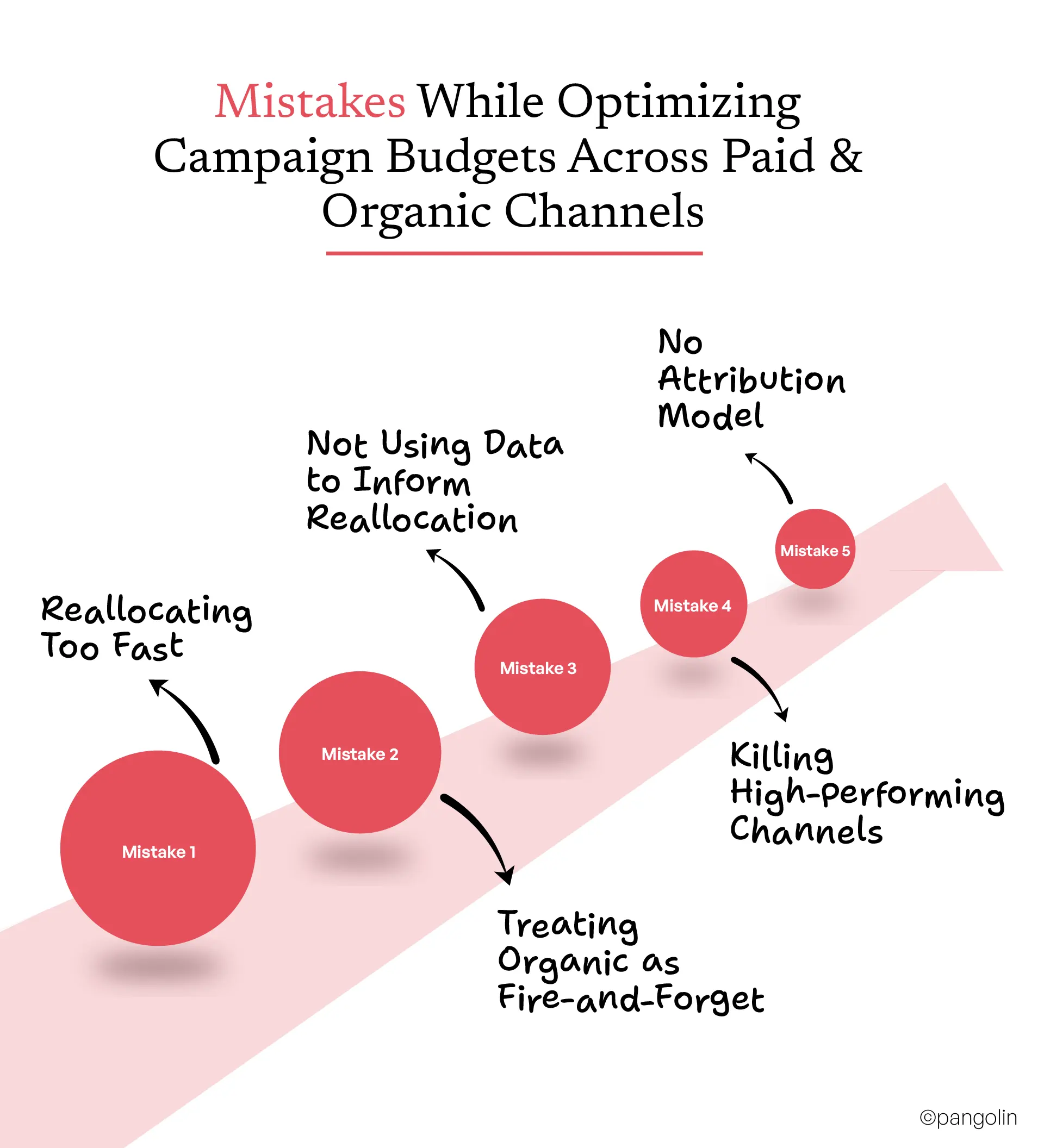
Temptation: Your CFO says "We need to improve efficiency immediately." You cut pay by 30% and reallocate to organic overnight.
Reality: Organic takes 4-6 months to mature. You've now cut paid before organic is contributing, created a lead generation cliff, and organic isn't ready to fill it.
Fix: Phased reallocation over 3 months, not weeks. Slow enough that organic can ramp before paid falls off.
You shift the budget to SEO and content. For 3 months, nothing happened. You blame the marketing team. You cut the budget. Ranking starts to work in Month 4... but you've already killed it.
Fix: Commit 6-month timelines for organic maturity. Document this timeline with leadership upfront so they're not surprised by the 90-day "slow period."
You guess at which channels to cut. You cut the wrong ones. Pipeline suffers. You blame the reallocation strategy instead of the data gaps.
Fix: Audit actual performance (ROI, CAC, conversion rates) before cutting anything. Let data drive the decision, not intuition.
Paid search generates 250 leads/month. Email generates 8,000 subscribers/month. You cut paid and overinvest in email.
Reality: Paid is bringing in new customers; email is engaging existing customers. Cutting paid starves the pipeline of new prospects.
Fix: Understand channel roles before reallocating. Paid = acquisition; Email = retention. Both are necessary. Reallocate within similar roles (paid to organic acquisition, not paid to email retention).
You reallocate based on last-click attribution: "Paid search got 70% of closes, so it's our best channel."
Reality: Organic built awareness; email built consideration; paid closed the deal. All three contributed.
Real attribution: Paid 25%, Organic 35%, Email 40%.
Reallocation decision changes completely.
Fix: Implement multi-touch attribution before major reallocation. It doesn't have to be perfect; even rough attribution beats last-click guessing.
Your CFO will ask three questions. Here's how to answer:
Answer: "We're not cutting paid search; we're optimizing it. Paid is generating 250 leads at $160 CAC today. Organic is generating 40 leads at $575 CAC because we're underfunding it. When organic is properly funded, it generates leads at $200 CAC with higher conversion rates. At 6-month maturity, organic ROI exceeds paid by 1.7x. We're reallocating to capture that efficiency without abandoning paid."
Data to show: Channel ROI comparison, organic conversion rate advantage, timeline to payoff
Answer: "We're phasing reallocation over 3 months, not flipping a switch. Month 1 we shift 5%, Month 2 we shift another 10%, Month 3 we finalize. If organic underperforms in Month 1, we stop and investigate before proceeding. We're testing the hypothesis, not betting the company on it."
Data to show: Phase-in timeline, contingency decision points, risk mitigation plan
Answer: "Lead generation impact in Months 2-3 as we reallocate. Revenue impact Months 4-6 as organic starts ranking and customer journey lengthens. Full ROI impact visible at 6-month window when organic reaches maturity. By Month 12, we'll have reduced CAC by 30-40% and grown pipeline 15-25% on the same budget."
Data to show: Timeline with milestones, financial projections by month, break-even analysis
Netflix didn't invent streaming. They reallocated their resources to where the future was headed, even though the present looked profitable.
Your marketing budget needs the same decision.
You don't need bigger budgets. Your budget is sufficient. You're just allocating it to the wrong channels in the wrong proportions.
75% of your traffic comes from organic channels. 5% of your budget funds those channels. That gap isn't a feature; it's a massive opportunity.
Your CPCs are rising 15% per year while your budget stays flat. The math doesn't work if you stay on the same reallocation path. You must shift budget toward higher-efficiency channels—organic, email, content—or CAC will keep rising until paid doesn't work anymore.
When you reallocate intelligently, combining paid and organic strategy instead of playing them against each other.
That's not a typo. That's the documented range from companies that got this right.
The 90-day roadmap works. The framework is proven. The data shows the ROI. The only missing ingredient is execution.
The question isn't whether you can afford to reallocate your budget.
The question is: Can you afford not to?
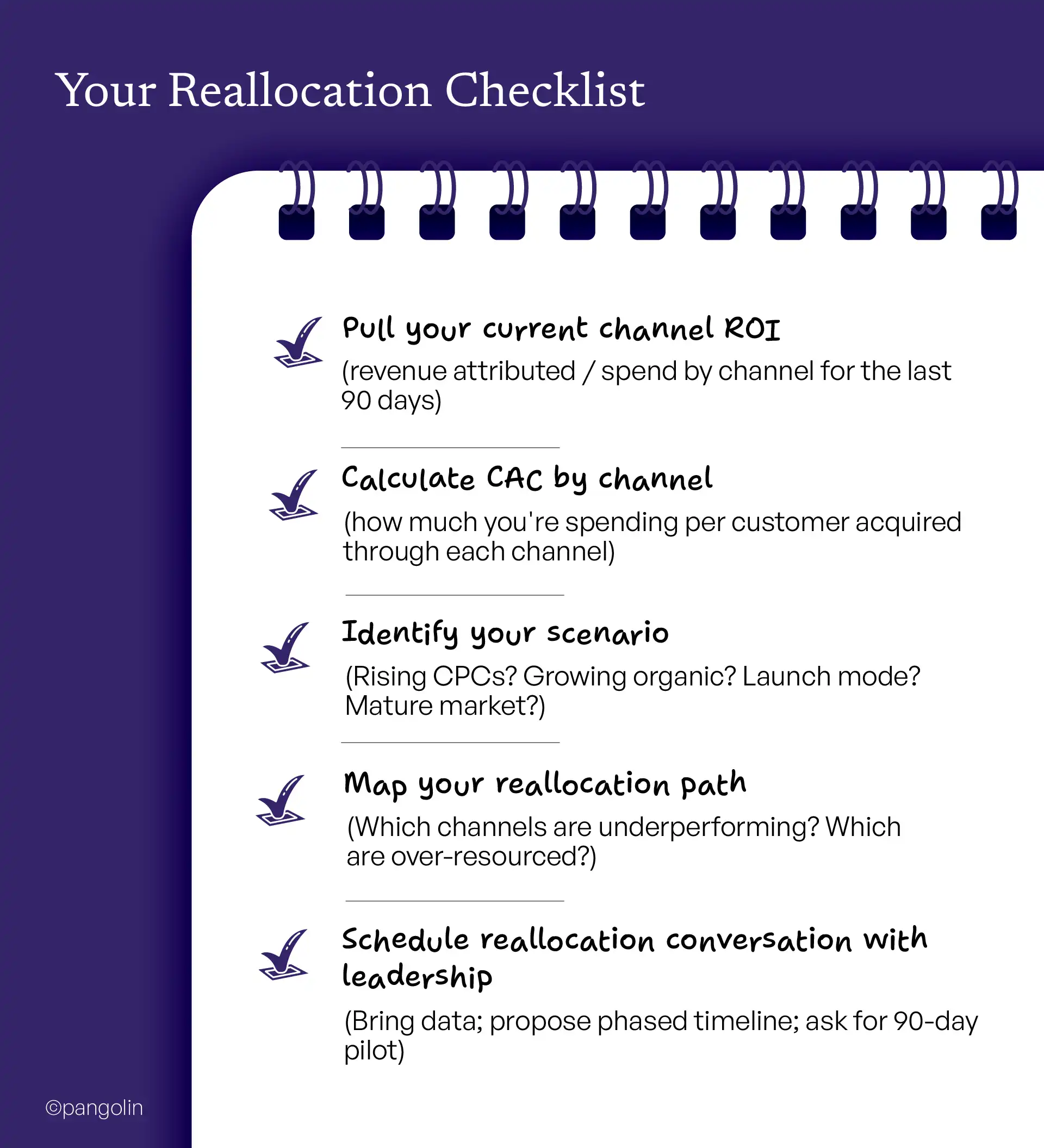
Pangolin helps you reallocate before the crisis.
We've guided B2B, IT services, and SaaS companies through budget reallocation dozens of times. We know exactly where the friction points are:
The gap between companies that reallocate well and companies that reallocate late (or not at all) widens every quarter.
The question isn't whether you should reallocate. The market has already decided that for you.
Or if you want to keep reading:
Other resources that might help:
A generic guide can only take you so far.
We can take you all the way.

