
You've got a product that outperforms the named competitor on every technical benchmark. You've got a product deck and a case study. You've lost three consecutive deals at the procurement committee stage anyway. The gap is that your sales team walks into a room where a CFO, a CTO, and a CISO are evaluating the same product against three completely different sets of criteria, and you've given them one flat document that speaks to none of those criteria with precision. Building an enterprise battle card for B2B sales means constructing a conversation architecture that equips your rep to handle role-specific objections from multiple buying roles in real time. That's what separates companies that win procurement reviews from companies that keep losing at the final stage. Businesses using battle cards report increased win rates at a 71% clip, with the vast majority seeing gains above 20%. The problem isn't whether battle cards work. The problem is that most of them are built wrong for enterprise committee sales.
Standard battle card advice produces a two-column feature comparison: your product versus the competitor, feature by feature. This format works in a single-buyer SMB sale. It fails completely in an enterprise evaluation where three to six buying roles evaluate the same product against different criteria.
A competitive battle card framework for B2B enterprise deals must account for domain translation requirements. The CFO needs commercial risk framing. The CTO needs integration architecture detail. The CISO needs security posture evidence. A single card written for all three serves none of them. An enterprise battle card addressing CFO, CTO, and CISO concerns requires separate registers for each role's evaluation criteria.
Technical credibility constraints make this worse for Series B companies. A Fortune 500 procurement committee will probe claims your SMB buyers never questioned. One inaccurate technical statement in a CISO's presence can disqualify you from the evaluation entirely. Generic competitive summaries carry that risk in every meeting.
The Four-Layer Enterprise Battle Card Framework produces a role-specific conversation architecture for multi-stakeholder procurement evaluations. It has four components because enterprise deals are won or lost across four distinct buyer registers, and this competitive battle card framework for B2B addresses each one.
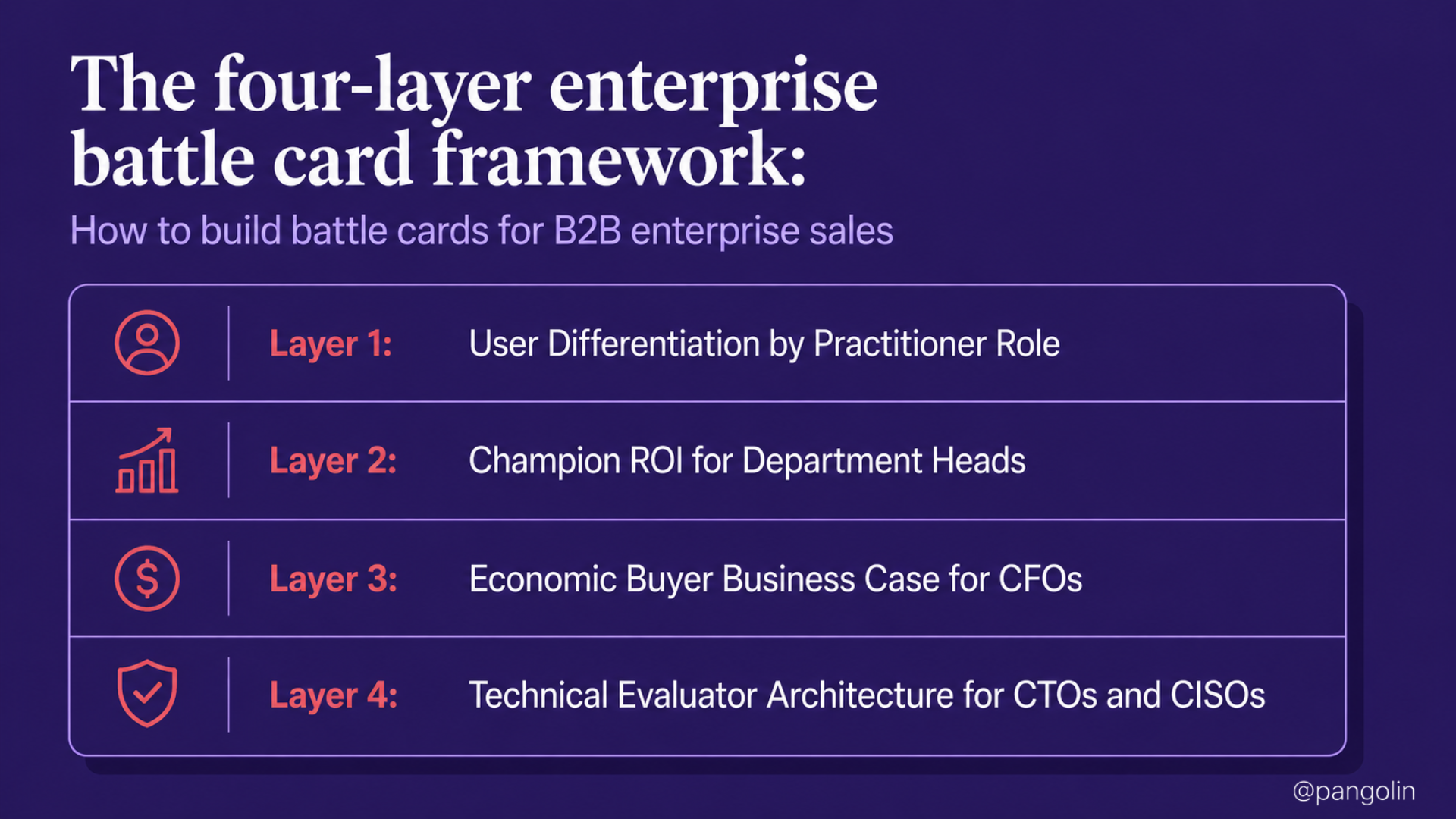
This layer maps your product's daily-use advantages in the vocabulary of the individual practitioner. It produces talking points that resonate with the person who will actually use the software every day.
In practice, this means writing separate cards for a SOC analyst versus a DevOps engineer. Each card names the specific workflow friction your competitor creates and the specific relief your product delivers in that practitioner's language.
This layer gives your internal champion the exact business case they need to justify budget approval within their department. It produces function-specific ROI framing tied to metrics that department heads report on quarterly.
For a sales battle card template in enterprise contexts, this looks like a card showing a VP of Engineering that your platform reduces deployment cycles by a specific number of days, with a named proof point from a comparable company.
This layer addresses how the CFO evaluates commercial risk and return. It produces a proof point hierarchy structured to survive a finance team's review, not just a sales conversation.
An enterprise battle card for CFO evaluation includes total cost of ownership over three years, switching cost analysis, and vendor risk scoring. The proof points are ordered by verifiability: audited metrics first, then customer-reported metrics, then projected savings.
This layer addresses integration risk, security posture, and technical fit. It's the layer that kills deals at the final stage when it's missing, and it's the one most Series B companies skip entirely.
An enterprise battle card for CTO and CISO evaluation includes architecture diagrams, compliance certifications (SOC 2, HIPAA, FedRAMP where applicable), and specific answers to the integration objections your competitor raises about your platform. This is where technical superiority becomes provable.
When all four layers are in place, you have a complete system for building battle cards for B2B enterprise sales that matches each buyer's evaluation criteria.
The mistake is building one battle card for all buying roles and distributing it as a reference document. Technically strong companies make this mistake because their product advantage feels self-evident. They assume a feature list speaks for itself.
The commercial consequence is predictable: deals die at the procurement stage. The CFO sees no business case. The CISO sees no security evidence. The CTO sees marketing copy where architecture detail should be.
The correction is building role-specific cards using a competitive battle card framework for B2B that treats each card as a conversation script, not a fact sheet. An enterprise battle card addressing CFO, CTO, and CISO concerns gives the sales rep exact language for each objection, mapped to the buyer role raising it. A sales battle card template for enterprise use should specify the objection, the buyer role, the response, and the proof point, in that order.
A document that doesn't do this is a competitive summary. Competitive summaries don't win procurement reviews.
CI53 and IntelliTrans both faced enterprise evaluations requiring technical credibility across multiple buyer roles, with no existing competitive intelligence infrastructure. CI53 operates in a regulated technical domain. IntelliTrans was preparing for a Tata Motors-scale enterprise evaluation with a compressed timeline. Both needed a competitive battle card framework for B2B that could hold up under scrutiny from technical evaluators.
Pangolin built role-specific battle card libraries for both companies. CI53's cards addressed CISO-level evaluation criteria across their regulated domain. IntelliTrans received a complete competitive intelligence stack within four weeks, with enterprise battle card content structured for CFO, CTO, and CISO review simultaneously.
The outcome: CI53's battle card library achieved zero technical accuracy corrections across a regulated domain, a sales battle card template for enterprise use that their technical evaluators validated without revision. IntelliTrans activated their sales team immediately for enterprise-scale evaluation.
See the full CI53 and IntelliTrans case study →
Build in-house if you have a PMM hire with prior competitive intelligence experience and six or more weeks before your next enterprise evaluation. Your sales team must be willing to contribute win-loss interview time. A competitive battle card framework for B2B built internally works when you have the domain expertise and runway to iterate.
Use a hybrid model when your sales team can provide competitive objection data but lacks the structure to build cards. An external partner builds the enterprise battle card architecture for CFO, CTO, and CISO roles while your team supplies the raw competitive intelligence. This preserves institutional knowledge while adding professional card structure.
Bring in an external specialist when you have no competitive intelligence capability in-house and an enterprise evaluation in under 30 days. Domain translation requirements in cybersecurity, fintech, or healthtech make this critical. One inaccurate claim damages credibility with the technical evaluator permanently. A sales battle card template for enterprise use requires domain fluency. Pangolin builds these for B2B tech companies entering enterprise evaluations with compressed timelines.
Pull your last three loss reports and map every objection by buyer role: CFO, CTO, CISO, VP Engineering. This single action reveals the pattern your current materials don't address. Once you've mapped objections by role, you have the input layer for the competitive battle card framework, and you can build a sales battle card template for enterprise use that matches each objection to a specific proof point.

Aniket leads content marketing at Pangolin, writing and editing for B2B tech clients who need sharp messaging and consistent output. He came from journalism and brings that newsroom discipline to content work, turning drafts around quickly and keeping quality high.