
TL;DR
I once sat across from a founder who told me he left his previous company because the company's strategy changed depending on which book the CEO was reading that week. One month it was Blue Ocean Strategy, so everything had to be "uncontested market space." The next month someone gifted him a copy of The Hard Thing About Hard Things, and suddenly the entire org was in crisis mode, doing layoffs for discipline's sake. The month after that, it was some podcast about community-led growth, and the sales team was told to stop selling and start "building tribes."
The founder sitting across from me wasn't angry. He was tired. He said: "It wasn't that he didn't do anything. He did too much all the time, in every direction. And none of it ever landed."
That conversation has stayed with me for years because it captures something I've been thinking about almost obsessively. If you forced me to name one superskill, one single trait I look for in people more than anything else, it would be this:
The ability to get things done.
I mean it in the most literal way. Tangibly, in the real world, things get done. Talking about getting things done does not count. Theorizing about it does not count. Building elaborate systems around it, or attaching urgency to it like a siren on an ambulance carrying nothing inside, does not count either.
There are roughly three kinds of people in any organization, and only one of them moves the needle.
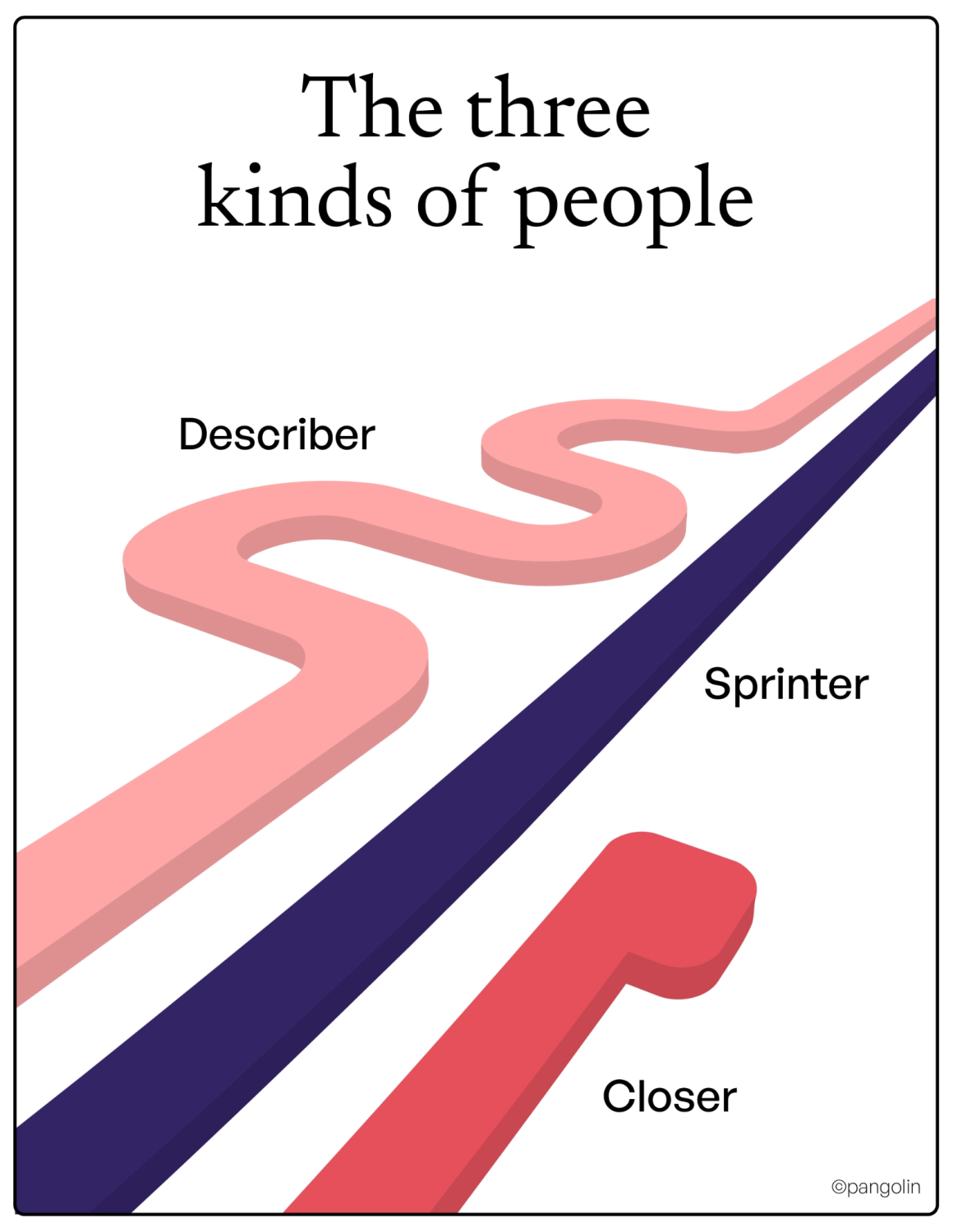
The first kind is the Describer. The Describer is brilliant at articulating problems. They can map the landscape. They can draw the quadrant. They can tell you, with extraordinary clarity, why something isn't working and what the ideal solution would look like. Their slides are gorgeous. Their frameworks are airtight. And six months later, nothing has shipped. Nothing has changed. The diagnosis was perfect, and the patient is still sick.
Describers are seductive because they sound like they're doing the work. In meetings, they dominate. On paper, they impress. But if you watch closely, there's a tell: they never have scars. They never talk about the thing that went wrong at 11 PM on a Thursday because they were in the middle of actually building it. Their hands are clean. That's the giveaway.
The second kind is the Sprinter. The Sprinter has overcorrected for the Describer's sin. They worship speed. Everything is urgent. Everything is "let's just get it out." They confuse motion with progress, activity with output. They'll launch the campaign before the strategy is done, ship the feature before anyone's talked to a customer, hire three people before defining what the role actually needs.
The Sprinter is dangerous because they look like they're getting things done. The calendar is full. Slack is buzzing. The energy is high. But if you trace the arc of their work over six months, you find a trail of half-built things. Launches that didn't land. Initiatives that were abandoned the moment a newer, shinier initiative appeared. They are busy in the way a hamster wheel is busy.
And this is where the book-reading CEO fits. He was a Sprinter. He read something, got excited, and within 48 hours had redirected the entire company toward a new mountain. He wasn't lazy. He was ferociously active. But the organization was exhausted, whiplashed, and building nothing of lasting value.
The third kind is the Closer. The Closer does something that sounds simple but is actually extraordinarily rare. They take a thing from idea to completion, navigating every boring, ugly, unsexy step in between.
The Closer is the one who, after the meeting where everyone is excited about the new initiative, goes back to their desk and asks: "Okay, but what specifically needs to happen by Friday?" They're the person who follows up when no one else does. Who sends the uncomfortable email. Who notices that the timeline has slipped by two weeks and says something about it instead of hoping it resolves itself. Who does the part of the work that no one wants to do. The reconciling, the QA, the tenth revision, the difficult conversation with the vendor.
Closers don't always have the best ideas. They aren't always the most articulate person in the room. But they are the reason anything actually exists. They are the bridge between what a company says it will do and what it actually does.
I run an agency. We work with multiple clients simultaneously, across campaigns, content pipelines, brand systems, GTM strategies. And the single biggest predictor of whether a motion succeeds or fails has nothing to do with budget, timeline, or even the quality of the brief. What decides it is whether there's a Closer on the team.
I've seen a beautifully funded project with a six-month runway and executive sponsorship die slowly because every single person involved was a Describer. And I've seen an underfunded, half-baked idea come to life in weeks because someone on the team simply refused to let it stay hypothetical.
When I hire now, I listen for a very specific thing in interviews. I've stopped asking "tell me about a project you're proud of," because everyone has a rehearsed answer for that. What I listen for now is the texture of how they talk about work. Do they mention the obstacle that almost killed the project? Do they talk about the thing they had to redo three times? Do they reference the moment they realized no one else was going to handle a certain piece, so they just handled it?
Closers talk about work the way someone who has cooked a meal from scratch talks about cooking. There are burns. There are substitutions. There's the part where the recipe didn't work and they improvised. What you hear is a lived account, the texture of someone who was actually in it.
Describers talk about work the way a food critic talks about dinner.
Now, the harder question. Because identifying Closers is one thing. Building a culture where Closing is the norm, where getting things done is the water everyone swims in rather than a trait held by a few heroic individuals, that's something else entirely.
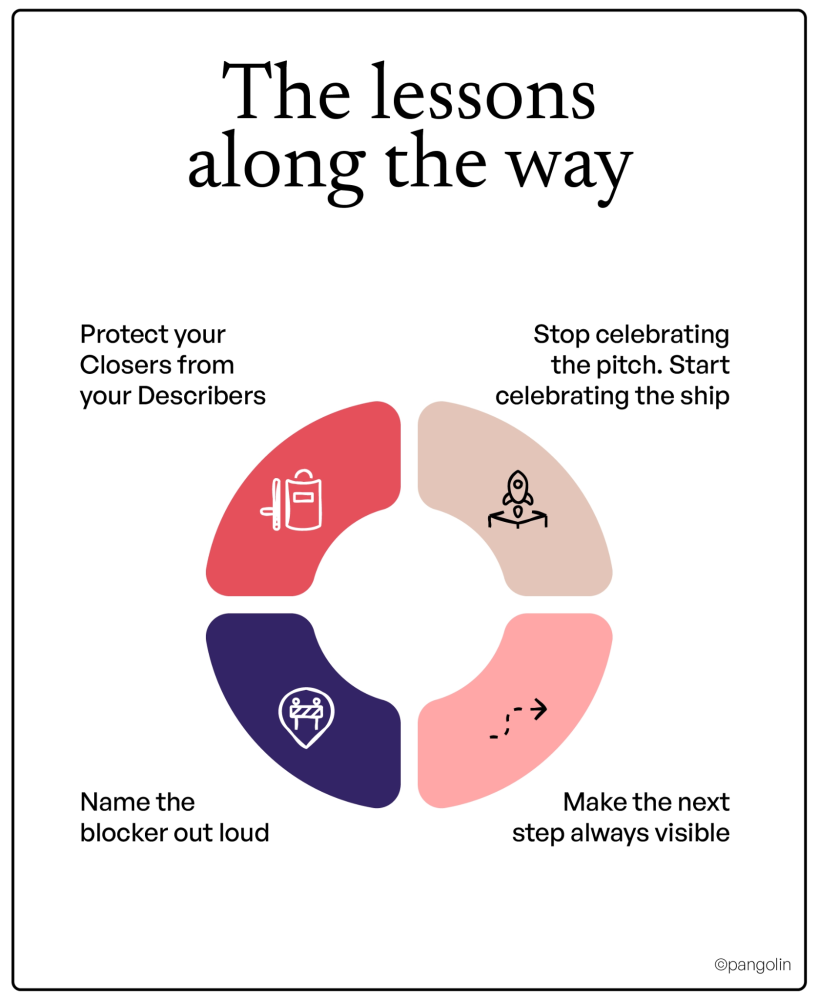
A few things I've learned, mostly the hard way:
Stop celebrating the pitch. Start celebrating the ship. Most organizations over-index on the moment of ideation. The brainstorm. The strategy deck. The big-room presentation. These are useful, but they are only the beginning. If you want people to get things done, make sure the thing that gets applause is the finished thing. The campaign that went live. The system that's running. The client who renewed because of work that actually happened.
Make the next step always visible. The reason things stall is rarely that people don't care. Usually the next action is just ambiguous. Compare two versions of the same instruction. "We need to finalize the content strategy" leaves everyone guessing. "Rina is sending the draft keyword map to Arjun by Wednesday for review" tells everyone exactly what happens next. Specificity like that is a kindness. It removes the fog that lets things drift.
Name the blocker out loud. In every stalled project I've ever autopsied, there was a moment where someone knew something was stuck and said nothing. They were waiting for someone else to notice. Or they didn't want to be the bearer of bad news. Or they assumed it would work itself out. It never works itself out. The culture you want is one where saying "this is stuck, and here's why" is treated as a professional act, the thing adults do. Nobody should hear it as a confession of failure.
Protect your Closers from your Describers. This sounds harsh, but it's real. Describers generate work for Closers. Every new idea, every reframe, every "what if we also..." creates a task that the Closer will end up carrying. If you don't build a filter, a way to evaluate whether a new idea is worth the execution cost, your Closers will burn out, quietly, and then leave. And you will be left with a room full of people who can describe the problem beautifully and do absolutely nothing about it.
I keep coming back to something a mentor told me years ago. She said: "The world is full of people who can describe the architecture of a cathedral. Very few people can lay the first brick and then show up the next day to lay the second one."
That's it. That's the whole thing. Lay the brick. Come back tomorrow. Lay another one.
If you're building a team, put the brick-layers at the centre. Everything else is commentary.