In 2018, Tesco did something unforgivable.
They halved the value of Clubcard points overnight.
Customers who'd been saving points for months woke up to find their points worth 50% less.
The backlash was instant and brutal. Social media exploded with angry customers calling it a betrayal. Longtime shoppers walked away. "I felt like my loyalty meant nothing," one customer wrote. "They just took it away like it was theirs to take."
Then in 2023, Tesco did it again. Another devaluation, another round of fury, another wave of customers deciding they were done.
Here's what's fascinating about the Tesco story: the program wasn't technically broken. Points still posted, rewards could still be redeemed and the mechanics worked fine.
But Tesco forgot one critical thing: loyalty is about how you make people feel.
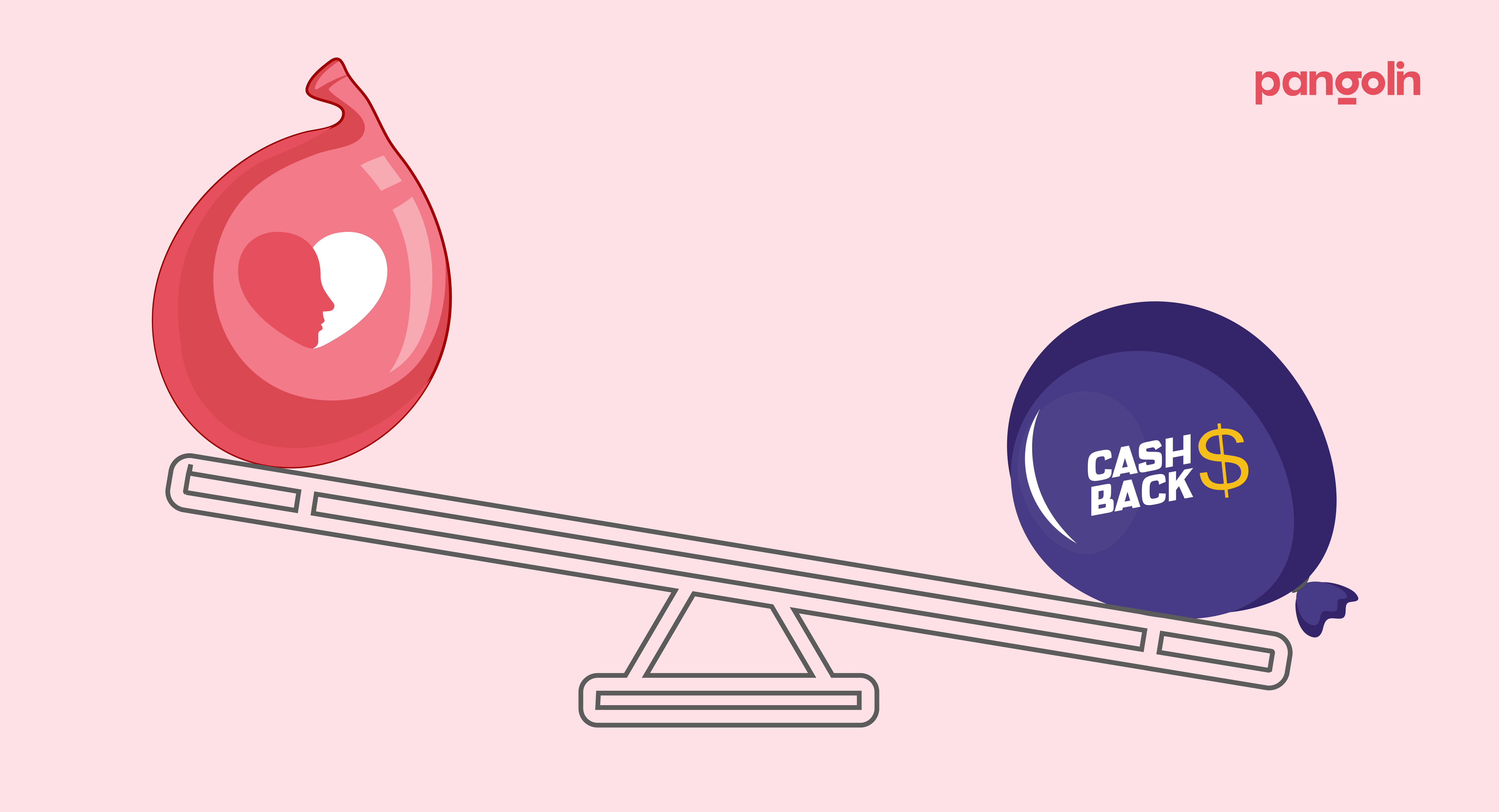
When you build loyalty on transactions alone, when your only promise is "spend money, get money back," you're not creating connection. You're running a vending machine and vending machines are easy to replace the moment someone offers a better deal.
That's the trap 97% of loyalty programs fall into. They think cashback equals loyalty. They measure enrollment numbers and call it success. Meanwhile, 50% of their members go inactive within months, their partners switch to competitors for 2% more, and the program bleeds millions in wasted spend.
The 3% of programs that actually work? They understand something Tesco learned the hard way:
Humans don't stay loyal to spreadsheets. They stay loyal to stories, status, community, and brands that make them feel something worth keeping.
Let's talk about why emotional loyalty beats cashback every single time, what the science says about it, and how you build it without becoming another Tesco cautionary tale.
Let's start with the math that doesn't work.
You run a loyalty program. Partners spend $1000, you give them $10 back. That's a 1% effective discount. Your competitor offers 12% instead of your 10% and your partner switches instantly. You raise yours to 13%. The competition goes to 15%. Round and round, eroding your margins until nobody's making money and everyone's miserable.
This is what researchers call "transactional loyalty." And here's the thing about transactional loyalty: it's loyalty to the offer, not the brand.
When your entire value proposition is "we pay you," you've made yourself replaceable. The moment someone pays more, your partner leaves.
97% of loyalty programs rely completely on transactional rewards like discounts, points, cashback and 97% of loyalty programs fail.
Here's what cashback fundamentally misses:
It doesn't solve real partner needs.
An electrician doesn't just want 8% back on wire purchases. He wants to be recognized as a skilled professional, not treated like interchangeable labor. He wants training that makes him better at his craft, a certification he can display at job sites that signals expertise and wants opportunities that advance his career.
A retailer doesn't just want margin support. She wants tools to grow her business, business coaching that helps her manage inventory better, she wants access to other successful retailers so she can learn what's working in different markets. She wants to be seen as a partner, not just a sales channel.
Cashback gives them none of this. It treats them like vending machines: put in purchases, get out money. It's efficient, measurable, soulless and it dies the moment someone offers a slightly better percentage.
It builds loyalty BEFORE purchase, not AFTER.
Transactional programs work backwards. Partners enroll for the discount, make one purchase, wait 15 days for points to post, get frustrated by the delay, forget about the program, and never come back.
The discount created a transaction not a relationship or emotions.
Emotional loyalty works the opposite way: you design experiences AFTER the purchase that make partners feel valued, respected, recognized, and part of something meaningful. That feeling creates the memory. The memory creates the return visit. The return visit creates the habit. The habit creates lifetime value.
It makes you commoditized.
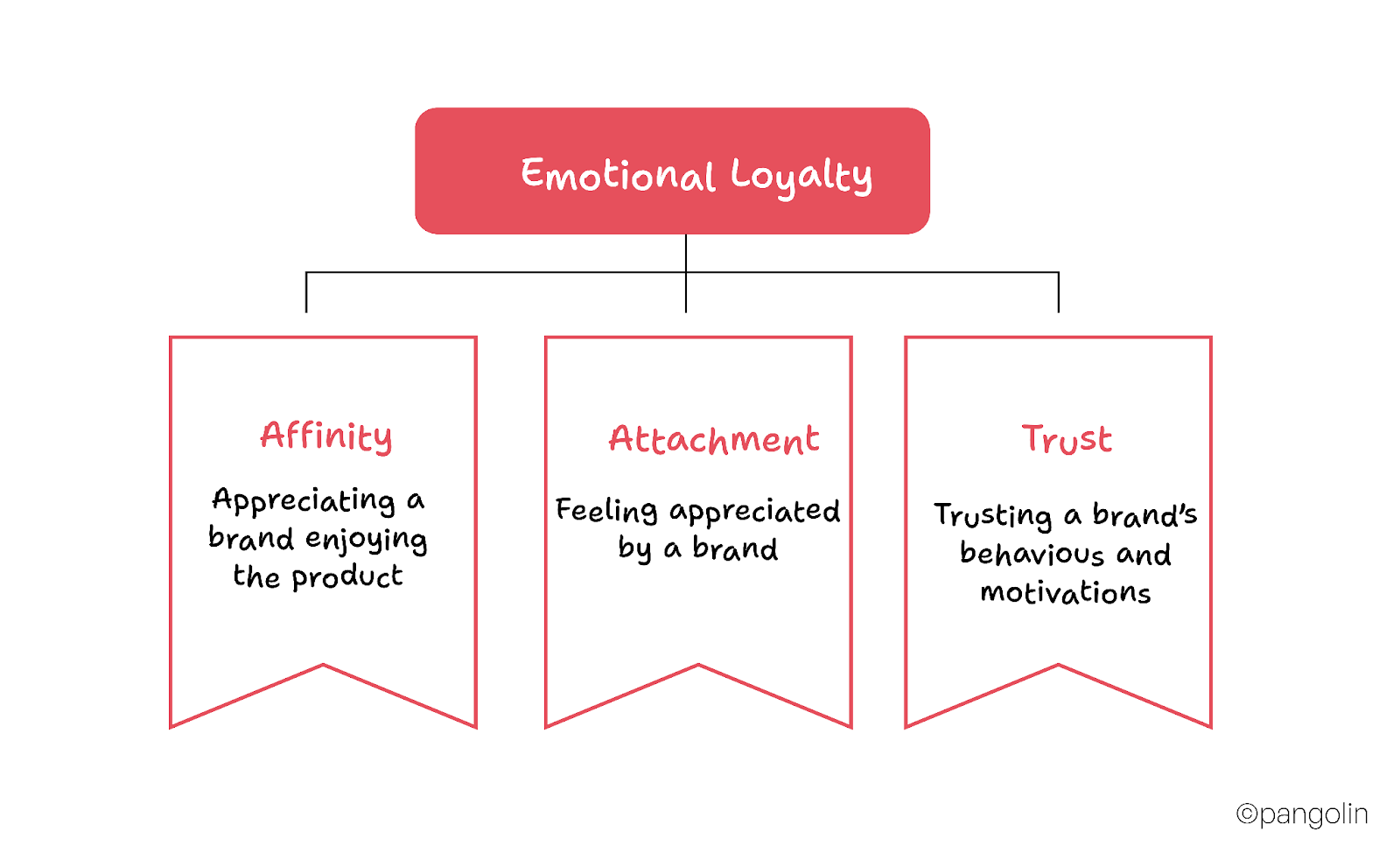
Here's where it gets interesting. The gap between emotional and transactional loyalty is so wide it's almost unfair.
Emotionally connected customers have 306% higher lifetime value than satisfied-but-not-emotionally-connected customers.
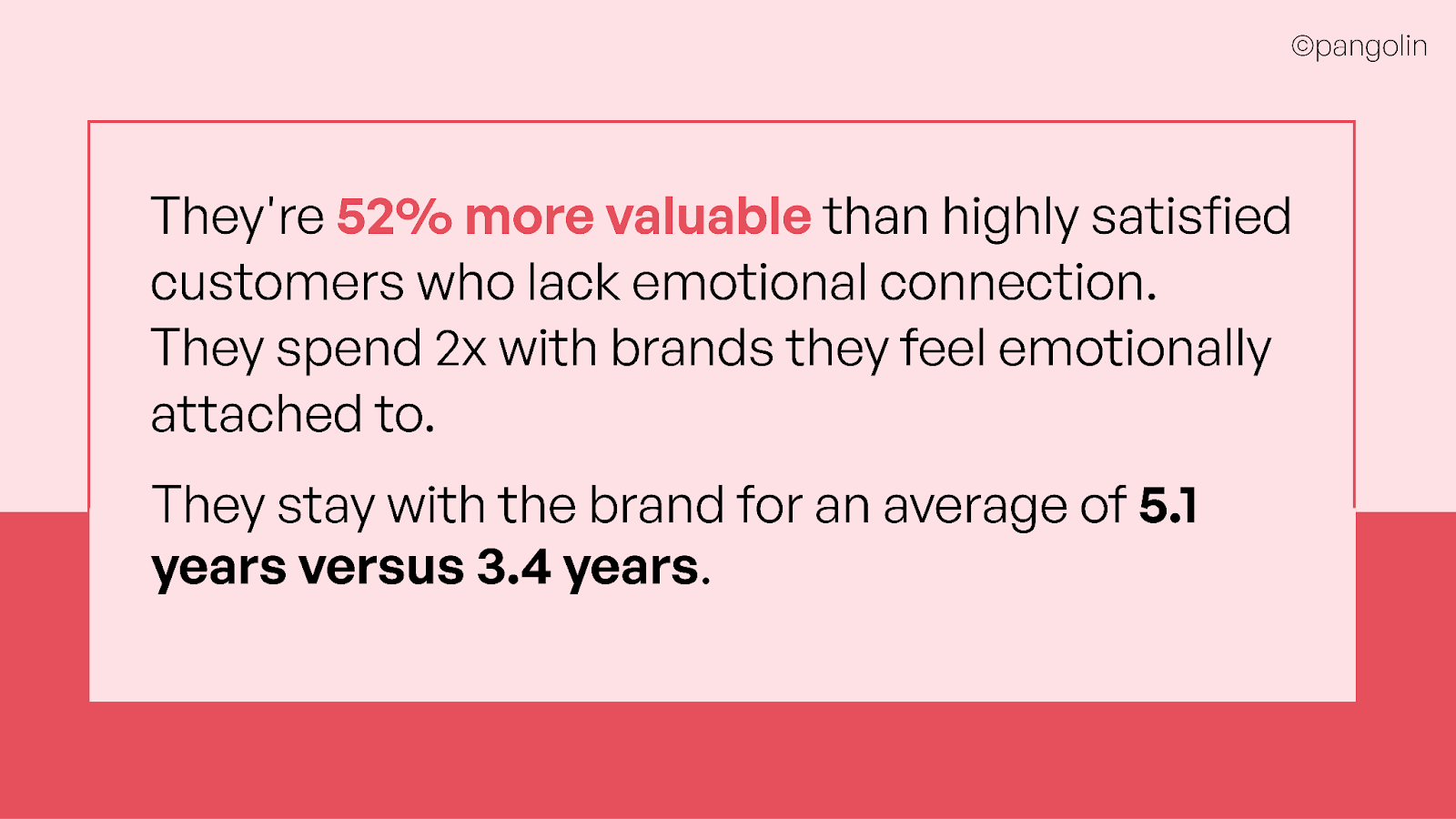
Partners with emotional connections are 82% more likely to remain loyal when considering purchase decisions.
They recommend brands at 30.2% versus 7.6% for satisfied-only customers. That's a 4X multiplier on unpaid advocacy. They become your sales force, recruiting peers without you asking, defending your brand against competitors, and amplifying your message organically.
In transactional programs, referral rates sit below 5%. In emotional programs, they jump to 15%+. That difference compounds. Every emotionally connected partner brings 2-3 others. Every transactionally-connected partner brings none.
Emotionally connected customers show 20-36% decrease in price sensitivity on average. When partners feel connected to your brand's purpose, when they see you as a career partner rather than a vendor, when they're part of your community, price becomes less relevant.
You're competing on value that competitors can't match with discounts.
Emotional campaigns boost sales by 23% compared to rational campaigns.
Customer acquisition costs drop because emotionally connected partners recruit others.
Marketing efficiency improves because 86% of emotionally engaged consumers expect brands to reciprocate loyalty beyond transactional rewards, they're primed to engage deeper.
Emotional loyalty creates nearly 3X more organic impressions per customer because emotionally connected partners talk about you unprompted.
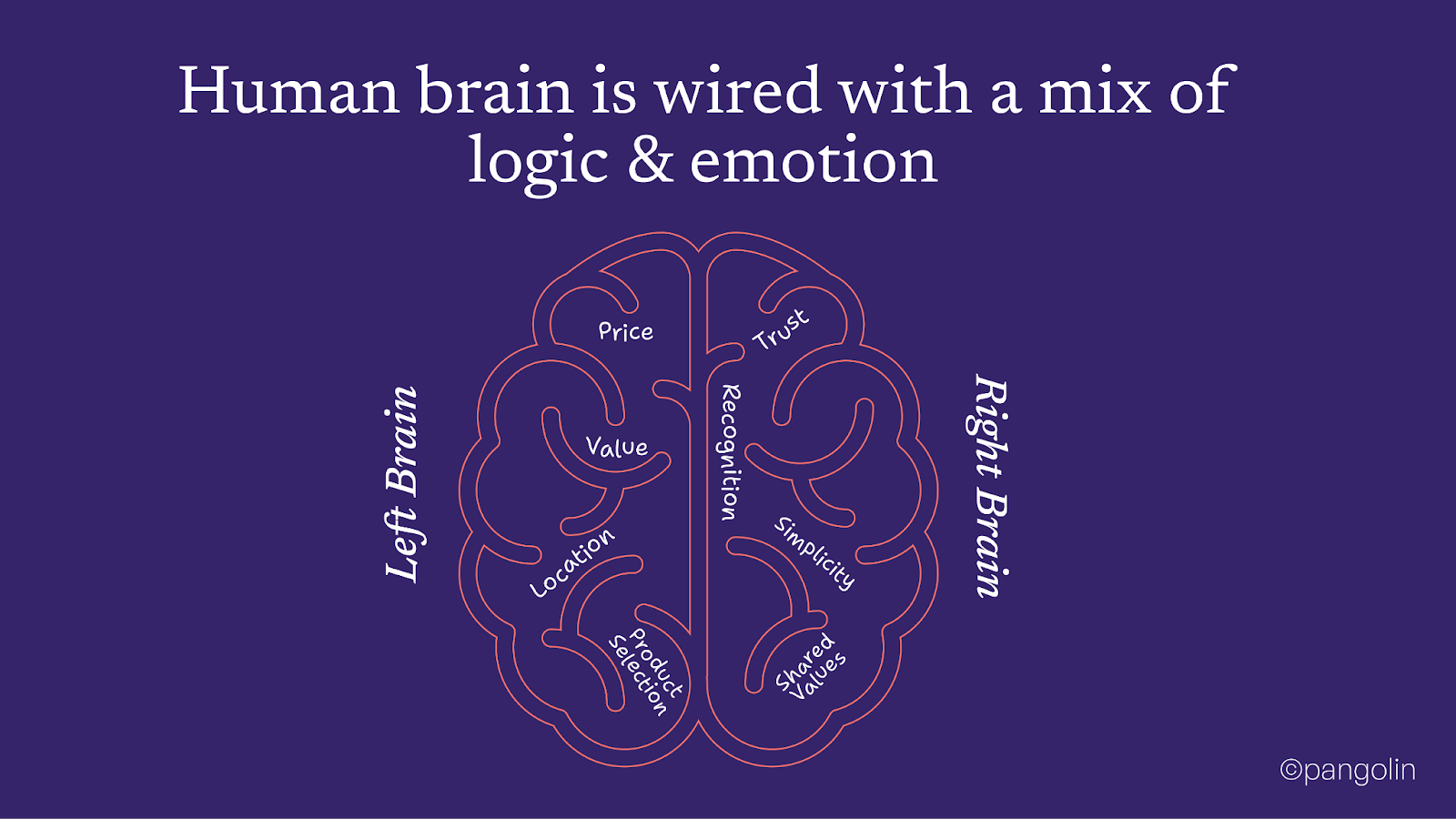
Here's why emotional loyalty works at a biological level.
Your brain processes emotional responses faster than rational thoughts and those emotional responses leave stronger memory imprints. When you feel something, you remember it. When you calculate ROI on a spreadsheet, you forget it by Tuesday.
70% of purchasing decisions are based on emotions. Only 30% are driven by rational thinking.
That's because emotions are efficient decision-making shortcuts. Your brain evolved to avoid threats and seek rewards, and emotional memory is how it learns what's safe, what's valuable, and what to repeat.
When GM Modular turned "Aur Milega" into a career capital promise instead of a cashback offer, they weren't just changing marketing language. They were activating different neural pathways.
Cashback activates your prefrontal cortex- the rational, calculating part of your brain. You think: "Is 8% better than 10%? What's the effective discount? How long until points post?" That's cognitive work. It's exhausting and doesn't create lasting memories.
Emotional loyalty activates your limbic system, the part of your brain that processes reward, connection, status, and belonging. When an electrician earns Gold tier status and gets a physical badge he displays at job sites, his brain releases dopamine - the neurotransmitter associated with pleasure and motivation.
That dopamine hit creates a habit loop.
Scan invoice to get recognition to feel valued to want to repeat.
The loop becomes automatic. It doesn't require conscious decision-making. It's embedded.
Here's the behavioral science stack that makes emotional loyalty work:
Loss Aversion: Humans are more motivated to avoid losses than achieve gains. When a partner earns Gold tier status, loses it by switching brands, they experience that loss emotionally. Cashback has no loss aversion, you just switch to whoever pays more.
Social Influence: Your brain's reward system is highly responsive to social cues. When partners see peers earning recognition, attending exclusive events, or displaying certifications, they want in. Community creates FOMO. Cashback doesn't.
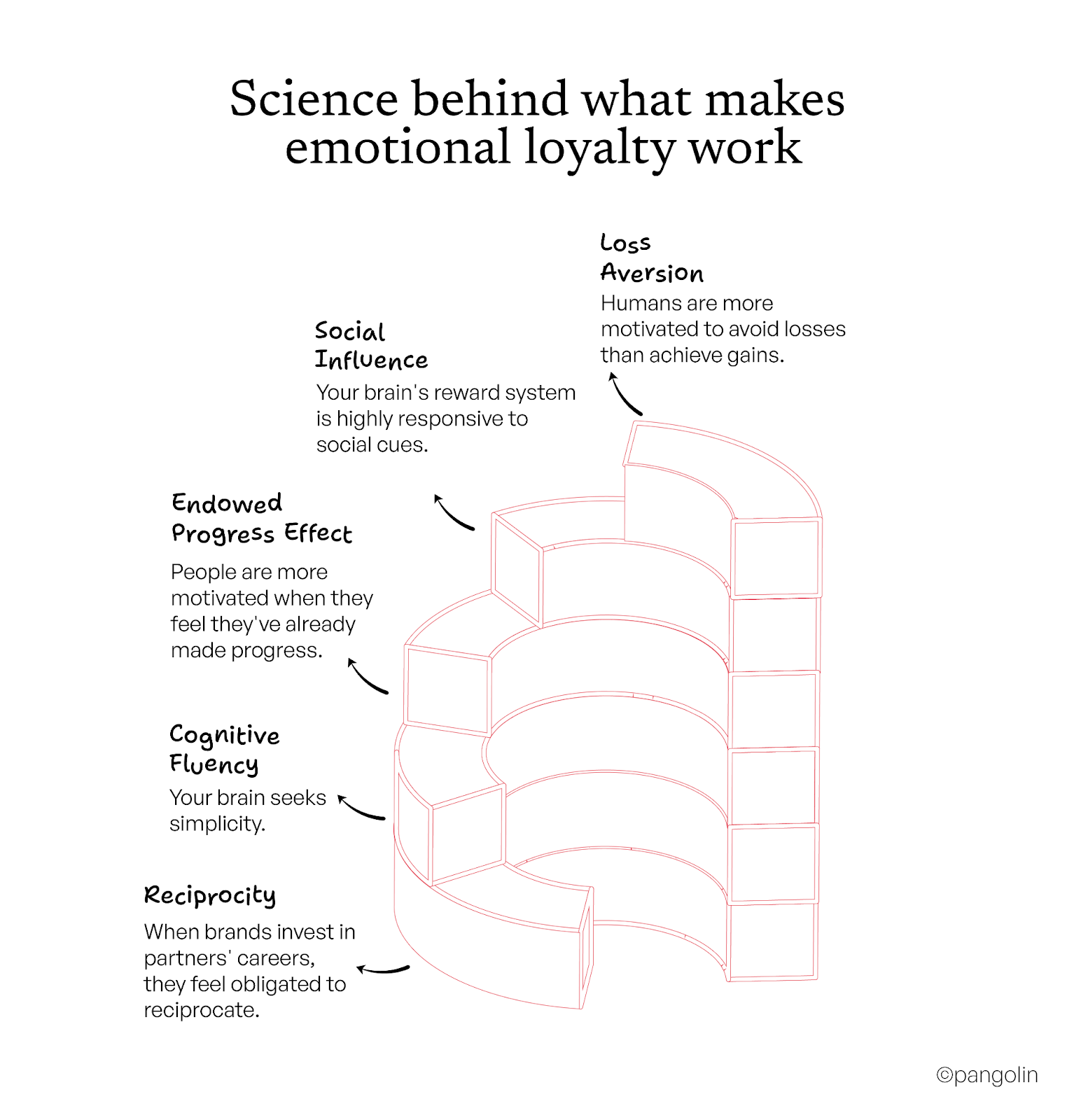
Endowed Progress Effect: People are more motivated when they feel they've already made progress. Tiered loyalty systems with visible progress bars tap into this. You're Bronze moving toward Silver. That partial progress motivates completion.
Cognitive Fluency: Your brain seeks simplicity. Emotional programs that clearly communicate status, progress, and community are easy to understand. Complex cashback calculation structures (spend $50 to earn $5, redeem at $500 minimum, expires in 45 days) create cognitive friction. Friction kills engagement.
Reciprocity: When brands invest in partners' careers through training, family benefits, and real support, partners feel obligated to reciprocate. That obligation is emotional, not rational. It creates loyalty that cashback never touches.
Let's make this concrete. Here's what separates transactional from emotional loyalty:
Transactional loyalty says: "Spend $1000, earn 100 points, redeem at 1000 points for a $10 gift card."
Emotional loyalty says: "Welcome to Bronze tier. Scan 10 invoices and you'll hit Silver where we will prioritise customer support, exclusive webinars with industry experts, and a physical certification card you can show customers. Our top 50 partners each quarter get invited to our annual summit where you'll network with other electrical professionals and meet our product team."
Transactional loyalty offers: Generic rewards catalog with toasters, Bluetooth speakers, and Amazon gift cards, items any competitor can offer.
Emotional loyalty offers: Skill certifications that advance careers, family health insurance, education scholarships for partners' kids, business coaching from industry veterans, advisory council seats where partners shape product roadmaps, recognition events that build status and community.
Transactional loyalty measures: Enrollment numbers, points issued, redemption rates, vanity metrics that look good on slides but don't predict retention.
Emotional loyalty measures: NPS (target: 50+), referral rate (target: 15%+), share of wallet (target: 60%+), brand lift surveys showing emotional connection, active engagement rates (target: 50%+ monthly), advocacy actions beyond purchases.
Here's the fundamental difference:
Transactional loyalty asks: "How much can I get?"
Emotional loyalty asks: "Who do I become by being part of this?"
When you answer the second question, the first becomes irrelevant.
You're probably thinking: "This sounds great, but we've got 30,000 enrolled partners expecting cashback. I can't just flip a switch."
You're right. You can't. But you can start layering emotional tactics on top of transactional infrastructure and measure what moves the needle.
Your first problem is that you can't answer these with data. You're measuring the wrong things.
Don't think that all partners desire the same thing. Segment by role and ask:
Don't use general "everyone gets the same reward" structures. Instead, build emotional strategies that meet their specific demands.
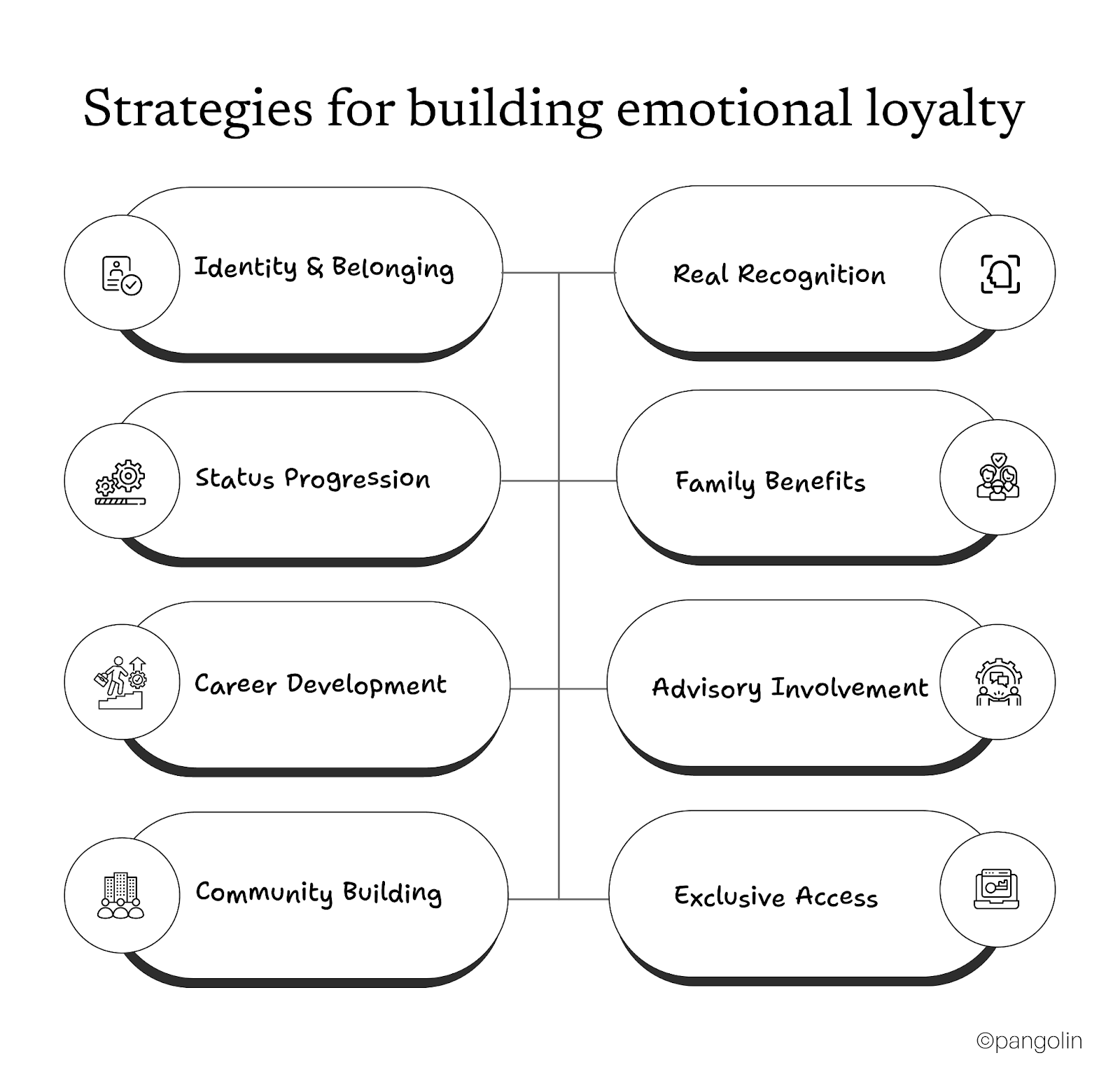
You don't have to kill cashback right away. Add layers of emotion:
Start with a tiered structure: Bronze, silver, gold, and platinum levels with observable progress and status symbols including digital badges, tangible cards, and public recognition.
Make programs to certify skills: Work with training providers to offer courses that partners can take to move up in their careers.
Give benefits to families: Health insurance, scholarships for school, and training on how to arrange your money are all benefits that go beyond work.
Put on events in your area: Quarterly appreciation events, annual summits, and peer learning sessions where partners network and share best practices
Create advisory councils: Ask your best partners for their thoughts on products, prices, and programs.
Don't simply make them customers; make them co-creators.
Do not start this without a sound. Make it a big deal.
To current members: "We heard you. Cashback alone isn't enough. We're adding actual support, professional growth, community, and recognition. "Your loyalty deserves more."
To field teams: "We're not just selling things anymore. We're making partners for our careers. Here's how you sell the new value of "status, skills, community, and belonging."
To the leaders: "We're moving from KPIs for enrollment to measures for engagement.
This is what we'll keep an eye on: NPS, the number of referrals, the share of wallet, and the brand lift.
These stats don't show how many people will sign up for vanity reasons; they show how much money they will make over their lives.
Stop rejoicing when people sign up. Begin keeping track:
NPS: Survey partners every three months. Target: 50 or more for emotional programs and 30 to 40 for transactional programs
Referral rate: the percentage of partners that are actively looking for new mates. Goal: 15% or more of the share of wallet What percentage of your partners' total spending in your category goes to you? Goal: 60% or more
Brand lift: Surveys before and after demonstrating changes in emotional connection
Active engagement: % of people who do things like scans, redemptions, and going to events per month. Target: More than 50%
You're creating emotional loyalty if these numbers go up. If the number of students increases but these stay the same, you're adding inactive accounts.
Here's the choice in front of you:
Option A: Keep running cashback programs.
You'll compete on price forever. Margins will erode. Partners will switch for 2% more. You'll celebrate enrollment numbers while 50% go inactive. Your CFO will eventually ask why you're spending millions on a program that doesn't move retention. You'll become another Tesco cautionary tale, alienating loyal customers by treating loyalty like a spreadsheet line item.
Option B: Build emotional loyalty.
You'll invest upfront in tiers, certifications, community, and family benefits. It'll take 6-12 months to show full results. But you'll create switching costs competitors can't replicate with price. Partners will stay because leaving means losing status, community, and career capital. They'll recruit peers unprompted. Your NPS will hit 50+. Your referral rate will jump to 15%+. Your lifetime value will increase 306%.
Cashback creates commoditization. It's easy to copy, easy to beat, easy to lose.
Emotional loyalty builds a category-defining moat. It's defensible, compounding, and damn near impossible to replicate.
GM Modular chose Option B with "Aur Milega." They turned a transactional program into a movement by positioning it as career capital, not cashback. The result: record engagement, viral adoption, brand transformation from product vendor to career partner.
Castrol, Asian Paints, Bosch, and Greenpanel made the same choice. They built programs around skill development, family benefits, status symbols, and community. They now command premium pricing, partner advocacy, and defensible competitive positions.
The 97% who fail keep running cashback programs and wondering why partners don't stay.
Most companies will read this, nod thoughtfully, and change nothing.
They'll keep measuring enrollment. Keep celebrating vanity metrics. Keep losing partners to competitors offering marginally better cashback. Keep wondering why 50% of members go inactive despite "successful" launches.
A few will see the pattern and act.
They'll audit their emotional loyalty gaps. They'll segment partners by persona and identify what drives connection. They'll layer tiered structures, certifications, family benefits, and community events on top of transactional infrastructure. They'll shift measurement from enrollment to NPS, referrals, and share of wallet. They'll pilot emotional tactics in one region, measure reactivation rates, and scale what works.
And they'll discover what the science already proves: humans don't stay loyal to vending machines. They stay loyal to brands that make them feel valued, recognized, respected, and part of something worth keeping.
Tesco forgot that. Don't make the same mistake.
Ready to transform your loyalty program from transactional to emotional?
Download the Guide : ‘From Cashback to Community,’ a research-grade white paper on trade influencer and channel partner loyalty transformation.
Read the Case Study: See how GM Modular transformed trade loyalty with the "Aur Milega" campaign, turning everyday bargaining language into a career capital movement that drove record engagement and brand transformation.
Book a Loyalty Program Diagnostic: Let's audit your current program, identify emotional loyalty gaps, and map out your transformation roadmap from cashback trap to defensible competitive advantage.

Aniket leads content marketing at Pangolin, writing and editing for B2B tech clients who need sharp messaging and consistent output. He came from journalism and brings that newsroom discipline to content work, turning drafts around quickly and keeping quality high.