TL;DR
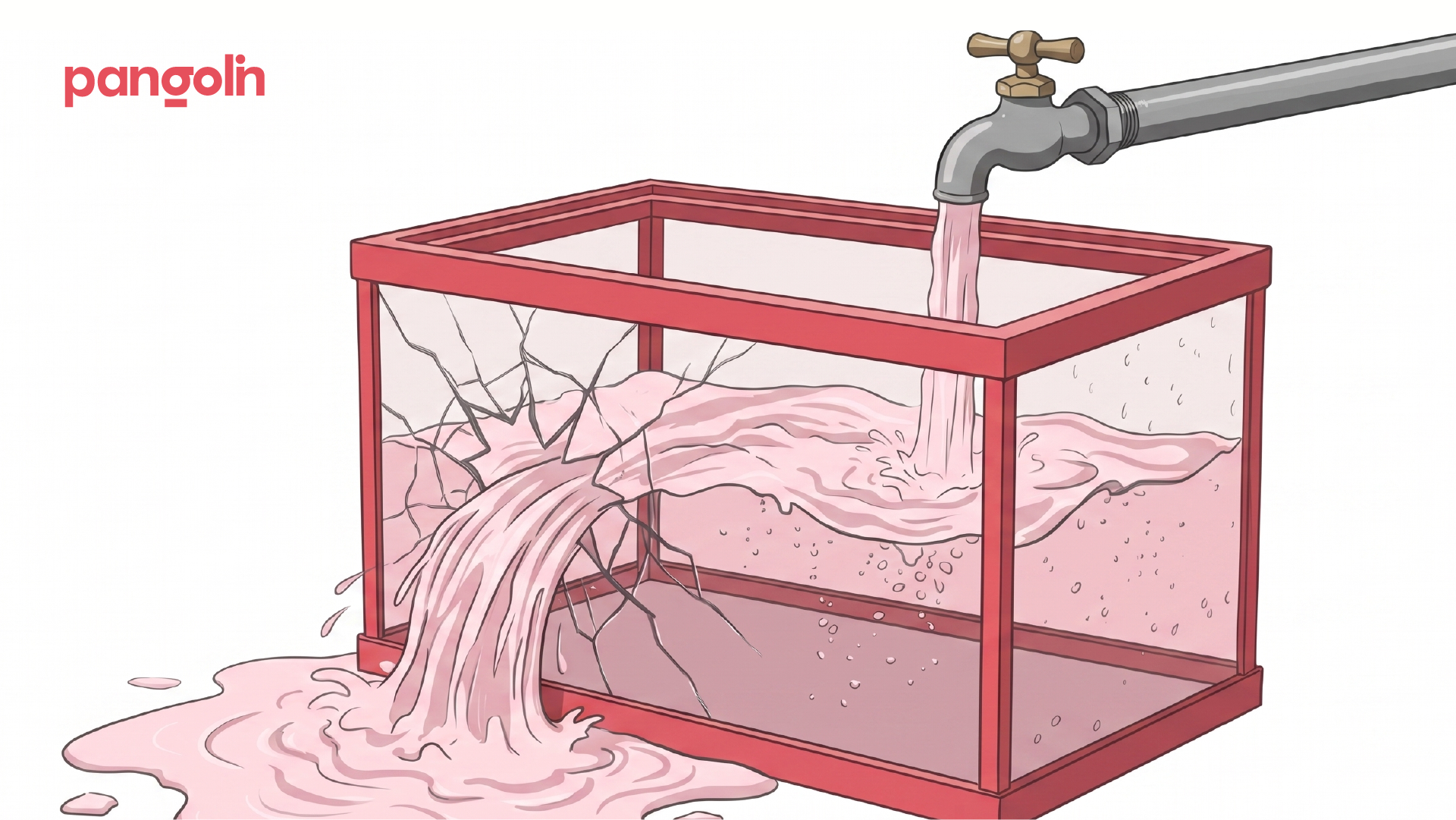
A VP of Marketing hires a demand gen agency. Traffic climbs 300% in six months. Pipeline stays flat. The board asks hard questions. The agency points at click-through rates and impression volume. The VP knows something deeper is broken but can't name it precisely. This is the most common failure pattern in B2B tech marketing: treating a positioning problem as a traffic problem. The difference between product marketing and demand generation in B2B is the difference between a revenue system that compounds and a budget that burns.
Enterprise buying committees with six to ten decision-makers across a cycle lasting six to twelve months don't convert because you showed them more ads. They convert because your positioning answers every stakeholder's specific question before they ask it. When the PMM foundation is missing, demand gen amplifies the wrong message to the right people. That's expensive.
This piece breaks down the PMM Foundation vs Demand Gen Activation Model: what each function actually produces, why one must precede the other, and what to do this week if your conversion is stuck. The framework applies specifically to B2B tech companies selling to multi-stakeholder buyer committees in enterprise accounts.
Most demand gen advice assumes a single buyer with a short decision cycle. B2B enterprise deals involve multi-stakeholder committees where each member evaluates your product through a different lens. A CTO needs technical credibility. A CFO needs cost justification. A procurement lead needs compliance proof. Standard volume-based tactics ignore these domain translation requirements entirely.
The distinction between product marketing vs growth marketing in SaaS matters here. Growth marketing optimises acquisition funnels for individual users. Product marketing builds the positioning architecture that lets six different stakeholders say yes in the same quarter. Strategic PMM vs content marketing is a similar misunderstanding: content fills a calendar, but PMM fills a commercial gap.
More traffic to broken positioning produces more evidence the positioning is broken. It does not produce more pipeline. Every impression served to a CISO with messaging written for a marketing director is budget wasted. The problem is that your message doesn't translate across the buyer committee, and more reach makes that gap more expensive. Standard advice can't fix that because standard advice wasn't built for this buying structure.
The PMM Foundation vs Demand Gen Activation Model produces a sequenced system for B2B tech companies selling to enterprise buyer committees. It has six components across two layers because each layer depends on the other, and the distinction between product marketing vs growth marketing in SaaS collapses without this structure.
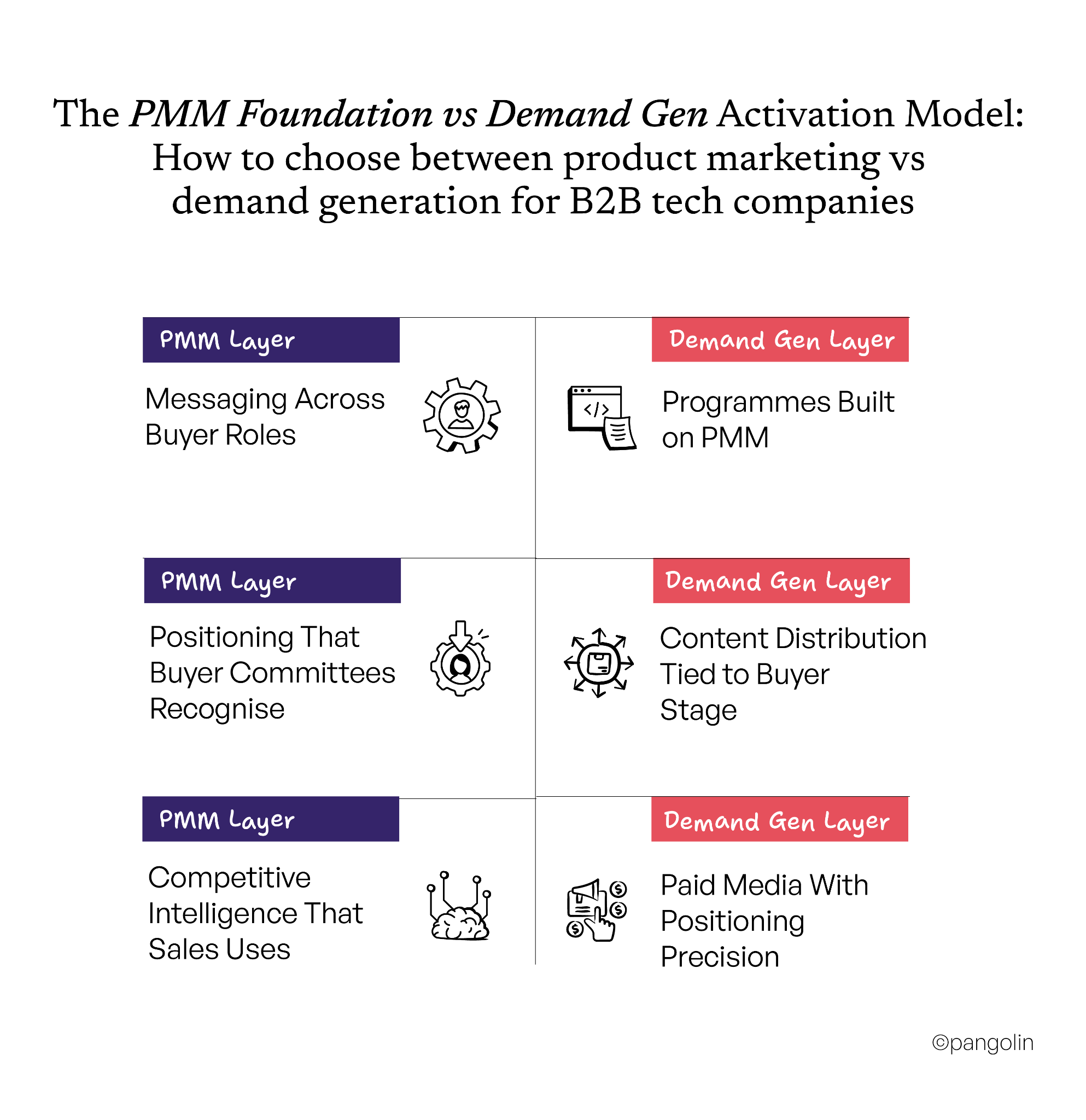
Positioning defines how each stakeholder in the buying committee understands your product's value. For a B2B cybersecurity company, this means a CISO-specific value proposition distinct from the CFO-facing business case.
Messaging translates positioning into specific language for each persona and buying stage. A data platform company might build separate messaging tracks for the CDO, the engineering lead, and the procurement officer.
Competitive intelligence maps your differentiation against named alternatives the buyer committee is evaluating. In practice, this is a battlecard set that sales reps reference in live calls, not a slide deck filed in a shared drive. Knowing when to hire a PMM vs a demand gen agency often starts here.
Campaign programmes distribute positioning-aligned content to defined segments through paid, organic, and outbound channels. A B2B fintech company runs LinkedIn programmes targeting CFOs with messaging already validated by PMM research.
Paid media amplifies the right message to the right buyer role at the right stage. Without PMM, paid media amplifies generic claims that no specific stakeholder finds credible. Strategic PMM vs content marketing determines whether your ad spend generates pipeline or noise.
Content distribution sequences assets by buying stage, not by content format. A whitepaper for a technical evaluator hits at a different moment than an ROI calculator for a finance stakeholder.
When all six components are in place, you have a connected system where product marketing and demand generation in B2B reinforce each other at every stage.
The most common product marketing vs demand generation B2B mistake B2B tech companies make
The mistake is investing in demand gen activation before the PMM foundation exists. Technically strong companies make this error because they assume product quality substitutes for positioning. It doesn't. The commercial consequence is a growing ad budget producing flat or declining conversion rates quarter over quarter.
The correction is straightforward: pause demand gen spend, build the PMM foundation, then reactivate campaigns on top of validated positioning. Strategic PMM vs content marketing clarity matters here because content without positioning is volume without direction. Knowing when to hire a PMM vs a demand gen agency depends entirely on whether this foundation exists yet.
In practice, this looks like a Series B company spending $40K per month on paid LinkedIn with messaging that speaks to "digital transformation" while their actual buyers are CTOs evaluating API architecture. The distinction between product marketing and growth marketing in SaaS is critical: growth tactics optimise what exists, but PMM builds what needs to exist first.
SAHI came to Pangolin with strong product capabilities but generic positioning that didn't differentiate across buyer roles in their target market, a classic product marketing vs growth marketing misalignment in B2B SaaS.
Using the PMM Foundation vs Demand Gen Activation Model, Pangolin built buyer-role-specific positioning, messaging architecture, and competitive intelligence assets within a focused eight-week engagement, a PMM-first sequence that preceded any demand gen activation.
The outcome was a 122% increase in conversion rates and a 28% reduction in customer acquisition cost, with qualified monthly leads climbing 145% after multi-stakeholder segmentation enabled precision targeting by buyer role. This answers the question of when to hire a PMM vs demand gen agency: before your demand gen budget is committed.
See the full SAHI case study →
Should you build product marketing vs demand generation for B2B in-house or hire a specialist?
Build in-house if you already have a dedicated PMM hire in seat with three or more months before demand gen budget is committed. This works when your team understands the product marketing vs growth marketing SaaS distinction and can build positioning without external domain translation support.
A hybrid model works when your in-house PMM builds the foundation and an external agency executes demand gen activation on top of it. This is the most common pattern for Series B companies where strategic PMM vs content marketing ownership stays internal but campaign execution scales through a specialist.
Hire an external specialist when you have no PMM capability, demand gen is already running with flat conversion, and the board expects pipeline results within 90 days. Pangolin builds this exact sequence for B2B tech companies. Knowing when to hire a PMM vs demand gen agency comes down to whether you need the foundation built or just the activation executed.
Where to start with product marketing vs demand generation B2B this week
Audit your current positioning against each distinct buyer role in your target account's committee this week. This single action reveals whether your conversion problem is a demand gen problem or a PMM problem, which determines everything about where budget should go. Once complete, you'll have the diagnostic input the PMM Foundation vs Demand Gen Activation Model requires to sequence your next investment correctly, whether that's product marketing vs growth marketing alignment in SaaS or demand gen recalibration. Knowing when to hire a PMM vs demand gen agency starts with this audit.
Traffic without positioning is noise with a budget. The pattern repeats across B2B tech companies at every stage: demand gen investment scales, dashboards look healthy, and pipeline stays flat. The fix isn't more spend or a new agency. The fix is building the PMM foundation first.
The PMM Foundation vs Demand Gen Activation Model gives you a clear sequence: build positioning and messaging for each buyer role, validate it with sales, then activate demand gen on top of a message the market actually responds to. SAHI's results (122% conversion lift, 28% CAC reduction) came from this exact sequence. Sprih's $3M raise and US market launch followed a persona-driven positioning process before any growth programme was activated.
Your conversion problem has a specific cause. Find it this week. Audit your positioning against the buyer committee. That single action will tell you whether you need a PMM foundation or a demand gen recalibration. Everything else follows from that answer.