Your pipeline isn't broken. Your VP Enterprise Sales isn't underperforming. The deals stalling at procurement are telling you something specific: the GTM motion you built for your home market doesn't translate to US enterprise buying committees. This is the single most common failure pattern for Series B SaaS companies with confirmed US expansion funding. The sales team is executing well against positioning that a five-person US buying committee doesn't recognize, trust, or know how to approve internally. The US SaaS market represents 44% of the $261 billion global total, and non-US players entering it consistently underestimate how different the procurement process is. A GTM strategy framework for B2B SaaS companies must account for this. What follows is a three-phase GTM sequence designed for exactly this situation: pipeline exists, deals stall, and the root cause is a Phase 1 positioning problem disguised as a Phase 2 sales problem.
Standard GTM advice says: define your ICP, build a plan, hire salespeople, and go. That sequence ignores the structural reality of US enterprise procurement. A three-phase GTM strategy for B2B SaaS must account for multi-stakeholder buying committees where six to ten people hold veto power.
US enterprise buyers require domain translation. Your home market positioning uses references, compliance frameworks, and competitive anchors that a US CISO or CFO doesn't recognize. A go-to-market strategy for enterprise SaaS must rebuild those reference points before any collateral is produced.
Technical credibility constraints are the third gap. Your product may be strong, but if the messaging doesn't speak to SOC 2, FedRAMP, or SEC/OCC requirements, procurement teams won't advance the deal. The standard playbook treats positioning as a one-time exercise. For companies entering the US from ANZ, India, or EMEA, it's the entire foundation.
Generic B2B advice assumes one buyer, one geography, one approval process. Your situation has none of those conditions. That's why standard frameworks fail here.
The Three-Phase B2B SaaS GTM Sequence produces a complete go-to-market system for companies entering a new geography or moving upmarket into enterprise. It has three components because each phase produces a specific output that the next phase depends on: skip one, and everything downstream breaks. This three-phase GTM strategy for B2B SaaS works as a strict sequence, not a menu.
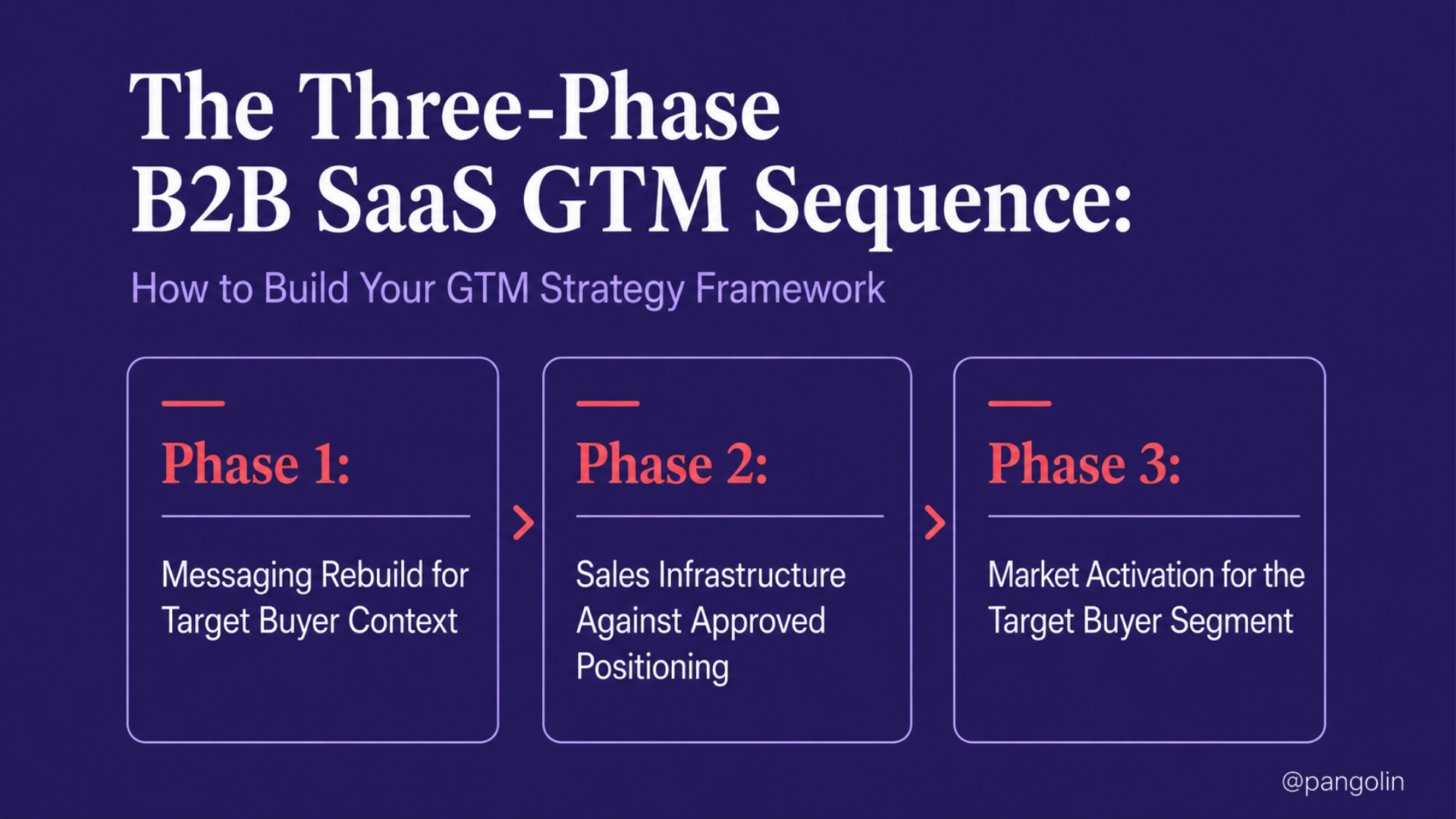
Phase 1 repositions your product from home market framing to target buyer framing before any collateral is created. In practice, this means rewriting your value proposition against US enterprise evaluation criteria: ROI models, compliance language, and competitive positioning that a VP of Procurement recognizes.
Phase 2 builds battle cards, pitch decks, ROI calculators, and objection handling against the Phase 1 positioning framework. For a go-to-market strategy targeting enterprise SaaS buyers, this looks like a complete sales toolkit where every asset references the same approved messaging architecture.
Phase 3 launches to the target segment with collateral built specifically for them. A SaaS US market entry GTM framework requires activation materials: outbound sequences, content programmes, and ABM assets that were never adapted from something that worked elsewhere. They were built from scratch for this buyer.
When all three phases are complete, you have a GTM strategy framework for B2B SaaS companies that connects positioning to pipeline to revenue in a single system. Every asset your sales team uses speaks the buyer's language. Every piece of collateral references the same competitive frame. That's the minimum standard for US enterprise entry.
The mistake is reversing the sequence. Companies hire a US sales team or launch demand gen before the positioning rebuild is complete. Technically strong companies make this error because the product works. They assume the product will sell itself if they just put enough pipeline in front of it.
The commercial consequence is specific and measurable. Deals enter the pipeline, progress through discovery and demo stages, then stall at procurement. The US buying committee can't build an internal business case because the positioning doesn't map to their evaluation criteria. Every stalled deal is a Phase 1 failure presenting as a Phase 2 problem.
The correction for any go-to-market strategy targeting enterprise SaaS is straightforward. Stop all collateral production. Rebuild positioning against the target buyer committee. Then rebuild sales infrastructure on top of the new messaging. A SaaS US market entry GTM framework that reverses this order will burn six to twelve months of runway before anyone diagnoses the root cause.
In practice, this looks like a VP Enterprise Sales reporting that "deals are progressing but not closing." The instinct is to fix the sales process. The root cause sits upstream at positioning.
Trundle, an AI-native company, needed to reposition from a technical founder narrative to an enterprise buyer evaluation frame. The founder had a strong product but no positioning that a procurement committee could evaluate. This is the exact scenario a three-phase GTM strategy for B2B SaaS is designed to solve.
Pangolin built a complete go-to-market strategy for enterprise SaaS positioning: messaging architecture, content strategy, and buyer-facing collateral scoped to a defined delivery window. The engagement covered Phase 1 and Phase 2 deliverables in sequence.
The outcome was specific. The founder was repositioned for enterprise buyer evaluation. Trundle found Pangolin via ChatGPT, signed without a formal sales process, and the GTM content strategy itself became the first proof point of the product's market positioning. This is a SaaS US market entry GTM framework producing commercial results before the first outbound sequence launched.
See the full Trundle case study →
Build in-house if you have a dedicated product marketing hire with prior GTM experience in the target geography. You also need three or more months before your first enterprise pipeline review. A three-phase GTM strategy for B2B SaaS can be executed internally when domain translation isn't required and your PMM has closed deals in the US before.
Use a hybrid model when your in-house team can own Phase 1 strategy but lacks capacity for Phase 2 collateral production. A go-to-market strategy for enterprise SaaS often requires 15 to 25 individual assets built in a compressed timeline. Internal strategy with external execution solves the capacity constraint without losing strategic control.
Engage an external specialist when you have no PMM hire, less than 90 days to your first pipeline review, or zero closed deals in the target geography. A SaaS US market entry GTM framework requires domain-specific credibility. Pangolin has delivered this for companies including Sprih, CarbonMinus, and IntelliTrans: all cross-geography repositioning engagements at growth stage.
Audit your current positioning against the US enterprise buying committee this week. Map every stakeholder who touches procurement: CISO, CFO, VP Engineering, legal, and compliance. Identify which of your current assets speak to each stakeholder's evaluation criteria.
This single exercise is higher-leverage than any other action because it reveals exactly where Phase 1 gaps exist. Once complete, you'll have a clear map of what the Three-Phase B2B SaaS GTM Sequence needs to fix first. That map becomes your SaaS US market entry GTM framework project brief.
If you want a structured assessment of your current positioning gaps, Pangolin's product marketing practice builds GTM strategy frameworks for B2B SaaS companies entering US enterprise markets.
The pattern is consistent across every cross-geography engagement Pangolin has delivered. Sprih used a persona-driven positioning rebuild to fuel a $3M raise and US market launch. The sequence was the same: Phase 1 positioning, Phase 2 infrastructure, Phase 3 activation. No shortcuts.
Your VP Enterprise Sales has been in seat for six months. Your pipeline exists. The funding is confirmed. The only variable you control right now is whether you fix the positioning before or after you burn another two quarters of runway. Every week you run the current sales motion against home market messaging, you're training your US prospects to associate your brand with collateral that doesn't speak their language.
The fix is upstream. It always is. Start with the buyer committee audit this week. Build the positioning architecture. Then rebuild every sales asset on top of it. That's the sequence. That's the framework. And that's how Series B SaaS companies actually close US enterprise deals.