.png)
You built something technically superior. You can whiteboard the architecture for any engineer in the room and watch them nod. But the CFO across the table checks her phone thirty seconds into your pitch. This is the core challenge of positioning a technical product for a non-technical buyer: the people who approve budgets don't evaluate products the way the people who use them do. Technical founders with deep product expertise routinely lose enterprise deals not because the product is wrong, but because the language is wrong. The Technical-to-Commercial Translation Framework exists to fix that specific gap. It converts architecture-level detail into the business outcome language that economic buyers need to say yes. This is about speaking a different language entirely: the language of revenue, risk reduction, and return on investment. What follows is a practical, component-by-component breakdown of how to make that translation without losing technical credibility in the process.
Most positioning advice assumes a single buyer. B2B enterprise deals involve committees of five to eleven people with conflicting evaluation criteria. Technical buyers need architecture validation. Economic buyers need business outcome clarity. Standard advice collapses both into one message.
Positioning a technical product for a CFO requires a completely different register than positioning it for a CTO. The CFO doesn't care about your microservices topology. She cares about cost-per-transaction reduction and audit risk. When you try to translate technical product details into business language using generic frameworks, you lose the domain specificity that makes your product credible to the technical evaluator who has to approve the shortlist.
Multi-stakeholder committees punish one-size-fits-all positioning. The technical buyer flags vague claims as a credibility risk. The economic buyer flags technical claims as irrelevant. You need separate messaging tracks that share a common strategic narrative. Most positioning guides don't account for this. They assume you're selling to one person. You're not.
The Technical-to-Commercial Translation Framework produces dual-track positioning for deals where both technical and economic buyers sit on the committee. It has four components because enterprise buying committees evaluate products across four distinct dimensions: capability, strategy, application, and return. Positioning a technical product for a CFO requires all four working together.
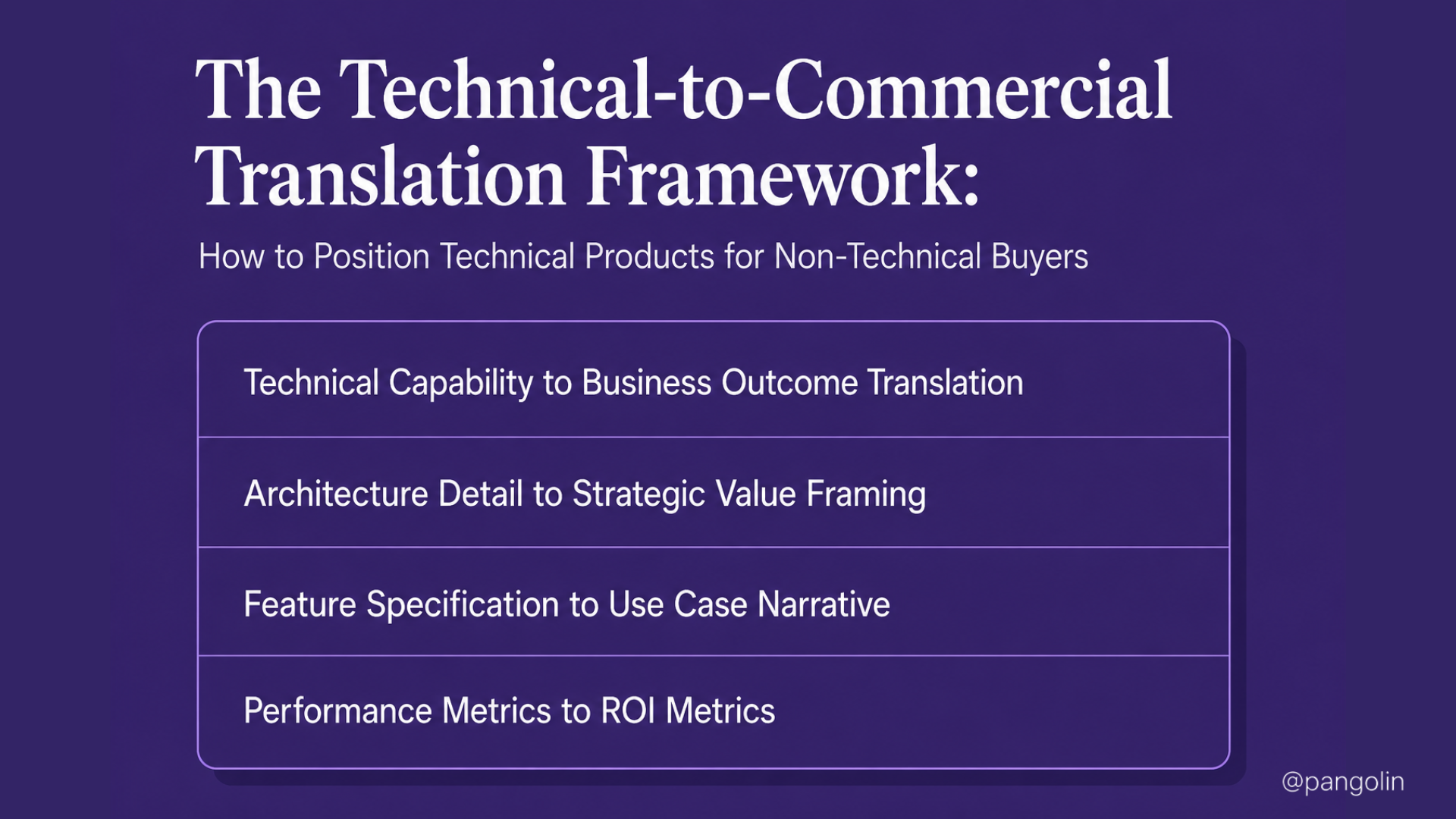
This component converts raw technical capabilities into measurable business outcomes the economic buyer can evaluate. In practice, "sub-50ms API response time" becomes "real-time fraud detection that prevents $2.3M in annual chargebacks."
This component reframes architecture decisions as strategic advantages that reduce enterprise risk. A technical founder's enterprise buyer messaging might convert "multi-tenant Kubernetes orchestration" into "infrastructure that meets SOC 2 and FedRAMP requirements without custom deployment."
This component translates feature lists into buyer-specific use case stories that procurement teams can evaluate. Instead of "configurable rule engine with 200+ parameters," you describe how a compliance officer uses three screens to set up automated regulatory reporting.
This component converts engineering performance data into financial projections a CFO can put into a budget justification. To translate technical product specs into business language, you'd convert "99.97% uptime SLA" into "$340K avoided downtime cost annually based on the buyer's revenue-per-hour."
When all four components are in place, you have positioning that satisfies the technical evaluator's need for rigour and the CFO's need for business case clarity.
The mistake is simplifying technical language instead of translating it into business value. These are two completely different operations.
Technically strong companies make this mistake because their founders assume the problem is complexity. The real problem is relevance. A CFO doesn't need a simpler explanation of your event-driven architecture. She needs to know it cuts processing costs by 40%.
The commercial consequence is devastating. Simplified technical language still sounds technical. The CFO tunes out, and the deal stalls in committee. The correction is to translate technical product details into business language: revenue impact, cost reduction, risk mitigation, and time-to-value.
In practice, this means your technical founder's enterprise buyer messaging has two versions. One for the CTO that explains the architecture. One for the CFO that explains the P&L impact. Same product. Different language. Different buyer.
CI53 operated in a regulated technical domain where positioning a technical product for a CFO-level buyer required both compliance precision and commercial clarity. Their existing content spoke exclusively to technical practitioners.
Pangolin built repositioned content assets using the Translation Framework, translating technical product claims into business language within a six-week engagement. The deliverables included a commercial positioning document, buyer-specific landing pages, and three content pieces targeting economic buyers.
The outcome: a Director of Marketing in CI53's target vertical converted through the repositioned content, signed without any prior relationship, and CI53's technical team flagged zero accuracy corrections. That's technical founder enterprise buyer messaging done right.
See the full CI53 case study →
Your technical founder can partner directly with a commercial executive who has sold to CFOs before. Positioning a technical product for a CFO is possible internally when someone on the team already speaks the buyer's language. You also need six-plus months of runway to iterate.
Your team has commercial instincts but lacks the frameworks to translate technical product details into business language systematically. A hybrid model works when you need an external partner to build the initial translation architecture, then hand off execution to your internal team.
Nobody on your team has sold to non-technical enterprise buyers before. Technical founder enterprise buyer messaging requires domain-specific translation skills that take years to develop. Pangolin builds this translation infrastructure for B2B tech companies, and the CI53 engagement is one example of what that looks like in practice.
Pull the pitch deck from your last lost enterprise deal and highlight every sentence that describes how your product works rather than what it does for the buyer's P&L. This single audit reveals the exact ratio of technical language to commercial language in your current positioning. That ratio is the starting input for the Technical-to-Commercial Translation Framework, and it gives you a concrete map of what needs to change in your technical founder enterprise buyer messaging.
If you want a structured approach to positioning a technical product for a non-technical buyer, Pangolin's B2B positioning services can help you build the translation layer.
The gap between a technically excellent product and a commercially successful one is almost never the product itself. It's the translation layer between what your engineers built and what your buyer's committee needs to hear. Every stalled enterprise deal, every CFO who went quiet after the demo: these are translation failures sitting above the product layer entirely.
The Technical-to-Commercial Translation Framework gives you a repeatable structure for closing that gap across four dimensions that map directly to how enterprise committees evaluate purchases. Your technical credibility stays intact. Your commercial message lands.
One data point worth noting: Pangolin's work with SAHI on a similar translation challenge lowered customer acquisition cost by 28% and lifted conversions by 122%. That's what happens when the right message reaches the right buyer in the right language.
Start with the pitch deck audit this week. Count how many sentences describe how your product works versus what it does for the buyer's bottom line. That ratio tells you exactly how much translation work sits between you and your next signed deal.