The Timeline: 4-6 months to meaningful revenue impact (not immediate)
The Investment: $10,000-$75,000/month depending on scale (pays for itself with one extra deal per quarter)
The Measurement: Multi-touch attribution proving which touchpoints drive deals, not lead volume
Beluga whales can reshape their foreheads into five completely different shapes. Researchers call it their "melon" - a rounded bulge above their snout.
The wild part?
They do it intentionally during social interactions. Each shape means something different. A pod of belugas doesn't scatter random signals hoping someone picks up the message. They adapt their shape to communicate with multiple members of their group at the exact same time.
Here's what most B2B IT services companies don't realize: Your sales process needs to work like a beluga pod, not like a one-man band.
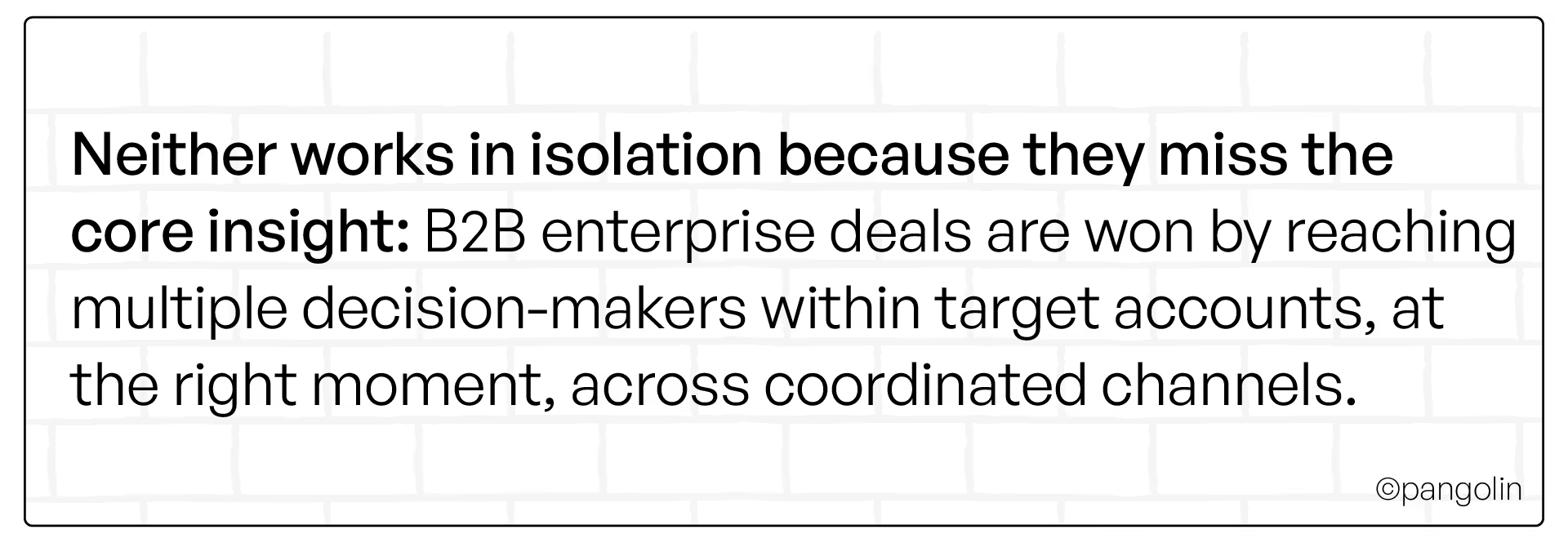
Enterprise deals in IT services aren't won by reaching one person. They're won when you orchestrate signals that land with the right stakeholders—the CFO, the CTO, the operations lead, the procurement director at the right moments across their entire buying journey. Individually targeted retargeting (pixel-based to random visitors) won't cut it. Broad ABM campaigns without sustained retargeting across multiple channels won't either.
But coordinated account-based marketing + strategic retargeting across the right channels? That closes deals 60% faster and drives win rates up by 60%.
This is the playbook B2B IT consulting firms are using to compress 6-18 month sales cycles, escape commodity pricing, and turn targeted accounts into predictable revenue. Here's how to build it.
The B2B IT Buying Committee Problem: Why One Touchpoint Fails
Let's start with the real problem. When your VP of Sales walks in, they see one person. Your VP of Marketing sends a retargeting ad to that person's browser. Your SDR emails that person's inbox. The three of you think you're synchronized. You're not.
Meanwhile, inside the prospect's organization, a buying committee is happening without you.
The Actual Committee (that you can't see):
The CTO is evaluating whether you can integrate with their existing stack and improve performance
The VP of Finance is asking "What's the ROI? Will this actually reduce costs or just spend money?"
The Chief Procurement Officer is checking whether you fit their vendor criteria
The Director of Operations is worried about implementation disruption
The VP of Sales/Business Development is wondering if this increases their revenue, not cuts costs
That's not one buying journey. That's five buying journeys happening in parallel inside the same account.
Here's what most B2B IT companies do: They retarget the person who visited the website (usually the IT manager, the lowest-ranking person in that group). The gatekeeper never reaches the CFO. The CFO never even knows your brand exists. Meanwhile, your competitors are already in those conversations.
The Result?
Your ad spend targets the wrong people
Your sales team only knows about half the stakeholders
Your conversations are tactical, not strategic
You don't close deals; you get into a pricing negotiation with one department
The alternative isn't more channels. It's coordinated channels reaching multiple stakeholders simultaneously.
Why ABM Alone (and Retargeting Alone) Both Fail
Before we talk about the solution, let's be honest: Most approaches fail because companies try them one at a time.
Account-Based Marketing sounds powerful:
"We identify 50 target accounts and customize our messaging to each one."
In theory, it's brilliant. In practice?
You spend weeks researching and personalizing campaigns
You send a LinkedIn ad
Nobody clicks
Or they click once, never see you again
Then they see a generic retargeting ad that has nothing to do with your ABM campaign
Signal lost. Budget wasted.
Retargeting sounds efficient:
"We show ads to people who visited our website."
The problem?
You're probably retargeting the gatekeeper, not the decision-maker
You have no idea if they're in a target account or a waste-of-time account
Your ads are generic (because you don't know who's viewing them)
Someone from Company A sees ads that are meant for Company B
Frequency caps get blown out; people get annoyed
96% of website visitors leave without converting, and pixel-based retargeting only recovers about 1% of them
The moment you add both together with orchestration, everything changes.
What Actually Works: The ABM + Retargeting Framework
Here's the framework that moves the needle:
Phase 1: Account Selection & Tiering (The Foundation)
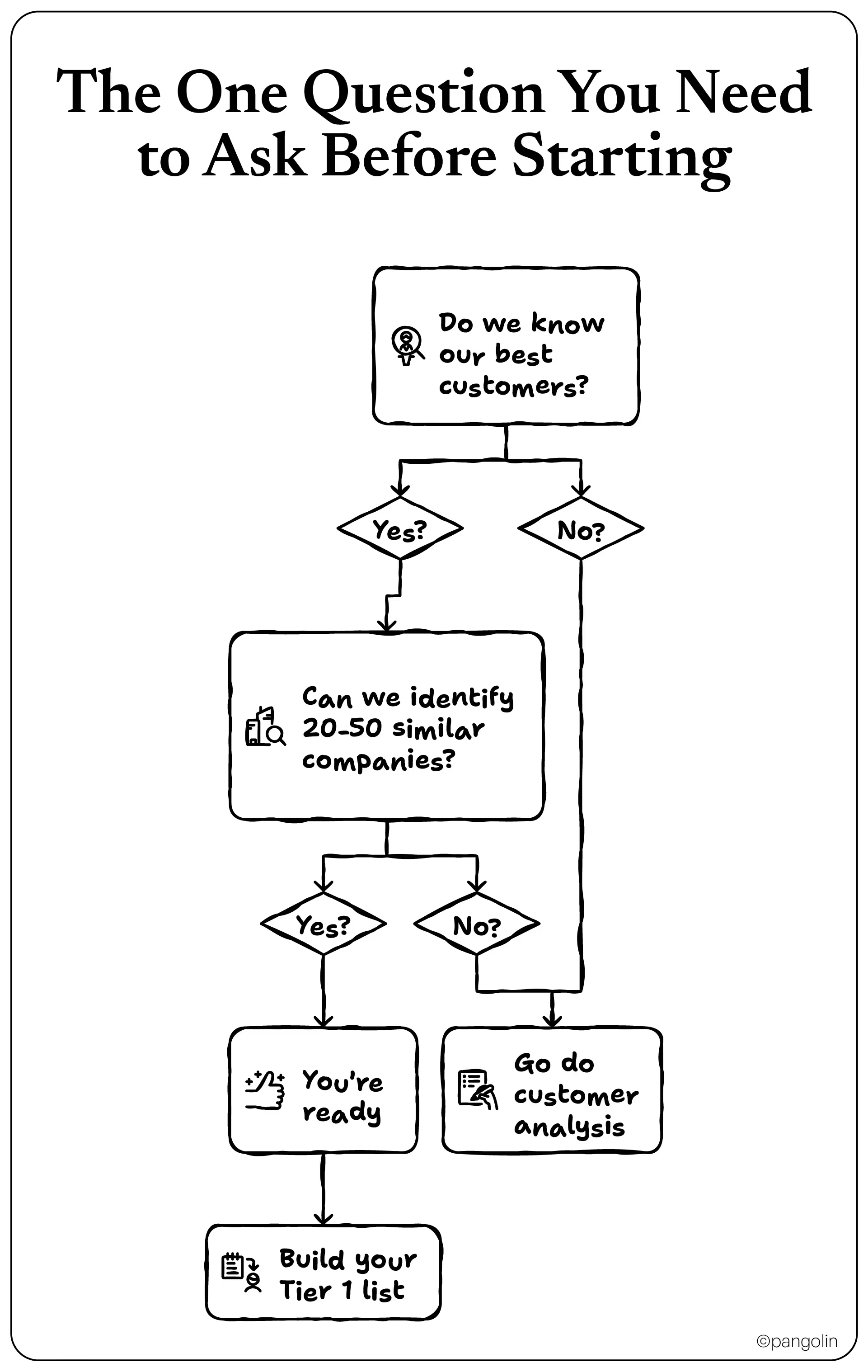
Before you run a single ad, you need to be honest about your target.
Not all accounts are created equal. Some are worth $500K deals. Others are $20K dead-ends disguised as opportunities.
Tier 1 (1-to-1): The Crown Jewels
5-20 highest-value target accounts
Average deal size: $200K-$2M+
Sales cycle: 6-18 months
Decision committee: 8-12 stakeholders
Engagement model: Hyper-personalized everything
Examples: Fortune 500 enterprises, large government agencies, publicly traded companies
How you engage Tier 1:
Dedicated account teams (marketing + sales)
Weekly or bi-weekly personalized touchpoints
Custom content created specifically for each account
Direct outreach to 6+ decision-makers
LinkedIn ads targeted to specific job titles within those accounts
The key insight: You can't afford to treat every prospect like Tier 1. But you absolutely can afford to treat your top 20 accounts like Tier 1.
Phase 2: Multi-Touch Channel Orchestration (The Engine)
Now that you know who you're targeting, here's how you reach them across channels.
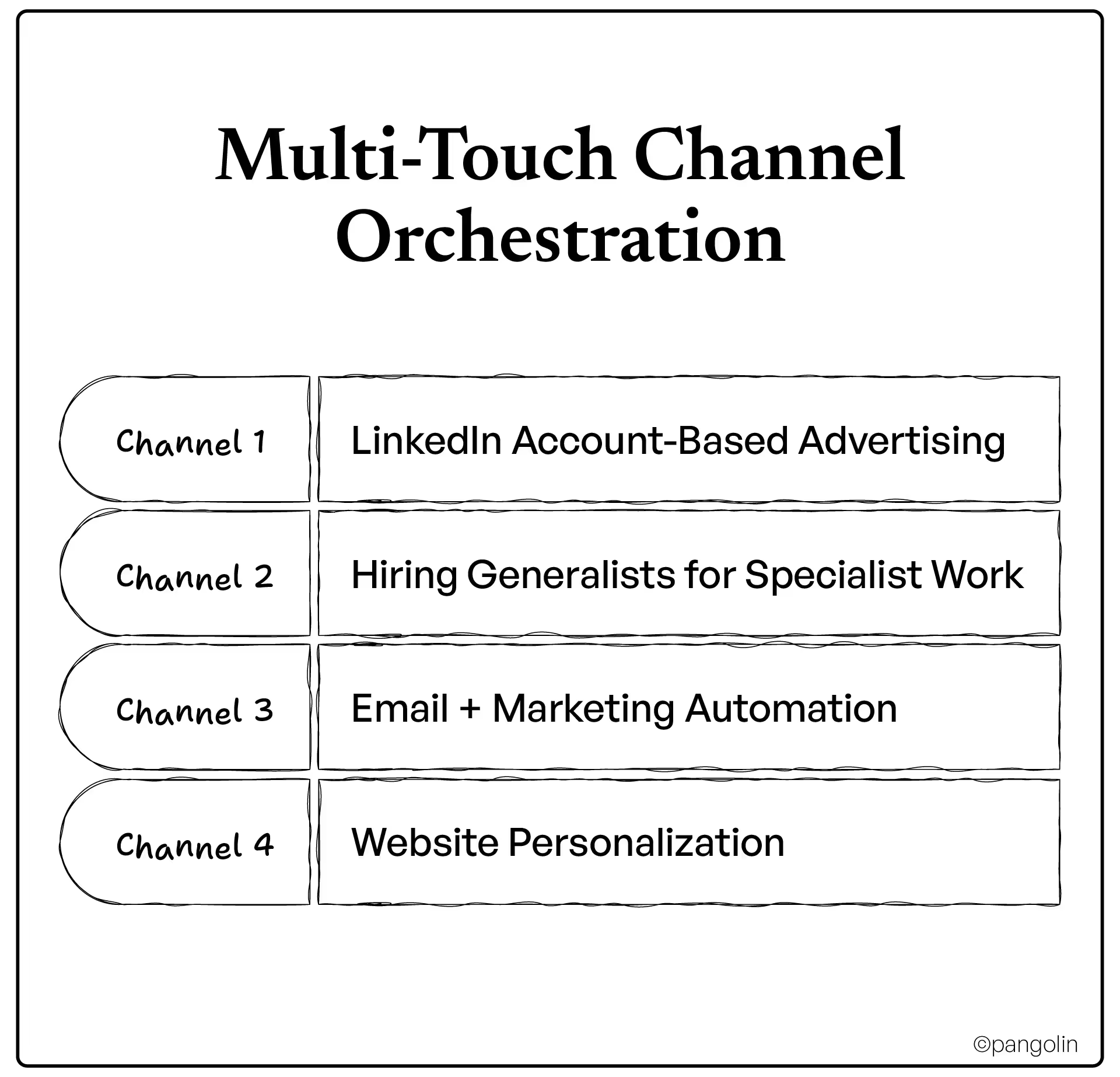
Think of each channel as a "shape" the beluga uses - a different way to communicate. The trick is making sure all the shapes work toward the same goal.
Channel 1: LinkedIn Account-Based Advertising
LinkedIn is where B2B decision-makers live. But most companies use it wrong.
The Wrong Way:
"Let's run a LinkedIn ad campaign to our industry." Result: Generic ad, generic audience, generic performance.
The Right Way (Account-Based):
Upload your target account list (CSV) directly to LinkedIn as a "Matched Audience."
This creates an audience of people who work at those companies. Now:
Filter by seniority: C-suite, Director level, Manager level
Filter by department: Finance, Operations, IT, Procurement
Filter by job title: "CFO," "VP of Operations," "CTO," etc.
Run different ads to each stakeholder group
Channel 2: Programmatic Display Retargeting (Targeted, Not Scattershot)
This is where most companies lose money. They show the same generic ad to everyone who visited their website.
The ABM + Retargeting approach:
Step 1: Identify which visitors came from target accounts. Use intent data platform (6sense, Bombora) or IP targeting (Terminus) to know when someone visiting your site is from a Tier 1, Tier 2, or Tier 3 account.
Step 2: Segment your retargeting by account tier AND behavior.
Retargeting Segment 1: Tier 1 Account Visitors
Visited pricing page = show "Book a Demo with Your CFO"
Downloaded case study = show "See [Industry Vertical] ROI"
Visited blog post on cost reduction = show "Cost Reduction: The 3-Pillar Framework"
Retargeting Segment 2: Tier 2 Account Visitors
Visited product demo = show "Why [Competitors] Switched to Us"
Visited comparison page = show "[Competitor] vs. Us: The Real Differences"
Visited support page = show "Implementation: 30, 60, 90 Day Timeline"
Retargeting Segment 3: Non-Target Accounts (Yes, segment these too)
Show general thought leadership
Don't use high-value CTAs
Don't waste budget on unqualified prospects
Step 3: Control frequency and duration.
Tier 1: Show ads for 180 days (long journey)
Tier 2: Show ads for 60-90 days
Tier 3: Show ads for 30 days
Frequency cap: 3-5 impressions per user per week (stop at Tier 1 after 2 weeks of no engagement—they're either engaged or not interested)
Channel 3: Email + Marketing Automation (The Orchestrator)
Email is where the ABM + retargeting strategy comes together. This is where signals from ads trigger strategic next steps.
How it works:
Someone from a Tier 1 account clicks your LinkedIn ad → They land on a personalized landing page → They see a "guided product tour" → Their email is captured → Your marketing automation platform notes:
They're from a target account
They engaged with [specific content]
They're in [stage of buying journey]
Now your email sequences change based on this intelligence.
Tier 1 Email Sequence Example (if they clicked the CFO ad):
Email 1 (Next day): "Here's the [ROI calculation] for companies like yours"
Email 2 (Day 3): "CFOs who move fast see 30-day wins. Here's the timeline."
Email 3 (Day 7): "Your CTO is probably evaluating us right now. Here's what she should know."
Email 4 (Day 14): "Can we show your full buying committee this?"
Each email is triggered by account tier + engagement level. Not blasted to everyone.
Simultaneously, your sales team sees this account is engaged and reaches out to the other stakeholders they haven't reached yet (the CTO, the Finance director). Email prepares them. Ads reinforce them. Sales closes them.
Channel 4: Website Personalization (The Closer)
When someone from a Tier 1 account lands on your website, they should see something different than someone from a Tier 3 account.
Tier 1 account visitor sees:
"Talk to [Your Company] for [Specific Vertical] Expertise"
Case studies from similar-sized companies
ROI calculators (not generic, vertical-specific)
Direct CTA to "Schedule with Your Account Lead"
Tier 2 account visitor sees:
General value proposition
Case studies from their industry
Standard demo request
Tier 3 account visitor sees:
Educational content
"Book a 20-minute discovery call"
Same website. Different experiences. Dramatically different conversion rates.
The Coordination Piece: Multi-Touch Attribution (How to Prove It Works)
Touchpoint
Credit Given
Why
First Touch (LinkedIn ABM ad)
25%
Introduces your company to the right stakeholder
Middle Touch (Email sequence)
25%
Moves them from awareness to consideration
Last-Middle Touch (Retargeting ad click)
20%
Re-engages them after dormant period
Final Touch (Sales email/demo)
30%
Closes the deal
Or better yet, Time-Decay Model:
First touch: 10% credit
Every subsequent touch: Increasing credit
Final touches: 40% credit (recognizes that closing is hard)
Why? Because in IT services, closing an enterprise deal is the hard part. Getting them interested is only the beginning.
How to Measure Multi-Touch Attribution:
Set up in your CRM: Map every touchpoint to every account
LinkedIn ad view = touchpoint
Email open = touchpoint
Website visit = touchpoint
Sales call = touchpoint
Demo booked = conversion
Use attribution software: HockeyStack, Dreamdata, or your marketing automation platform's built-in analytics
Track by account tier:
"What % of Tier 1 accounts reached 4+ touchpoints before closing?"
"What % of closed deals had ABM + retargeting touchpoints?"
"What's the average deal size for prospects with multi-touch journeys vs. single touch?"
Report in business terms (not marketing jargon):
❌ "We generated 500 MQLs this quarter"
✅ "Multi-touch campaigns influenced $3.2M in closed revenue (up 60% from last year)"
The Three Mistakes That Kill ABM + Retargeting Campaigns
Before we talk about how to execute, let's talk about how this fails. Because most companies fail.
Mistake 1: Targeting the Wrong Accounts (Wrong Foundation)
You send ABM campaigns to 50 accounts that look good on paper but aren't actually in-market.
How to avoid it:
Use intent data: Which accounts are actively searching for solutions like yours? (6sense, Bombora, ZoomInfo Intelligence)
Use leading indicators: Which accounts are hiring in key departments? Which just got funding? (use Crunchbase, LinkedIn)
Validate with sales: Ask your reps, "If you could pick 10 accounts to close next, who would it be?" Start there.
Tier 1 should be 5-20 accounts that your sales team already wants to close.
Mistake 2: Retargeting Without Account Awareness (Wasting Budget)
You run retargeting ads to pixel-based audiences without knowing if they're from target accounts.
Result: Someone from a non-target company visits your website, they stay in your retargeting audience for 180 days, and you show them ads for 6 months. You're wasting budget on prospects you'll never close.
How to avoid it:
Use IP-based or account-based retargeting, not pixel-based
Segment retargeting audiences by account tier
Use shorter retargeting windows for non-target accounts (30 days max)
Don't show high-intent CTAs ("Book a Demo") to low-intent prospects
Mistake 3: Expecting Results in 30 Days (Impatience)
ABM + retargeting doesn't work like performance marketing.
Performance marketing: "We run ads to 50,000 people, 50 click, 5 buy. 10% conversion rate."
ABM: "We run ads to 50 accounts. Nobody clicks. But they remember us. On week 4, our SDR reaches out because they already know who we are. Sales cycle compresses from 9 months to 4 months."
It's not about immediate clicks. It's about pipeline velocity and deal size.
How to avoid it:
Set expectations: "ABM + retargeting takes 4-6 months to show meaningful revenue impact"
Don't measure ABM by MQL volume; measure by deal size and cycle time
The Playbook: Step-by-Step
Let's get tactical. Here's exactly how to run an ABM + retargeting campaign for one Tier 1 account.
Target Account: "Enterprise Bank Inc."
5,000+ employees
Annual revenue: $500M+
Current state: Using competitor's solution
Deal size if we win: $450K annually
Buying committee: CFO, CTO, VP of Operations, Chief Procurement Officer, VP of IT
Month 1: Preparation & Research
Week 1:
Research the account: Company overview, recent news, funding, org structure (LinkedIn, Crunchbase, their newsroom)
Identify 6-8 decision-makers by name and title
Note their recent LinkedIn activity—what are they posting about? What problems are they mentioning?
Week 2-3:
Create account playbook: "Why does Enterprise Bank Inc. need us? What specific problems does each stakeholder have?"
Develop messaging by stakeholder:
CFO: "30% reduction in infrastructure costs"
CTO: "Enterprise-grade security + compliance"
VP of Ops: "Reduced downtime from 5% to 0.2%"
Week 4:
Set up LinkedIn Matched Audience with this account
Create landing pages: One for CFOs, one for CTOs, one for Ops leaders
Brief your sales team on the campaign
Month 2-3: First Touch (Brand Awareness)
LinkedIn ABM Ads:
Run ads to each decision-maker with role-specific messaging
Budget: $2,000-$3,000/month for one Tier 1 account
Run for 8-12 weeks (let them see you multiple times)
Expected: 0.3-1% CTR from target stakeholders (this is not lead generation; it's brand building)
Display Retargeting:
20-30% of that budget to programmatic display (Terminus, Demandbase, RollWorks)
Show ads on business sites they visit (LinkedIn, Forbes, industry publications)
Different ads based on which content they viewed on your website
Email:
Don't email them yet (if you have the emails)
If you do: One educational email from your CEO or subject-matter expert (not a pitch)
Subject: "[Industry Insight] How Top 50 Enterprise Banks Are Reducing IT Costs by 30%"
Sales Outreach:
Week 6-8 of the campaign, your SDR reaches out to the CTO first (technical buyer)
Why after 6-8 weeks? They've seen your ads multiple times now; they know who you are
Message: "I noticed your recent LinkedIn post about [topic]. We've been working with banks like yours on this exact problem. Thought it might be worth 20 minutes."
You're not cold calling; you're warm-calling because they've seen your brand
Month 4-6: Deeper Engagement (Consideration)
If they book a call or demo:
Personalize everything. You know exactly what their problem is.
Invite their buying committee to a webinar specifically designed for Enterprise Bank Inc.
Send retargeting ads to "people who attended our webinar + work at Enterprise Bank Inc."
Email sequences shift to consideration stage (case studies, ROI comparisons, security docs)
If they don't respond:
Month 4: Shift ad messaging from "awareness" to "urgency"
"Top 50 Banks Are Already Cutting IT Spend by 30%. Here's How."
Month 5: Consider a different decision-maker angle
If CTO isn't responding, try CFO with financial angle
Intent data (6sense, Bombora, ZoomInfo): $1,000-$5,000/month
Paid ads (LinkedIn, display): $5,000-$50,000+/month (depends on scale)
Total monthly for full ABM + retargeting program: $10,000-$75,000
Sounds expensive? Compare to:
Hiring one full-time sales person: $80,000-$150,000 salary + $40,000 overhead
One lost deal: $100,000-$500,000 in opportunity cost
ABM + retargeting pay for themselves if they close one extra deal per quarter.
The Winning Playbook: What Separates Winners From Everyone Else
After reviewing 50+ case studies and 100+ sources, here's what the top-performing B2B IT companies are doing differently:
They're obsessive about account selection. Not "50 accounts that look good on LinkedIn." Instead: "These 15 accounts represent 60% of our TAM; we're going to own them."
They coordinate channels deliberately. Not "run LinkedIn ads and hope people click." Instead: "LinkedIn creates awareness → retargeting keeps us visible → email moves them to consideration → sales closes them."
They use multi-touch attribution religiously. Not "How many leads did we generate?" Instead: "Which touchpoints actually drive deals? What's the winning sequence?"
They evolve messaging by stakeholder. Not "Here's our value prop." Instead: "CFOs care about cost. CTOs care about architecture. We have different ads for each."
They measure pipeline velocity, not lead volume. Not "500 MQLs." Instead: "Our ABM accounts move 40% faster through the funnel."
They play the long game. ABM + retargeting isn't about conversions in week 2. It's about owning your target market in 6 months.
Conclusion: From Commodity Vendor to Strategic Partner
Your competitors are competing on price and team size. You're going to compete on precision and results.
ABM + retargeting isn't a marketing tactic. It's a repositioning strategy. It says: "We don't spray and pray. We understand your business. We reach your entire decision-making team. We compress your buying cycle. We deliver measurable value."
That's not a service vendor message. That's a strategic partner message.
And strategic partners close bigger deals, faster.
Here's what to do Monday morning:
Identify 10 target accounts that represent your ideal customer profile (work with sales to validate)
Map the buying committee for each account (use LinkedIn to find 5-7 decision-makers per account)
Choose one Tier 1 account to pilot the playbook
Build the messaging framework (what does each stakeholder care about?)
Set up LinkedIn Matched Audiences for that account
Run a 12-week ABM campaign to that account
Measure account engagement and sales cycle impact
By week 8, you'll know if ABM + retargeting works for your company. By week 16, you'll have the proof to scale it.
The path from "generic IT services vendor" to "they actually understand our business" is through coordinated, multi-touch campaigns to the buying committee that matters.
That's the playbook. Now go use it.
Perfect. Now let me update the conclusion with Pangolin and provide the FAQs.
Conclusion: From Commodity Vendor to Strategic Partner (With Pangolin)
Your competitors are competing on price and team size. You're going to compete on precision and results.
ABM + retargeting isn't a marketing tactic. It's a repositioning strategy. It says: "We don't spray and pray. We understand your business. We reach your entire decision-making team. We compress your buying cycle. We deliver measurable value."
That's not a service vendor message. That's a strategic partner message.
And strategic partners close bigger deals, faster.
Here's what to do Monday morning:
Identify 10 target accounts that represent your ideal customer profile (work with sales to validate)
Map the buying committee for each account (use LinkedIn to find 5-7 decision-makers per account)
Choose one Tier 1 account to pilot the playbook
Build the messaging framework (what does each stakeholder care about?)
Set up LinkedIn Matched Audiences for that account
Run a 12-week ABM campaign to that account
Measure account engagement and sales cycle impact
By week 8, you'll know if ABM + retargeting works for your company. By week 16, you'll have the proof to scale it.
The path from "generic IT services vendor" to "they actually understand our business" is through coordinated, multi-touch campaigns to the buying committee that matters.
That's the playbook. Now go use it.
Need Help Building This System?
This is exactly what Pangolin Marketing specializes in. They engineer full-funnel growth marketing systems that integrate ABM, retargeting, demand generation, and revenue automation into one coordinated revenue engine.
Pangolin's approach for B2B IT companies:
Full-Funnel Growth Marketing:ABM that nurtures buying committees + paid media targeting decision-makers + content that builds authority + analytics proving ROI.
Revenue Automation: Integrates CRM, marketing automation, and sales workflows into one revenue
What makes them different:
They start with customer journey mapping and conversion path analysis (not tactics)
They integrate sales enablement and marketing into one unified revenue system
They combine strategic thinking with North American market execution
They report on business metrics (revenue influenced, CAC efficiency) not vanity metrics
About our Authors
Kavya Somani and Aniket Panja are the writers behind Pangolin's Edge content strategy, focusing on IT services and SaaS marketing. The design team with Adhiraj Jadhav and Sohini Some translated insights into visual narratives. Adil Abdul and Yugandhar LakshmiNarayana led interface design and user flows, while YuvaPriyadarshini and Aniket Singh ensured technical SEO and organic reach. Project coordination was managed by Deepti Karn.
The team extends thanks to Avani Nagwann and co-founder Shashank Ayyar for their strategic input and editorial oversight.
Avani Nagwann
Co-Founder & CEO, Pangolin
Avani is the co-founder and "Co-Dreamer" at Pangolin, a specialist B2B marketing agency where she leads the firm’s mission to leverage "tech for good."
Shashank Ayyar
Co-Founder, Pangolin
Advises tech founders and enterprises on brand clarity, go-to-market systems, and strategic narrative; builds high-impact marketing engines for B2B SaaS and service companies; advocates for "tech for good" and value-driven growth in the IT sector.
FAQs
How long before we see results from ABM + retargeting campaigns?
Which channel should we prioritize first: LinkedIn, display retargeting, or email?
How do we know which accounts are actually worth ABM investment?
We have a small team. Can we run ABM + retargeting without hiring new people?
How do we prove ABM + retargeting ROI to our CFO?
What if our Tier 1 accounts don't respond to our ABM campaigns in the first month?
How many decision-makers in a buying committee should we try to reach?