In August 2025, Gap did something unusual: they made dancing a KPI.
Their 90-second KATSEYE dance video to "Milkshake" generated 400 million views, 8 billion impressions, and became the #1 TikTok search during launch week. The result? Gap's brand comparisons jumped 4% year-over-year, ending seven straight quarters of growth. Oh, and the featured denim sold out completely.
Here's what's interesting: Gap didn't choose between short-term sales and long-term brand building. They orchestrated both simultaneously. The viral moment drove immediate revenue. The brand lift compounded over time.
Most B2B marketers face a similar (if less dance-filled) dilemma. Your CFO questions why you're burning $15K/month on PPC when "SEO is free." Your CEO wants to know why you're not ranking #1 on Google yet. Your board demands proof that every dollar drives pipeline. Meanwhile, your sales team complains the leads aren't good enough.
Sound familiar?
The "SEO vs PPC" debate isn't just exhausting, it's expensive. Treating these channels as competitors fighting for budget leaves money on the table and creates a false choice that handicaps growth.
Here's the reality: The brands winning in 2025 aren't choosing between long-term SEO growth and short-term PPC wins. They're building integrated search strategies that deliver wins today and compound over time.
This article shows you how to do exactly that, with budget allocation frameworks, tactical integration playbooks, and decision triggers based on real data, not guesswork.
Most comparison articles pit SEO against PPC like it's a cage match. That's not just wrong, it's expensive.
Here's the reality check. SEO requires upfront investment with decreasing marginal costs. Results show up in 6-12 months and peak in years 2-3. PPC operates on continuous cost-per-click. You get immediate visibility within days, but everything stops when the budget stops.
The data makes this concrete. SEO delivers 8x ROI on average versus PPC's 4x. For e-commerce specifically, SEO ROI grows from 0.8x at 6 months to 5.2x at 36+ months. That's the compounding effect everyone talks about but few actually measure.
But here's what changes the game entirely: integration.
When brands appear in both paid and organic results, something remarkable happens. Organic click-through rate increases 38% (from 0.74% to 1.02%). Paid CTR jumps 39% (from 7.89% to 11%). And this isn't theoretical, 70% of conversions involve multiple touchpoints across paid and organic channels.
There's also what I call the "confidence tax." Searchers perceive brands ranking organically and running ads as more credible and established. Single-channel presence signals either budget constraints or low market authority. Neither helps your case in front of enterprise buyers.
The Real Framework: PPC is the sprint, immediate revenue, market testing, competitive defense. SEO is the marathon, compounding growth, brand authority, sustainable traffic. Winners train for both.
Stop thinking "either/or." Start thinking "when and how much."
Integration isn't about running both channels simultaneously and hoping for the best. It's about creating feedback loops where each channel makes the other more effective.
Here's how the best B2B marketers actually do this.
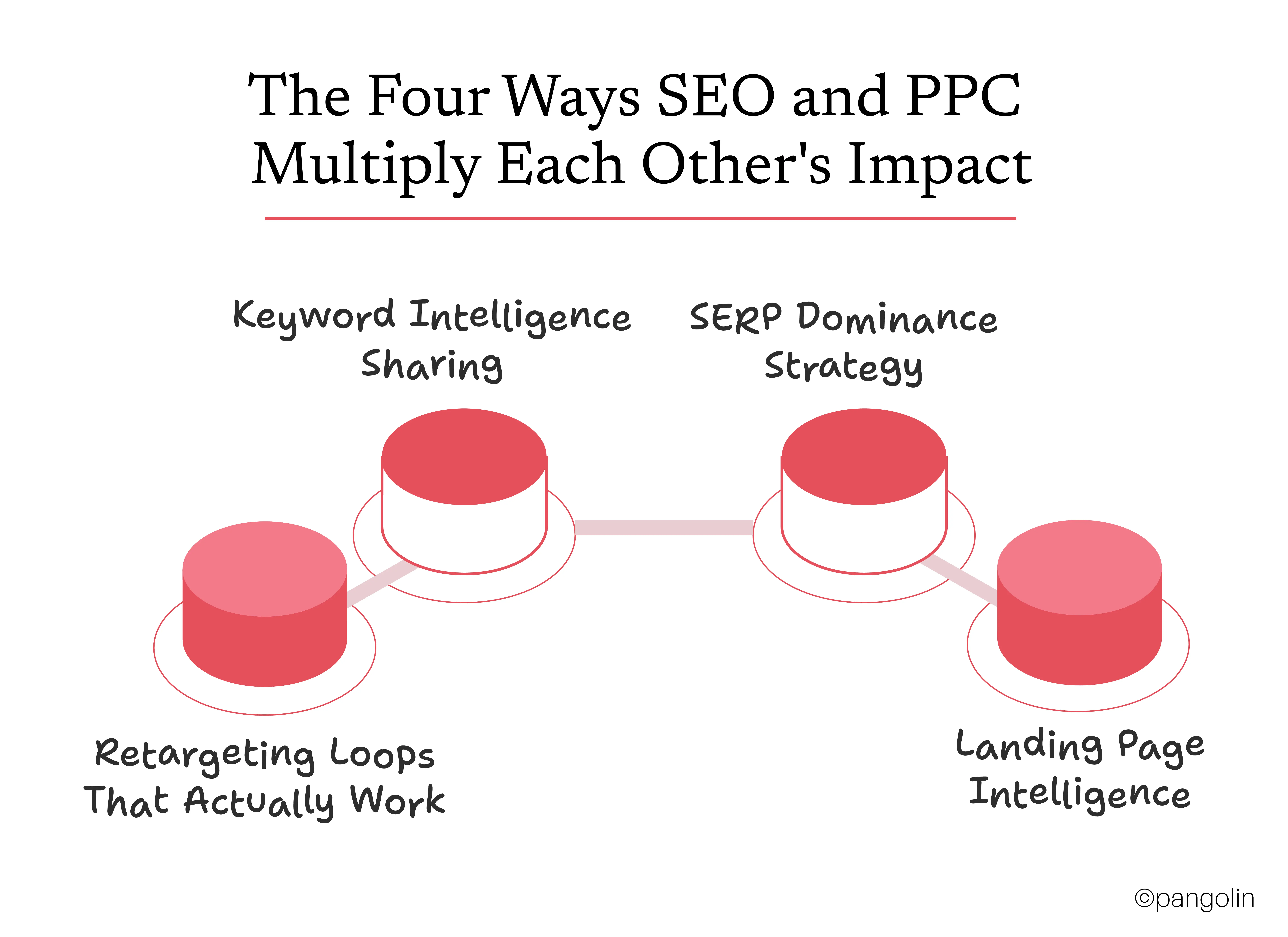
Your PPC campaigns are sitting on conversion data that could transform your SEO strategy. Every click, every conversion, every bounce, that's intelligence you're paying for. Use it.
From PPC to SEO: Test keyword viability with PPC before investing months in SEO content creation. Identify which keywords actually convert, not just click, and prioritize those for organic content. Even your negative keywords tell you something valuable: which terms waste PPC budget and should be excluded from SEO targeting too.
From SEO to PPC: Use organic search query data to find long-tail opportunities with lower CPCs. Your best-performing SEO content reveals which topics drive real engagement. Create PPC ads around those proven themes.
This isn't rocket science. It's just ruthlessly practical.
Run PPC for high-intent keywords where you already rank organically. Yes, seriously.
Combined paid and organic presence increases overall click-through by 50-70%. Even if you're ranking #1 organically, adding PPC ads captures users who prefer sponsored results (and there are more of them than you think).
Deploy this when you're launching products or running promotions, times when you need maximum visibility. Use it for competitive defense when competitors bid on your brand terms. And absolutely use it for high-value keywords where conversion rates justify the dual investment.
One healthcare technology company added PPC to keywords where they already ranked #2 organically. Total conversions increased 28%. They weren't cannibalizing traffic. They were capturing more of it.
Retarget organic visitors who didn't convert with PPC display and search ads. Use PPC to drive traffic to new content pages, building engagement signals that help SEO rankings. Create email capture campaigns via PPC, then nurture those contacts with SEO content.
Why does this work? Multi-touch attribution shows most conversions require 3-7 interactions. Each channel captures users at different buying stages. SEO builds awareness at low cost. PPC converts warm traffic efficiently.
You're not picking favorites. You're covering the entire journey.
Here's a workflow that cuts SEO optimization cycles by 70%:
Run three PPC ad variations testing different value propositions. Track which one hits 4.2% CTR versus 2.1% for the others. Apply that winning messaging to your organic title tags and meta descriptions. Monitor as organic CTR improves from 2.8% to 3.9%.
PPC delivers statistically significant results in 2-4 weeks. SEO would take 3-6 months to test the same variables organically. Use the speed of paid to inform the permanence of organic.
The right SEO/PPC split isn't universal. It shifts based on where you are in the growth curve.
Here's the framework that actually works in practice.

Allocation: 70-75% PPC / 25-30% SEO
You need immediate visibility while your organic foundation builds. PPC drives brand awareness, validates market demand, and acquires your first customers. Meanwhile, SEO focuses on technical foundation, content strategy, and initial authority signals.
Expected timeline: PPC drives revenue from day one. SEO shows early ranking movement but minimal traffic. That's normal. You're playing two different games simultaneously.
Allocation: 60% PPC / 40% SEO
SEO is gaining traction. You can start reducing reliance on paid-only traffic. PPC scales winning campaigns, handles retargeting, and defends against competitive threats. SEO ramps up content production, link building, and conversion optimization.
The trigger to move here: When organic traffic reaches 20-30% of total traffic. That's your signal that SEO investments are starting to pay off.
Allocation: 40% PPC / 60% SEO (or lower PPC depending on goals)
Organic delivers sustainable baseline traffic. PPC becomes a tactical tool for high-intent keywords, seasonal campaigns, and new product launches. SEO focuses on authority building, content expansion, and technical optimization.
The trigger: When SEO customer acquisition cost (CAC) is 30-50% lower than PPC CAC. At that point, you're not abandoning PPC, you're rebalancing toward the more efficient channel while keeping PPC for strategic moments.
Across typical B2B marketing budgets, the allocation looks like this:
These aren't commandments. They're starting points. Your actual numbers depend on industry, growth stage, competitive dynamics, and strategic priorities.
Knowing when to shift budget matters as much as knowing how much.
You're launching new products or services. SEO won't deliver fast enough. You need immediate visibility.
You're meeting quarterly revenue targets. The board needs pipeline this quarter, not next year. PPC is your answer.
An algorithm update tanks organic traffic. Google giveth and Google taketh away. PPC covers the gap while you diagnose and fix SEO issues.
Competitors are dominating your brand terms. If someone else is buying ads on your company name, you can't afford to sit that out.
Your customer lifetime value justifies aggressive CAC. If LTV is $10K and PPC CAC is $800, keep spending.
PPC cost per acquisition exceeds customer lifetime value. When the math stops working, it's time to diversify.
High-competition keywords are driving CPCs up 30% or more. Paid efficiency is declining. Organic becomes relatively more attractive.
You've been running stable PPC campaigns for 12+ months. You understand what works. Now build the organic foundation that doesn't require continuous spend.
Building long-term brand authority is a strategic priority. Enterprise buyers research extensively. They need to find you organically, not just in ads.
You're preparing for budget cuts or economic uncertainty. SEO investments today pay dividends even if budgets get slashed next quarter.
These triggers aren't opinions. They're based on analyzing what actually drives sustainable growth across hundreds of B2B companies.
Theory is nice. Implementation pays the bills. Here are six proven tactics you can deploy in the next 90 days.
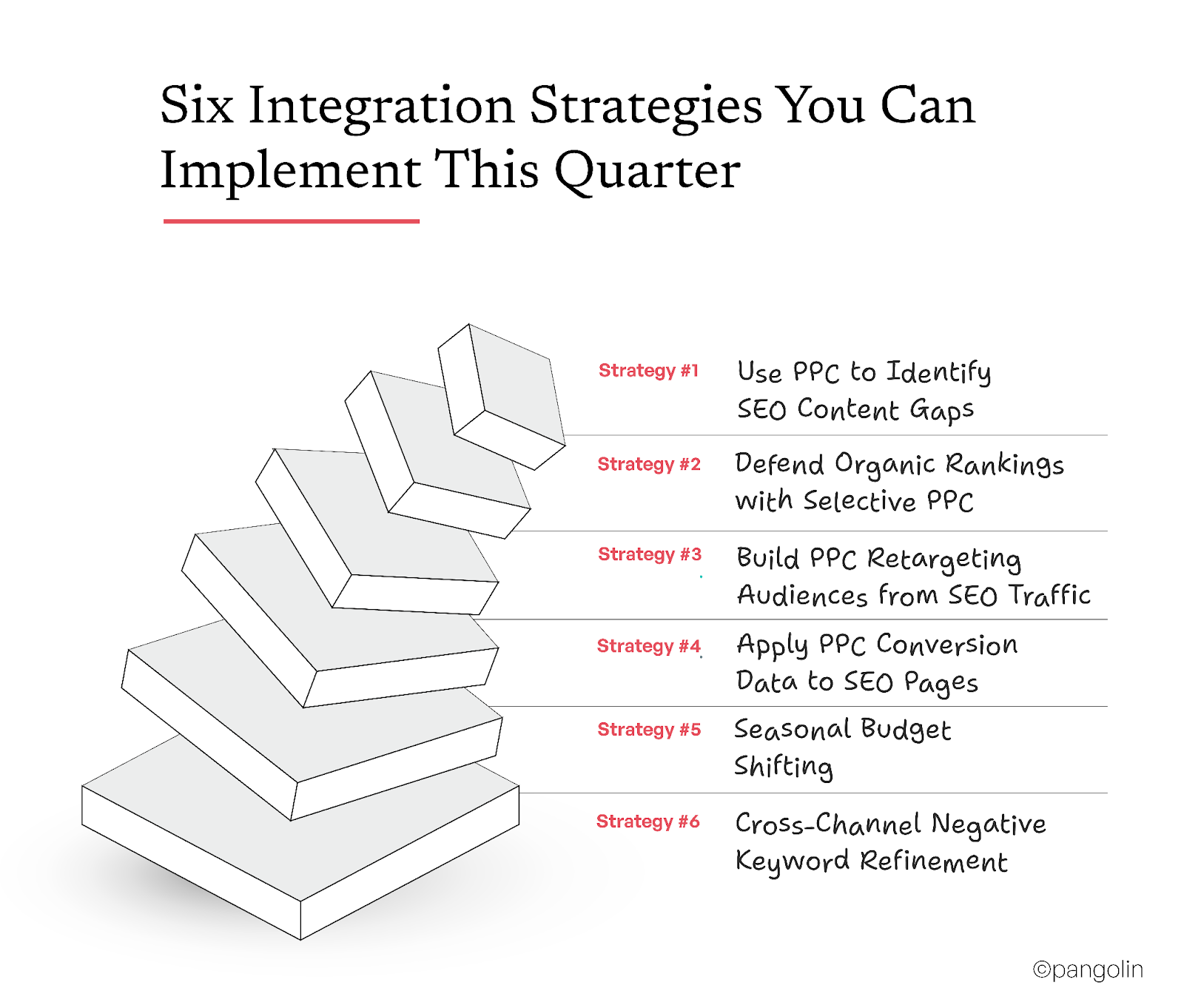
Run PPC campaigns on 20-30 keywords in your category. Track which ones have high CTR (above 4%) and strong conversion rates (above 3%). Those keywords signal commercial intent worth targeting.
Prioritize them for SEO content development. You're not guessing what might work. You're building on proven demand.
Real application for B2B SaaS: Run PPC for "project management software for remote teams." You discover it converts at 6.2% versus 1.8% for the generic "project management tools." Build your comprehensive SEO content hub around the "remote teams" angle instead of competing in the overcrowded generic space.
You rank #2-3 organically for a high-value keyword. Competitors are running aggressive PPC ads above you. What do you do?
Run PPC ads for that keyword even though you rank organically. This increases total SERP presence and prevents competitor monopolization.
Deploy this when conversion value justifies dual spend (customer LTV above $2,000). Use it when there are 3+ PPC ads above organic results. And definitely use it when a competitor is aggressively targeting your category.
The ROI: One healthcare tech company saw a 28% increase in total conversions by adding PPC to their organic #2 ranking.
Tag all organic blog visitors with retargeting pixels. Segment by content topic, awareness versus consideration versus decision-stage content. Serve PPC display ads based on what they consumed.
Example segmentation:
SEO builds awareness cheaply. PPC converts warm traffic efficiently. Multi-touch attribution captures the complete customer journey.
Test messaging in PPC campaigns where you get results in 2-4 weeks. Then apply winners to SEO, where testing would take 3-6 months.
The workflow:
You just shortened your SEO optimization cycle by 70%.
Lean heavily on PPC for Q4, product launches, or limited-time campaigns. Use SEO to maintain baseline traffic year-round.
E-commerce example:
Industry applications:
PPC reveals which keywords attract clicks but don't convert. These same keywords probably waste SEO resources too.
Export your PPC negative keywords, terms like "free," "cheap," "jobs," "salary," "DIY." Audit SEO content to ensure you're not targeting those terms. Reallocate effort toward commercial-intent keywords.
This eliminates 20-30% of wasted PPC spend. It improves SEO content ROI by focusing on keywords that actually drive conversions.
If you're using last-click attribution, you're giving PPC all the credit and starving SEO of budget.
Here's what to track instead.
Formula: Total channel spend ÷ customers acquired through that channel
This reveals true cost efficiency, not just conversion count. Your goal: SEO CAC should be 30-60% lower than PPC CAC by month 18.
If it's not, something's broken in your SEO execution or measurement.
This shows how often SEO appears in the conversion path before PPC gets last-click credit.
Where to find it: Google Analytics → Conversions → Multi-Channel Funnels → Assisted Conversions
If SEO assists 40% of PPC conversions, it deserves credit in ROI calculations. Last-click attribution would hide this completely.
Track combined impression share across both channels for target keywords. Total SERP dominance matters more than channel-specific rankings.
Tools like SEMrush or Ahrefs can track this for you. The metric: What percentage of total search visibility do you own across paid and organic combined?
Formula: Customer LTV ÷ CAC
Benchmark: Healthy ratio is 3:1 or higher
If PPC CAC is $500 but customer LTV is $5,000 (10:1 ratio), aggressive PPC spend is justified. Conversely, if SEO CAC is $200 with the same $5,000 LTV (25:1 ratio), that channel deserves more budget.
SEO average: 14.6% for organic leads
PPC average: 4-6% for search ads; 10% for high-intent campaigns
Even if PPC drives more volume, SEO often converts better per visitor. Volume and efficiency are different metrics. Track both.
SEO: Meaningful results in 6-12 months; peak performance at 24-36 months
PPC: Immediate results within days; plateaus after 6-12 months unless continuously optimized
Budget for SEO as a long-term investment. Treat PPC as an immediate revenue driver. They play different games on different timelines.
Attribution Model Recommendation: Use position-based (U-shaped) attribution for integrated campaigns. This gives 40% credit to first touch (often SEO), 40% to last touch (often PPC), and 20% to middle touches. It more accurately reflects how channels work together.
The attribution problem is real. Seventy percent of conversions involve 3-7 touchpoints across paid and organic channels. Single-touch models distort reality and lead to bad budget decisions.
Even smart marketers make these errors. The difference is recognizing them early.

Competitors fill the PPC space above your organic result. You lose SERP dominance and 30-40% of potential clicks. Brand perception suffers, it looks like budget constraints.
The fix: Maintain selective PPC for high-value keywords even when ranking organically. Focus on brand terms and high-converting commercial keywords.
You're paying for keyword performance data with PPC but not leveraging it. SEO teams waste months creating content for keywords that don't convert.
The fix: Monthly sync between PPC and SEO teams. Share conversion rate data, search query reports, and negative keywords.
Twenty to thirty percent of PPC spend goes to irrelevant clicks without proper negative keyword management. Common culprits: "free," "cheap," "jobs," "DIY," "how to become" queries.
The fix: Weekly negative keyword audits for PPC campaigns. Build a robust negative keyword list with 200-500 terms minimum.
Last-click attribution underfunds SEO by 40-60%. It creates false ROI comparisons between channels.
The fix: Switch to position-based or data-driven attribution models. Track assisted conversions in Google Analytics.
Siloed teams duplicate work and miss integration opportunities. No data sharing means no strategic advantage.
The fix: Create a unified search team or at minimum schedule monthly cross-team strategy sessions. Build shared dashboards showing combined channel performance.
These mistakes aren't just inefficient. They're expensive. Fix them before they compound.
The search landscape changed more in the last 18 months than the previous decade. Here's what that means for your strategy.
Google's AI Overviews now appear for 15-20% of queries. Both organic and paid CTRs drop when AI Overviews appear.
But here's the opportunity: Brands featured in AI Overviews see a 38% organic CTR boost for related queries.
What to do: Optimize content for AI summary inclusion with clear answers, structured data, and concise explanations. Don't abandon PPC, it still appears above AI Overviews and captures clicks. Focus SEO on entity building and topical authority to improve AI citation chances.
Thirty percent of searches now happen in ChatGPT, Perplexity, and other AI engines. These platforms don't show PPC ads yet. Traditional SEO tactics don't guarantee GEO visibility.
GEO strategies for 2025:
PPC adaptation: While GEO doesn't have ads yet, use PPC to capture Google traffic while competitors sleep on AI search. Expect AI platforms to introduce paid placement by 2026.
Thirty percent of searches are now voice-based. Voice queries are longer (7-10 words) and conversational. Traditional short-tail keywords miss voice search traffic entirely.
How to adapt both channels:
For SEO: Target question-based keywords ("How do I..." "What is the best..." "Where can I find..."). Create FAQ pages with natural language answers. Optimize for featured snippets, voice assistants read these first.
For PPC: Bid on conversational long-tail keywords. Use phrase match and broad match modifier to capture voice variations. Create ad copy in question-answer format.
Google Performance Max and Smart Bidding use AI to automate campaigns. Sixty-five percent of PPC advertisers now use some form of AI automation.
The risk: AI can burn budget quickly without proper guardrails. "Set it and forget it" leads to wasted spend.
The strategy: Use AI automation but set strict conversion goals and budget caps. Monitor search term reports weekly, AI sometimes targets irrelevant queries. Feed AI better data by improving conversion tracking and audience signals.
The future isn't "SEO versus PPC versus AI search." It's orchestrating all three into a unified visibility strategy.
The principles are universal. The execution varies. Here's how to adapt the SEO-PPC balance for specific industries.
Challenge: Long sales cycles (3-9 months), high CAC, complex buying committees
SEO priority: 60-70% of budget, builds authority for consideration stage
PPC priority: 30-40%, captures high-intent bottom-funnel searches and retargeting
Key metric: SEO delivers 702% ROI for B2B SaaS versus PPC's 250%
Tactic: Use PPC for free trial signups and demo requests. Use SEO for thought leadership that influences buying committees.
Challenge: High CPCs ($50-150 per click), intense local competition, urgency-driven searches
SEO priority: 50-60%, delivers 526% ROI and builds long-term local authority
PPC priority: 40-50%, critical for "near me" searches and urgent queries like "DUI lawyer tonight"
Key metric: First responder wins 70% of legal clients
Tactic: PPC for immediate response to urgent inquiries. SEO for practice area authority and local visibility.
Challenge: Niche markets, long RFP cycles, technical specifications
SEO priority: 70%, builds technical authority and captures early research
PPC priority: 30%, targets specific product SKUs and RFP-stage buyers
Tactic: SEO for technical content hubs demonstrating expertise. PPC for product catalog campaigns when buyers know exactly what they need.
Challenge: Commoditization, price competition, proving differentiated expertise
SEO priority: 65%, differentiates through methodology and thought leadership
PPC priority: 35%, captures high-intent outsourcing searches
Tactic: SEO for industry-specific expertise that can't be commoditized. PPC for geographic expansion into new markets.
Challenge: Need rapid traction for fundraising, limited runway, intense investor scrutiny
SEO priority: 30-40% initially, builds credibility signals for investors
PPC priority: 60-70% initially, demonstrates market demand quickly
Shift trigger: Post-Series A, flip to 60% SEO as you build sustainable growth mechanisms
Your industry dictates starting allocations. Your growth stage dictates when to shift them.
You don't need to overhaul everything at once. Start here.
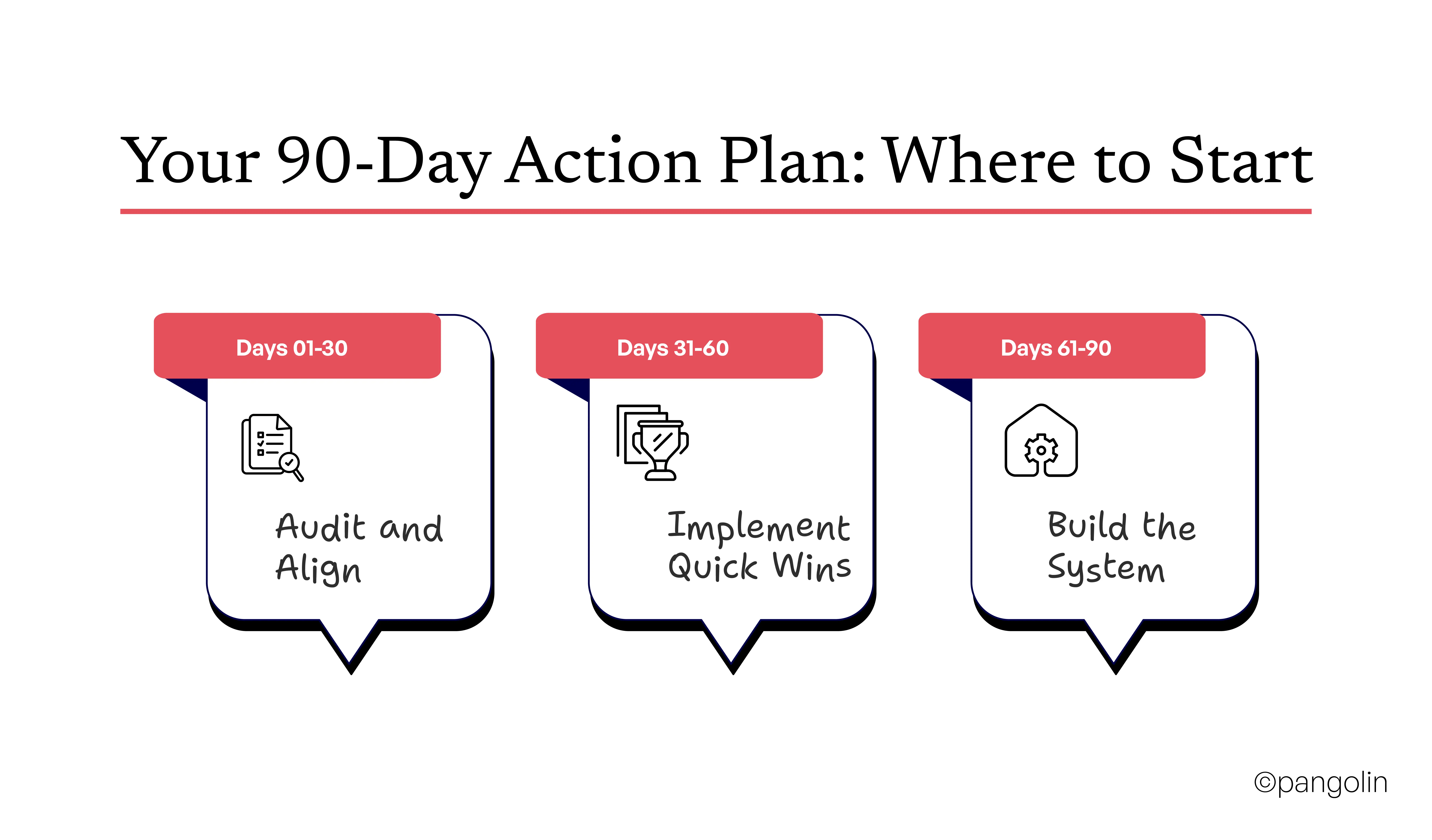
Week 1-2:
Week 3-4:
Quick Win #1: Start PPC campaign for SEO content gap validation
Quick Win #2: Add PPC to your top 3 organic-ranking keywords
Quick Win #3: Set up retargeting for organic blog traffic
System #1: Monthly SEO-PPC sync meetings
System #2: Unified dashboard combining both channels
System #3: Quarterly budget rebalancing review
These aren't aspirational. They're actionable. Pick one and start Monday morning.
Your CFO gets immediate PPC revenue to hit quarterly targets. Your CMO gets compounding SEO growth that reduces CAC over time. Your board gets a sustainable, defensible search strategy that doesn't collapse when budgets get tight.
Stop choosing. Start integrating.
The brands dominating search in 2025 aren't debating "SEO versus PPC." They're orchestrating both into unified systems where paid intelligence informs organic strategy, organic authority amplifies paid performance, and every dollar compounds instead of competing.
Gap made dancing a KPI and ended seven quarters of decline. You can make integration a system and end the budget battles that drain your team's energy and your company's growth potential.
The framework is here. The tactics are proven. The data backs it up.
Now it's your move.


Aniket leads content marketing at Pangolin, writing and editing for B2B tech clients who need sharp messaging and consistent output. He came from journalism and brings that newsroom discipline to content work, turning drafts around quickly and keeping quality high.