On June 21, 2019, Spring Rewards sent an email to tens of thousands of customers at 200 restaurants and businesses across Chicago. The message was short: the loyalty program was discontinuing operations, and users had exactly six days to redeem any remaining rewards before everything disappeared.
Restaurant owners like Taryn Kelly from Sopraffina Marketcaffe found out the same way their customers did, by email, sitting at her desk. Just "we made the unfortunate decision to end our rewards program effective one week from now."
The fallout was brutal. Businesses scrambled to apologize to loyal customers. Sweetwater Tavern sent $10 discounts acknowledging the end was frustrating and happened on short notice. Spring's River North offices turned out to be an empty space. The Illinois Secretary of State had revoked their business certificate two years earlier for failing to file reports and pay taxes. Spring owed back taxes, penalties, and interest.
Here's the kicker: Spring called the shutdown "a disappointing but mundane set of commercial events." Nothing newsworthy, they said.
But for the restaurants that built their customer retention strategy around that program, for the electricians and mechanics who earned points they'd never redeem, and for the businesses now left without a loyalty infrastructure, it was catastrophic.
Spring Rewards is a warning sign.
77% of loyalty programs fail within two years because they die slowly from inactivity while leadership celebrates enrollment numbers on dashboards.
Let's calculate exactly what that costs.
Here's what your quarterly loyalty report probably shows you:
Leadership sees those numbers and thinks the program is working.
But here's what the dashboard doesn't show:
Active members (scanned/claimed in last 30 days): 5,700 (20% of enrolled base)
When 80% of your "members" are ghosts, you're not running a loyalty program. You're funding an expensive database of people who will never engage again.
Let's say you're a building materials manufacturer with 30,000 enrolled trade influencers—electricians, painters, contractors, dealers—across 15 states. Your program costs ₹1.8 crore annually: tech platform, agency fees, reward fulfillment, field activation, customer support.
Now let's run the numbers on what you're actually getting versus what you're leaving on the table.
Research shows active loyalty members spend 38% more than non-members. In B2B trade contexts, the gap is even wider. Partners who regularly engage with your program recommend your products, push premium SKUs, and defend your brand when competitors offer better credit terms.
Your 5,700 active members are generating incremental revenue. But your 22,800 inactive members? They're costing you program expenses with zero return.
Here's the calculation:
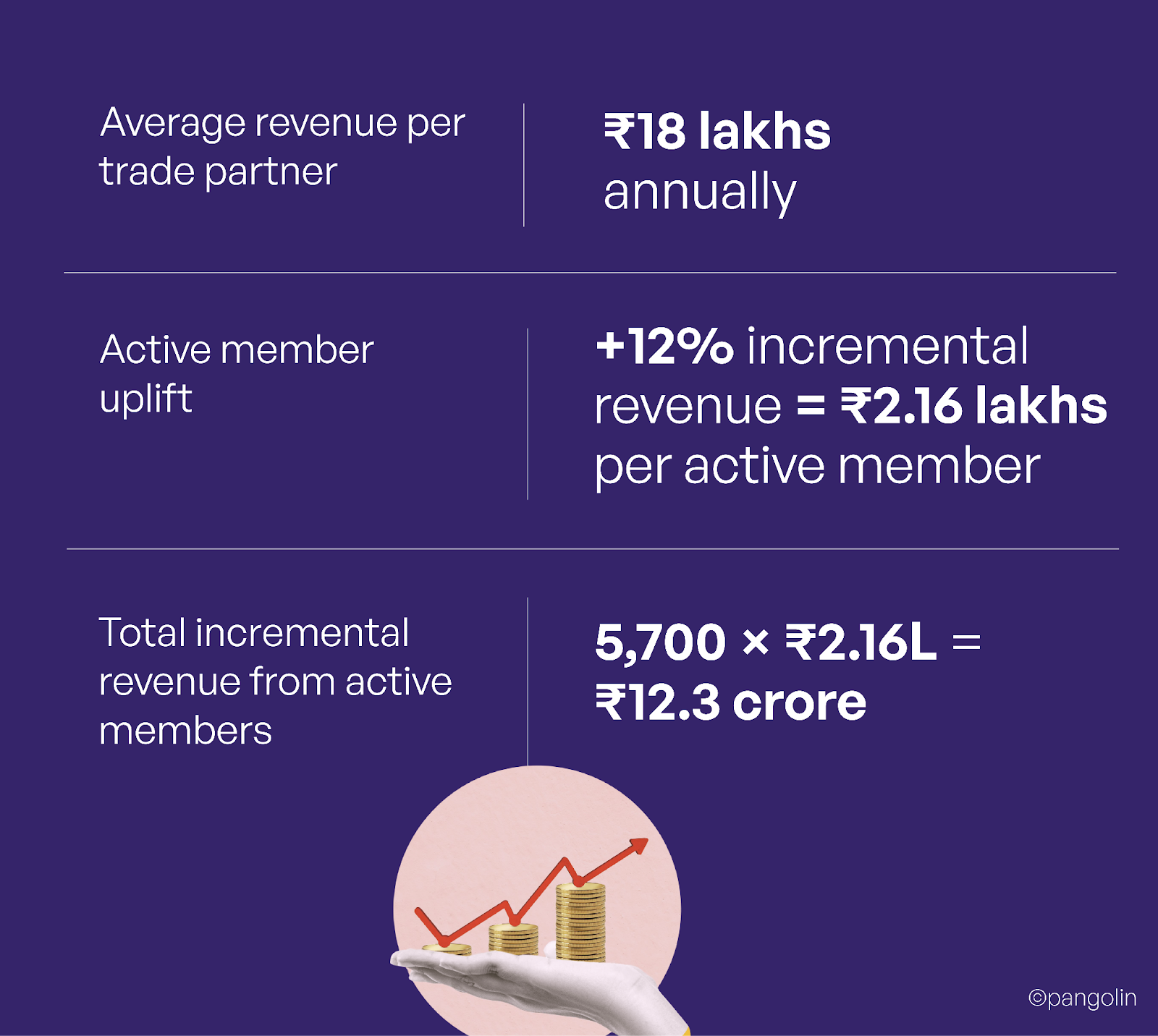
That's your current return. But what about the 22,800 inactive members?
If you could activate even half of them, 11,400 partners, to similar engagement levels, that's an additional ₹24.6 crore in incremental revenue sitting on the table.
Your program is generating ₹12 crore but leaving ₹25 crore unrealized.
That's your revenue leak.
Revenue Reality Guide
Direct program costs are just the beginning. Inactive loyalty programs drain resources in ways most finance teams never measure:
Your customer support team fields calls from confused partners: "I scanned 5 bills last month, where are my points?" Your field sales team spends hours explaining a program that partners stopped believing in months ago. Your IT team troubleshoots app login issues for members who will never open the app again after this one incident.
When your program delivers no emotional connection, switching costs become zero. A competitor launches a program offering 10% cashback versus your 8%, and overnight your partners switch. You're trapped in a cashback war where the only way to compete is to destroy your own margins.
This is what happens when loyalty is transactional instead of emotional. Partners don't choose you because they feel connected to your brand—they choose whoever pays more this quarter.
Your field sales team stops pitching the program because they've seen partners enroll, get frustrated, and abandon it. Sales reps hear: "Your app doesn't work," "I never got my points," "The redemption process is too complicated."
80% of marketing-generated leads in B2B contexts get ignored by sales teams because of broken trust between marketing initiatives and sales execution. When your loyalty program becomes another "marketing scheme that doesn't actually help me sell," it poisons the well for future initiatives.
A mechanic enrolls in your program, scans two invoices, waits three weeks, never sees his points post, calls your helpline and can't get through, then gives up. He doesn't just become inactive. He becomes a vocal critic who tells five other mechanics: "Don't bother with their program, it's a scam."
In India's trade channels where WhatsApp groups and peer networks drive adoption, negative word-of-mouth kills programs faster than any competitor ever could.
Most loyalty programs don't fail at launch. They fail in the messy middle, the 90 days after enrollment when excitement fades and reality sets in.
Here's where the leakage happens:
An electrician hears about your program from a dealer. He tries to sign up during his lunch break. The app asks for Aadhaar verification, PAN card upload, bank details, and a workshop photo. Five minutes in, his phone crashes. He never comes back.
Industry average activation rate (first action within 7 days): less than 30%.
The fix: Reduce signup to under 90 seconds. Use mobile-first OTP verification. Offer instant ₹50 cashback on first scan. Make the first win immediate.
A painter enrolls with excitement, scans his first two invoices, and waits. Ten days pass with no points credited. He checks the app, it says "points will be posted within 15 working days." He tries calling the helpline but can't get through. By week three, he stops opening the app entirely.
Delayed gratification kills momentum. The gap between action and reward creates suspicion: "Is this even real?"
The fix: Real-time points posting. Instant redemption options. WhatsApp notifications confirming every transaction. Weekly earning digests so partners see progress.
Your program offers points for purchases. That's it. No tiers, no badges, no learning modules, no family benefits, no recognition events. Partners see it as a side income supplement, not part of their professional identity.
When a competitor offers 12% cashback versus your 10%, they switch. Zero emotional switching costs.
Emotionally engaged partners show 82% higher retention rates. They stay not because you pay them, but because leaving means losing their status, community, and professional development tools.
The fix: Launch tiered structures (Bronze/Silver/Gold/Platinum). Offer skill certifications that partners display at job sites. Provide family health benefits. Host regional recognition events. Transform "points for purchases" into "career capital."
Most loyalty reports measure the wrong things. Here's what actually matters when you're calculating how much inactivity is costing you:
Formula: (Members who took first action within 7 days / Total enrolled) × 100
Healthy benchmark: 60%+
Typical reality: <30%
If your activation rate is below 40%, you have an onboarding crisis. Partners don't understand the value proposition, the signup friction is too high, or the first reward isn't compelling enough.
Formula: (Members who scanned/claimed/redeemed in last 30 days / Total enrolled) × 100
Healthy benchmark: 50%+
Typical reality: 15-25%
This is your program's pulse. If less than 40% of enrolled members are actively engaging monthly, you're bleeding from a stage-specific failure, usually Onboarded to Earning or Earning to Belonging.
Formula: Total program-attributed incremental revenue / Active members
This metric separates vanity from value. A program with 50,000 enrolled members but ₹8 crore in incremental revenue (₹16,000 per active member at 10,000 active) is weaker than a program with 10,000 enrolled members generating ₹12 crore (₹120,000 per active member at 10,000 active).
Enrollment is theater. RPAM is truth.
Formula: (Members who were active last month but inactive this month / Total active members last month) × 100
Healthy benchmark: <10% monthly
Typical reality: 15-25% monthly
High churn means you're winning members but losing them just as fast. This signals weak habit formation (no compelling reason to come back) or broken trust (promises not delivered).
Formula: Incremental revenue from active members - Total program cost = Net ROI
This is the number your CFO actually cares about. If you're spending ₹1.8 crore annually and generating ₹12 crore in incremental revenue, your ROI is 6.7X. That's defensible.
But if you're spending ₹1.8 crore and only generating ₹3 crore because 80% of your members are inactive, your ROI is 1.7X. That's on life support.
If you are still not sure where to start, try out the ROI calculator from Pangolin Marketing.
Let's walk through a real scenario using conservative assumptions.
Your Current State:
Current Program Value:
Not bad. But here's what you're missing:
Target State (Best-Practice Benchmarks):
Revenue Headroom Calculation:
Your inactive members aren't just neutral. They're costing you ₹13 crore in unrealized opportunity every year.
At a conservative 16% gross margin, that's ₹2.08 crore in unrealized gross profit you're leaving on the table.
It's not hard to see the difference between programs that are dying and those that are doing well. It's real.
Program Dying:
Program Thriving:
If you're sitting on a database of inactive members, here's how to bring them back:
Run the numbers:
Common answers from trade partners: "I forgot about it," "Points never showed up," "Too complicated," "Didn't see any benefit."
If the problem is Onboarded → Earning (most common):
If the problem is Earning → Belonging:
Track reactivation rate: What % of inactive members took an action in the past 30 days?
Target: 15-20% reactivation in the first 60 days.
If you hit that, scale the tactics. If you don't, go back to diagnostics, you may have a deeper trust issue or product-market fit problem.
Download Whitepaper
If a loyalty program isn’t really working and nobody intervenes, three patterns tend to show up. None of them end well for the business or for the person who championed the program.
The CFO looks at the numbers: decent enrollment, decent awareness, but no clear lift in revenue or share. On paper, it looks like a nice-to-have cost centre, not a growth lever. So next year, your budget is cut by 30–40%.
You trim field activations, shrink rewards, maybe switch off a few regions. The experience gets weaker, partners disengage, performance drops further. The program enters a slow death spiral: less spend, worse experience, more churn, weaker ROI, then even more cuts.
On the career side, your name is now attached to “the ₹2 crore initiative that didn’t really move the needle.” When VP or CXO roles open up, leadership remembers that.
Scenario 2: The Competitor Steals the Story
While your program stays mostly transactional, a competitor launches something more ambitious and emotional—skill-building, family-linked benefits, visible recognition, and instant rewards that actually feel tangible.
Your top electricians, painters, or dealers don’t make a big announcement; they just quietly shift their loyalty. Over a year or two, you see key regions where share drops by a few percentage points that are hard to win back. The board starts asking: “We invested in loyalty. Why didn’t it protect us?”
Internally, the finger often points to the program owner. Sometimes that ends in a tough performance review, sometimes in a quiet exit to a smaller brand with less political heat.
No one is brave enough to kill the program, but no one really believes in it either. It stays live with bare-minimum funding. Enrollment plateaus. Active engagement shrinks into the low double digits, then single digits.
It becomes an internal joke: “Remember when we thought loyalty would be our big unlock?” Dashboards still get updated, but nobody really looks at them. The initiative turns into background noise.
For the marketer or product owner, this is corrosive. You start playing it safe, stop pushing new ideas, and wait for a reorg or a new role to escape the zombie.
When nothing changes, the costs stack up quietly:
Doing nothing feels like keeping the peace. In reality, it’s choosing slow, compounding damage over the discomfort of redesigning the program properly.
You don't need to scrap your program and start over. You need to diagnose where it's leaking and fix that stage first.
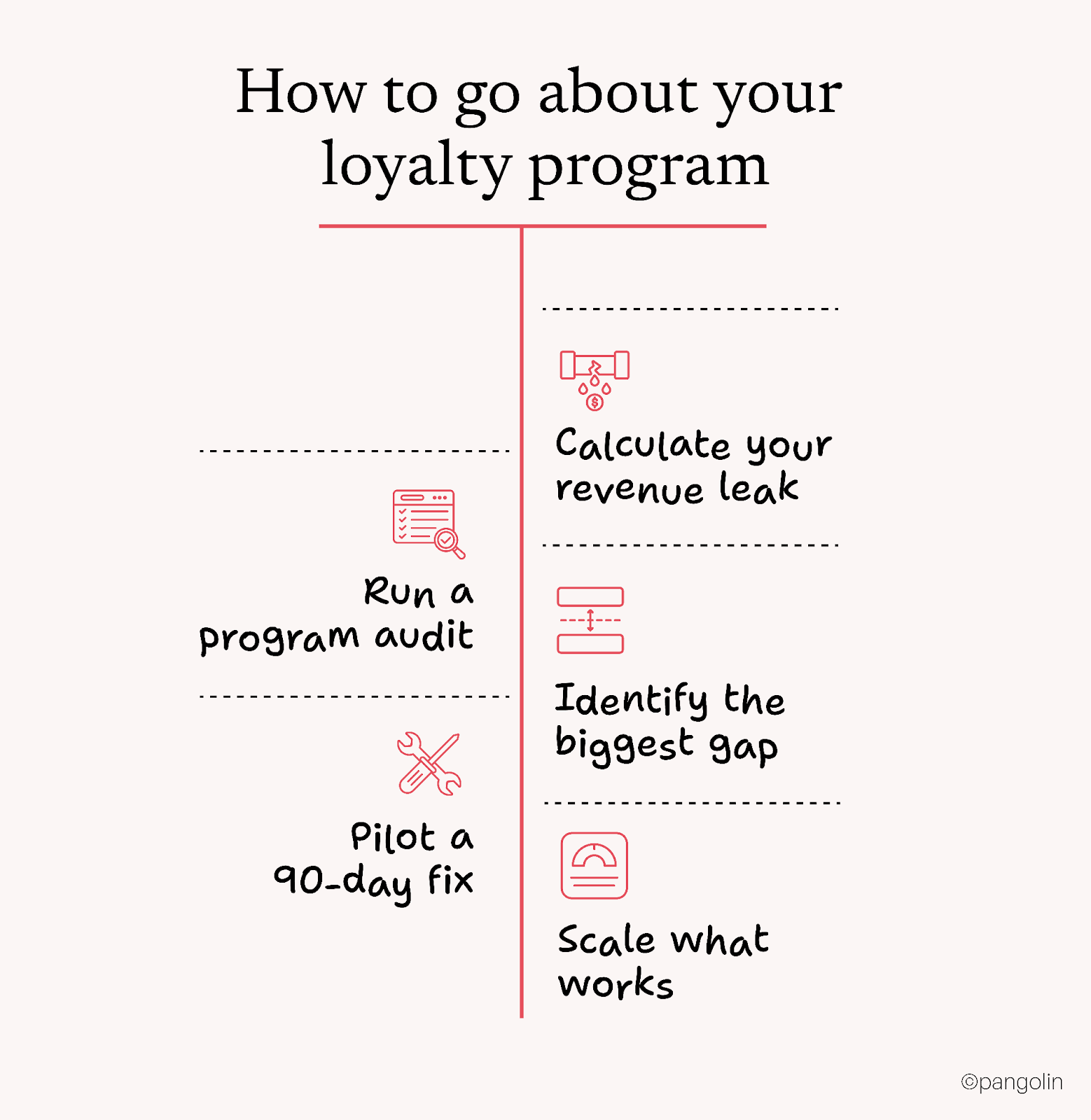
Begin here:
1. Figure out how much money you're losing: Follow the steps above. Find out just how much extra money you're missing out on because of inactive members.
2. Check the program: Ask 50 members who aren't active to fill out a survey. "Why did you stop using the program?" The answers will tell you exactly where your program is going wrong.
3. Find the main problem: Is it hard to get started? Rewards that come later? Not feeling emotionally connected? First, fix the biggest hole.
4. Try out a 90-day fix: Pick one area or group. Use strategies that are specific to each level. Check the rate of reactivation and the extra money coming in.
5. Make what works bigger: If the pilot moves the needle (15% or more reactivation and a measurable increase in income), roll it out to the whole country.
The idea behind loyalty programs isn't broken, so they don't fail. They fail because brands look at enrollment instead of engagement, reward transactions instead of relationships, and think that being seen means being loyal.
The electrician who signed up six months ago and then disappeared after scanning two invoices is not lost for good. He wants you to give him a reason to come back.
The challenge is, will you plug the leak before your rival does?
Find out how much money you're losing: Use our ROI calculator to figure out how much money inactive members are costing your business.
Set up a 30-Minute Diagnostic: Let's look at the data for your program and find the best way for you to get immediate wins.
Pangolin Marketing is a strategic growth firm that connects brand strategy with execution. They work with businesses in India to create B2B loyalty programs, activate channel partners, and change trade marketing in the manufacturing, FMCG, electrical, and automotive sectors.

Aniket leads content marketing at Pangolin, writing and editing for B2B tech clients who need sharp messaging and consistent output. He came from journalism and brings that newsroom discipline to content work, turning drafts around quickly and keeping quality high.