TL;DR
Suresh sat in his small distributor office in Indore, staring at three different loyalty program pamphlets spread across his desk. All from electrical brands, promising cashback and points and in English.
He had tried explaining the first program to an electrician last week. The electrician stared at the app interface, clicked around for 30 seconds, then handed the phone back. "Bahut complicated hai," (It’s too complicated) he said. Too complicated. The second program required uploading workshop photos and filling out a 12-field registration form. Nobody completed it. The third program offered rewards you could only redeem after accumulating ₹2,000 in points.
Meanwhile, Suresh heard that his counterpart in Coimbatore was crushing adoption numbers with a vernacular WhatsApp-first loyalty program. No app download or English barriers and an instant ₹50 mobile recharges electricians could use the same day. 65% activation rate within 30 days.
That gap between Suresh's reality and his peer's success is exactly why 77% of loyalty programs fail in Tier 2 and Tier 3 markets. Brands design programs for metros and expect them to work unchanged in regional markets. They don't. And the cost of that misunderstanding is massive. Tier 2 and 3 cities contribute 45% of India's industrial output, 40% of exports, and are expected to drive 45% of GDP growth by 2025. But most loyalty programs capture less than 20% of their potential value from these markets.
This is how you fix it.
Download Whitepaper - From Cashback to Community
Your dashboard still celebrates 50,000 enrolled members. Your field sales team knows that 82% of those members never activated.
The disconnect is about fundamental design misalignment with regional ground reality.
Activating regional markets isn't about running your metro strategy harder. It's about building a completely different activation architecture designed for how Tier 2 and 3 trade partners actually work, communicate, and make decisions.
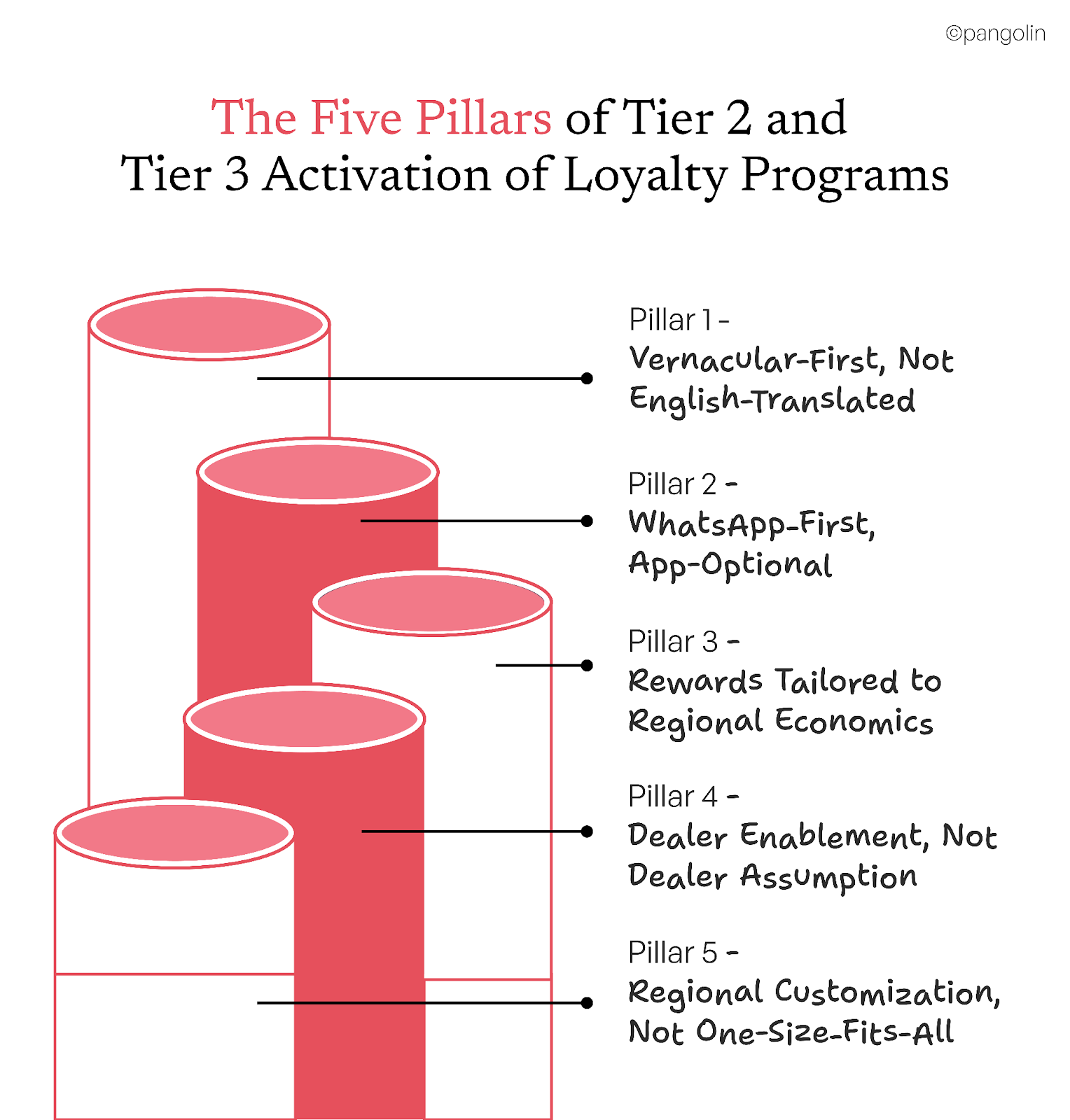
There's a difference between translating your English app into regional languages and designing vernacular-first experiences. Translation feels corporate and awkward. Vernacular-first feels native and authentic.
For loyalty programs, vernacular-first means mobile app interfaces in 8+ languages.
WhatsApp communication in the language the electrician prefers, customer support available in regional languages, not just Hindi and English.
Training materials, counter posters, and dealer scripts localized not just in language but in cultural reference points.
ShareChat exploded in Tier 2 and 3 markets by offering content in 15+ Indian languages when Instagram and Snapchat stuck to English. That single decision unlocked 400 million+ users (2025) who felt genuinely welcome, not grudgingly accommodated.
Here's a reality that destroys most regional loyalty strategies. Trade partners in Tier 2 and 3 cities live on WhatsApp. They don't check email. They barely open dedicated apps. But WhatsApp messages? Those get read immediately.
WhatsApp-based loyalty programs eliminate the biggest friction points killing adoption. No app download required, which means no storage constraints and no connectivity failures during installation. No complex onboarding inside an unfamiliar interface. Just scan a QR code, get an instant WhatsApp opt-in, see points posted in real time, and redeem rewards through simple chat interactions.
You can use WhatsApp on basic smartphones, feature phones, and the web. It works with rich media including pictures, movies, and voice messages for people who don't read well. It lets people share things with their friends, which leads to natural peer-to-peer growth. It also has conversational commerce, which lets electricians look at products, ask questions, and even buy things without leaving the chat window.
Metro loyalty programs operate in a world where disposable incomes are higher, digital payments are ubiquitous, and aspirational rewards drive engagement. Tier 2 and 3 markets operate differently. Price sensitivity is higher. Cash-on-delivery still dominates 35%+ of transactions. Families make collective purchasing decisions. And practical daily utilities matter more than aspirational experiences.
Lower your redemption thresholds dramatically. Instead of ₹500 minimum redemption, offer ₹50 or ₹100 thresholds that electricians can reach quickly and repeatedly. That creates immediate gratification and habit formation instead of distant promises nobody believes.
Shift your reward catalog to practical, immediate, family-oriented benefits. Mobile recharges everyone needs daily. Bill payment credits for electricity, water, and DTH subscriptions. Fuel vouchers redeemable at nearby pumps. Grocery credits at local supermarkets and kirana stores. Educational support like tuition fee assistance or school supply vouchers. Healthcare benefits including medical check-ups and insurance.
When rewards directly address daily expenses families already have, redemption rates skyrocket because you're not asking them to want something new. You're helping them pay for things they already need.
Festival-specific rewards resonate deeply in regional markets. Diwali bonuses in North India. Pongal rewards in Tamil Nadu. Durga Puja incentives in West Bengal. Navratri campaigns in Gujarat. When you integrate loyalty with cultural moments that matter to specific regions, you're not running generic promotions. You're showing you understand their lives.
Most loyalty programs fail in Tier 2 and 3 markets not because electricians don't want rewards but because dealers can't explain the program in under 30 seconds at the counter.
Your plan for dealer enablement should see distributors as important partners, not just middlemen. Write short, basic scripts in everyday languages that convey the benefits of the program. Make posters and counter displays with step-by-step signup instructions in the languages of the area. Create incentive schemes that provide dealers shadow points or commissions based on activations, not just sales.
Dealers learn about program updates, new prizes, and success stories from other distributors at monthly training sessions. Dealers can call toll-free help lines in their own language when electricians have queries that they can't answer. Recognition programs that highlight the best dealers who are active foster healthy competition and motivate peers.
Field sales teams also need to be on the same page. Salespeople should get a commission for every trade partner they activate. This will provide them a direct reason to promote the program. Reps can see how well they're doing and where they're falling short using mobile dashboards that offer real-time activation metrics by region. Regional competition leaderboards encourage people to use the service by making it fun and comparing it to others.
When a Tier 2 Rajkot distributor gets 200 electricians to work in 90 days and gets a performance incentive and is mentioned in a company-wide email, all the other distributors pay attention. That's how you get more people to use your product in the field, not only through corporate marketing.
Gujarat is not Tamil Nadu. Tamil Nadu is not West Bengal. Anyone who has actually tried to run a “national” program from a metro boardroom knows this the hard way.
A lot of loyalty programs fail not because the idea is bad, but because the same playbook gets dumped across regions that speak different languages, celebrate different festivals, and think about money and family in completely different ways. On paper it looks efficient. On the ground it looks tone-deaf.
In North India, campaigns that show up around Diwali, Holi, Lohri, or Karva Chauth feel like they’re a part of people’s lives. Decisions in many households are still taken jointly – parents, grandparents, even extended family weighing in. So rewards that include the family, or create some social “status moment”, land much better than purely individual perks. Hindi and Punjabi are basic hygiene, and when a loyalty program suddenly shows up with a Bhangra artist or a known North Indian film face, people pay more attention because it feels familiar, not imported.
Move down to South India, and you can’t simply copy-paste that logic.Tamil, Telugu, Kannada, Malayalam - each carries a different tone, humour, even respect level. Mixing them up is a fast way to lose trust. Products like the Samosa App showed that when you build vernacular-first, especially in Tier 2 and 3 towns, adoption doesn’t creep up, it spikes. Cinema here is also local first: Tollywood, Kollywood and others shape aspiration more than pan-India celebrities. Temple events, cultural functions, local community gatherings, these are the places where brands earn the right to be taken seriously. And when the rewards lean into education, tuition, or skill-building, you’re not just giving out points; you are aligning with what many families already prioritise for the next generation.
In East India, if your experience ignores Bengali and Odia, you’ve opted out of the conversation before you’ve even started in cities like Kolkata and Bhubaneswar. These are not “experimental” markets anymore; Tier 2 growth here is very real. Quick-service restaurants and retail chains are quietly training customers to expect some form of loyalty by default. Durga Puja and Rath Yatra are not just “good campaign windows”; they are the emotional peaks of the year. If your program isn’t visible there, it just doesn’t feel present.
In Central and West India, especially Gujarat and Maharashtra, there’s a strong entrepreneurial flavour running through the market. People don’t just see themselves as consumers; they see themselves as business owners, traders, professionals. So when the rewards speak the language of business – better margins, tools, financing support, savings on inputs – they cut through far more than generic cashback. Gujarati and Marathi interfaces are not “nice to have”, they are a basic sign of respect. And if you ignore Navratri or Ganesh Chaturthi in your engagement calendar, you’re leaving the biggest organic engagement spikes of the year untouched.
Tech is usually sold as the “easy” part of loyalty. In Tier 2 and Tier 3 India, it’s usually where things quietly fall apart.
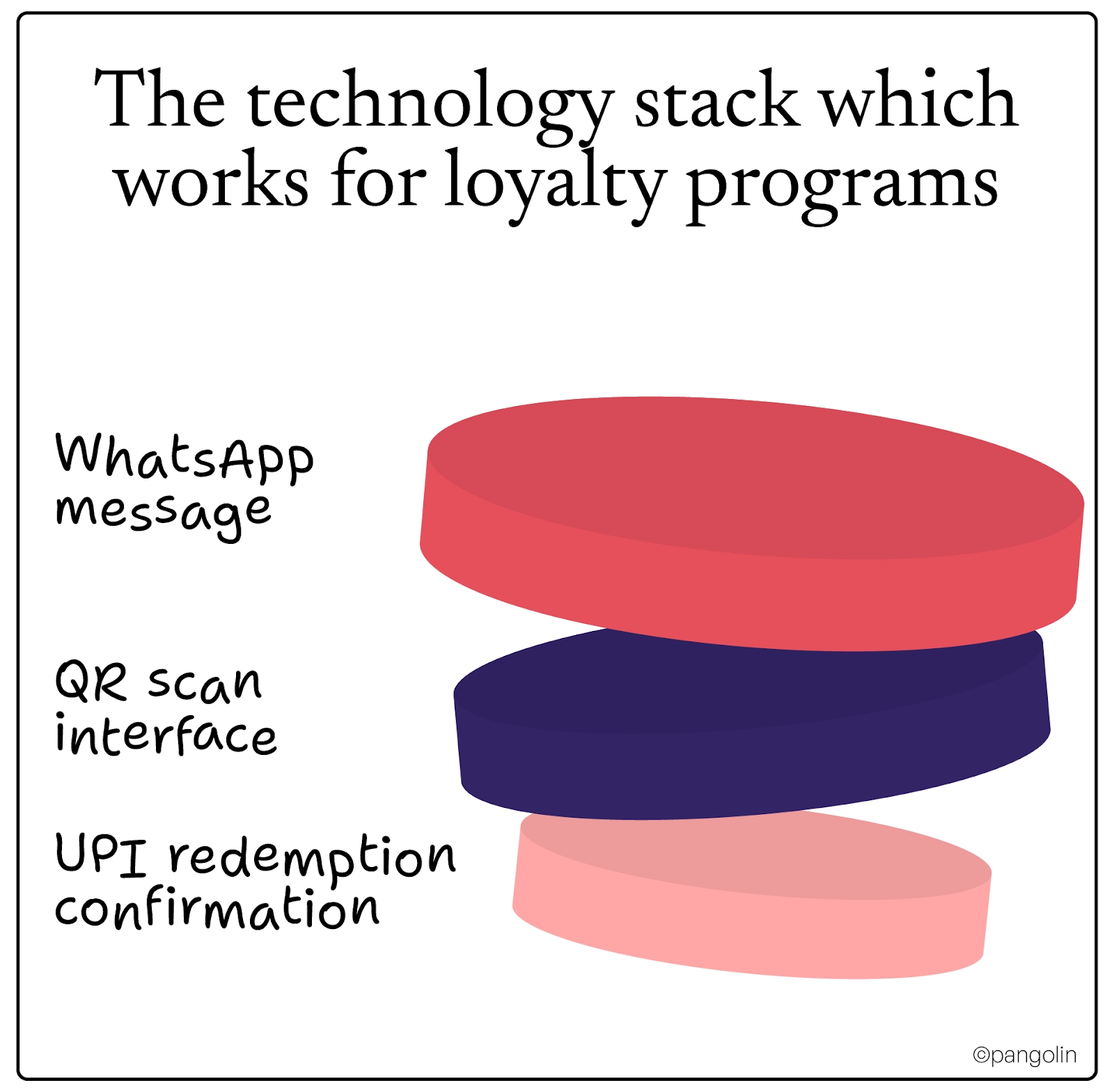
If your stack is built for metro assumptions – strong data, app store comfort, English-heavy UX – it looks fine in a demo and then stalls in the field. But when you design for low bandwidth, mixed literacy, and a patchwork of languages from day zero, adoption suddenly starts to look a lot more natural.
For a huge chunk of users, WhatsApp is the internet. Expecting them to download a separate app, remember a password, and navigate a dense interface is wishful thinking. The WhatsApp Business API should be the main entry point: joining the program, checking points, submitting a bill photo, redeeming a reward – all inside a chat they already use every day, ideally in their own language.
The platform itself should handle multiple regional languages natively. Not just “we’ll add translations later”, but eight or more languages considered in the core flows, layouts, and error messages. On top of that, the whole experience has to survive on 2G or shaky 3G without freezing, because that is still reality in many pockets.
Field partners – electricians, mechanics, small retailers – don’t stand in front of fibre Wi‑Fi all day. They’re on sites, in workshops, in small shops. They should be able to scan a QR code, get their points logged, and move on, even if the network drops right then. The system can quietly sync when the phone catches signal again. Most of these partners are using Android phones in the ₹5,000–₹8,000 range, so QR flows that demand high-end cameras are simply going to fail. A Progressive Web App approach helps remove a bunch of friction: no app store hunting, fewer storage complaints, and no forced updates that break things.
Then there’s comfort with interfaces. A lot of users are far more comfortable speaking than typing long forms. Voice input and audio prompts in regional languages meet them where they already are. When there’s no data at all, SMS fallback and USSD keep the door open – especially for feature phone users who still move a meaningful amount of business volume. And at redemption time, UPI, Paytm, PhonePe and similar rails should feel built-in, not bolted on, because that’s what people already trust for daily transactions.
Underneath all this, the analytics layer has to stop pretending India is one homogeneous cluster. Behaviour in Gujarat will not mirror behaviour in Tamil Nadu. The data should show that clearly: which languages people actually select, which ones they ignore, which device types struggle to complete flows, where in the country the network keeps dropping. When you see that, you stop blaming “low engagement” in general and start fixing specific frictions. Feed those patterns into an AI layer that shapes offers by region, wallet reality, and cultural context, and suddenly the loyalty engine feels less like a blunt national scheme and more like something that understands the local ground.
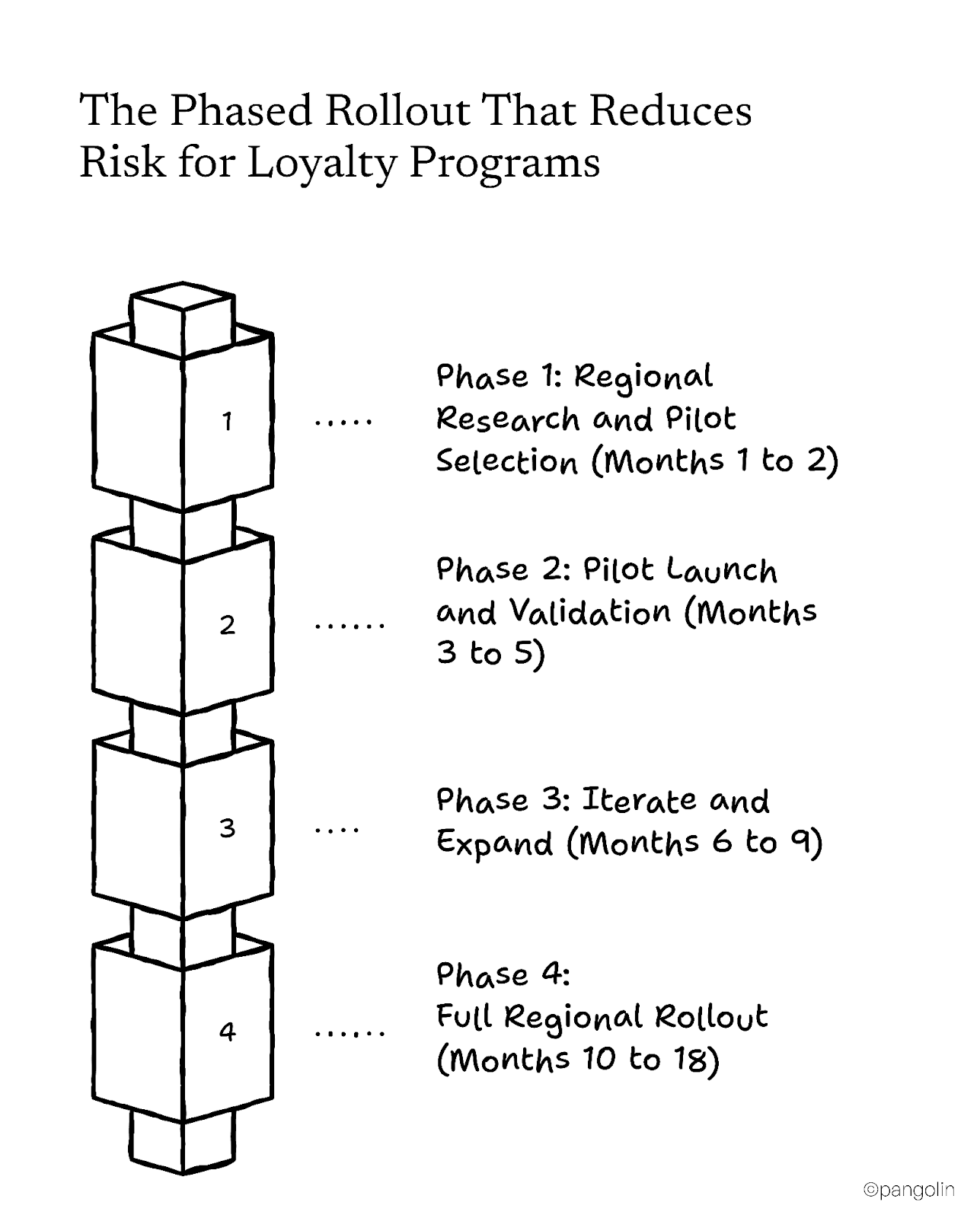
Trying to activate all Tier 2 and 3 markets simultaneously is how programs blow budgets and fail publicly. Smart activation happens in phases that prove concepts, iterate on feedback, and scale systematically.
Phase 1: Regional Research and Pilot Selection (Months 1 to 2)
Map target Tier 2 and 3 cities by potential. Population density, industrial presence, competitive intensity, and existing distribution strength determine which markets offer the highest probability of success. Language needs assessment by region identifies which vernacular interfaces to build first. Dealer and distributor network audits reveal training gaps, technology readiness, and incentive misalignment. Connectivity and infrastructure analysis shows which technology requirements are realistic versus aspirational.
Select 2 to 3 pilot cities representing different regions. If you're expanding nationally, pilot in one North, one South, and one West city to test regional customization strategies before scaling.
Phase 2: Pilot Launch and Validation (Months 3 to 5)
Build vernacular assets for pilot languages. Launch WhatsApp-first communication infrastructure. Train dealers intensively in pilot markets with monthly check-ins. Deploy field sales reps dedicated to activation, not just revenue. Measure activation rates, engagement patterns, reward redemption frequency, language preferences, and dealer feedback daily.
This phase validates assumptions. Does vernacular communication actually improve adoption? Do ₹50 redemption thresholds drive more engagement than ₹500? Are dealers explaining the program correctly after training? Is WhatsApp engagement higher than app engagement? You need real data from real markets before committing ₹2cr to national rollout.
Phase 3: Iterate and Expand (Months 6 to 9)
Analyze pilot data by city, language, dealer performance, and trade partner persona. Fix friction points identified during the pilot. If electricians in Coimbatore struggled with QR scanning in low light, optimize camera settings or add manual code entry options. If dealers in Jaipur couldn't explain tier progression, simplify the structure or create better visual aids.
Add more regional languages based on pilot learnings. Expand to 10 to 15 cities across different regions. Scale dealer training playbooks proven in pilots. Build regional influencer partnerships with vernacular content creators, local celebrities, and respected trade community leaders.
Phase 4: Full Regional Rollout (Months 10 to 18)
Cover all target Tier 2 and 3 markets with full vernacular support across 8+ languages. Launch regional marketing campaigns timed to local festivals and cultural moments. Implement dealer and distributor incentive programs at scale. Organize community events in key cities bringing trade partners together for networking, training, and recognition. Deploy always-on regional engagement with monthly themes, weekly content, and real-time responsiveness.
Look at the GM Modular case study for this.
Vegh Automobiles designed affordable electric scooters specifically for Tier 2 and 3 markets. But scaling efficiently required attracting the right dealership partners in regional cities, not metros where competition was brutal.
They rebuilt their dealership acquisition engine with clear regional personas. Ambitious first-time entrepreneurs in Tier 3 towns looking for business opportunities. Experienced rural dealers who understood local customer behaviors. Regional investors seeking growth sectors.
Within 1.5 months, Vegh generated 70 qualified dealership inquiries from high-intent leads. Campaign launch happened within 7 days of kickoff, enabling early momentum in critical growth phases. Cost per sales qualified lead dropped 3x, allowing Vegh to meet customer acquisition cost targets within 2 months.
The difference wasn't better marketing. It was understanding that Tier 2 and 3 dealer activation requires different messaging, different channels, and different value propositions than metro strategies.
SoftwareHunt built their business matching SME owners in Tier 2 and 3 cities with the right software through high-touch consulting. But human-led consulting couldn't scale without exponentially increasing headcount. Regional dependency and upskilling challenges created operational constraints.
They codified expertise into a guided product system that could run 24/7. Behavioral archetypes representing different SME buyer personas informed tone, interface design, and copy strategy. The platform automated lead scoping and qualification, freeing consultants to focus on high-value interactions. SME owners could move from vague pain points to curated vendor shortlists within a single guided session.
The transformation set the stage for structural leverage across operations, buyer enablement, vendor alignment, and scalable intellectual property. That's what happens when you design for Tier 2 and 3 ground reality instead of retrofitting metro solutions.
Your dashboard celebrates 50,000 enrolled members while your regional sales managers quietly tell you that 82% never activated.
You have two paths forward. Continue running your metro-optimized program harder, spending more on English-language ads, adding more reward tiers nobody in regional markets cares about, and wondering why 70% of India's geography contributes only 28% of your loyalty value.
Or recognize that Tier 2 and 3 activation requires vernacular-first design, WhatsApp-first engagement, dealer enablement, reward localization, and regional customization built into the foundation, not added as afterthoughts.
The brands moving first with 8+ language support, ₹50 redemption thresholds, WhatsApp integration, dealer incentive structures, and regional festival calendars are already capturing value while others are still debating whether "vernacular really matters."
It does. And the window to build regional loyalty before competitors saturate these markets is measured in quarters, not years.
Tier 2 and 3 markets aren't smaller metros. They're fundamentally different ecosystems requiring different activation strategies. The question is whether you'll design for their reality or keep forcing metro playbooks into regional contexts where they don't work. One strategy scales. The other bleeds budget while competitors win.
Let's build your Tier 2 and 3 activation roadmap before your competition does.