Walk into any electrical shop in Mumbai, Delhi, or Ahmedabad, and you'll hear the same phrase dozens of times a day: "Aur Milega?"
An electrician asks the counter boy for a 15-amp MCB. The counter boy hands him one. The electrician squints at it and asks, "Aur Milega?" The counter boy nods, pulls out another brand, maybe throws in a small discount. The electrician nods back and the transaction is complete.
This is how business happens in India's trade channels. "Aur Milega?" is the sound of commerce, the rhythm of negotiation, the verbal handshake that says: I'm here to deal, are you?
In India, every transaction gets negotiated. Restaurant bills, cab fare, wedding dowries, vegetable purchases, everything. The phrase "Aur Milega?" sits at the heart of that culture. It's a question laced with expectation: What else are you giving me? Can you do better? Is there more value here than meets the eye?
For decades, electrical brands in India watched this ritual play out millions of times daily and missed the opportunity hiding in plain sight. They kept launching loyalty programs built around generic promises: "Earn points!" "Get cashback!" "Redeem rewards!" Programs that sounded like they were designed in a boardroom far from any actual electrical shop counter.
Then GM Modular did something different. They took that everyday phrase, "Aur Milega?", and turned it into a loyalty movement that transformed how electricians, retailers, and wholesalers think about their brand.
Here's how they did it, why it worked, and what you can steal from their playbook.
Before we get to the breakthrough, let's talk about what was happening with GM Modular..
India's electrical trade industry is a cashback war zone. Every brand offers the same thing: buy our switches, get 8% back. Buy our MCBs, earn points. Install our panels, redeem a toaster.
When everyone offers cashback, nobody wins. Partners see these programs as income supplements, not reasons to stay loyal. An electrician enrolled in five different brand programs will happily switch to whichever one offers 10% instead of 8% that month. Zero switching cost. Zero emotional connection.
GM Modular's old loyalty program suffered from the same problem: low adoption and high churn. Electricians would sign up during a dealer promotion, scan two invoices, wait for points that took three weeks to post, get frustrated, and disappear. Retailers enrolled because the sales rep pushed them, but never actually used the app. Wholesalers ignored the program entirely because it didn't address their real business needs.
Leadership looked at enrollment numbers and thought things were working. Field teams looked at active engagement and knew the program was dying.
The challenge wasn't just operational. It was strategic. How do you create loyalty when you're selling commoditized products in a market where every competitor offers the same financial incentives?
The answer: you stop competing on price and start building career capital.
Most brands would have responded to GM Modular's problem by tweaking the program. Higher cashback percentages. Faster point posting. A better redemption catalog.
Pangolin Marketing and GM Modular took a different approach. They asked: what if this isn't a loyalty program problem? What if it's a positioning problem?
The insight that changed everything: partners don't want another scheme. They want respect, progress, and proof that you care about their future.
Three mindsets needed to shift:
That last mindset shift is critical. In India's trade channels, status matters. An electrician who carries a Gold tier certification card from a respected brand signals something to his peers and customers. A retailer who gets invited to exclusive GM Modular recognition events gains social capital in his distributor network. Status symbols create switching costs that cashback never can.
The decision: reimagine Bandhan (GM Modular's loyalty platform) not as a loyalty program but as a movement, something partners would want to be part of, not just enroll in.
And the phrase that would carry that movement? "Aur Milega."
Here's what makes "Aur Milega" brilliant: it's a phrase every trade partner in India already says twenty times a day, but GM Modular recast it from a question into a promise.
Before: "Aur Milega?" (Will I get more?)
After: "Aur Milega." (You'll always get more with us.)
That shift turns loss-aversion into gain. It transforms a bargaining tactic into a brand promise. It takes everyday language and loads it with new meaning.
The phrase works because it's:
Culturally resonant: You don't need to explain what it means. Every electrician, retailer, and wholesaler has used this phrase since they started working. It's familiar, comfortable, and instantly recognizable.
Status-signaling: When a partner says "Aur Milega" in the context of GM Modular's program, they're not just asking for more—they're signaling they're part of something. They're in the know. They're members of a community that gets more.
Flipping the script: Instead of partners wondering if they'll get value, GM Modular declares upfront: yes, you'll always get more. More training. More recognition. More opportunities. More respect. The phrase becomes a standing claim, not a hopeful question.
Senior leadership at GM Modular compared the campaign to Fogg's iconic "Aur Kya Chal Raha Hai" for its cultural resonance and punchy simplicity. That's the benchmark. Not "clever advertising," but a phrase so embedded in daily language that it becomes shorthand for the brand.

Take a look here.
Most loyalty campaigns make a fatal mistake: they send the same message to every partner. One poster. One WhatsApp blast. One value proposition.
The "Aur Milega" campaign took the opposite approach: segmented engagement playbooks built around what each trade role actually needs.
Electricians don't just want to get paid. They want to be viewed as professionals, not just workers. The marketing made it clear that Bandhan was not a points scheme but a way to help people grow in their careers.
What they got:
The phrase "Aur Milega" doesn't just mean getting more money today. It's about making your career better in the future.
Foot traffic, profit margins, and keeping customers are important to retailers. The campaign didn't simply provide them discounts on things; it also gave them tools to operate their business better.
What they got:
"Aur Milega" suggests you're not just buying things. You're working with a brand that will help your business grow.
Wholesalers are the ones who decide who gets to sell electrical goods. They choose which brands get the best shelf space, which ones retailers should recommend, and which ones they should ignore. The advertising made them feel like the important people they are.
What they received:
The message is "Aur Milega," which means "Your voice matters here." You are more than just a customer. You're a partner.
Counter boys (shop assistants) are often overlooked in loyalty programs, but they're the ones who actually hand products to electricians and influence purchase decisions. The campaign made it ridiculously easy for them to participate.
What they got:
The message: "Aur Milega" recognizes your contribution, even if you're not the business owner.
Here's what separated this from generic campaigns: every piece of content was localized by language, channel, and persona.
A Gujarati-speaking retailer in Surat got different messaging than a Hindi-speaking electrician in Lucknow. WhatsApp kits were different from counter posters. Onboarding modules were role-specific.
This is cultural adaptation. What motivates a Tier 1 city electrician (status, skill recognition) differs from what motivates a Tier 3 city electrician (immediate cash, family benefits, peer validation). The campaign respected those differences instead of flattening them into one generic message.
Every successful loyalty transformation follows a predictable path. Partners move through six stages, and most programs die because they optimize for the wrong stage.
Here's how "Aur Milega" addressed each transition point:
Most programs die here because partners never hear about them. Field visibility ends after the launch event, and the program becomes invisible within weeks.
What "Aur Milega" did:
The result: Awareness spread organically because the phrase was already part of trade vocabulary.
Industry average activation rate (first action within 7 days of signup): less than 30%. Most programs lose half their signups here because KYC is too complex, the app crashes, or the value proposition isn't clear.
What "Aur Milega" did:
The result: Activation rates jumped because entry friction dropped and first-win came immediately.
This is where most programs bleed. Partners sign up, scan once or twice, wait for points that take 10-15 days to post, get suspicious, and abandon the app. 70% engagement decay by month three is typical.
What "Aur Milega" did:
The result: Partners trusted the system because it delivered on its promise immediately and transparently.
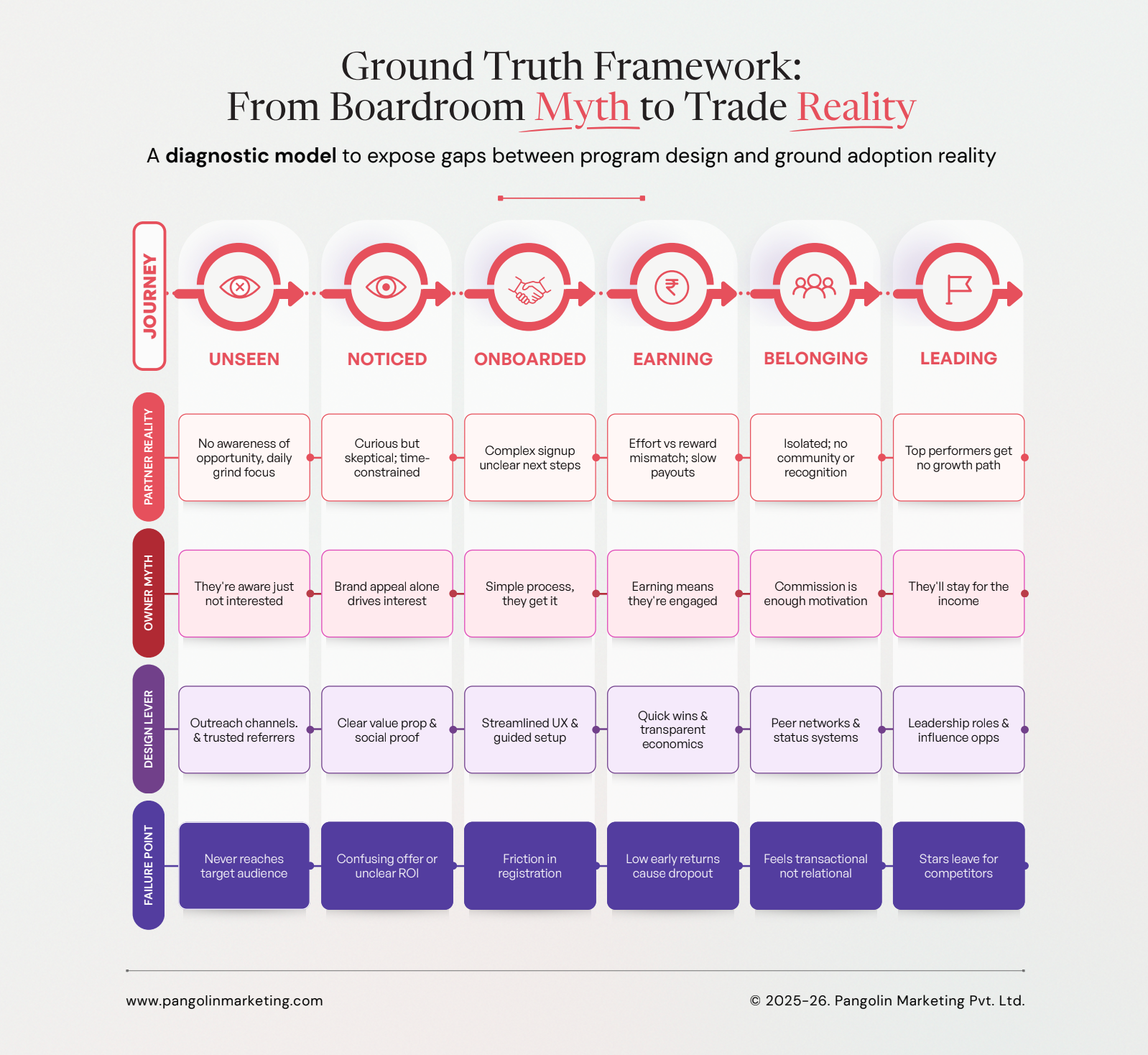
Pure cashback programs never escape this stage. Partners earn points, redeem them, and see the relationship as purely transactional. When competitors offer 12% versus your 10%, they switch.
What "Aur Milega" did:
The result: Partners started seeing Bandhan as part of their professional identity, not just an income supplement. Switching meant losing status, community, and development opportunities.
The ultimate stage: partners who actively recruit others, defend your brand, push premium products, and provide feedback. Referral rates jump from less than 5% (transactional programs) to 15%+ (emotional programs).
What "Aur Milega" did:
The result: Top partners became vocal brand evangelists who used "Aur Milega" as their own catch phrase when recruiting peers.
Here's what most loyalty program reports show you: enrollment growth, app downloads, total members.
Here's what actually matters: active engagement, behavioral change, emotional shift, competitive positioning.
While the "Aur Milega" campaign hadn't launched publicly when the case study was documented, internal and field results were already clear:
Record Loyalty App Downloads: Not just installs, but active first-scans within 48 hours.
High QR Scan Rates: Partners weren't just enrolling, they were using the program repeatedly.
Repeat Program Engagement: Partners came back month after month, not just during promotional periods.
Viral Recognition in Trade Channels: The phrase "Aur Milega" became part of trade vocabulary. Partners used it when talking to peers, signaling they were part of something.
Brand Mindset Shift: Partners started associating GM Modular with career development and respect, not just products and discounts.
Improved Competitive Position: GM Modular differentiated itself in a commoditized market where every brand offered the same cashback.
Internal Momentum: The campaign became "instantly iconic" inside GM Modular, with senior leadership comparing it to famous Indian campaigns for cultural resonance.
You're probably not selling electrical switches. Maybe you're in building materials, automotive parts, paint, FMCG, or industrial supplies. But the principles behind "Aur Milega" work across any B2B trade channel where partners manage multiple competing brands.
Here's how to adapt this playbook:
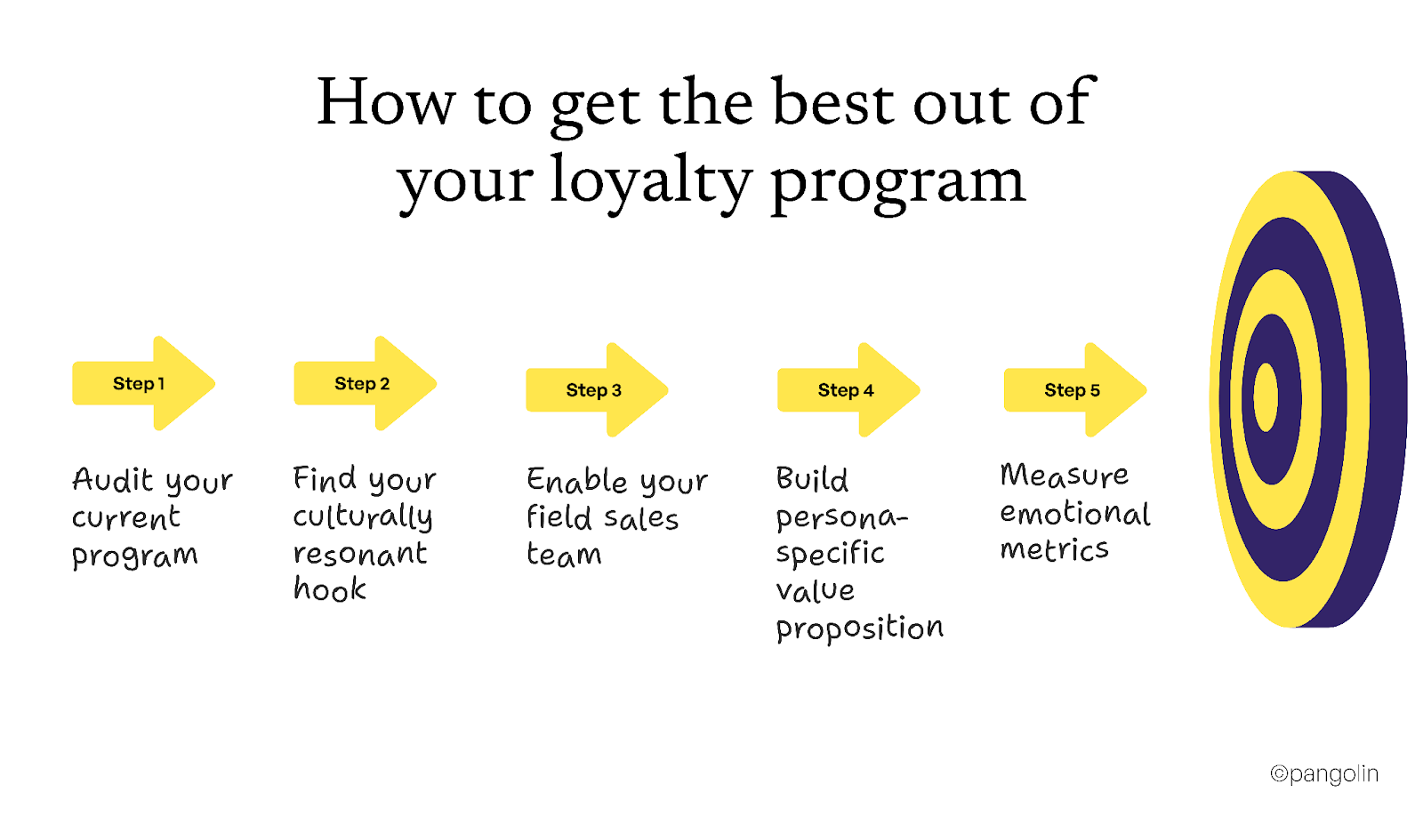
Ask yourself:
If you can't answer these questions with data, you don't have a loyalty program. You have a database with a mobile app.
"Aur Milega" works because it's already part of daily trade language. What's the equivalent phrase in your industry?
Building materials: Maybe it's "Mazboot Hai?" (Is it strong?) recast as a promise about durability and support
Automotive parts: Maybe it's "Chalega?" (Will it work?) recast as a guarantee of quality and reliability
Paint: Maybe it's "Tikau Hai?" (Will it last?) recast as a commitment to longevity and performance
The key: don't invent new language. Elevate existing language your partners already use.
Stop sending the same message to everyone. An electrician's needs are different from a retailer's needs are different from a contractor's needs.
Ask each persona:
Then build programs that address those specific needs:
Your sales reps are the front line. If they don't believe in the program, it dies in the field. 80% of marketing-generated leads in B2B get ignored by sales teams because trust is broken.
Give them:
Test your field enablement: Can a new sales rep explain your program's value proposition in 60 seconds to a skeptical electrician at a noisy job site? If not, your materials aren't field-ready.
Stop celebrating how many people sign up. Begin to keep track:
These numbers will show you if you're building a movement or just getting a lot of accounts that aren't being used.
Don't launch nationally before testing regionally. Pick one state, two cities, or a specific trade segment. Test messaging, measure activation, iterate based on feedback. Scale what works.
Don't assume one message works across all trade roles. An electrician cares about skill development. A retailer cares about margins. A distributor cares about influence. Segment or die.
Don't measure success by enrollment in first 90 days. Enrollment is theater. Active engagement at month six is truth. If you celebrate 50,000 signups but only 8,000 are active three months later, you failed.
Don't forget about WhatsApp. WhatsApp is where business happens in India's trade routes. It's hard to get people to use your program if it only works on mobile devices. Go where your partners already hang out.
Don't forget that it takes time to build emotional loyalty. You can gain quick wins in 60 to 90 days by fixing onboarding problems and giving instant rewards. But it takes 6 to 12 months of regular engagement to turn transactional connections into emotional loyalty.
Don't forget about customizing for your area. What works in Mumbai doesn't work in Tier 3 Uttar Pradesh. Language, value propositions, and proof points must be changed to fit the way business is done in each area.
The "Aur Milega" campaign proves a principle that applies far beyond electrical switches:
In B2B trade channels where products are commoditized and every competitor offers cashback, the only defensible competitive advantage is emotional loyalty.
When you build career capital instead of distributing points, when you create status symbols instead of generic rewards, when you construct community instead of maintaining databases, you build switching costs competitors cannot replicate with price alone.
A mechanic who's earned Gold tier certification from your automotive parts program doesn't leave for 2% more cashback. An electrician who's completed your skill development courses and wears your branded certification at job sites doesn't switch brands on a whim. A retailer who's part of your advisory council and gets invited to exclusive recognition events thinks twice before dropping your product line.
This is true for:
The unifying thread is that commoditized goods, transactional competition, and broken trade channels create a huge chance for emotional loyalty distinction.
Download Whitepaper
Most companies will read this case study, nod appreciatively, and change nothing. They'll keep running the same cashback programs, celebrating the same enrollment metrics, and wondering why partners keep switching to competitors.
A few will see the pattern and act on it.
They'll audit their current program honestly. They'll find their culturally resonant hook. They'll build persona-specific journeys. They'll enable their field teams. They'll measure emotional metrics. They'll pilot in one region before scaling nationally.
And they'll discover what GM Modular discovered: when you stop competing on price and start building career capital, you don't just retain partners. You turn them into advocates who recruit peers, defend your brand, and make your competitors irrelevant.
The question isn't whether emotional loyalty works. The data proves it does. 82% higher retention. 15%+ referral rates. 2-3X lifetime value.
The question is: will you build a loyalty program or a loyalty movement?
Because "Aur Milega" is a promise that every partner interaction will deliver more value, more respect, more opportunity, and more reasons to stay than any competitor can match with cashback alone.

Aniket leads content marketing at Pangolin, writing and editing for B2B tech clients who need sharp messaging and consistent output. He came from journalism and brings that newsroom discipline to content work, turning drafts around quickly and keeping quality high.