.webp)
You're publishing 20 blog posts a month. Organic traffic is climbing. Your SEO metrics look healthy. But pipeline is flat. The disconnect is familiar to nearly every B2B tech marketing leader running a content programme at scale: volume and visibility are up, yet qualified opportunities aren't following. The problem is architecture. Your content doesn't map to how enterprise buyers actually evaluate, shortlist, and purchase. Your content doesn't map to how enterprise buyers actually evaluate, shortlist, and purchase. A B2B content marketing strategy that drives pipeline requires more than consistent publishing. It requires a structure where every piece of content connects to a specific stage of the buyer journey, speaks to a specific member of the buying committee, and moves a prospect closer to a commercial conversation. That structure is what we call the Pipeline-Driven Content Stack. This article breaks it apart, component by component, so you can diagnose what's broken in your current content operation and fix it with precision. The reality is stark: content oversaturation is now a top challenge for 42% of marketers, and only 29% have reliable attribution connecting content to revenue. If your traffic graph points up and your pipeline graph points sideways, the framework below is built for your exact situation.
Standard content marketing advice assumes a single reader converts after enough blog visits. Enterprise buyers don't work that way. A B2B content strategy for enterprise buyers must account for buying committees of five to eleven stakeholders, each with different evaluation criteria. The CTO needs technical credibility. The CFO needs cost justification. The procurement lead needs compliance proof.
Generic SEO content can't perform domain translation across these roles. A blog post ranking for a high-volume keyword won't address the specific commercial problem a CISO is trying to solve. The gap between content marketing vs demand generation becomes obvious here: traffic is a marketing metric, but pipeline is a commercial one.
B2B tech companies face technical credibility constraints that consumer brands don't. Your reader knows when the content is surface-level. Enterprise buyers evaluate vendors partly on whether their content reflects genuine domain expertise, not just keyword coverage. Growing analytics dashboards and flat pipeline are the predictable result of ignoring these constraints.
The Pipeline-Driven Content Stack produces stage-specific content for enterprise buyers evaluating complex B2B tech purchases. It has four components because enterprise buying journeys have four distinct phases, each requiring different content types and different proof points. This is a B2B content strategy for enterprise buyers built around commercial outcomes, not publishing volume.
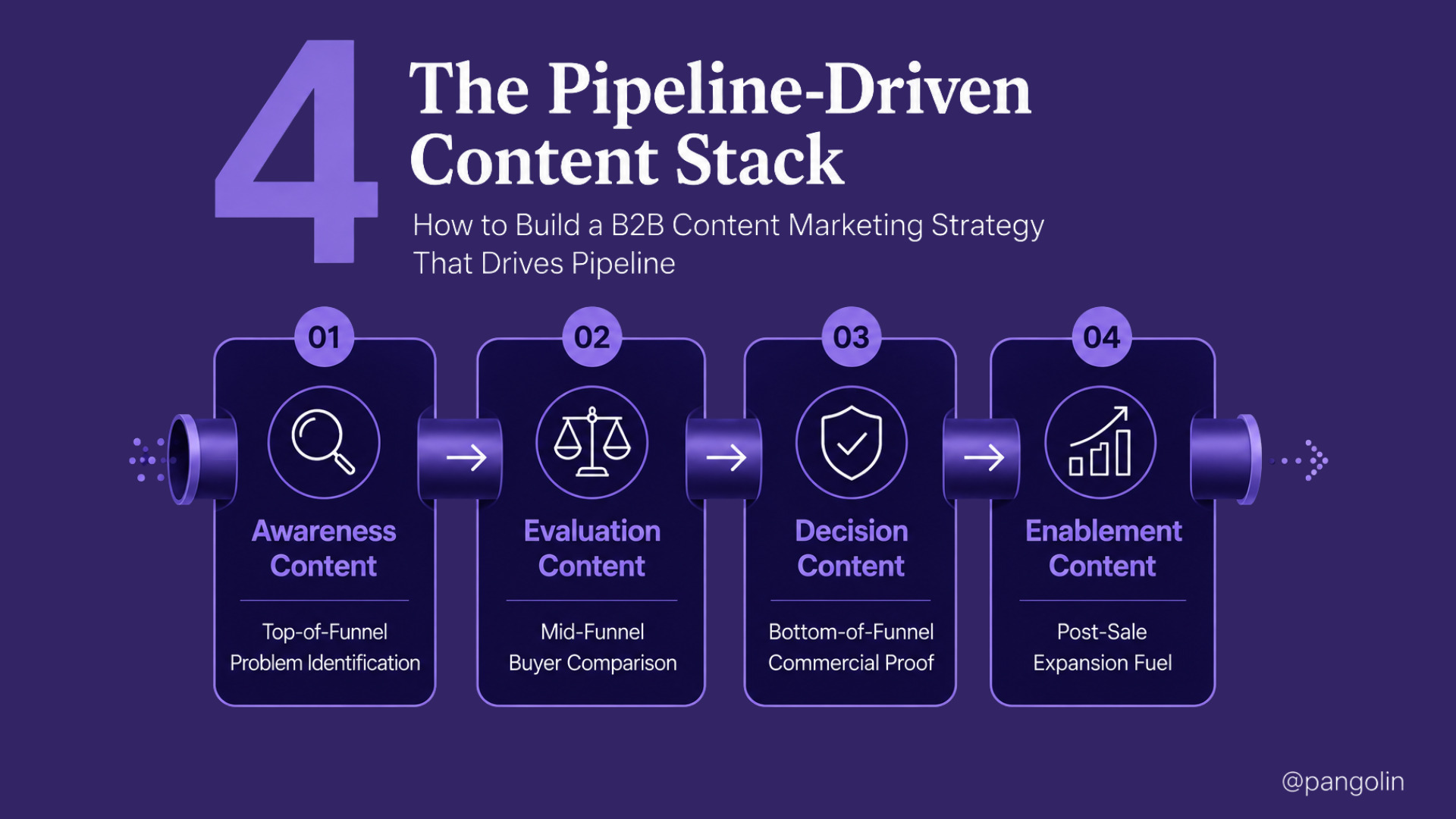
Awareness content names the commercial problem before your product enters the conversation. It builds category credibility and captures early-stage search intent. In practice, this looks like a B2B SaaS company publishing a data-backed report on compliance cost trends for CFOs evaluating spend reduction. This layer addresses the content marketing vs demand generation question directly: awareness content generates demand, not leads.
Evaluation content equips the buying committee with frameworks to compare approaches and vendors. It positions your methodology against alternatives without resorting to feature lists. A B2B buyer journey content framework at this stage might be a comparison guide showing three architectural approaches to data integration, with trade-offs named for each stakeholder role.
Decision content provides the specific evidence a champion needs to get internal sign-off. This includes ROI calculators, technical architecture documents, and procurement-ready case studies. A pipeline-driven content programme for B2B SaaS companies might produce a CFO-facing one-pager showing 18-month payback period with named metrics from an existing deployment.
Enablement content supports expansion revenue and reduces churn by proving ongoing value. It turns customers into internal advocates who pull your product into adjacent business units. A practical example: a quarterly business review template pre-loaded with usage data and ROI metrics specific to each buyer role's original evaluation criteria.
When all four components operate together, you have a B2B content marketing strategy that drives pipeline from first touch through expansion.
The most common mistake is creating content that generates traffic without connecting any piece to a buyer journey stage. Technically strong companies make this mistake because their subject matter experts write about what they know, not what the buyer committee needs to evaluate. The commercial consequence is a content library that educates the market but never converts it. The correction is mapping every planned content piece to a specific buying stage and a specific committee role.
In practice, this means your content calendar has a column for buyer stage and a column for committee member. If a piece doesn't serve both, it doesn't get produced. This is where content marketing vs demand generation stops being a theoretical debate. A B2B buyer journey content framework forces the distinction into every editorial decision. Traffic without pipeline attribution is a cost centre.
SAHI was a B2B SaaS company with strong domain expertise but flat pipeline despite consistent content output, a common pattern among companies needing a B2B content strategy for enterprise buyers.
Pangolin built a full Pipeline-Driven Content Stack for SAHI over 90 days, including buyer-stage content mapping, BOFU assets for sales enablement, and a revised editorial calendar distinguishing content marketing vs demand generation priorities.
The outcome was a 145% increase in qualified monthly leads through content mapped to each buyer role's evaluation criteria and a 28% CAC reduction through precision content targeting, validated through a B2B buyer journey content framework tied to CRM attribution.
See the full SAHI case study →
Build in-house if you have a dedicated content hire with enterprise B2B buyer journey understanding. You also need a product marketing foundation that already maps content to buying stages. A B2B content strategy for enterprise buyers requires at least three months of runway before pipeline targets are set, so plan accordingly.
A hybrid model works when your in-house content team produces volume but lacks pipeline-driven architecture. The external partner builds the content marketing vs demand generation framework and BOFU assets while your team handles awareness-stage production. This splits cost and speed effectively.
Go external when you have no product marketing foundation and your content team produces traffic without pipeline. This is especially true for US market entry where the buyer context differs from your home market. Pangolin builds B2B buyer journey content frameworks for exactly this scenario, with proven results across cross-geography market entries like CarbonMinus and Sprih.
Audit your top 20 performing blog posts and tag each one by buyer journey stage and buyer committee role. This single action reveals whether your content library has structural gaps or just volume gaps. By the end of the audit, you'll have the diagnostic input the Pipeline-Driven Content Stack needs to prioritize what gets built next, grounded in a B2B buyer journey content framework tied to your actual content inventory.
If you need a partner to build pipeline-driven B2B content architecture, Pangolin's growth services team scopes the engagement around your specific pipeline targets.
Your content operation doesn't have a volume problem. It has an architecture problem. Twenty blog posts a month without buyer journey mapping is twenty missed opportunities to move a prospect toward a commercial conversation.
The Pipeline-Driven Content Stack gives you a repeatable structure: awareness content that names the problem, evaluation content that frames the comparison, decision content that closes the deal, and enablement content that expands the account. Each layer serves a different buyer, at a different stage, with a different proof point.
SAHI's results tell the story concisely: 145% more qualified leads, 28% lower CAC. Those numbers came from restructuring existing content efforts around buyer committee needs, not from publishing more.
Start with the audit. Tag your top 20 posts by stage and role. The gaps will tell you exactly where pipeline is leaking. If you need a team that builds pipeline-driven content architecture for B2B tech companies, Pangolin delivers that engagement scoped to your specific commercial targets.