
Your new VP of Sales starts on Monday. By Wednesday, she's asking for battle cards. By Thursday, she's looking for competitive positioning decks. By Friday, she discovers the truth: nothing exists beyond product documentation and a two-year-old pitch deck that references a feature set you've since deprecated. This is the single most common failure point for B2B enterprise companies scaling their sales motion. The hire is expensive. The pipeline is real. And the sales enablement materials that should equip her to win six-figure deals simply don't exist.
This gap is a revenue architecture problem, and it compounds every week a new rep improvises without structured assets. When your enterprise sales enablement strategy consists of product docs and good intentions, every deal cycle becomes an improvisation exercise. Your reps build their own decks. They guess at competitive positioning. They walk into CFO meetings without an ROI model. The result: longer cycles, lower win rates, and a VP Sales who's questioning whether your company is actually ready for enterprise.
The three-tier sales enablement stack fixes this by giving B2B enterprise companies a repeatable system for equipping every buyer conversation across every stage of a complex procurement cycle. What follows is the framework, the common mistakes, and the specific starting point for building yours this week.
Standard sales enablement advice prescribes a pitch deck and a one-pager. That fails in B2B tech because a six-to-twelve month procurement cycle involves multiple buying roles. Each role requires distinct conversation architecture: your champion needs a vision narrative, your CFO needs a business case, and your CISO needs a technical validation framework. A sales enablement framework for B2B SaaS companies must account for multi-stakeholder committees where each member evaluates a different risk surface. Domain translation is a real constraint: your product team speaks in system architecture, but procurement speaks in cost avoidance and compliance. Technical credibility collapses when a generic pitch deck meets a buyer committee that includes a CTO who built their current stack. Battle cards, pitch decks, and ROI calculators each serve different moments in this cycle. One-size-fits-all enablement ignores all of them.
Organizations that deploy proper battle cards can improve their win rates by as much as 71% in competitive deals. That number isn't surprising when you consider what a battle card actually does: it gives your rep the exact counter-positioning for the exact objection at the exact moment it surfaces. Generic collateral can't do that.
The three-tier sales enablement stack produces a complete set of buyer-facing and rep-facing assets for every stage of a multi-stakeholder enterprise procurement. It has three layers because enterprise deals move through three distinct phases: competitive positioning, stakeholder conversation, and financial justification. This sales enablement framework for B2B SaaS companies maps directly to how procurement committees actually evaluate.
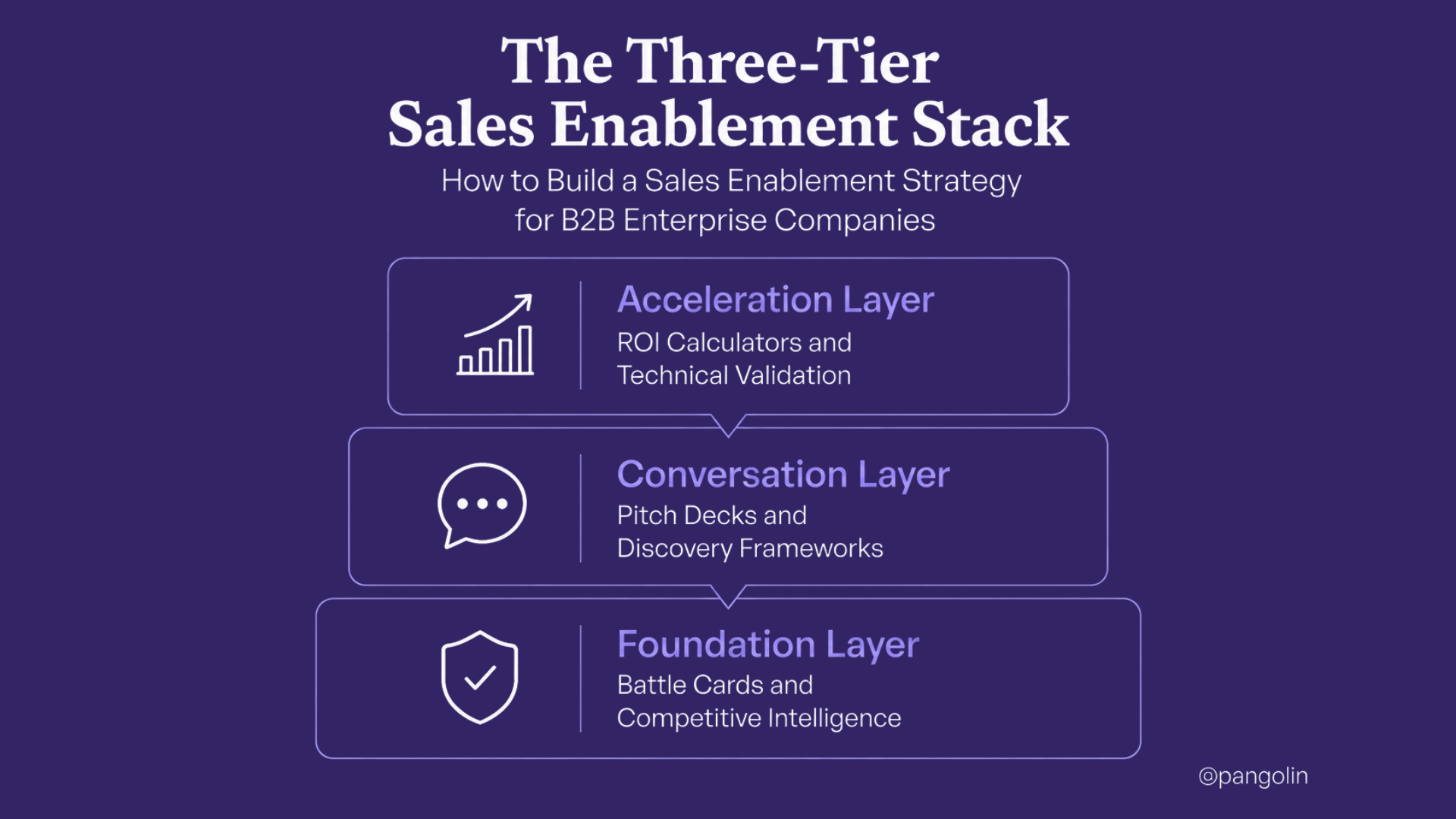
Battle cards are structured documents that arm reps with competitive positioning against each named competitor. In practice, a B2B logistics SaaS company would have one battle card per competitor covering pricing, feature gaps, and win/loss objection data. These enterprise sales enablement materials form the base everything else builds on.
Pitch decks and discovery frameworks give reps a structured conversation path for each buying role in the committee. A Series B cybersecurity company might have three distinct decks: one for the CISO technical review, one for the CFO business case, and one for the champion's internal pitch. Battle cards inform these decks, but the decks themselves are conversation tools, not feature lists.
ROI calculators and technical validation documents convert interest into procurement momentum by quantifying the commercial case. A supply chain SaaS company would build a calculator that lets the CFO model cost savings against their current manual process, using their own numbers. These assets close the gap between "we like this" and "we can justify this."
When all three layers are in place, a B2B enterprise company has a sales enablement strategy that matches the complexity of its actual buyer journey.
The mistake is treating sales enablement as a documentation exercise rather than conversation architecture. Technically strong companies make this error because their founders and product teams default to explaining features. The commercial consequence is predictable: reps have specs but no positioning, so every deal becomes a custom pitch.
The correction is building every asset around a specific buyer conversation at a specific deal stage. In practice, this means your battle cards address the five objections that kill deals, your pitch decks follow discovery frameworks, and your ROI calculators use enterprise sales enablement materials that map to procurement language. Documentation tells. Conversation architecture sells.
IntelliTrans needed a complete B2B enterprise sales enablement guide and infrastructure before launching an enterprise motion targeting Tata Motors-scale accounts, with no existing sales enablement framework in place. Pangolin built the full stack: battle cards, pitch decks, competitive intelligence briefs, and an ROI calculator, all delivered within a four-week sprint. The outcome was a complete sales enablement infrastructure including battle cards, competitive intelligence, and objection handling frameworks built for enterprise-scale deals, with zero accuracy corrections required and immediate sales team activation using the enterprise sales enablement materials.
See the full IntelliTrans case study →
Build your own sales enablement framework for B2B SaaS if you have a product marketing hire with prior enablement experience in your target domain. You also need six or more weeks of runway before your first enterprise evaluation and a VP Sales willing to contribute competitive data.
A hybrid model works when your VP Sales can provide competitive objection data but you need an external partner to build the collateral architecture. This approach produces battle cards, pitch decks, and ROI calculators faster than a solo PMM hire while keeping institutional knowledge internal.
Bring in a specialist when your VP Sales is joining in under 30 days, you have no competitive intelligence capability, or you operate in a regulated domain requiring technical accuracy. Pangolin builds enterprise sales enablement materials for exactly this scenario: compressed timelines where accuracy and speed both matter.
Audit your last five lost enterprise deals and identify which buyer conversation lacked a supporting asset. This single action is higher-priority than building any new collateral because it tells you exactly where your revenue is leaking. Once complete, you'll have the input data for the foundation layer of the three-tier sales enablement stack, and a prioritized build list for your enterprise sales enablement materials.
If you need the full stack built in weeks rather than months, Pangolin's product marketing practice delivers B2B enterprise sales enablement strategy scoped to your deal cycle.
Every week without proper sales enablement materials is a week your enterprise reps improvise. That means inconsistent positioning, missed objections, and deals that stall at the procurement stage because nobody built the CFO's business case. The three-tier stack isn't a content project. It's revenue infrastructure.
If you're a Series A to C company with an enterprise sales hire starting soon, the math is straightforward. Sprih used a persona-driven approach to fuel a $3M raise and US market launch. SAHI saw a 28% drop in customer acquisition cost and a 122% conversion lift from targeted commercial infrastructure. The pattern holds: companies that build enablement systems before they need them outperform companies that scramble after the fact.
Your VP Sales shouldn't have to build her own battle cards. Build the stack. Win the deals.