
Your CHRO champion is enthusiastic, your product demo went perfectly, and the deal just stalled at finance. The CFO asked a single question: "What's the hard-dollar return?" Your champion couldn't answer with the precision that question demands. This is the CHRO to CFO translation problem in HR technology ROI, and it's the most common reason enterprise HR tech deals die after winning internal sponsorship.
The deal isn't lost yet, but every week it sits in procurement limbo, the probability of close drops. You need an HR tech CFO business case ROI framework that speaks the language finance teams use to approve six- and seven-figure software purchases. This piece gives you the exact structure for translating people outcomes into financial outcomes that CFOs approve.
If you're an HR tech founder, a head of sales, or a marketing lead watching qualified deals stall at the final gate, this is written for you.
This gap is a structural pattern that appears predictably when HR tech companies grow from mid-market into enterprise sales. Your marketing and sales teams built the entire go-to-market motion around the CHRO buyer persona. The gap between HR technology CFO approval requirements and employee engagement ROI framing becomes visible the first time a deal requires CFO or procurement sign-off.
No amount of earlier planning prevents this because mid-market deals rarely involve finance. The CHRO champion in an enterprise HR SaaS deal evaluates your product on retention, culture, and engagement. The CFO evaluates on cost per hire, annualized turnover cost, and productivity gains per dollar spent. When the business case only speaks one of those languages, the deal sits in limbo, burning your pipeline and your champion's internal credibility.
These attempts are rational responses to the problem. None of them are bad decisions. They're structurally insufficient because they all share the same misdiagnosis: assuming the CHRO champion can carry a finance-grade argument without a CFO-calibrated framework.
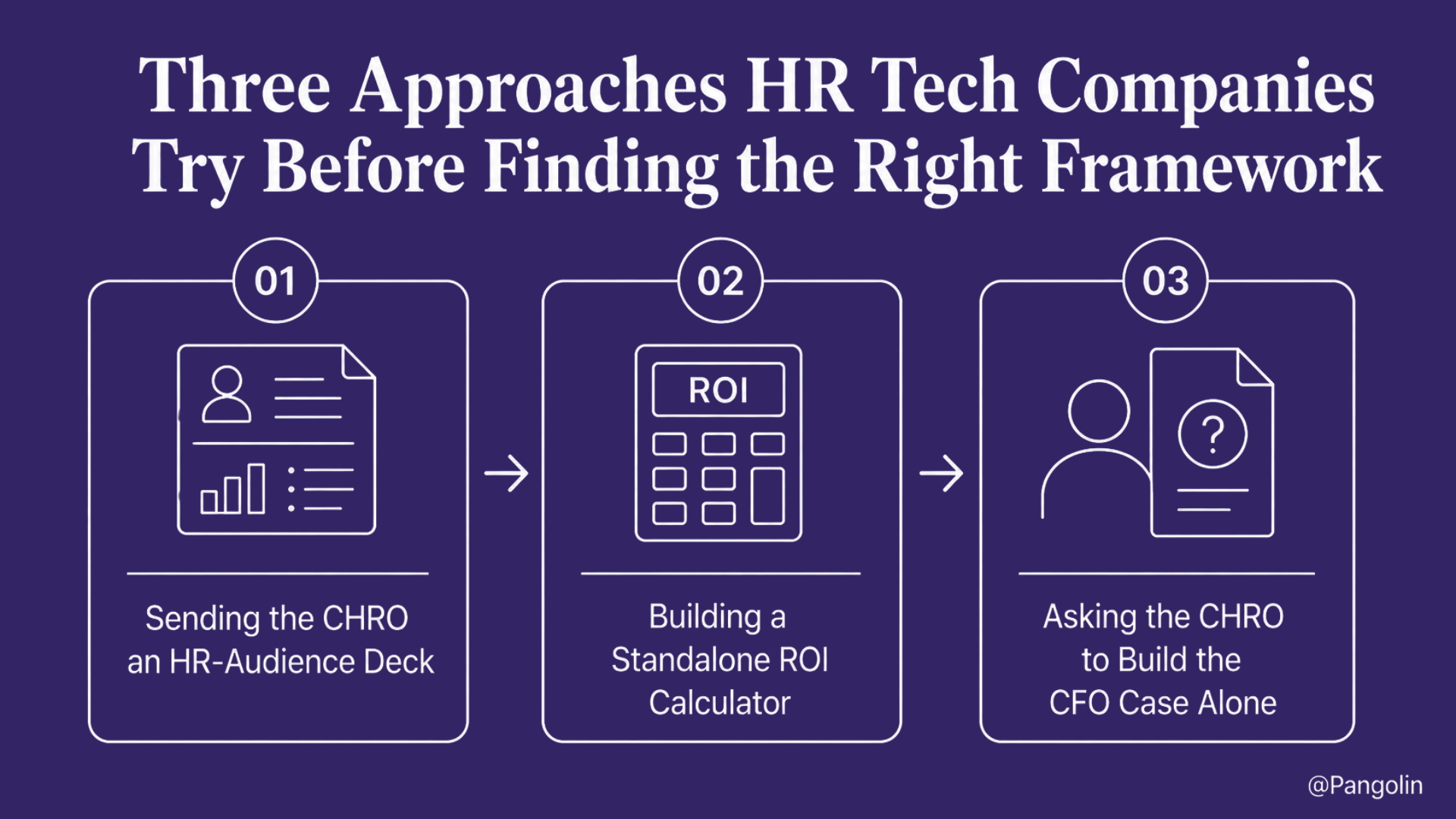
The CHRO presented your standard product deck to the CFO. The CFO asked for ROI and the champion had no financial model to reference. An HR-audience deck answers "why this product" but never answers "what's the return" in finance terms.
You produced a separate ROI calculator, but the finance team rejected the assumptions as too optimistic. ROI calculators fail when the inputs aren't grounded in the prospect's own cost data and benchmarks.
You asked your champion to construct the business case internally. The champion was enthusiastic but lacked a commercial translation framework, and the internal presentation stalled. HR leaders are trained to champion people's outcomes. Building procurement-grade financial models requires a commercial translation framework they were never given.
Here's the core reframe for your CHRO to CFO translation in HR technology ROI. Engagement is a predictor of financial outcomes. The CFO's approval rubric scores against the outcome, and the business case must name it explicitly. CFOs set aside engagement data because it leaves the core procurement question unanswered: what does this cost and what does it return in dollars?
Smart companies miss this because engagement data feels compelling. Scores go up, people stay longer, managers report better team health. But a CHRO champion seeking CFO approval for an HR SaaS purchase needs to show that a 10-point engagement lift translates into, say, a 15% reduction in voluntary turnover. That turnover reduction, multiplied by replacement cost at roughly 20% of salary per mid-level employee, produces a number the CFO can model.
In CFO-facing documents, the dollar value engagement produces is the headline. Engagement scores belong in the supporting evidence layer beneath it.
The solved state is specific: named artefacts on the CFO's desk, named metrics in the approval memo, named alignment between HR and finance stakeholders. You know the problem is solved when the CFO approves the purchase without requesting a second review cycle, because the business case answered every financial question on first pass.
An HR tech company had won CHRO sponsorship at a 2,000-person financial services firm. The deal stalled for eleven weeks after the CFO rejected the initial business case. Previous attempts included an HR-focused slide deck and an ROI calculator with assumptions the finance team called "aspirational."
Within three weeks, the vendor rebuilt the business case using the prospect's own HR and finance data. The CHRO champion presented a model showing that a projected 12% reduction in voluntary turnover would save $1.4M annually in replacement costs alone. The CFO approved the purchase in the next budget cycle.
The reason this worked: the business case gave the CFO a methodology with defensible, company-specific assumptions. It also included competitive framing that answered "why now" and "why this vendor" in financial risk language. The CHRO champion didn't need to become a finance expert. They needed a business case built in two registers.
Read the full case study on building CFO-ready business cases for HR tech →
Take your prospect's annual voluntary turnover rate and multiply it by their average replacement cost per employee. If your product reduces turnover by even 5%, that single calculation gives you a CFO-grade number. This one action produces more CFO-ready evidence than any engagement score or satisfaction survey.
At the end of this exercise, you'll have a dollar figure tied directly to HR tech ROI and financial outcomes for the CFO business case. That figure becomes the anchor for every conversation with finance from this point forward. HR technology CFO approval depends on this kind of specificity: not engagement promises, but cost reduction projections grounded in the prospect's own data.
Pangolin builds these CHRO to CFO translation frameworks for HR tech companies selling into enterprise buyer committees: see how we structure business cases that close.
Deals stall when the value is expressed in a language the approver has no framework to score. The entire CHRO to CFO translation problem comes down to one structural gap: people outcomes presented without financial conversion.
Your CHRO champion already believes in your product. Give them a business case that lets the CFO believe in the numbers. That means replacement cost calculations, productivity gain models, and payback projections built on the prospect's own data. Dollar figures the finance team can verify, stress-test, and approve.
Pangolin has built these commercial translation frameworks for B2B tech companies across HR, sustainability, and enterprise SaaS: one engagement with Sprih produced a persona-driven website that fuelled a $3M raise and US market launch. The same methodology applies to your CFO-facing business case. Build the financial proof. Equip your champion. Close the deal.

Aniket leads content marketing at Pangolin, writing and editing for B2B tech clients who need sharp messaging and consistent output. He came from journalism and brings that newsroom discipline to content work, turning drafts around quickly and keeping quality high.