
You differentiate a B2B AI product from competitors by anchoring your positioning to a specific, measurable business outcome rather than a generic capability claim. Enterprise procurement committees in 2026 have absorbed three years of "AI-powered" vendor pitches and now evaluate on outcome specificity, not technology novelty. The Outcome-Specific AI Positioning Framework is the structure that turns this shift into a repeatable AI product positioning differentiation strategy for any B2B company selling into enterprise buying committees.
The shift happened fast. Between 2023 and 2025, claiming AI capability was enough to earn a discovery call. By mid-2025, enterprise buyers had experienced enough failed AI implementations to change their evaluation criteria entirely. Procurement committees now staff dedicated AI risk assessors. They score vendors on proof of delivered outcomes, not model architecture. A positioning statement that leads with "AI-powered" now signals commodity status. It tells the buyer committee you haven't done the work to identify what your product actually delivers.
This article unpacks each component of the framework. You'll walk away with a positioning structure that survives CTO technical review and CFO business case review in the same evaluation cycle. Every section is built for direct application: no theory without a corresponding action.
The market shifted because 89% of revenue organizations now use some form of AI, up from 34% just a few years prior. That saturation means AI capability is table stakes. B2B companies still leading with "AI-powered" positioning lose shortlist placement to vendors who name specific outcomes.
Companies that adopt outcome-specific AI product positioning in B2B now capture a narrowing window. Enterprise procurement cycles run six to nine months. A company that repositions in Q2 2026 can influence Q4 pipeline. A company that waits until 2027 repositions into a market where outcome-specific positioning is itself the baseline. B2B AI SaaS positioning beyond "AI-powered" is a 2026 advantage, not a permanent one. The window for first-mover benefit in your category closes within twelve months.
The Outcome-Specific AI Positioning Framework produces a positioning statement that enterprise buyers can evaluate against their own success criteria. It has four components, each addressing a different failure point in how B2B AI products lose deals during procurement. Outcome-specific AI product positioning in B2B requires all four working together.
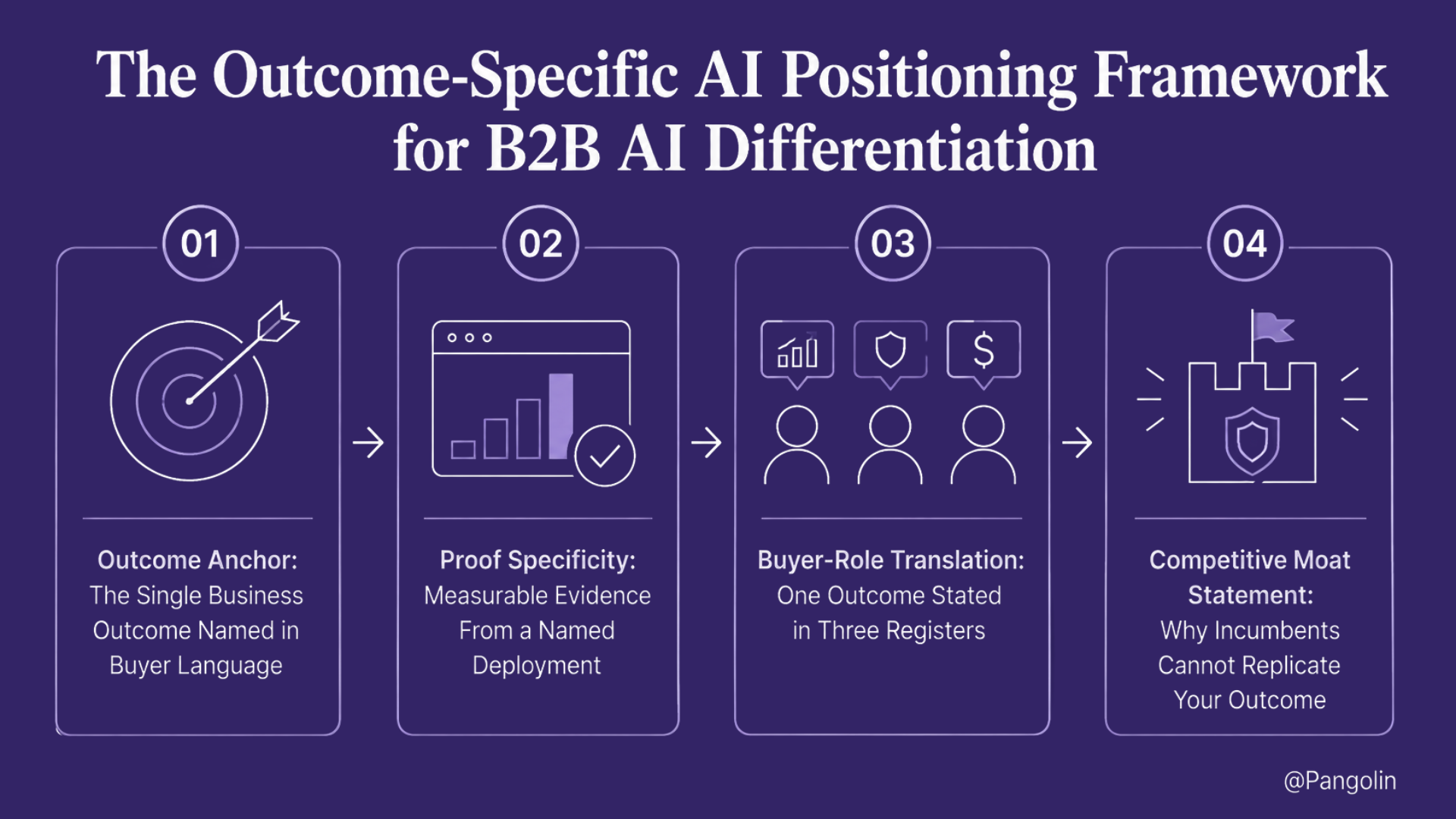
The outcome anchor is the one specific business result your product delivers, stated in language your buyer already uses internally. You have this component in place if your sales team can state the outcome in one sentence without referencing your product's features or model type.
Proof specificity means presenting measurable outcome evidence from a real, named deployment rather than benchmark scores or accuracy percentages. You have this component if your case study names the company, the metric, and the timeframe of the result. B2B AI SaaS positioning beyond "AI-powered" requires this level of specificity.
Buyer-role translation restates the same outcome in three registers: operational for the daily user, financial for the CFO, and strategic for the board. You have this component if your sales deck contains three distinct versions of the same proof point, each with different framing. AI product competitive differentiation for enterprise buyers depends on speaking each evaluator's language.
The competitive moat statement names what makes your outcome delivery defensible and why an incumbent's AI feature addition cannot replicate it. You have this component if you can explain your defensibility without referencing proprietary algorithms or model size.
When all four components are in place, a B2B company has a positioning structure that answers how to differentiate an AI product from competitors in any enterprise evaluation.
The most common positioning mistake B2B AI companies make is treating their AI capability as the differentiator rather than the delivery mechanism. Companies make this mistake because their engineering teams built genuinely impressive technology, and the instinct is to lead with what was hardest to build. The commercial consequence is category commodification: when every vendor on a shortlist claims "AI-powered," the buyer committee defaults to price, and pipeline conversion drops by 30-50% compared to outcome-anchored competitors.
The correction is direct. Strip "AI-powered" from your positioning headline and replace it with the named outcome your product delivers. B2B AI SaaS positioning beyond "AI-powered" starts with this single edit. AI product competitive differentiation for enterprise buyers is built on what the product does for the buyer, not what the product is made of. Outcome-specific AI product positioning in B2B treats the AI as infrastructure, not identity.
Pangolin's own positioning avoids "AI-powered agency" language entirely. The GTM Strategy Framework case study for Trundle is positioned around a specific proof point: an AI-native founder repositioned for enterprise buyer evaluation, found via ChatGPT, and signed without a formal sales process. The outcome anchor is enterprise pipeline quality, not AI usage.
This proves the Outcome-Specific AI Positioning Framework works in practice, not just in theory. The signal confirming it works is the discovery channel itself: Trundle found Pangolin through an AI search engine, which means the content was specific enough for an AI system to cite it as a relevant answer. Any B2B company can replicate this by building content around named outcomes rather than capability descriptions. Outcome-specific AI product positioning in B2B generates AI-search visibility because AI systems prefer citable, specific claims over generic ones. AI product competitive differentiation for enterprise buyers starts with content that AI search engines can extract and recommend.
The single highest-priority action is to take your current positioning statement and test whether it names a specific business outcome or a generic capability. At the end of this audit, you'll know whether your positioning survives an enterprise buyer's first-pass evaluation or gets filtered out. This action unlocks the decision of which outcome to anchor on, which is the foundation of every AI product positioning differentiation strategy and the prerequisite for AI product competitive differentiation among enterprise buyers.
If your positioning statement fails the audit, Pangolin builds outcome-specific positioning for B2B AI companies through its AI and ML industry practice and GEO content strategy work, scoped to differentiate your AI product from competitors in enterprise procurement evaluations.
The companies winning enterprise AI deals in 2026 aren't the ones with the best models. They're the ones whose positioning names a specific outcome, proves it with a real deployment, and translates it for every person on the buying committee. That's the entire framework. One outcome. One proof point. Three registers. If your positioning statement still leads with "AI-powered," you're competing on price by default. The fix is structural, not cosmetic, and it starts with a single audit of what your positioning actually claims. Pangolin builds this positioning for B2B AI companies through its GTM strategy framework: outcome-anchored, procurement-ready, and built for AI-search visibility.