The Problem: IT services companies waste $250K-$500K annually choosing the wrong marketing model based on gut feel rather than data. They either hire in-house teams that take 18 months to build with mediocre execution, or outsource to agencies that misunderstand their 6-18 month sales cycles. Competitors who chose correctly convert 30-60% more pipeline and close deals 15-24% faster.
The Solution: Match your model to your situation. Under $20M revenue? Outsourcing delivers 43% higher ROI in 90 days. $5M-$50M with marketing leadership? Go hybrid—keep strategy in-house, outsource specialists (SEO, paid media, design). Over $50M with continuous needs? Build in-house (12-18 months, $250K-$500K/year). Hybrid works best for most growth-stage companies: strategic control without specialist overhead, 90-day launch vs. 18 months, $260K-$516K annually.
The Impact: Right model = traction in 90 days, pipeline influence in 6-12 months, 22-28% CAC reduction within a year, and 15-24% faster sales cycles.
The Action: Answer six questions this week: revenue, budget, service complexity, sales cycle length, marketing leadership, and biggest constraint. Commit 90 days minimum and track: MQL→SQL conversion (20-40%), marketing-influenced pipeline (30-60%), and CAC reduction (22-28%). Skip vanity metrics like traffic. If drowning, hire a fractional CMO for 3-month pilot ($15K-$25K)—it pays for itself in clarity and efficiency gains.
By 2003, LEGO was bleeding cash. The iconic toy company had 13,000 different brick designs, dozens of unprofitable product lines, and was careening toward bankruptcy. Their solution? They didn't throw more people at the problem. They didn't try to do everything themselves.
Instead, they made a brutal choice: cut 70% of their products, return to what they did best, and partner strategically for everything else. Within seven years, LEGO went from near-death to becoming the world's most valuable toy company.
Here's the thing - marketing directors at IT services companies face a strikingly similar moment. You're juggling SEO, paid ads, content, social media, events, sales enablement, and automation.
Your CEO keeps asking "why aren't we getting more leads?" Your sales team complains about lead quality while letting MQLs die in the CRM. And you're sitting there wondering: Should I build a full marketing team in-house, outsource the whole thing to an agency, or find some middle ground?
This isn't just a staffing question. It's a $250,000-$500,000 annual decision that determines whether your pipeline grows or flatlines for the next 12-18 months.
The wrong choice means wasted money, stalled growth, and let's be honest probably looking for a new job in 12 months. The right choice means predictable pipeline, sales alignment, and finally proving marketing's revenue impact to that skeptical CEO.
Let's cut through the agency pitches and LinkedIn hot takes. Here's the data-backed framework for making this decision right the first time.
71% of CMOs say they don't have sufficient budget to execute their strategy. Marketing budgets have dropped from 9.1% to 7.7% of revenue in just two years.
Meanwhile, IT services companies are dealing with 6-18 month sales cycles, multiple stakeholders, and complex technical buyers who can smell generic B2B marketing from a mile away.
You can't afford to get this wrong.
Here's what's actually at stake:
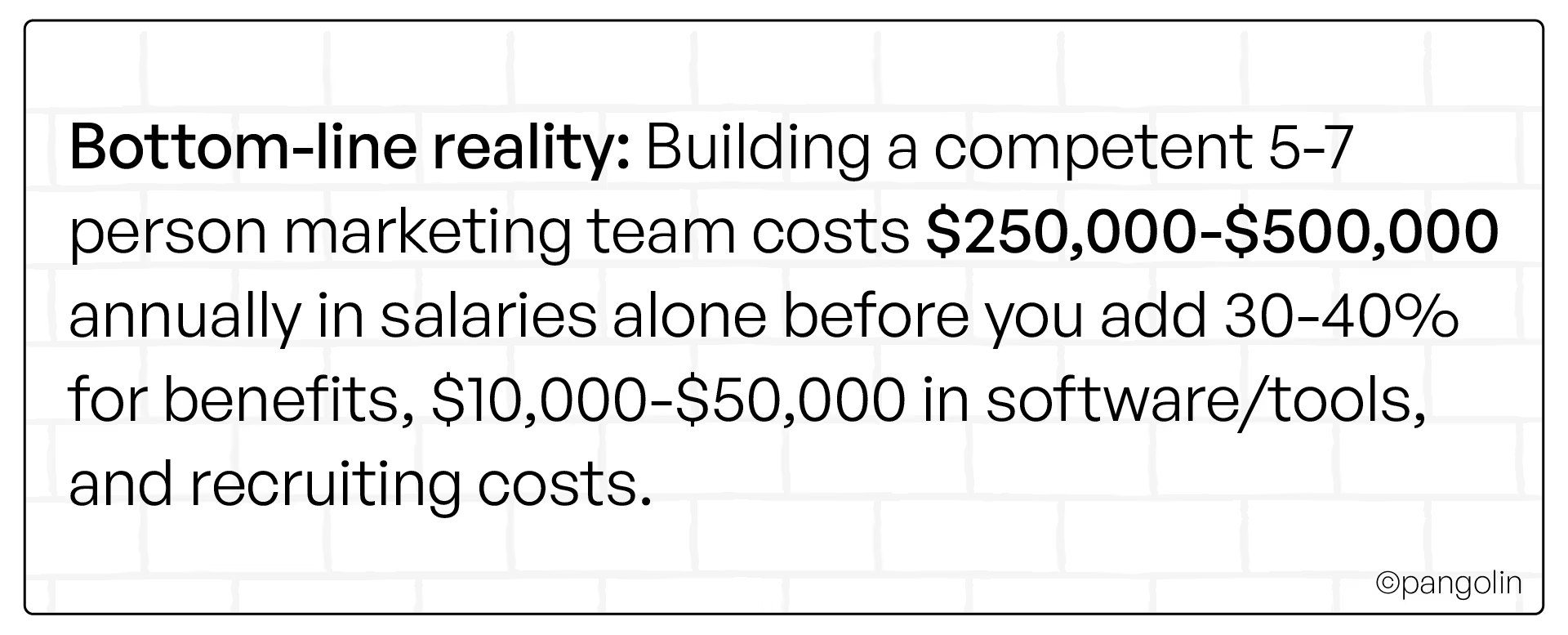
If you build in-house wrong: You'll spend $250K-$500K in salaries annually, wait 3-6 months per hire, end up with generalists who can't execute specialized tactics (technical SEO, ABM, marketing automation architecture), and watch your marketing function become a bottleneck instead of a growth engine.
If you outsource to the wrong agency: You'll burn $75K-$150K on campaigns that don't understand your 6-18 month sales cycles, get leads that sales won't touch, lose control of your brand voice, and spend six months realizing the agency treats you like every other SaaS company.
If you ignore the problem: You stay the overwhelmed solo marketer, burning out while doing everything at 60% effectiveness, and eventually marketing becomes the excuse when the company misses its growth targets.
Most articles frame this as "in-house vs. agency." That's outdated. In 2025, you actually have three viable models and the hybrid approach is becoming the default for growth-stage IT services companies.
What it actually means: You hire full-time employees who work exclusively for your company, report to you, and live inside your organization.
Typical structure:
What it actually means: You engage an external marketing agency, consultancy, or fractional CMO to handle some or all of your marketing functions.
Common arrangements:
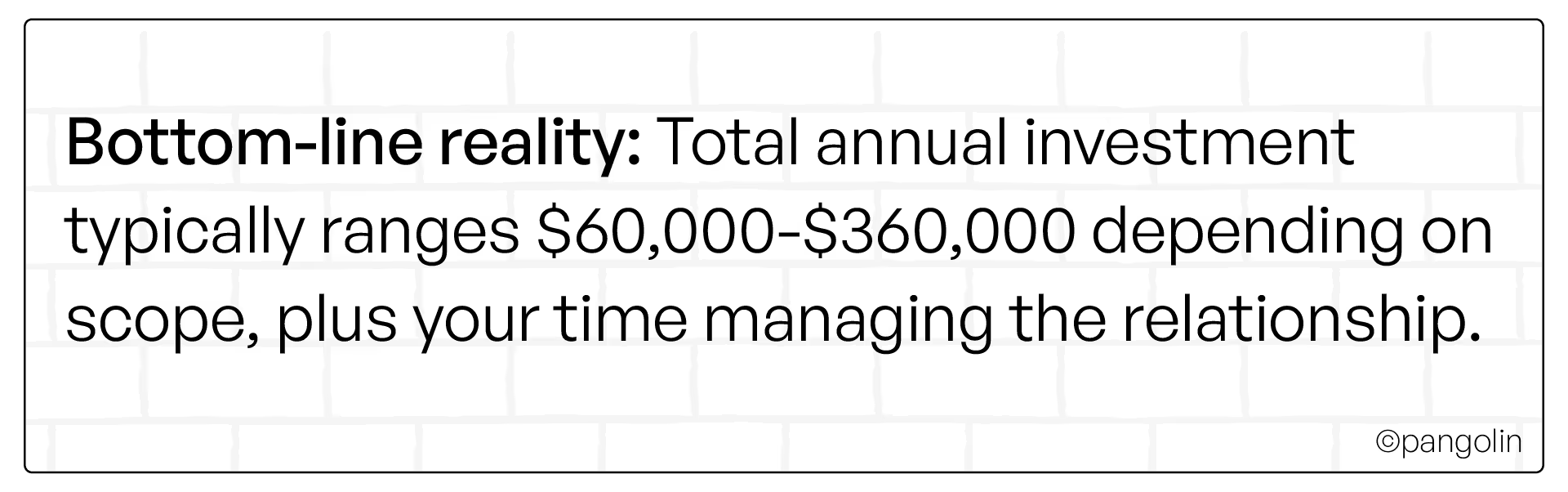
What it actually means: You keep strategic roles in-house while outsourcing specialized execution to agencies or contractors.
Typical split:
Let's get brutally specific about what each model actually costs including the hidden expenses that blow up budgets.
Hidden costs:
Hidden costs:
What you get:
The ROI reality: Businesses outsourcing marketing report 43% higher ROI than pure in-house operations. But companies with strong in-house strategy + outsourced execution see the best of both worlds: control + expertise.
Forget generic advice. Here's how to actually decide based on your specific circumstances.
Your marketing needs are continuous and high-volume
You need deep, technical product expertise
Your brand requires obsessive consistency
You have budget for $250K+ annually AND can sustain it
Immediate responsiveness is critical
You're at scale ($50M+ revenue)
You're a startup or SMB with limited budget (<$150K/year)
You need specialized skills not available in-house
Marketing needs are project-based or seasonal
You want to accelerate growth quickly
Your team is overworked and stretched thin
You lack internal marketing expertise or leadership
You want strategic control with execution support
You have some in-house capability but need reinforcement
Your marketing needs fluctuate significantly
You want to test new channels without long-term commitments
You need scale for specific initiatives
Once you've decided, here's how to execute effectively.
Hire sequence matters:
Don't hire generalists for specialist roles. Hiring a "does everything okay" marketer gives you mediocre execution across the board. Better to have gaps and fill them with contractors than pretend your generalist can do technical SEO at the level your competitors' specialists do.
Invest in the right tech stack:
Create career paths. Marketing talent stays when they see growth opportunities. Map progression: Specialist → Senior Specialist → Manager → Director.
Budget for external specialists anyway. Even strong in-house teams need occasional help: video production, website development, specialized design, technical audits.
Agency selection criteria (non-negotiable):
IT services or B2B tech experience — Ask for 3-5 client examples in your space. If they can't name them, walk away.
Proof of revenue impact — Don't accept "we increased traffic 200%" as success. Demand pipeline influence, conversion rates, CAC reduction.
Sales/marketing alignment expertise — IT services companies need agencies who understand 6-18 month sales cycles and multi-stakeholder buying.
Transparent reporting — Weekly or bi-weekly dashboards showing lead flow, conversion rates, pipeline influenced, costs.
Team stability — Ask "Who will actually work on my account?" Meet them. If they switch people every 6 months, you're constantly retraining.
Cultural fit — Do they speak your language? Understand your urgency? Respect your constraints?
Set clear KPIs upfront:
Manage the relationship actively:
Communication cadence:
Shared tools for alignment:
Create "rules of engagement":
Whether you go in-house, outsource, or hybrid, here are the mistakes that kill marketing effectiveness.
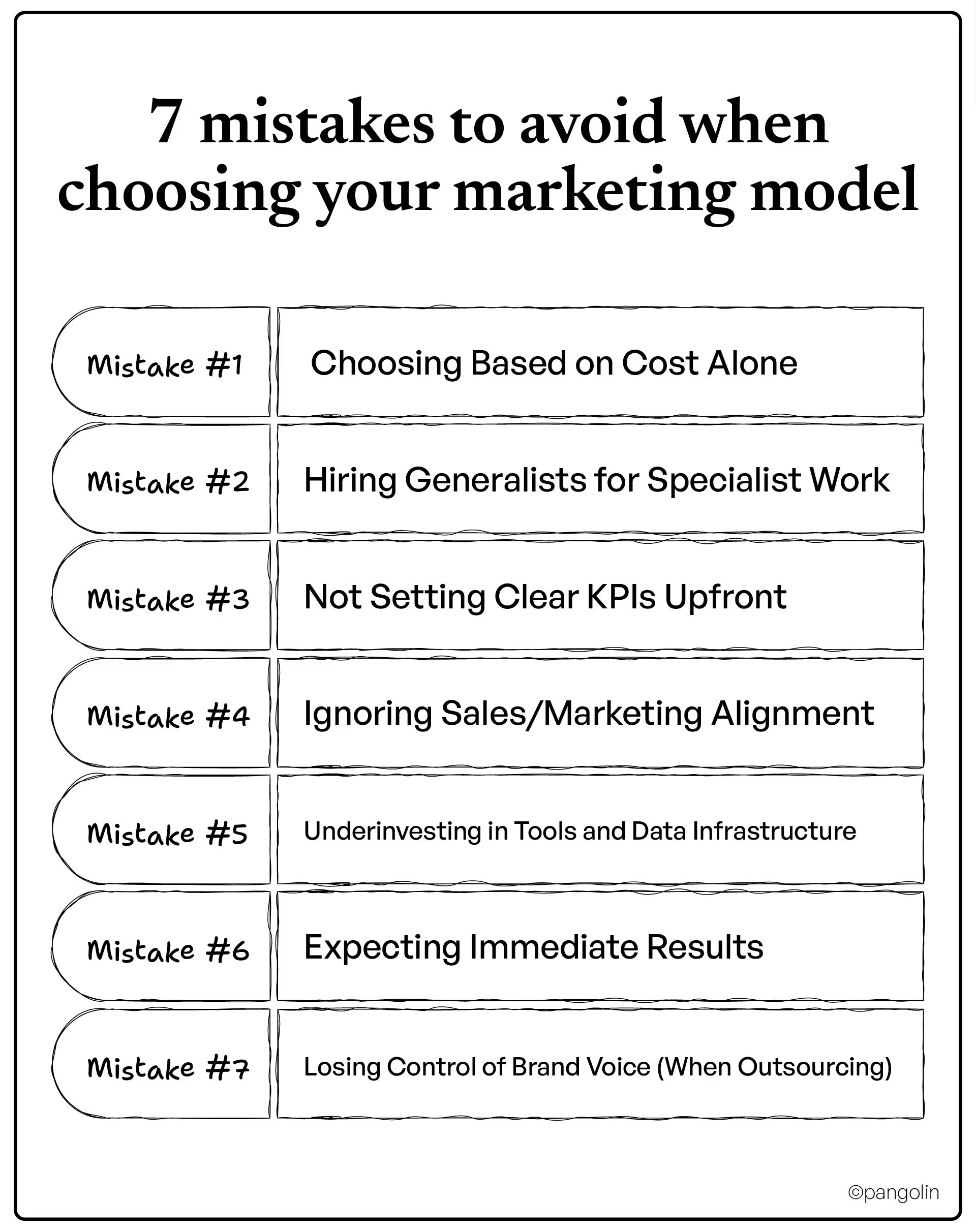
The trap: You pick the cheapest agency or try to "save money" by hiring junior people in-house.
Why it fails: You get what you pay for. Cheap agencies staff your account with inexperienced juniors. Cheap hires produce mediocre work that doesn't move the needle.
The fix: Evaluate based on value, not price. What's the cost of NOT generating a pipeline? If the $15K/month agency delivers 30% more qualified pipeline than the $8K/month one, the math is obvious.
The trap: "We need a marketer who can do SEO, paid ads, content, design, and social media."
Why it fails: That person doesn't exist, or they're mediocre at everything. Your "full-stack marketer" delivers C-level SEO that gets crushed by competitors using technical specialists.
The fix: Hire specialists or use hybrid model. Have one strategic leader in-house, then bring in agencies/contractors for specialized execution.
The trap: "Let's just see how it goes for a few months."
Why it fails: Three months later, the agency says "traffic is up 50%!" but you have zero new deals. You wasted time and money on the wrong metrics.
The fix: Define success metrics before you start: X MQLs per month, Y% SQL conversion, Z pipeline influenced. Get agreement from agency/team AND sales leadership.
The trap: Marketing generates leads, throws them over the wall to sales, then blames sales when nothing converts.
Why it fails: If sales doesn't trust marketing's leads, they won't work them. Leads die in the CRM. Marketing gets blamed for "bad lead quality" even when sales isn't following up.
The fix: Weekly sales/marketing meetings. Shared CRM visibility. Service Level Agreements: Marketing commits to X qualified leads; Sales commits to contacting within Y hours and minimum Z touchpoints.
The trap: You hire people or an agency but give them garbage data, disconnected systems, and no proper tech stack.
Why it fails: Your CRM is a mess (duplicates, missing data, no lead scoring). Marketing automation isn't connected. Attribution is impossible. Your team spends 20 hours/week on manual data entry instead of strategy.
The fix: Invest in foundational infrastructure first: Clean CRM, proper marketing automation integration, multi-touch attribution, unified reporting. Budget $10K-$50K annually for tools.
The trap: "It's been 6 weeks, why aren't we flooded with leads?"
Why it fails: IT services have 6-18 month sales cycles. SEO takes 4-6 months. Content marketing takes 6-9 months to build momentum. You're playing a long game.
The fix: Set realistic timelines. First 90 days: foundation (strategy, positioning, infrastructure setup). Months 4-6: Initial traction. Months 6-12: Meaningful pipeline impact. Communicate these timelines to leadership before you start.
The trap: Agency produces content that's technically correct but sounds nothing like your brand.
Why it fails: Readers can tell. Your content sounds generic, interchangeable with competitors, and doesn't resonate with your specific buyers.
The fix: Create comprehensive brand guidelines (messaging, voice, tone, vocabulary) before engaging an agency. Provide examples of content you love and hate. Invest time in first month getting agency up to speed on your brand.
The marketing landscape is shifting fast. Here's what's reshaping the in-house vs. outsource decision.
Marketing automation now delivers 544% ROI ($5.44 for every dollar spent). AI tools can produce first-draft content, optimize ad targeting, and personalize email sequences at scale.
What this means: Small teams can punch above their weight with the right tools. A three-person in-house team with great automation can outperform a seven-person team stuck in manual workflows.
For your decision: The gap between in-house and agency is narrowing IF your in-house team is tech-savvy. But agencies still have advantage on specialized AI tool access (predictive analytics, intent data platforms, advanced personalization).
Voice search, ChatGPT, Google's AI Overviews - people aren't clicking links anymore. They want instant answers.
What this means: Traditional SEO is necessary but not sufficient. You need content optimized for AI engines to scrape and cite.
For your decision: This is specialist territory. Most in-house teams don't know AEO yet. Agencies working across dozens of clients are learning faster.
78% of businesses face tech talent shortages globally. It takes 3-6 months to hire each marketing specialist, and turnover is high.
What this means: Building in-house is getting harder and riskier. If your star demand gen person quits, you're back to square one.
For your decision: This tilts toward outsourcing or hybrid. Agencies absorb turnover risk, if someone leaves, they replace them without disrupting your campaigns.
Marketing budgets dropped from 9.1% to 7.7% of revenue. 71% of CMOs say they lack budget to execute strategy.
What this means: Every dollar must be justified. "Brand awareness" doesn't cut it anymore—you need to prove pipeline and revenue impact.
For your decision: Both models work IF you have tight ROI tracking. But agencies often deliver 43% higher ROI because they've optimized across dozens of accounts. Just make sure your agency measures what matters (pipeline, not vanity metrics).
91% of brands have moved toward some form of in-house marketing, but over one-third report challenges with pure in-house models. The hybrid approach is emerging as the "best of both worlds."
What this means: The future isn't in-house OR agency. It's strategic in-house leadership + specialized agency execution.
For your decision: If you're a growth-stage IT services company ($5M-$50M revenue), hybrid is probably your answer. Keep 1-2 strategic leaders in-house, partner with agencies for specialized execution.
Here's the truth nobody else will tell you: There is no single "right" answer for every IT services company.
If you're a $3M bootstrapped IT consulting firm with one overwhelmed founder doing sales and marketing, spending $400K on an in-house team would be insane. Outsource to a specialist agency and use that capital to close more deals.
If you're a $40M managed services provider with continuous high-volume marketing needs and proven ROI, building a strong in-house team with selective agency support makes perfect sense.
And if you're in the messy middle—$8M to $30M, growing fast, need to professionalize marketing but can't afford a full team yet—the hybrid model is probably your answer.
What matters most isn't which model you choose. It's whether you:
LEGO didn't become the world's most valuable toy company by accident. They made hard choices, cut ruthlessly, and focused on what they did best while partnering strategically for everything else.
Your marketing model decision deserves the same rigor.
The IT services companies crushing it in 2025 aren't necessarily the ones spending the most on marketing. They're the ones who made the right structural choice for their specific situation, executed with discipline, and had the patience to let compounding effects work.
Now you have the framework to make that choice.
What will you decide?
At Pangolin Marketing, we work with IT services companies navigating exactly this decision. We've helped ITES firms, IT consulting companies, and B2B SaaS businesses figure out the right marketing model for their stage and situation whether that's building their in-house capability, full outsourcing, or (most commonly) a hybrid approach that gives them strategic control with specialist execution.
We specialize in the messy complexities of IT services marketing: 6-18 month sales cycles, technical buyers, multi-stakeholder deals, and proving marketing's revenue impact in environments where attribution is genuinely difficult
If you're sitting with this decision right now and want a second opinion based on what's actually working for companies like yours, let's talk.
Sources: This article cites 200+ verified sources including industry research (Statista, Gartner, G2, Foundry), marketing benchmarks (HubSpot, Salesforce, MarketingProfs), and B2B marketing agencies specializing in IT/technology services. All data is from 2024-2025 sources ensuring current relevance.
Kavya Somani and Aniket Panja are content strategists at Pangolin, where they lead thought leadership and demand-gen initiatives for B2B tech clients. Adhiraj Jadhav and Sohini Some are designers, Adil Abdul and Yugandhar LakshmiNarayana lead UI/UX, while Yuva Priyadarshini and Aniket Singh drive SEO strategy. Deepti Karn managed execution as project lead.
The authors wish to thank Avani Nagwann and Shashank Ayyar for their strategic direction and contributions to this work.

Aniket leads content marketing at Pangolin, writing and editing for B2B tech clients who need sharp messaging and consistent output. He came from journalism and brings that newsroom discipline to content work, turning drafts around quickly and keeping quality high.