
Your first six-figure deal just died in procurement. The champion loved the product. The CFO asked, "What does this actually do for our business?" and nobody had a crisp answer. That silence is a messaging architecture problem. Your sales team walked into a procurement committee with assets designed for a different buyer entirely.
This is the predictable failure point for PLG SaaS companies with 10,000-plus users attempting an enterprise motion. The messaging written for individual users who self-serve into your product is structurally incapable of surviving a procurement committee. It was never designed to.
This piece gives you the exact framework: a three-layer messaging architecture for B2B SaaS that serves your self-serve users, your internal champions, and the economic buyers who sign six-figure contracts. You'll get the diagnosis, the structure, and the specific audit you can run this week.
If you're a founder, CEO, or head of marketing at a Series A to C SaaS company watching enterprise pipeline stall despite strong product-led growth, this is written for you.
Every PLG company builds its messaging around the person who signs up, activates, and gets value alone. That's the entire point of product-led growth. Your marketing, onboarding copy, and positioning all speak to an individual evaluating utility.
The gap appears the moment a 500-seat enterprise contract enters your pipeline. Three to five people on that procurement committee never touched your product. They evaluate on business outcome, total cost of ownership, and risk mitigation. Your PLG enterprise transition messaging strategy didn't account for them because they didn't exist as a buying motion until now.
This is a predictable consequence of successful PLG growth, and it follows the same pattern at every company that scales a self-serve motion before enterprise pipeline arrives. No company at 500 users builds messaging for a procurement committee it hasn't met yet. The commercial cost of leaving this gap open compounds with every enterprise deal that stalls at champion-level enthusiasm. A three-layer messaging architecture for PLG SaaS resolves the structural mismatch without dismantling what already works.
Every attempt below is rational. Each one reflects a reasonable hypothesis about what's broken. They all share the same misdiagnosis: the problem is a structural messaging architecture gap, and content production alone cannot close it.
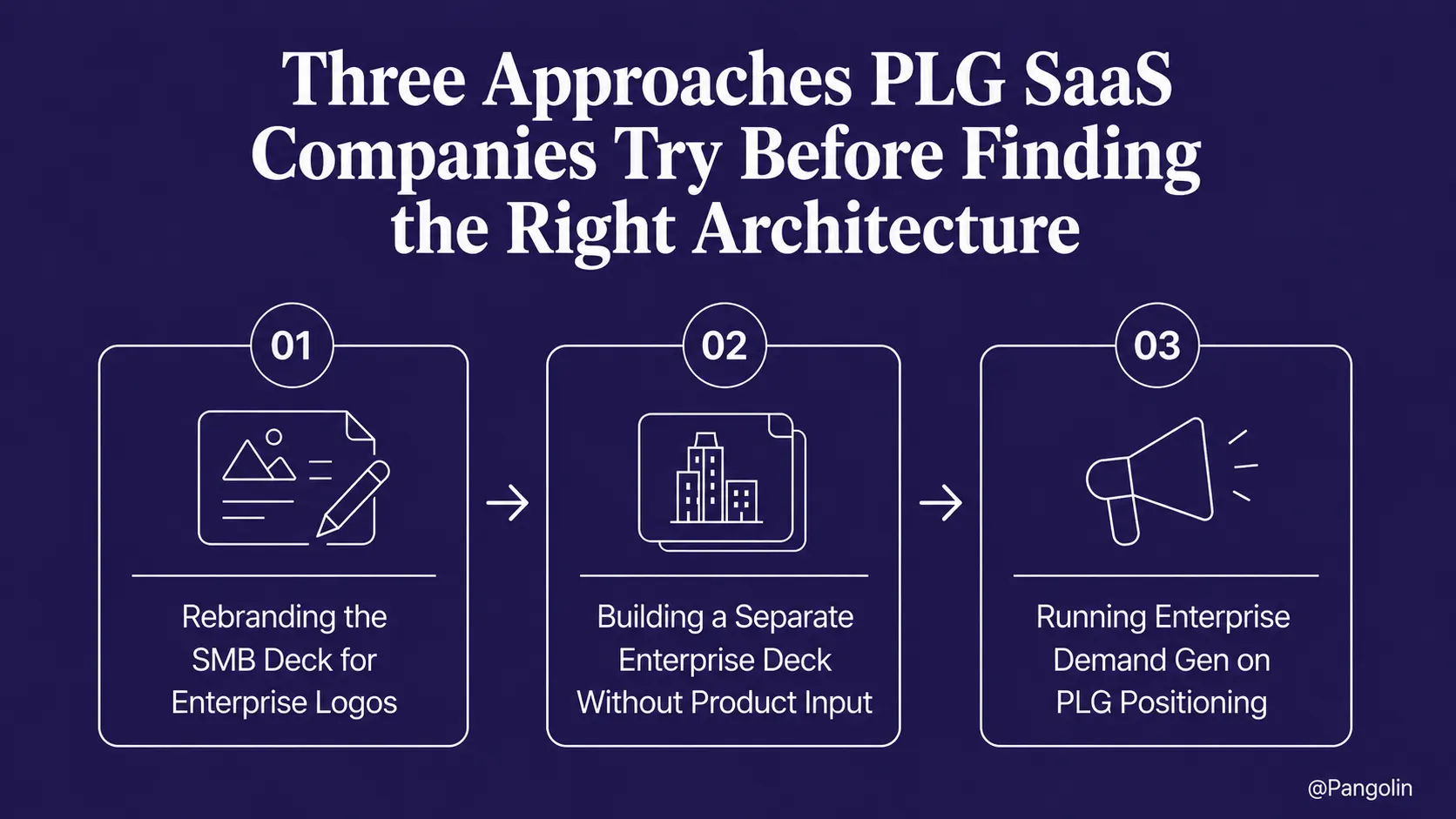
The VP Enterprise Sales took the existing deck, swapped in enterprise pricing, and added logos. The CFO asked about business outcomes and got feature descriptions. This approach fails because PLG enterprise transition messaging strategy requires different evaluation criteria per role, not different formatting.
A copywriter built an enterprise-only deck that sounded polished but described a product the engineering team didn't recognize. The three-layer messaging architecture for PLG SaaS must be grounded in the actual product, or internal credibility collapses before external credibility is tested.
Enterprise-targeted ads drove qualified traffic to landing pages still written for developers evaluating a tool, not executives evaluating a platform. The approach to bridge PLG and enterprise sales motion in SaaS requires messaging calibrated to the buyer context, not just the traffic source.
You don't need a separate enterprise messaging strategy. You need a three-layer messaging architecture for PLG SaaS that runs all three layers at once without any layer contradicting the others.
Most companies miss this because they frame the problem as "PLG versus enterprise." That framing produces two competing messaging systems that describe what sounds like two different products. When you build three layers of the same product story, calibrated to three different evaluation criteria, your enterprise deals accelerate because every stakeholder hears a version that answers their specific question.
In practice, this means your product page describes utility for the individual user. Your team adoption page describes productivity gains and implementation overhead for the champion. Your enterprise page describes business outcomes, TCO, and procurement risk for the economic buyer. All three pages reference the same capabilities. None contradict.
The correct move is building layers that bridge PLG and enterprise sales motion from one coherent product narrative. Separate enterprise messaging produces two systems that describe what sounds like two different products.
The solved state is specific and measurable: named documents, named roles, named commercial outcomes. The primary signal that this problem is solved is enterprise deals reaching legal review within the expected sales cycle rather than stalling at champion enthusiasm, which is the core indicator of a working PLG enterprise transition messaging strategy.
SAHI faced the exact situation described here: strong product-led traction, growing enterprise interest, and messaging that couldn't survive a procurement conversation. Previous attempts at repositioning had produced incremental improvements without resolving the structural gap. Their PLG enterprise transition messaging strategy needed a full architectural rebuild.
Pangolin built a three-layer messaging architecture for PLG SaaS across SAHI's website, sales collateral, and demand generation programmes within a single quarter. The result was a 122% increase in conversion rates and 145% increase in qualified monthly leads, with CAC dropping 28% as messaging alignment reduced wasted spend across channels.
122% - conversion rate increase after messaging architecture rebuild
145% - increase in qualified monthly leads within one quarter
28% - reduction in customer acquisition cost from aligned positioning
Pull up your current enterprise pitch deck right now. Count every slide that answers "what does this do" versus every slide that answers "what business outcome does this produce." If more than half your slides answer the first question, you have a PLG messaging architecture problem confirmed.
This single audit is higher-leverage than any other action this week because it gives you a quantified gap. You'll know exactly how many slides need to shift from feature description to business outcome framing. That count becomes the starting brief for building a three-layer system that can bridge PLG and enterprise sales motion in SaaS.
The output is a slide-by-slide gap analysis you can hand to your product marketing team or an external partner. It connects directly to the PLG enterprise transition messaging strategy described above.
If your audit confirms the gap, Pangolin builds messaging architecture for B2B SaaS companies in exactly this transition, scoped from positioning through sales enablement.

Aniket leads content marketing at Pangolin, writing and editing for B2B tech clients who need sharp messaging and consistent output. He came from journalism and brings that newsroom discipline to content work, turning drafts around quickly and keeping quality high.