TL;DR
Your enterprise deal died at the final stage. The procurement committee picked a competitor with a worse product. Your rep couldn't answer the CFO's objection about switching costs. This is the article that explains why your B2B enterprise sales team needs battle cards before the first meeting, not after the first loss. It's written for VP Sales, CROs, and founders at Series A through C companies watching winnable deals slip away.
Your reps know the product cold. They can demo every feature, recite every spec, and handle technical questions from a CTO without flinching. None of that matters when a procurement committee member asks a question designed to compare you against the incumbent. The competitor's rep had a prepared, calibrated answer. Yours improvised. That gap between product knowledge and competitive objection handling is where enterprise deals go to die. Sales teams equipped with enterprise battle cards before the first meeting control the conversation. Teams without them react to it.
Early-stage companies win deals on product strength alone. That works until you enter structured enterprise procurement cycles. The gap appears when a second or third vendor enters the evaluation. Engineering built a better product, but nobody built the competitive positioning to defend it. B2B competitive battle card sales enablement becomes visible as a gap only when deals reach the final stage. Before that, product demos carry the weight. Once a procurement committee introduces a formal scoring rubric, your reps need structured responses to named objections. The cost of this gap compounds quarterly. Battle cards for enterprise deals at the final stage are the difference between a closed deal and a lost one. No amount of product improvement fixes a positioning failure in a competitive evaluation.
Every attempt below is rational. None of them are bad decisions. They all share a single misdiagnosis: battle cards are a conversation design problem for enterprise deals, and documentation alone cannot solve it..
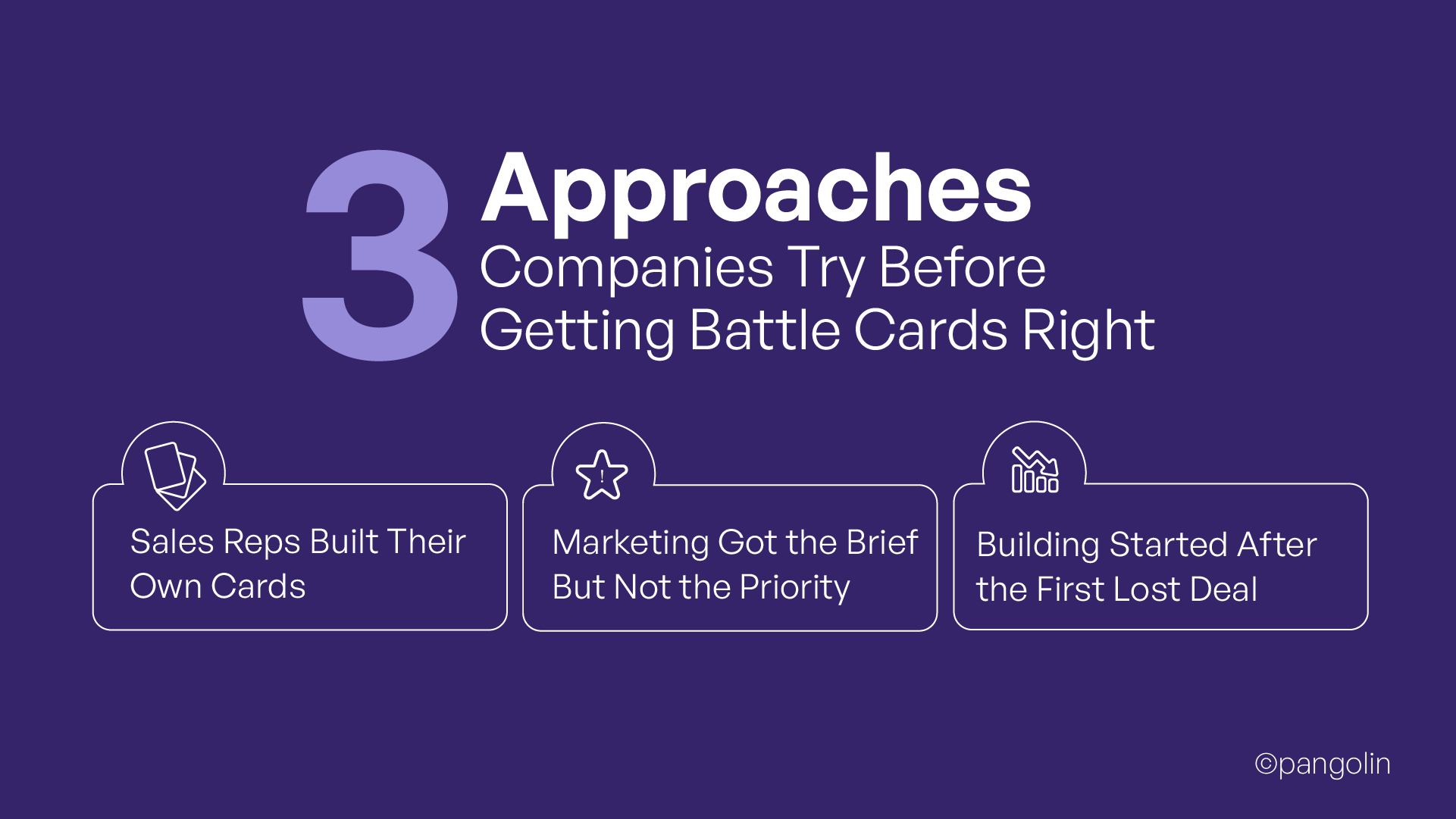
Reps pulled product docs and created feature comparison tables. Feature tables answer engineering questions, not the competitive objections a procurement committee raises during final evaluations.
Marketing received the battle card request and queued it behind campaign work. B2B competitive battle card sales enablement requires dedicated competitive research, not leftover bandwidth from demand gen.
The team waited until a deal was lost before starting. Reactive battle card creation produces rushed, untested content that misses the sales team's competitive intelligence needs for enterprise cycles.
Each of these approaches treats the battle card as an internal document. The real problem isn't documentation. It's that your reps enter conversations without a pre-built response architecture for the three to five objections that appear in every enterprise evaluation. The brief needs to come from lost-deal analysis, not product marketing assumptions. And the output needs to be structured by buyer role, not by product feature.
Most companies build battle cards as internal wikis. Reps don't open wikis during a live procurement call. The real function of a battle card is to pre-load your rep's brain with a specific response to a specific objection from a specific buyer role. Companies miss this because they assign battle card creation to the team closest to the product, not the team closest to the buyer's objections. When you reframe battle cards as conversation architecture, win rates change. Companies using battle cards report a 71% increase in win rates, with 93% of those experiencing gains above 20%. In practice, this means your rep hears "why not the incumbent?" from a CFO and delivers a two-sentence answer calibrated to total cost of ownership, not a feature list. Stop building battle cards that read like product briefs. Start building cards that script the ten sentences your rep needs most in the final stage of an enterprise deal. Sales team competitive intelligence for enterprise evaluations lives inside these cards, not inside a Confluence page nobody opens.
The solved state is specific and measurable: named cards, named buyer roles, named objection responses. The primary indicator is that your reps stop requesting ad hoc competitive information before enterprise meetings because B2B competitive battle card sales enablement is already built into their workflow.
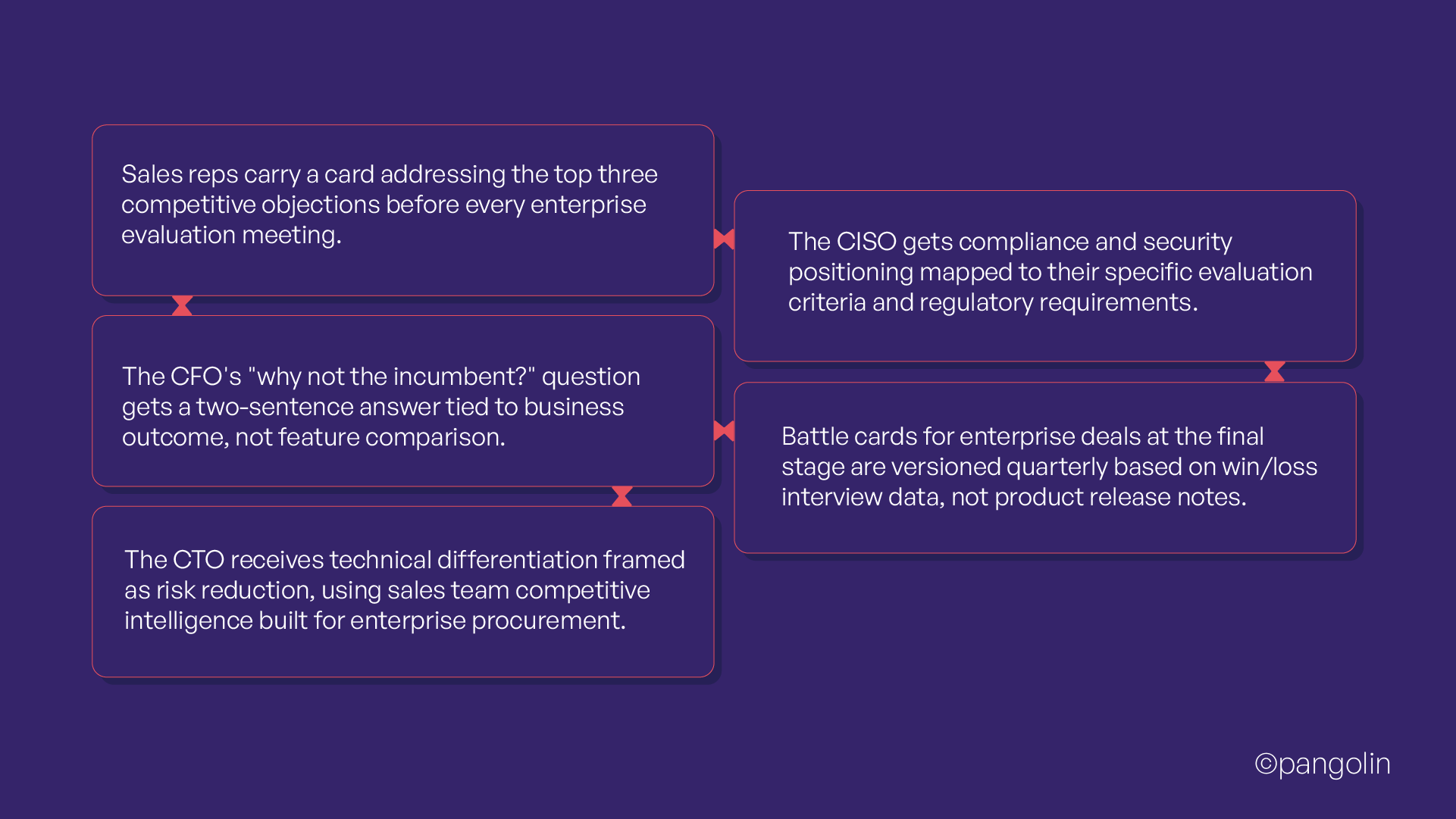
Each card is a single page. Each response is under 30 words. Each objection is sourced from actual lost-deal interviews, not assumptions. Your reps don't study these cards. They internalize them because the language mirrors what buyers actually say.
IntelliTrans faced the exact situation described in this article: enterprise deals stalling at the final stage against competitors with inferior products. The team had tried building cards internally from product documentation, producing materials that didn't address real procurement objections. B2B competitive battle card sales enablement was the gap.
Pangolin built a complete battle card library structured for Tata Motors-scale procurement evaluation across CISO, CFO, and VP Engineering buyer roles. The library was delivered in four weeks before their VP Sales activation, with zero accuracy corrections required and immediate sales team deployment. Battle cards for enterprise deals at the final stage were structured by objection, not by feature.
4 weeks - complete battle card library delivered before VP Sales activation
3 buyer roles - CISO, CFO, and VP Engineering cards built for procurement-scale evaluation
0 accuracy corrections - zero revisions required, immediate deployment to the sales team
Read the full IntelliTrans story →
This engagement followed the same methodology Pangolin used with Sprih, where a persona-driven website fuelled a $3M raise and US market launch. The pattern is consistent: commercial positioning built for the buyer committee, not for internal stakeholders.
Pull your CRM data from the last six months and identify the single competitor that appears most often in your lost enterprise deals. Call three reps who lost to that competitor and write down every objection they heard. You now have the first battle card brief, sourced from real buyer language. This output is higher-value than any internal brainstorm because it reflects what procurement committees actually say. B2B competitive battle card sales enablement starts with this list, not with a product feature matrix. Sales team competitive intelligence for enterprise cycles is built from lost-deal language, not won-deal assumptions. At the end of this exercise, you'll have a prioritized objection list organized by buyer role.
If you need that list turned into production-ready battle cards built for enterprise procurement, Pangolin builds B2B enterprise sales enablement assets scoped to your specific competitive situation.

Aniket leads content marketing at Pangolin, writing and editing for B2B tech clients who need sharp messaging and consistent output. He came from journalism and brings that newsroom discipline to content work, turning drafts around quickly and keeping quality high.