In March 2021, eBay sent an email to millions of customers with a headline that tried to soften the blow: "Important update to the eBay Bucks program."
But there was nothing "updated" about it. eBay was killing the program.
For years, eBay Bucks had been one of the platform's most beloved features. Shoppers earned 1% back on every purchase, sometimes up to 10% during special promotions. Collectors would save their bucks for months, timing purchases around quarterly redemptions.
Then, without warning, eBay retired the 1% everyday reward. The email said they'd made the decision "after careful consideration," but customers saw through it immediately. One user on Reddit put it bluntly: "I'm sure some dude in a suit wanted a raise. Cancel that sh... he said."
Another wrote: "To me, the program gave me a reason to go back and shop at eBay, especially after a larger purchase. I never cared when I had 20 cents or something to use, but occasionally I'd have a few dollars worth and it made me choose eBay over Amazon or whatnot."
The backlash was swift. Longtime sellers and buyers who'd been on the platform since the early 2000s felt betrayed. "With practically all pricing on eBay mimicking Amazon, there's no incentive to keep using them. I know 1% wasn't much, but it was something, especially on larger purchases."
Here's what eBay missed: the program wasn't just about the money, it was about the habit and anticipation. The psychological win at the end of every transaction. When eBay killed it, they broke the loyalty loop that kept customers coming back.
Starbucks made similar changes to its rewards program in 2023, doubling the star cost for a free cup of coffee.
Most programs leak at predictable stages. They lose partners during signup, fail to activate them after enrollment, can't keep them engaged long enough to matter, and never convert them into advocates who recruit others.
The good news? Those leaks are fixable. You just need to know where they're happening and what to do about them.
Let's break down exactly why loyalty programs fail, where the cracks appear, and how to patch them before your program becomes another statistic.
Companies obsess over the tangible costs: reward fulfillment (1%), platform software (£45-150/month), and marketing campaigns. Then the real costs hit like a truck.
Here's what the Midwest electrical distributor encountered, and what most programs face:
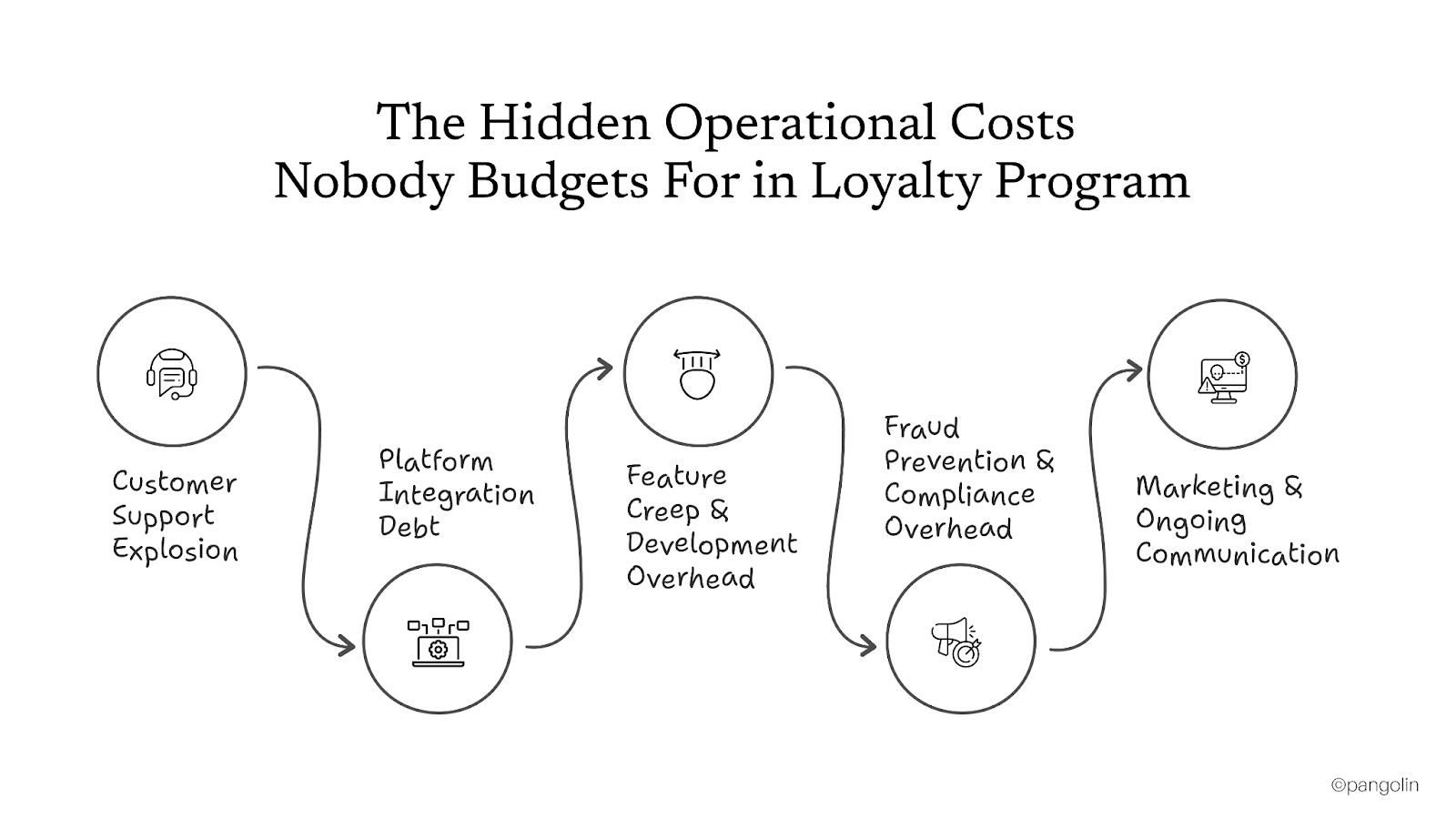
The Problem: When you launch a loyalty program, support volume doesn't increase gradually. It spikes.
Partners who don't understand how to scan invoices, forget passwords, can't access their points, dispute redemptions, or experience glitches all call support. For the electrical distributor, support tickets went from 10/month to 300/month in the first 60 days.
The Real Cost: You need 1.5-2 additional FTE (full-time equivalent) just to handle loyalty program support alone. In the US, that's $60,000-90,000/year in salary plus benefits. In India, it's $18,000-30,000/year. Either way, it wasn't budgeted because companies assume "the app handles it."
The electrical distributor paid $8,500/month for a contractor to cover support overflow. That's $102,000/year on top of base costs.
The Problem: "We'll integrate the loyalty platform with CRM, ERP, and POS." Sounds simple. It's not.
If those three systems don't talk to each other natively, you're stuck paying developers to build custom integrations. And when your CRM updates their API (which they do monthly), your integration breaks.
The Real Cost: Initial integration costs range from $4,000-8,500/month per specialist. Most programs need 3-6 months of integration work before launch, then ongoing maintenance ($2,000-5,000/month) just to keep the bridges functional.
The electrical distributor spent $45,000 upfront on integrations, then $3,500/month in maintenance. They discovered this only after launch.
The Problem: You launch with basic functionality (earn points, redeem rewards). Then requests flood in: "Can we add tiers?" "Can we do referral bonuses?" "Can we integrate with WhatsApp?"
Each request requires development time. And if you built custom software (vs. using a SaaS platform), you're paying developers $80-150/hour to make changes that should take 2 clicks on a commercial platform.
The Real Cost: A single developer costs $60,000-100,000/year. If your program needs even part-time development (20 hours/month), that's $15,000-20,000/year in perpetuity.
The electrical distributor initially had one developer. After six months of feature requests, they needed 1.5 developers. At $85,000/year each (loaded cost), that's $127,500/year to maintain what a $50/month SaaS platform could do automatically.
The Problem: If you're not using real-time APIs, you're stuck with batch jobs. "Every night at 11 PM, pull sales data from ERP, calculate points, update the loyalty platform, push results back."
Batch jobs fail. Network timeouts. Data corruption. The scheduled task runs 6 hours late and points don't post until morning. Or worse, it fails silently and points never post at all.
The Real Cost: You need someone to monitor these jobs daily. That's 10-15 hours/week of a mid-level technical person ($50,000-70,000/year). Plus ongoing troubleshooting when things break (which they do, frequently).
The electrical distributor's batch job failed 3 times in month two. Partners saw points post 3 days late. Trust eroded immediately.
The Problem: When you open a loyalty program, fraudsters test it immediately. Duplicate accounts. Manipulated transactions. Referral loops. Redemption abuse.
Implementing anti-fraud measures means either buying expensive fraud-detection software or hiring someone to monitor for abuse manually.
The Real Cost: Fraud detection tools cost $5,000-15,000/month for enterprise systems, or you hire a risk analyst ($50,000-70,000/year) to flag suspicious activity manually.
The electrical distributor discovered someone had created 47 fake accounts and was feeding fraudulent transactions to run up points. Cleaning it up cost $12,000 in developer time plus $20,000 in consultant fees to audit for similar issues.
The Real Cost: Launching a loyalty program costs $1,000 in marketing (email, banners, field rep pitch sheets). But sustaining visibility costs $500-1,000/month just to keep the program top of mind.
You need quarterly promotional campaigns, monthly email reminders, seasonal pushes, regional promotions. That's $6,000-12,000/year in marketing labor alone.
Beyond costs, programs fail because they hit specific operational walls that weren't anticipated:
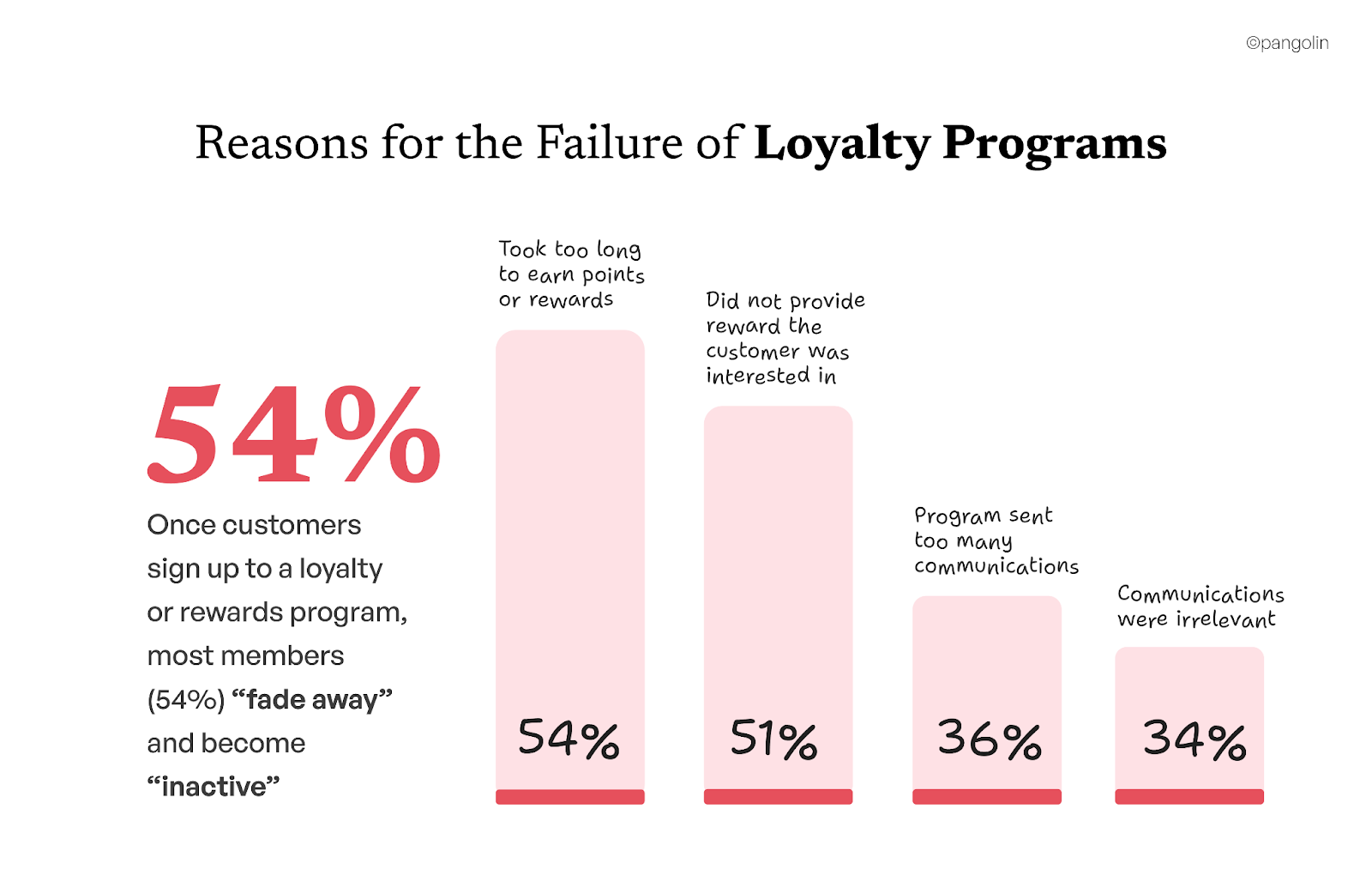
Programs launch, initial enrollment is strong (50,000 partners), marketing declares victory. Then 60% of those partners never activate. Month two activation rate sits at 15%. Program reaches 30,000 inactive accounts that still consume platform licenses, support overhead, and data storage.
The Problem: You've budgeted for 50,000 active partners, not 50,000 enrolled + 30,000 inactive. Operational costs don't scale down when engagement plummets.
Program works fine with 10,000 partners. Then you cross 50,000 and the platform starts choking. Batch jobs that took 2 hours now take 6 hours. Point calculations get delayed. Support ticket resolution time doubles. The system designed for "scale to 100k partners" actually breaks at 60k.
The Problem: Custom-built systems hit complexity ceilings. SaaS platforms you should have used charge per transaction, which gets expensive fast.
Field teams were supposed to pitch the program. Instead, they ignore it because it doesn't directly help them hit sales targets. Distributors resist because they see it as administrative overhead. Partners don't enroll because visibility is zero.
The Problem: You designed an elegant loyalty program and forgot that humans have to actively promote it. Without field team incentives and distributor buy-in, enrollment flatlines and the program becomes a cost center with no revenue driver.
Your CRM vendor releases API v3. Your custom integration breaks. What should be a 10-minute update becomes a $5,000 emergency fix. Happens 3-4 times per year. By year two, you've spent $60,000 in emergency maintenance.
The Problem: Custom integrations are technical debt. Every API change in any connected system breaks your program.
You budgeted for program costs of £150,000/year and expected £500,000 incremental revenue (3:1 ROI). Year one lands at 1.5:1 (£150k cost, £225k revenue). You decide to optimize for efficiency. You cut support (complaints surge). You reduce marketing (activation drops further). You fire the developer (bugs pile up). Now it's 0.8:1 (£180k cost, £140k revenue from abandoned partners) and the program is bleeding money while you're cutting spending to keep up.
The Problem: Cutting corners on a failing program doesn't fix it. It accelerates the death spiral.
Not all loyalty programs fail. But the ones that succeed have something in common: they're built for operational sustainability from day one.
Here's what actually works:
Model: "Scan invoice, earn 1% back, redeem for gift card." Minimal moving parts.
Technology: Off-the-shelf SaaS platform (Square, Perkstar, Smile.io). £50-200/month.
Operational Requirement: One person managing the program (10-15 hours/week). No custom development. No integrations beyond CRM sync.
Cost Structure: £800-3,000/month total. Works if incremental revenue is £30,000+/month.
Who Should Build This: Retailers, small manufacturers, simple channel programs.
Model: Tiers (Bronze/Silver/Gold), certifications, community events, family benefits. Emotionally sticky but operationally complex.
Technology: Salesforce Loyalty Cloud or similar enterprise platform. £10,000-25,000/month.
Operational Requirement: Program manager (1 FTE), marketing manager (0.5 FTE), technical integrations specialist (0.25 FTE).
Cost Structure: £18,000-30,000/month. Needs incremental revenue of £100,000+/month to make sense.
Who Should Build This: Large manufacturers, complex B2B channel programs, brands with multi-layer distribution.
Model: Receipt scanning, invoice upload, promotional code verification for proof of purchase. Trust-based, fraud-resistant.
Technology: Purpose-built B2B loyalty platform with validation layer (Incentivaction, Channel Play). £5,000-15,000/month.
Operational Requirement: Program manager (1 FTE), fraud analyst (0.25 FTE), data analyst (0.25 FTE).
Cost Structure: £12,000-25,000/month. Needs incremental revenue of £75,000+/month.
Who Should Build This: B2B distributors, electrical suppliers, construction materials, complex channel networks.
Stop guessing about loyalty program costs. Try our ROI Calculator.
Before building, answer these questions honestly:
Q1: Is your incremental revenue from loyalty at least 3X your program costs?
Q2: Do you have the operational resources to sustain it?
Q3: Is your distribution channel aligned?
Q4: Do you have 6-12 months of patience?
If you answer no to two or more questions: don't build. The math won't work.
This is the earliest warning light. Partners enrolled, but they didn't actually use the program. They signed up for the discount, scanned one invoice, and disappeared.
What This Means: You have an awareness or onboarding problem. Either they don't know how to use the program, they don't see the value in the first interaction, or the signup process was too friction-heavy and they forgot about it by the time they got in.
What To Do: Fix the signup friction immediately. Get your signup flow under 5 minutes. Guarantee a "first-win" reward that partners can claim instantly (50 bonus points, a small gift card, or a discount code). Remove any verification steps that delay the first experience. If you can get 60%+ of new enrollees activated within 7 days, you've fixed this problem.
This is different from activation. These partners DID engage initially. They were scanning invoices, redeeming rewards, checking their points. Then they stopped.
What This Means: Engagement problem. Either your reward thresholds are too high (they need 500 points but only earn 10 per transaction), or your points are posting too slowly (they scan on Monday, points don't show up until Thursday), or your rewards just aren't appealing anymore.
What To Do: Lower your redemption thresholds dramatically. If partners need 500 points for the first reward, drop it to 100. Make points post in real-time instead of on a daily batch. Add gamification elements (streak bonuses, tier progress bars) that create reason to come back weekly. If you can get your monthly active rate back above 50%, the program is salvageable.
This tells you something fundamental is broken: either the program is too complex for partners to understand, or the technology has usability problems.
What This Means: Every partner interaction creates a support ticket. They don't understand how points work. They can't figure out how to redeem. The app crashes or is confusing. Your support team is drowning in "how do I..." questions instead of handling exceptions.
What To Do: Simplify the program immediately. Cut features. Make the core mechanics so obvious that partners don't need to call support. Or invest heavily in training and onboarding materials (video tutorials, step-by-step guides, FAQ pages) that answer questions before partners call. If support costs are above 20%, your program is too complicated.
Net Promoter Score below 40 means your program isn't creating loyalty. It's creating frustration.
What This Means: Partners don't feel valued. They're not recommending the program to peers. Worse, they're actively discouraging others. Your program feels like a hassle, not a benefit. When a competitor offers something marginally better, partners switch without hesitation.
What To Do: This is harder to fix than activation or engagement problems because it's emotional. You need to revisit what the program actually offers. Are your rewards relevant to partner needs? Do partners feel recognized and valued, or just transactional? Consider adding emotional components: tier status with visible recognition, certifications that advance careers, community events where partners network, family benefits that show you care beyond the sale. If NPS stays below 40 after 6 months, your program needs a fundamental redesign.
This means your program isn't creating advocates. Engaged, happy partners should be recruiting peers. If less than 5% are referring others, you have no word-of-mouth growth engine.
What This Means: Advocacy problem. Either you haven't incentivized referrals (most programs don't), or referral mechanics are too hard (no "share" button, no unique referral codes, no tracking), or partners just don't feel excited enough about the program to recommend it.
What To Do: Activate referrals aggressively. Offer double points for every peer referred. Create a "Top Recruiters" leaderboard with public recognition. Make sharing easy: generate unique referral codes partners can share via WhatsApp or email, add "Invite a Friend" buttons everywhere. If you can get referral rate above 10%, you've unlocked low-cost growth.
This is the financial kill shot. If you're spending £100,000/year on your program and only generating £150,000 in incremental revenue, you're barely breaking even and one bad quarter kills you.
What This Means: Your economics are broken. Either incremental revenue is lower than projected, or operational costs are higher than budgeted, or both. You're in a death spiral where the more you try to fix other problems (add support staff, add features, add marketing), the worse the economics get.
Why It Matters: This is the point where companies start cost-cutting. They fire support staff (complaints spike). They reduce marketing (activation drops). They stop feature development (partners feel abandoned). Each cost-cut makes the program worse, which accelerates revenue decline, which justifies more cost-cuts. By month 18, you're spending £80,000 to generate £70,000 in revenue.
What To Do: You have two options. Option A: Commit serious additional investment (another £100,000+) to fix the core problems (redesign for emotional loyalty, overhaul the technology, rebuild field team enablement). Give it 6 months and measure if incremental revenue can hit 3X costs. Option B: Shut it down. Admit the sunk cost, reallocate the budget to marketing or sales, and move on.
Most companies choose Option B because they've already spent the sunk cost and additional investment feels like throwing good money after bad. The electrical distributor shut theirs down at month 12 when they realized they were bleeding £102,000/year.
Free Download : Trade Loyalty Leakage Template
If three or more of these apply: your program is dying. You have a choice:
Option A: Shut it down, admit the sunk cost, reinvest in marketing or sales.
Option B: Commit serious resources to fixing the operational problems (another £100,000+/year) and give it 6 more months.
Most companies choose Option A because by the time they realize it's failing, they've already spent the sunk cost and additional investment feels like throwing good money after bad.
The electrical distributor chose Option A in month 12. They shut it down.
If you do decide to build, do it this way:
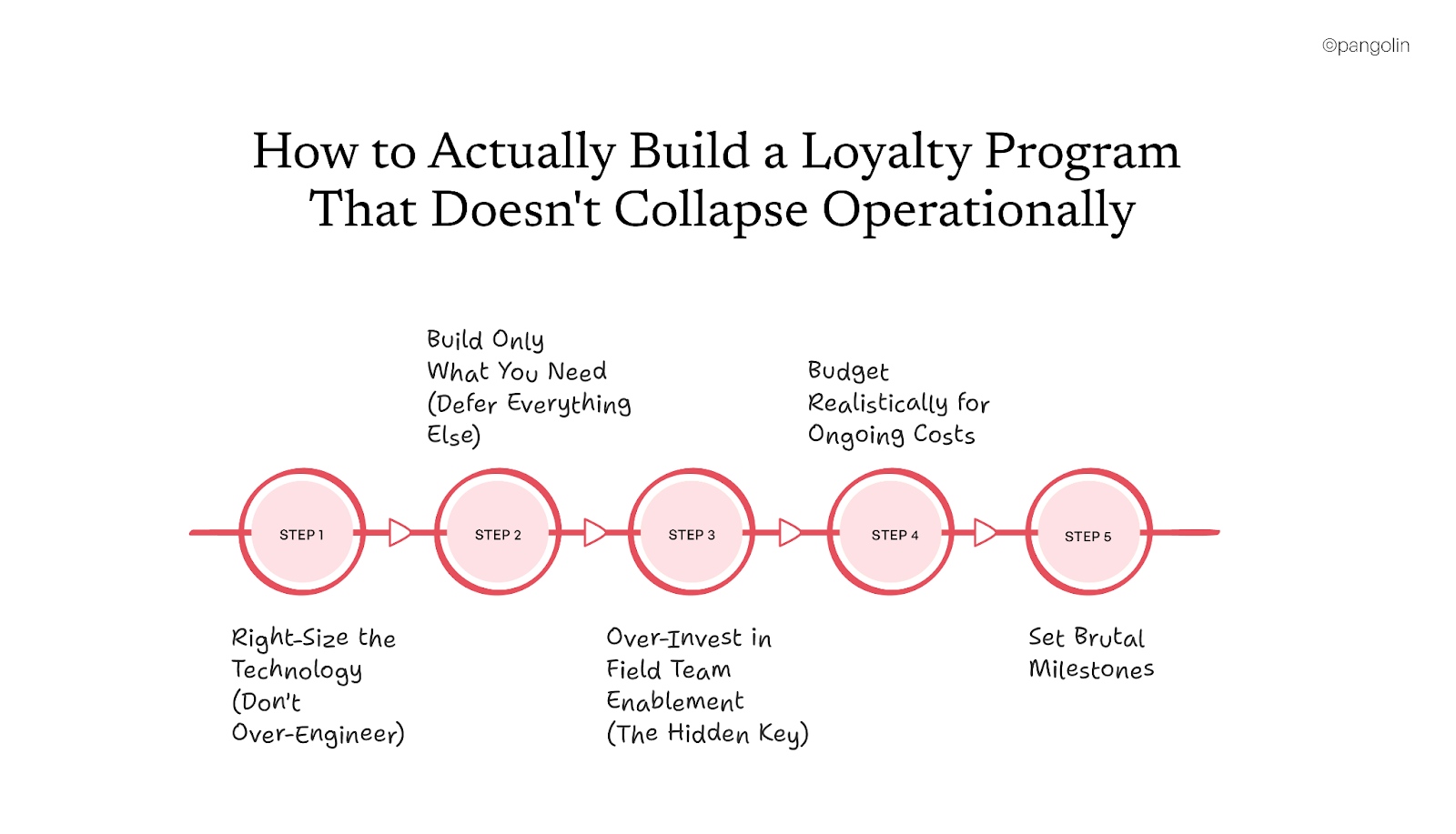
Bad Approach: "We'll build custom software so we can have full control."
Good Approach: Use a proven SaaS platform (Smile.io, Perkstar, Loyalify, Incentivaction).
Bad Approach: Launch with tiers, certifications, referral bonuses, family benefits, and gamification.
Good Approach: Launch with ONE clear value prop (e.g., "earn 1% back on every purchase, track it in real-time").
Cost: £5,000-10,000 upfront for training, pitch decks, incentives for early enrollment.
Return: Field teams actually pitch it, enrollment spikes, program gains velocity.
Most companies skip this and wonder why programs fail. The electrical distributor allocated zero dollars to field enablement. By month three, only 12% of field reps were actively pitching the program.
Don't budget £100,000/year. Budget £200,000/year and be prepared to shut it down if it doesn't deliver £600,000 in incremental revenue by month 12.
If you miss these milestones, you don't scale. You diagnose and fix.
97% of loyalty programs fail because companies build programs designed for marketing impact without understanding the operational machinery required to sustain them.
They underestimate support costs. They don't budget for integration debt, they forget that field teams need incentives to promote it and cut corners on technology and end up with systems that can't scale.
By the time they realized the program was bleeding £102,000/year, it was too late to fix it without massive additional investment.
The question before you launch isn't "Will loyalty work?" It's "Do I have the operational infrastructure to sustain it?"
If the answer is no, don't launch. The sunk cost of failure will cost you more than the revenue you'd generate anyway.
If the answer is yes, launch smart: use SaaS technology, start simple, over-invest in field enablement, and set brutal milestones. Either you'll build a defensible growth engine, or you'll know within 6 months that you should shut it down and reinvest elsewhere.
Before You Launch a Loyalty Program:
ROI Calculator: Plug in your expected partners, predicted engagement rates, and operational costs. See the math before you commit.
Book an Operational Feasibility Assessment: We'll audit your distribution, field team capacity, and integration requirements to tell you exactly what your program costs will actually be (not what vendors promise).


Aniket leads content marketing at Pangolin, writing and editing for B2B tech clients who need sharp messaging and consistent output. He came from journalism and brings that newsroom discipline to content work, turning drafts around quickly and keeping quality high.