Starbucks cut back on reward redemption windows. ASOS discontinued A-List due to low engagement despite thousands of signups. Bink shut down despite a £100 million valuation, causing 46 staff redundancies. Plenti collapsed when partners like AT&T and Expedia exited.
These programs didn't fail because the concept was flawed. They failed because companies launched before they had the infrastructure to operate them. Now 77% of loyalty programs fail within two years. The reason is rarely the design. It's always the same: readiness.
Before you spend $450,000 on a loyalty program, ask yourself: Are we actually ready?
Most loyalty programs don't fail because the concept is flawed. They fail because companies skip the capability assessment and jump straight to execution. They confuse excitement with readiness, assumptions with infrastructure, and PowerPoint plans with operational capacity.
The pattern is remarkably consistent across industries. Leadership approves the program. Marketing designs the mechanics. IT picks a platform. Finance models the ROI. Everyone stays in their lane, nodding along, and six months later the program launches into a world that isn't ready to support it.
What causes this readiness gap? Three things:
Companies treat loyalty programs like campaigns, not operating models.
They think loyalty is something marketing "runs," like a seasonal promotion or product launch. In reality, loyalty programs are cross-functional systems that require ongoing coordination between sales (who pitch it), tech (who build and maintain it), operations (who manage redemptions and support), and finance (who track ROI and liability). When companies don't build that coordination upfront, programs feel disjointed and partners lose trust.
Leadership asks the wrong questions at approval.
The conversation focuses on "What rewards should we offer?" and "What's the expected ROI?" instead of "Do we have the organizational infrastructure to execute this?" Nobody asks whether the CRM can actually integrate with a loyalty platform software. Nobody checks if customer support has bandwidth for 300% more tickets. Nobody verifies that the sales team is trained and incentivized to promote it. These capability gaps only surface after launch, when it's too late and expensive to fix.
Companies assume "we'll figure it out" is a viable plan.
Leadership believes that smart people can solve problems as they arise. That works for small tactical initiatives. It doesn't work for programs that require coordination across six departments, real-time data sync between four systems, content production in five languages, and field enablement across 50 sales reps in 15 regions. "Figuring it out" after launch means your partners experience chaos, confusion, and broken promises, which kills trust and engagement faster than any competitor can.
The result is predictable and expensive. Programs launch with 30,000 signups, celebrate the "success," then watch 60% of members go inactive within 90 days because the infrastructure to keep them engaged never existed. Support costs explode because nobody planned for the volume. Field teams stop pitching the program because they don't understand it or trust that it works. Integrations break because nobody anticipated that the CRM vendor updates their API monthly. And leadership wonders why the program isn't delivering the ROI they modeled in Excel.
Here's what you need to understand before you go any further: readiness isn't about having the perfect plan. It's about having the organizational capability to execute the plan you have. That means assessing whether you have the right people, systems, processes, budget, and cross-functional alignment in place before you commit resources. And if you don't, it means building those capabilities first or accepting that your program will be one of the 77% that collapses within two years.
Modern loyalty program requirements go far beyond picking a platform and designing rewards. Successful programs mature across eight distinct capability areas, each requiring specific resources, processes, and expertise. Companies that assess these areas honestly before launching avoid expensive failures. Companies that skip this assessment end up like the Michigan automotive parts manufacturer, spending $680,000 to learn what they should have known upfront.
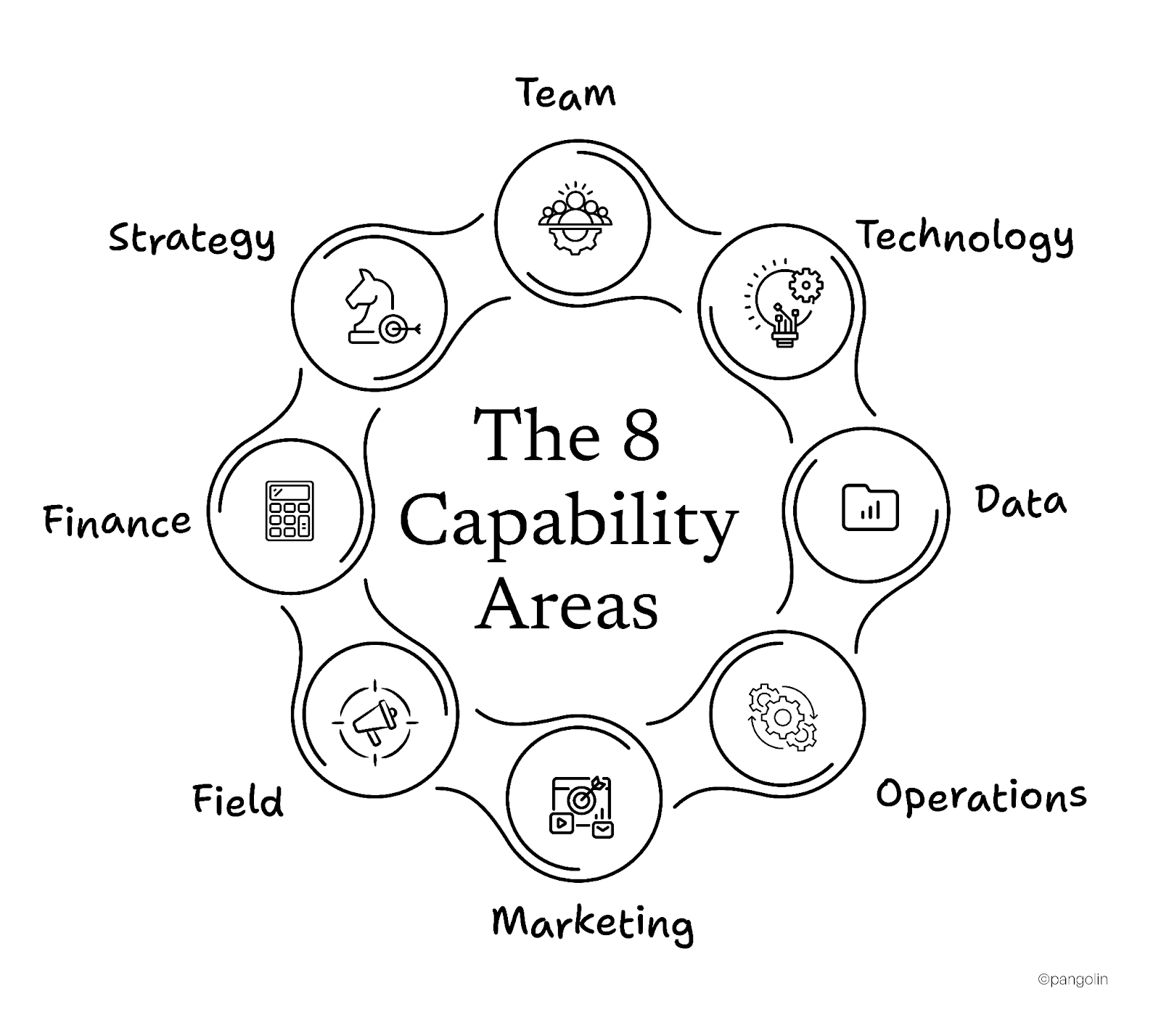
Let's walk through each capability area with the diagnostic questions that reveal whether you're ready.
Every successful loyalty program starts with clarity - clarity of purpose, ownership, and decision-making. Without it, teams drift, priorities blur, and no one can answer simple questions like, “Who owns this?” or “What exactly are we trying to achieve?”
A well-governed program has a clear strategic direction and measurable goals linked to business outcomes — like growing customer retention by 15%, expanding share of wallet by 20%, or cutting churn by 10%. There’s a cross-functional steering committee that brings together sales, marketing, tech, operations, and finance. One senior executive, ideally a VP or C-level sponsor, owns the program’s success and has real authority to make decisions.
Budgets are locked in, priorities are explicit, and KPIs are reviewed monthly. Everyone knows where the program is headed and who is accountable for getting it there.
Assign clear ownership at VP level or higher. Establish a cross-functional steering committee with authority to make and enforce decisions. Define three SMART goals (Specific, Measurable, Achievable, Relevant, Time-bound) that tie to business impact. Most importantly, secure budget commitments for at least two years, not just for launch.
Loyalty programs don’t run themselves. They need dedicated people with the right skills and bandwidth. Too many companies assume existing teams can “absorb” the extra work and that’s where things fall apart.
A mature program has a dedicated manager (at least one FTE) who owns coordination across teams. Customer support has 1.5–2 FTEs allocated for program inquiries. Marketing has ongoing capacity for engagement campaigns, not just the launch burst. Sales enablement is built in, with quarterly training to keep field teams sharp and aligned.
If in-house resources don’t exist for campaign design, content localization, or community management, the company has already partnered with a specialist to fill those gaps.
Hire or assign a dedicated program manager. Staff customer support to handle the increased volume. Create a 12-month marketing content calendar with ongoing campaigns. Plan quarterly field enablement sessions and allocate budget for them. If you don’t have in-house specialists for campaign orchestration or vernacular content, identify a partner before you go live.
Technology is often where loyalty programs stumble. Companies pick a loyalty platform without fully checking how it will integrate with their existing systems only to find out later that data doesn’t sync, points post late, or manual workarounds become the norm.
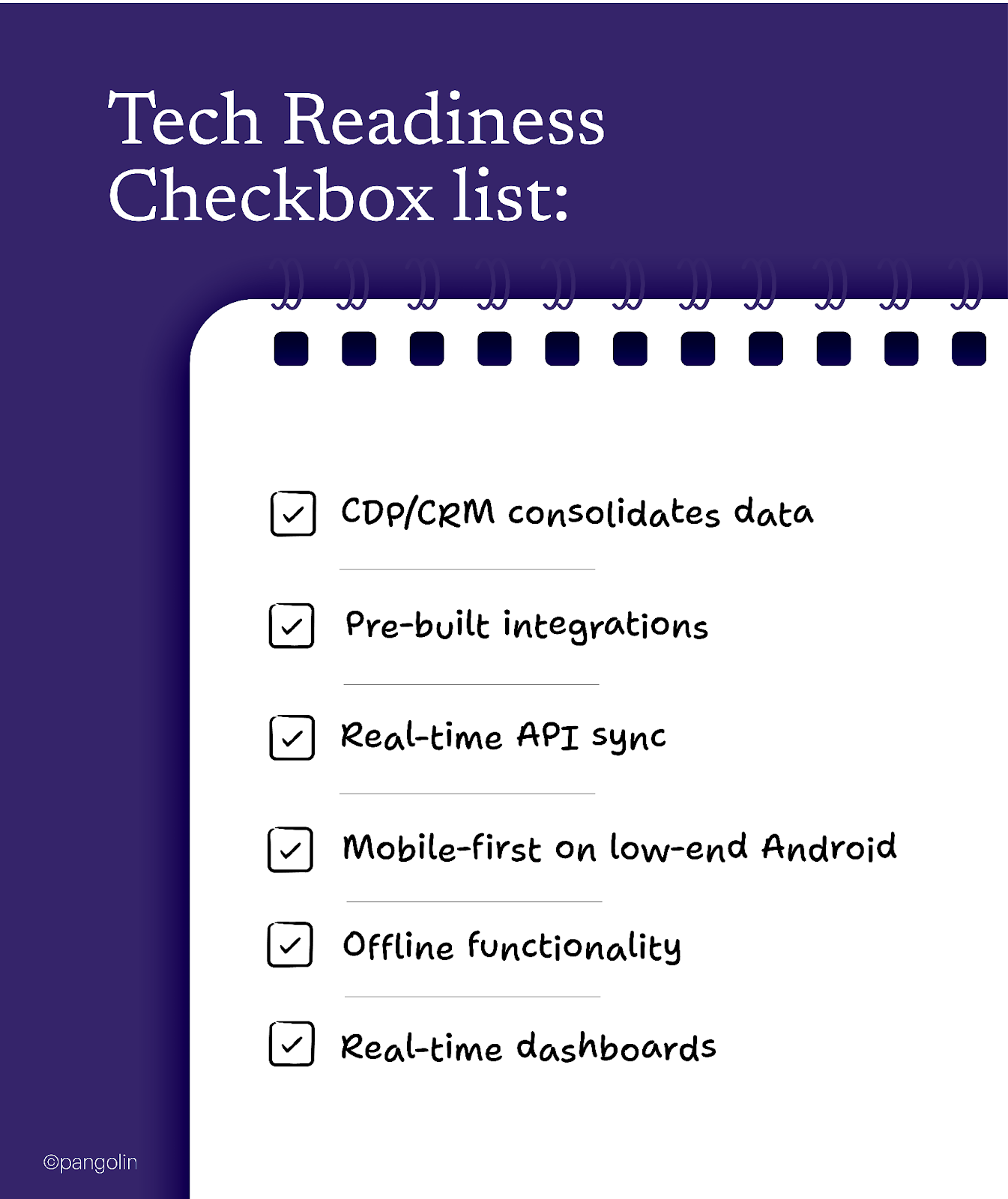
A strong tech foundation starts with unified customer data. The company uses a CDP or CRM as the single source of truth, and the loyalty platform integrates smoothly with CRM, ERP, and POS systems through APIs. Data syncs in real-time, not overnight.
The platform itself is mobile-first, stable on low-end Android devices, and works offline when necessary. The tech stack follows an API-first, composable design so it can evolve with the business. Integration points are clearly documented, and someone is assigned to maintain and monitor them as systems change.
Run a full technical compatibility check before signing with any platform. Choose solutions with pre-built connectors for your CRM and ERP, or budget ₹15–30 lakh for custom integrations. Consider using middleware like MuleSoft or Dell Boomi in complex setups. Always test your mobile experience on the devices your users actually own. Finally, assign 0.25–0.5 FTE for ongoing integration monitoring and maintenance.
If you can’t measure it, you can’t manage it. Yet many loyalty programs launch without clean, unified data or solid metrics making it impossible to prove impact or fix what’s not working.
A data-ready organization has at least 12–18 months of baseline data on customer behavior before launch. Tracking purchase frequency, average order value, and churn patterns. Customer data is clean and unified across systems, with deduplication complete.
The loyalty platform features real-time dashboards showing key funnel metrics like enrollment, activation, engagement, retention, and redemption by segment. A BI tool such as Tableau or Power BI integrates loyalty data with sales, finance, and operations to track ROI end-to-end. The team monitors both leading indicators (activation rate, active members) and lagging ones (CLV lift, incremental revenue).
Spend a few months consolidating and cleaning customer data before launch. Establish key baseline metrics like purchase frequency, retention, and AOV. Build dashboards that track loyalty progression across stages (Unseen to Noticed to Onboarded to Earning to Belonging to Leading). Connect your BI tool to the loyalty platform so finance can monitor ROI in real time. Finally, define which metrics are “leading” (tracked weekly) and which are “lagging” (reviewed monthly) to create a rhythm of learning and improvement.
Download the Ground Truth Framework. It's the diagnostic framework where you need to fill in which stage you are in, write what you think is happening (Myth) vs what's actually happening on the ground (Reality).
DOWNLOAD THE FRAMEWORK
A mature program has clear, documented workflows for every core process: enrollment, point posting, redemption, fraud checks, and support escalation. Customer support teams are trained with scripts, FAQs, and defined escalation paths so they can resolve common issues quickly and consistently. Fraud is monitored proactively using tools or manual review, with suspicious activity flagged within a defined window (for example, 24–48 hours).
Rewards inventory is tracked with lead times and safety stock, so high-demand items don’t mysteriously “go out of stock.” There are published SLAs such as enrollments processed within 24 hours, points posted within a few hours, redemptions fulfilled within 7 days, and support tickets resolved within 48 hours, and performance against these SLAs is monitored weekly.
Document every core workflow end-to-end. Train support teams before launch, not after tickets spike. Put a basic fraud detection setup in place (automated checks and/or manual review). Implement inventory tracking with safety stock for popular rewards. Define SLAs and review them weekly. Allocate at least 1 FTE for day-to-day program operations to own execution and issue resolution.
A loyalty program without ongoing marketing is invisible. A loud launch followed by months of silence is one of the fastest ways to kill engagement.
A mature setup runs on a 12‑month content calendar that includes monthly engagement campaigns, quarterly pushes, and seasonal themes mapped to business cycles. Content is produced in multiple regional languages with real cultural adaptation, not just literal translation. Campaigns are designed for specific journey stages: early campaigns focus on awareness and FOMO, onboarding campaigns emphasize quick wins, earning-stage campaigns build habits, and belonging-stage campaigns reinforce status and community.
For each campaign, the team can reliably produce a full asset set — for example 20–40 pieces across WhatsApp templates, SMS, in-store collateral, decks, reels, and email — and distribute them across all relevant channels. There is a clear rhythm: newsletters, monthly nudges, quarterly promos, and regular recognition moments.
Build the 12‑month content calendar before launch, including stage-based campaigns. Ring-fence budget for always-on marketing, not just launch. Line up in-house or external partners who can deliver vernacular content at scale. Map each campaign to a journey stage using your framework, and set a consistent monthly engagement rhythm (WhatsApp, email, recognition stories, etc.). Train the marketing team to think in terms of continuous orchestration, not one-off blitzes.
Field teams - sales reps, distributors, and retail staff - are usually the face of your loyalty program. If they are confused, unmotivated, or poorly equipped, enrollment stalls and the program never escapes “nice idea on paper” status.
In a mature program, field teams are trained at least quarterly on how the program works, what’s in it for partners, and how to handle objections. They have ready-to-use pitch decks, demo videos, one-pagers, and FAQs they can share in conversations and over messaging apps.
Incentives like SPIFFs, bonuses, or recognition are tied to key behaviors such as enrollment and activation, so promoting the program feels rewarding, not like unpaid extra work. Distributors and retailers receive co-branded in-store materials — standees, posters, wobblers, danglers — to create visibility at the point of sale. Feedback from the field is collected monthly and used to refine messaging, offers, and materials.
Run field training at least two weeks before public launch. Create pitch kits — decks, scripts, short videos, one-pagers, FAQs — in key regional languages. Set up SPIFFs or bonuses for early enrollment and activation to build momentum in the first quarter. Ship co-branded POS materials to distributors and retailers ahead of launch day. Finally, formalize a monthly channel feedback loop and treat it as an input into continuous improvement, not an afterthought.
Loyalty programs don’t just need great creative ideas, they need disciplined financial planning. Many companies make the mistake of treating loyalty like a one-time investment, similar to building a website. In reality, it’s more like running customer support: an ongoing operational expense that requires continuous funding, tracking, and course correction.
When the financial plan only covers launch costs, programs tend to run out of money midway through the year, leaving teams unable to sustain engagement or honor earned rewards.
A financially mature program runs on a three-year model that accounts for both upfront and ongoing costs. Upfront costs cover the platform, integration, and launch campaign. Ongoing costs include support staff, content creation, reward fulfillment, tech maintenance, and field incentives.
Finance reviews the program’s performance quarterly, comparing actual ROI against forecasts and adjusting budgets as needed. The model tracks both liabilities (like unredeemed points) and revenue impact (like CLV lift, incremental sales, and improved retention). There’s also a contingency fund — typically 15–20% of the total budget to handle unexpected changes or cost spikes. And importantly, funding is secured for at least the first two years, not just the initial launch.
Before going live, treat the financial model as a living system. Build a realistic three-year plan, not just a launch budget. Set up monthly tracking for unredeemed points and quarterly reviews to refresh the ROI model with actual data. Include a 15–20% buffer for surprises. And most importantly, secure multi-year funding upfront, otherwise, the program may stall before it has the chance to prove its value.

Now that you've assessed your organizational capabilities, you need a tool that reveals where your program will actually break when it hits the field. Most companies design loyalty programs in boardrooms based on assumptions that sound reasonable but don't survive contact with reality. The Ground Truth Framework exposes the gap between what leadership thinks is happening and what's actually happening at each stage of the partner journey.
This framework breaks the partner journey into six stages and looks at each stage through four lenses: what leadership believes (Owner Myth), what partners actually experience (Partner Reality), what you can change to close the gap (Design Lever), and where programs typically break (Failure Point). When you map your program through this lens, you see exactly where you lack the capability to move partners forward.
Owner Myth: "Our program is live. We sent emails and posted on social media. Partners know about it."
Partner Reality: A mechanic working at a small workshop has never heard of your program. The dealer mentioned something once but he was busy with a customer. He's seen ten other brand schemes this year and none stuck. Your logo blends into the background noise.
Failure Point: Six months after launch, less than 30% of your target partners even know the program exists.
Diagnostic questions:
What capability this requires: Field enablement (materials deployed, reps trained), marketing (FOMO-driven awareness campaigns), content (vernacular reels, WhatsApp forwards), and distributor alignment (incentives for promotion).
Owner Myth: "Partners have heard about the program. They'll sign up when they're ready."
Partner Reality: The mechanic heard "there's some app, you scan bills, you get something" from a peer. But he doesn't know what he gets, when rewards arrive, if it's worth his time, or if it's yet another scheme that disappears in three months. Curiosity exists but skepticism is higher.
Failure Point: Partners hear about the program but never take action because the value proposition isn't clear or compelling enough to overcome signup friction.
Diagnostic questions:
What capability this requires: Marketing (clear value proposition, peer proof), content (before/after testimonials, earnings calculators), and technology (fast signup experience).
Owner Myth: "We have 30,000 enrollments. The program is successful."
Partner Reality: The mechanic downloaded the app, filled out the form, and now it's sitting on his phone. He doesn't know what to do next. He hasn't received any confirmation or welcome message. He tried to scan an invoice but nothing happened. Three days later, he's forgotten about it.
Failure Point: 50-60% of enrollees never take their first action (scan, claim, redemption) because there's no immediate win and no habit-building trigger.
Diagnostic questions:
What capability this requires: Technology (instant welcome trigger, real-time point posting), operations (fast first-win fulfillment), and marketing (habit-building nudge campaigns).
Owner Myth: "Partners are scanning and earning. The program is working."
Partner Reality: The mechanic scanned twice, got points, but they took 10 days to show up. He doesn't know how many more scans he needs to redeem anything. The catalog has 50 options but nothing he actually wants. He checks the app once a month, sees his points sitting there, and feels no urgency to scan again.
Failure Point: Monthly active engagement drops below 30% because points post too slowly, redemption thresholds are too high, or rewards aren't relevant.
Diagnostic questions:
What capability this requires: Technology (real-time point sync), operations (fast redemption fulfillment), marketing (engagement campaigns with urgency), and partner insight (rewards that actually matter).
Owner Myth: "Partners are active. They're loyal to us."
Partner Reality: The mechanic uses the app to earn points, but it's transactional. If a competitor offers slightly better terms, he'll switch. There's no emotional attachment. He doesn't feel part of a community. He doesn't see this as career capital or status, just extra income.
Failure Point: NPS stays below 40, referral rate is under 5%, and partners churn when competitors offer marginally better deals because there's no emotional stickiness.
Diagnostic questions:
What capability this requires: Marketing (tier campaigns, recognition spotlights), operations (events, advisory councils), content (success stories, community-building), and partnership (NGO partnerships for family benefits).
Owner Myth: "Our best partners use the program regularly."
Partner Reality: The mechanic has climbed to Gold tier, completed training, earned enough to buy a motorbike, and now recommends your brand to customers without being asked. He refers other mechanics. He influences purchasing decisions at three retail shops. He attends your advisory council meetings and gives product feedback. The program isn't just about rewards anymore, it's part of his professional identity.
Failure Point: Programs never reach this stage because there's no advocacy engine, no referral rewards, no influence tracking, and no co-creation opportunities.
Diagnostic questions:
What capability this requires: Marketing (referral campaigns, advocate spotlights), operations (advisory councils, exclusive events), sales (influence tracking, co-marketing), and data (identifying top advocates).
Download Whitepaper
You've assessed your eight capability areas. You've mapped your program through the Ground Truth Framework. Now you need to know: should you launch, or do you need to build more capabilities first?
Use this scorecard to rate your organization across the eight capability areas. Be brutally honest. Score each area 1-5:
1 = Non-existent: We have nothing in place
2 = Basic: We have some informal processes but they're not documented or resourced
3 = Developing: We have processes and some resources but gaps remain
4 = Mature: We have documented processes, dedicated resources, and proven track record
5 = Advanced: We're best-in-class, with automation, real-time optimization, and continuous improvement
Capability Area
Your Score (1-5)
Strategy & Governance (clear objectives, executive ownership, steering committee)
____
Team & Resources (dedicated program manager, support FTE, marketing capacity)
____
Technology & Integration (CDP/CRM, API integrations, mobile-first, real-time sync)
____
Data & Analytics (baseline metrics, clean data, dashboards, ROI tracking)
____
Operations & Process (documented workflows, support training, fraud detection, SLAs)
____
Marketing & Content (12-month calendar, vernacular content, stage-based campaigns)
____
Field Enablement (trained reps, pitch materials, incentives, retail visibility)
____
Financial Planning (3-year model, liability tracking, ongoing budget, contingency)
____
TOTAL SCORE
____ / 40
Interpreting Your Score:
Score 8–16: Not Ready
You have big gaps in your skills in a lot of different areas. Starting now would cost a lot and probably not work. Before you sign up for a loyalty program, you need to construct the basic infrastructure.
What to do: For the following three to six months, work on building the skills you don't have. Begin with Strategy & Governance (give people ownership, set goals, and form a steering committee). Then work on Technology & Integration and Data & Analytics (clean up your customer data, check to see whether your systems are ready, and choose a loyalty platform). Before you grow, think about testing your skills with a small group of partners (500 to 1,000) in one area.
Score 17–28: Partially Ready
You have some skills, but there are still important ones that you need to work on. You could start a simple software in one market, but it would show flaws as it grew. While running the application, you'll need to deal with gaps, which is hard yet possible.
What to do: Find the 2–3 locations where you scored the lowest and repair them before you launch. If Technology & Integration got a low score, wait to launch until the systems can sync up properly. If Field Enablement got a poor grade, get training and resources right now. Launch in stages: test it in one area for 90 days, fix any problems, and then move on to the next area. If you can't quickly build the skills you need in-house, hire a specialist partner to do it for you.
Score 29–40: Ready to Go
You are really good at most things and have a clear plan on how to get better at the things you aren't as good at. You are ready to start and run a large loyalty program in your firm.
What to do: Roll out in stages. In the first six months, start Phase 1 (Awareness, Onboarding, Earning) and make sure everything runs smoothly. Then, in the next six months, add Phase 2 (Belonging) with levels, rewards, and a community. Set tough goals: 60% activation in the first month, 50% active every month by the third month, and an NPS of above 45 by the sixth month. If you miss these, figure out what's wrong and correct it right away instead of moving on without knowing.
If your readiness score revealed gaps, you have three options: build the capabilities in-house, use a specialist partner, or delay the launch until you're ready. Here's how to approach each gap:
If you're missing Strategy & Governance
Run a Ground Truth Framework workshop with your cross-functional team. Spend two days diagnosing where your program will leak (Unseen, Noticed, Onboarded, Earning, Belonging, Leading) and what capabilities you need at each stage. Assign executive ownership and establish a steering committee before you go any further. Don't launch without governance, it guarantees failure.
If you're missing Team & Resources
Hire a dedicated program manager immediately. This person coordinates across sales, marketing, tech, ops, and finance. Allocate 1.5-2 FTE for customer support before launch, not after tickets start flooding in. If you lack in-house capacity for content production or community management, partner with a specialist who can provide those capabilities on demand
If you're missing Technology & Integration
Select loyalty platform software that has pre-built integrations for your CRM and ERP. Avoid custom builds unless you have $100,000+ budget and 6-12 months to dedicate. Use SaaS platforms (OpenLoyalty, Antavo, Smile.io) that handle tech complexity and let you focus on program design. Test mobile experience on low-end Android devices before launch, not after partners complain.
If you're missing Data & Analytics
Spend 2-3 months cleaning and unifying customer data before you launch. Establish baseline metrics for purchase frequency, retention, churn, and CLV so you can measure incremental impact. Build dashboards that show stage-based KPIs (activation rate, monthly active rate, redemption rate) segmented by persona and region. If you don't have a BI analyst, hire one or use your platform's built-in reporting.
If you're missing Operations & Process
Document workflows for every process before launch: enrollment, point posting, redemption, fraud review, support escalation. Train your support team two weeks before public launch. Set up fraud detection (automated tools or manual review). Define SLAs and track them weekly. If you skip this, operational chaos will kill your program in Month 2.
If you're missing Marketing & Content
Build a 12-month content calendar before launch. Allocate ongoing budget for monthly campaigns, not just the big launch. If you lack capacity to produce vernacular content in 3-5 languages, partner with a content agency or use your loyalty platform's campaign tools. Remember: programs die in silence. Always-on marketing is non-negotiable.
If you're missing Field Enablement
Conduct field training at least two weeks before public launch. Produce pitch kits (decks, videos, one-pagers) in regional languages. Set up SPIFFs or bonuses tied to enrollment and activation. Provide co-branded materials to distributors and retailers. If your field teams don't understand or can't pitch the program, nobody will enroll.
If you're missing Financial Planning
Build a three-year financial model showing all costs (upfront and ongoing). Track program liability monthly. Set up quarterly ROI reviews where the model is updated with actual performance. Secure multi-year funding commitment from leadership. If you only have Year 1 funding, the program may get cut mid-flight when it doesn't deliver instant ROI.
Download the Revenue Guide
Here's the reality: most manufacturers and brands lack the five critical capabilities needed to run modern loyalty program operations and management at scale: ground insight research, stage-based GTM design, vernacular content systems, always-on orchestration, and community management. You can spend 12-18 months building these capabilities in-house, or you can partner with a specialist who already has them.
When to build in-house: You have dedicated resources (3-5 FTE across marketing, ops, tech), long-term commitment (3+ years), and organizational appetite to learn by doing. You're willing to accept 6-12 months of trial and error while you figure out what works. You have executive patience for slow ramp-up and iterative improvement.
When to partner: You need to launch faster (4-6 months), lack in-house capabilities (content production, campaign orchestration, field enablement), or want to de-risk the investment by leveraging proven frameworks and playbooks. A specialist partner brings diagnostic tools (Ground Truth Framework, Campaign Architecture Mapper), execution capacity (20-40 assets per campaign), and cross-functional coordination that most companies can't build quickly.
The companies that succeed aren't always the ones with the biggest budgets. They're the ones who honestly assess their capabilities, fix the gaps before launching, and accept that modern loyalty program requirements go far beyond picking rewards and designing mechanics. They treat loyalty as an operating system, not a marketing campaign. They build the infrastructure first, then launch when they're actually ready.
Use the Ground Truth Framework Worksheet to diagnose where your program will leak before launch.
Not sure if you're ready? Book a Call. We'll walk your leadership team through the eight capability areas, identify gaps, and build a roadmap to launch-readiness.


Aniket leads content marketing at Pangolin, writing and editing for B2B tech clients who need sharp messaging and consistent output. He came from journalism and brings that newsroom discipline to content work, turning drafts around quickly and keeping quality high.