
TL;DR
Your sales team just lost another six-figure deal to a competitor with worse documentation. The VP Engineering killed it during procurement review, citing vendor lock-in concerns your battle cards never addressed. This article gives you a developer tools battle card enterprise sales framework built around four distinct buyer layers. It's written for Series A-to-C founders and heads of marketing whose positioning works at the practitioner level but fails at the approval stage.
Developer tools companies grow by winning individual practitioners first. That bottom-up adoption model means product marketing, competitive intelligence, and battle cards all get built for the developer persona. The gap becomes visible the moment a deal crosses the $50K threshold and requires VP or CTO sign-off. No amount of planning prevents this because the growth model itself selects for practitioner-focused positioning. The commercial cost is a pipeline full of deals that stall at procurement. A developer tools enterprise positioning strategy must account for this structural pattern from the start. Developer tools economic buyer positioning must be built into the framework from the start.
Every approach below is rational. Each one fails because it assumes the person evaluating the product is the same person approving the purchase: a misdiagnosis that undermines developer tools economic buyer positioning at the root.
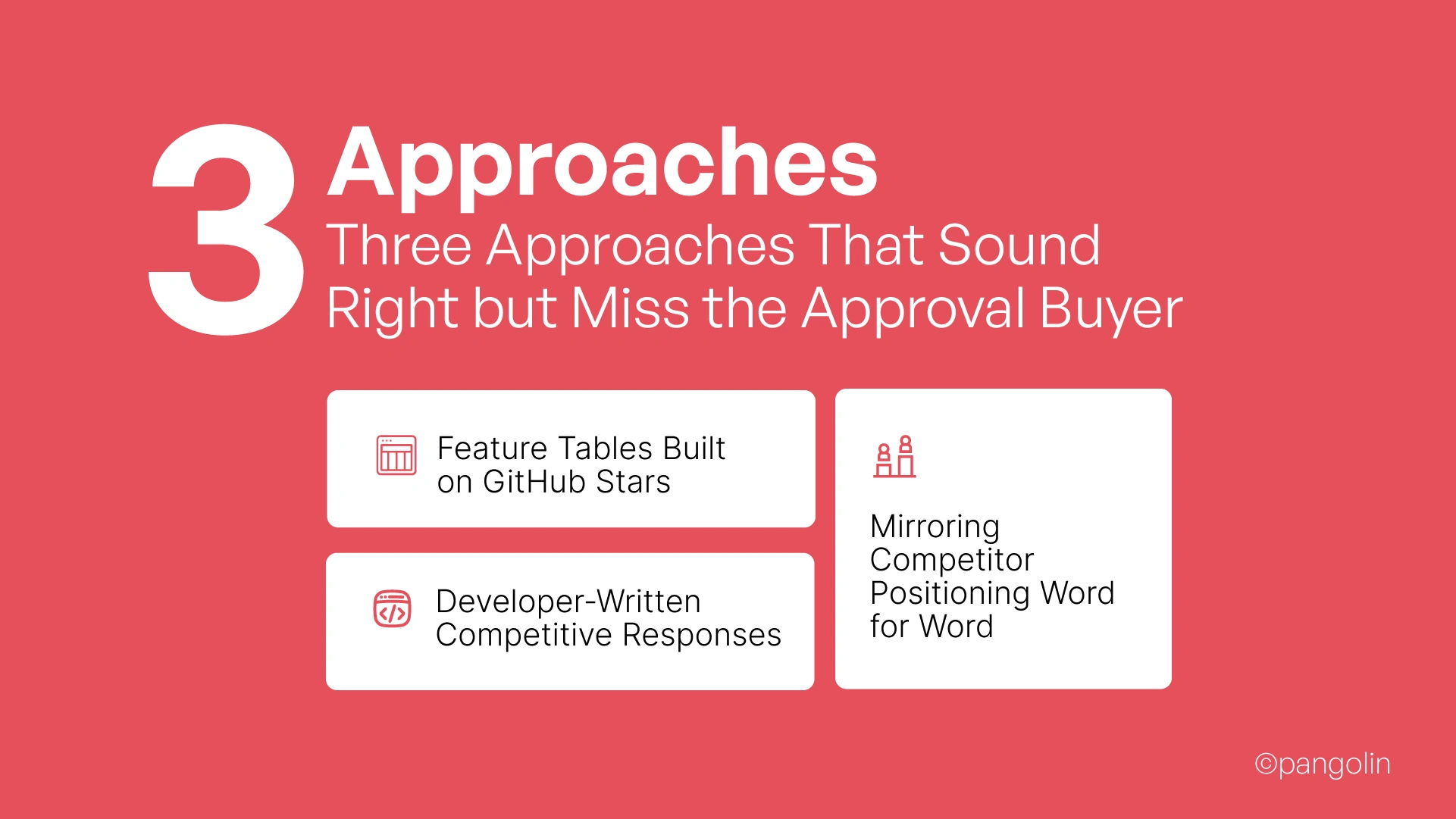
Teams built comparison tables using GitHub stars, integration counts, and API documentation quality. These metrics matter to practitioners but PQLs convert 3-5x better than MQLs precisely because product engagement signals differ from procurement criteria: a VP Engineering never opens a GitHub stars spreadsheet during a vendor review.
Companies asked internal developers to draft competitive responses. The output was technically accurate but commercially useless because developers write for developers. The buyer committee controlling budget approval requires a different register entirely and developer tools for B2B enterprise sales enablement requires commercial framing.
Teams copied competitor language and countered it feature-by-feature. This approach anchors your positioning to someone else's frame. Developer tools enterprise positioning strategy requires you to set the evaluation criteria before the competitor does.
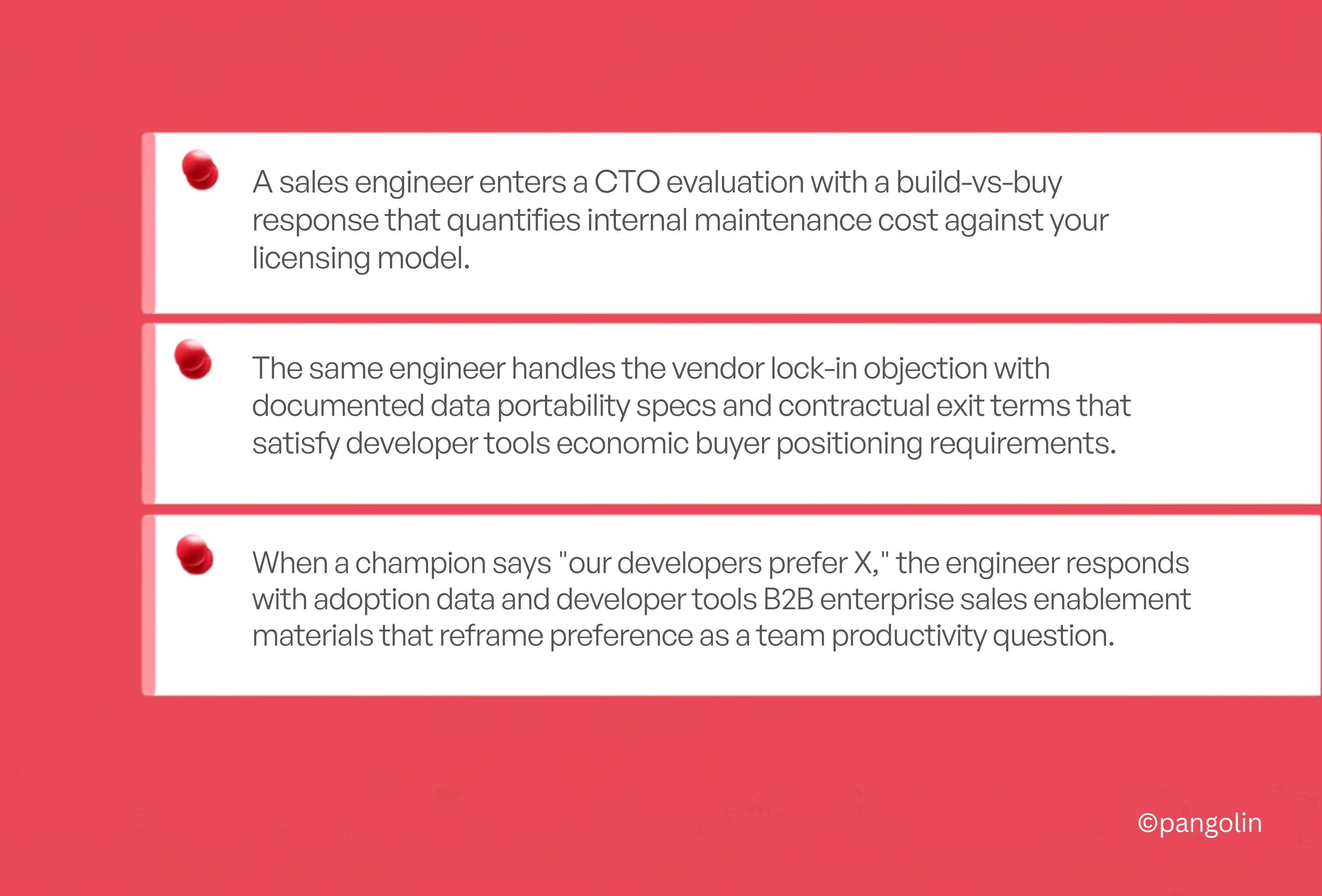
A single battle card written for one buyer type cannot serve four distinct evaluation conversations. That's the reframe. Companies miss this because the developer persona is so vocal and visible that it crowds out every other buyer signal. When you structure a developer tools battle card enterprise sales framework around four layers, win rates on deals above $50K change measurably. A practical example: your developer layer card handles API ergonomics and DX quality, while your economic layer card addresses total cost of ownership and vendor exit cost. Stop writing one card and calling it complete. Developer tools B2B enterprise sales enablement starts with acknowledging that each buyer role asks fundamentally different questions, and developer tools economic buyer positioning requires its own dedicated artifact.
The solved state is specific. Your sales engineer carries a four-layer developer tools battle card with named objection responses mapped to the evaluating buyer's role. The primary signal that your developer tools enterprise positioning strategy is working: deal velocity above $50K increases because procurement conversations stop stalling at the approval stage.
CI53 came to Pangolin with the exact situation described above. Their developer-focused positioning had produced strong practitioner adoption but stalled enterprise deals. Their prior developer tools enterprise positioning strategy consisted of ad hoc objection handling pulled from Slack threads.
Pangolin built a complete battle card library across all four layers within a single engagement cycle. The result: practitioner-level technical accuracy with zero corrections from CI53's in-house engineering team, and systematic competitive intelligence that replaced anecdotal sales objection handling. Developer tools economic buyer positioning was embedded into every card's architecture layer and economic layer.
0 technical corrections required from the in-house engineering team
100% domain absorption accuracy across regulated technical content
Systematic competitive intelligence replacing anecdotal objection handling
Pull your last three lost enterprise deals and identify the role that made the final rejection. This single action reveals whether your gap is at the developer layer, the engineering leader layer, or the economic layer. At the end of this exercise, you'll have a clear map of which battle card layer is missing or weak. That map connects directly to the four-layer framework and tells you exactly where to build first. Developer tools B2B enterprise sales enablement starts with this diagnostic, and a developer tools enterprise positioning strategy can't be prioritized without it.
If your map shows VP Engineering or CTO rejections and your current battle cards only address developers, Pangolin builds developer tools battle card enterprise sales frameworks scoped to your specific buyer committee and competitive set.