
Your product is better. Your engineering team knows it. Your early customers confirm it. Yet you keep losing enterprise deals to the same incumbent with inferior technology, a bigger logo, and a procurement-friendly risk story. This is the defining challenge for Series B B2B tech companies: figuring out how to position your product against larger competitors in B2B when the buyer committee isn't evaluating technology at all. They're evaluating risk.
The sales experience itself accounts for 53% of customer loyalty in B2B, outweighing brand, reputation, service, quality, and price combined. That means the way you frame risk, structure proof, and sequence your narrative matters more than your feature set. The challenger positioning playbook outlined here gives Series B companies a repeatable method to reframe enterprise evaluations away from incumbent safety and toward measurable business outcomes. It's built for companies that have the better product but keep losing to the better story.
This is about building a positioning system that makes your company the lowest-risk, highest-return choice in the room.
Standard challenger positioning tells you to sell agility and speed against a slow incumbent. That advice collapses in enterprise B2B, where procurement committees don't reward speed. They reward predictability. Competing against enterprise incumbents means surviving a multi-stakeholder evaluation where legal, finance, IT security, and the business unit each carry veto power.
A B2B David vs Goliath positioning strategy built on "we're more agile" fails the domain translation test. Your CTO buyer might believe you. The CFO and CISO on the same committee need a different register entirely. They need SOC 2 compliance language, implementation risk mitigation, and vendor continuity assurance. None of those are addressed by agility narratives.
Technical credibility alone doesn't close deals either. The incumbent's technology may be worse, but their sales team has spent years building procurement-stage assets: reference architectures, risk matrices, and named customer proof at the buyer's exact scale. Your positioning has to dismantle that advantage structurally, not just technically.
The Challenger Positioning Playbook produces a positioning system that wins enterprise evaluations against entrenched incumbents. It has four components because enterprise buying committees evaluate vendors across four distinct risk dimensions when competing against enterprise incumbents.
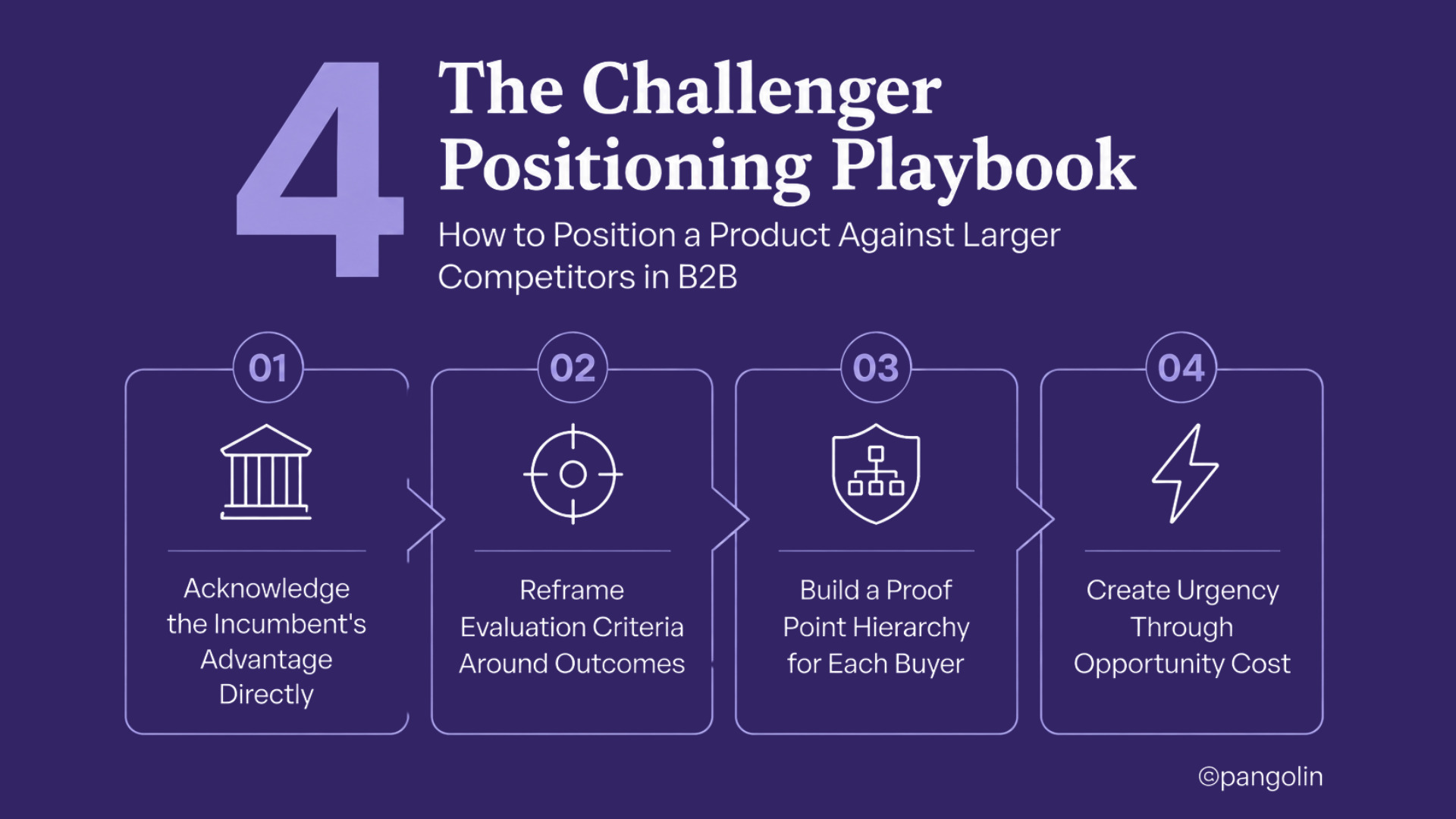
This component maps every real advantage the incumbent holds and names it explicitly in your sales materials. In practice, a B2B security company might open its pitch deck with "Vendor X has 12 years of SOC integrations - here's why that history creates specific constraints for your use case."
This component shifts the buyer committee's scoring rubric from feature parity to business outcome delivery. A B2B David vs Goliath positioning strategy might reframe "number of integrations" to "time-to-value on the three integrations your team actually uses."
This component creates tiered evidence matched to each stakeholder's risk threshold and decision authority. A Series B company might present a named CTO reference for the technical buyer and a CFO-facing TCO analysis for the finance stakeholder, structured as a single proof package. Knowing how to differentiate from a market leader in B2B requires this kind of register-specific evidence.
This component quantifies what the buyer loses each quarter by staying with the incumbent's inferior technology. A data platform challenger might show that the incumbent's batch processing adds 14 hours of latency per reporting cycle, costing $280K annually in delayed decisions.
When all four components are in place, you have a complete system for positioning your product against larger B2B competitors that addresses every objection before it surfaces.
The most common mistake is competing on features when the incumbent holds a budget and brand advantage. Technically strong companies make this error because their founders and engineers genuinely believe the best product wins. It doesn't.
The commercial consequence is predictable: you win the technical evaluation and lose the procurement decision. The correction requires shifting from feature comparison to outcome comparison. A B2B David vs Goliath positioning strategy built on "our API is faster" loses to an incumbent who says "we've reduced risk for 200 companies like yours."
Learning how to differentiate from a market leader in B2B means accepting that the buyer committee's definition of "better" isn't yours. In practice, this looks like replacing your feature comparison slide with a business outcome comparison slide that names specific dollar amounts, time savings, and risk reductions tied to the buyer's stated priorities.
Feature superiority is your foundation. Your message must be built one layer above it.
CarbonMinus was competing against enterprise incumbents in the sustainability platform space, facing established players with longer track records and deeper procurement relationships in the US market.
Using a B2B David vs Goliath positioning strategy, Pangolin built a full challenger positioning framework and battle cards within a focused engagement timeline. The deliverables included persona-mapped messaging, competitive objection handling, and a reframed evaluation narrative called "Net Zero for Net Gain."
The outcome demonstrated how to differentiate from a market leader in B2B at the commercial level: challenger positioning built against established enterprise sustainability platforms delivered a 42% increase in qualified leads, accelerated US market entry against incumbents with longer track records, and the "Net Zero for Net Gain" positioning reframed evaluation criteria from compliance checkbox to business value.
See the full CarbonMinus case study →
The answer depends on three variables: your competitive intelligence depth, your timeline, and your loss pattern.
Build in-house if you have a product marketing hire with direct experience in your competitive space. You also need at least eight weeks of runway before your next major enterprise evaluation where the incumbent is named. Competing against enterprise incumbents requires deep familiarity with the specific objections that kill your deals.
A hybrid works when your in-house team can map competitive objections from recent losses but lacks framework-building experience. An external partner builds the challenger positioning framework and battle cards while your team provides the raw competitive data. This B2B David vs Goliath positioning strategy splits the work along capability lines.
Hire externally if you're entering a new market with no prior competitive intelligence or losing deals at the final stage to the same competitor repeatedly. Pangolin builds these challenger frameworks for Series B companies entering the US market from other geographies, a repeatable methodology proven with companies like Sprih and IntelliTrans. Knowing how to differentiate from a market leader in B2B requires pattern recognition across multiple competitive contexts.
Pull the loss reports from your last five enterprise deals where the incumbent won and tag every objection by stakeholder role. This single action reveals whether you're losing on technology, risk, proof, or urgency, and which buyer on the committee is blocking you. That audit becomes the input for your challenger positioning strategy in B2B, and by Friday you'll have a prioritized map of the gaps your positioning must close to compete against enterprise incumbents.
If you need a structured method for how to differentiate from a market leader in B2B, Pangolin's positioning engagements start with exactly this competitive audit.
Enterprise deals aren't won by the best product. They're won by the company that makes the buyer committee feel safest choosing them. For Series B companies with superior technology, the gap between product quality and commercial outcome is almost always a positioning gap.
The four components of the challenger playbook: acknowledging incumbent advantage, reframing evaluation criteria, building proof hierarchies, and creating urgency through opportunity cost give you a structured method to close that gap. Sprih used a persona-driven approach to fuel a $3M raise and US market launch. The pattern repeats across every Series B company that stops selling features and starts selling outcomes.
Your product is already better. Your positioning needs to prove it to the six people on the committee who will never see a demo.

Aniket leads content marketing at Pangolin, writing and editing for B2B tech clients who need sharp messaging and consistent output. He came from journalism and brings that newsroom discipline to content work, turning drafts around quickly and keeping quality high.