
TL;DR
AI GTM strategy for B2B startups in 2026 requires building content infrastructure that surfaces in AI tool responses, because buyers now compile vendor shortlists before they ever type a Google query. The most important shift in B2B go-to-market strategy for the AI era is this: the buyer research journey has a pre-Google phase where AI chatbots produce the initial consideration set. The AI-Era GTM Stack is the three-layer framework this article uses to break down how B2B companies can respond to that shift with a specific, repeatable system.
Your buyers are already asking ChatGPT, Perplexity, and Claude for vendor recommendations. They're arriving at your site, or your competitor's site, with a shortlist already formed. The companies that appear in those AI-generated shortlists win the first and most decisive filter in the 2026 buying process. The companies that don't appear there are competing for scraps in a second-stage search that carries less purchase intent than it did even 12 months ago.
This isn't a theoretical concern. AI chatbots are now the number one source influencing B2B buyer shortlists at 54%, ahead of software review sites at 43% and vendor websites at a distant third. If your GTM motion is still built around ranking on Google and running paid media to cold audiences, you're optimizing for a stage of the funnel that no longer sits at the top.
B2B buyers in 2026 use AI tools as their first research step, creating a pre-Google buyer discovery layer that most B2B companies haven't built for. Companies without presence in AI vendor discovery responses lose pipeline before their sales team knows a deal existed. Startups that structure content for AI citation now capture a positioning advantage that compounds monthly. By late 2026, the majority of enterprise buying committees will treat AI-generated shortlists as the default starting point, which means the window for early movers is roughly 12 months.
The data confirms the velocity of this shift. Roughly 72% of B2B buyers prefer a rep-free experience, and AI tools are filling the advisory gap that sales teams once occupied. Pre-Google buyer discovery in B2B AI tools isn't a niche behaviour. It's the new normal for technical buyer committees evaluating SaaS, infrastructure, and professional services vendors.
The AI-Era GTM Stack produces a connected system where every content asset serves a specific role in the pre-Google buyer discovery process. It has three components: the AI Discovery Layer addresses how you get cited, the Intent Capture Layer addresses how you convert interest, and the Conversion Layer addresses how you close.
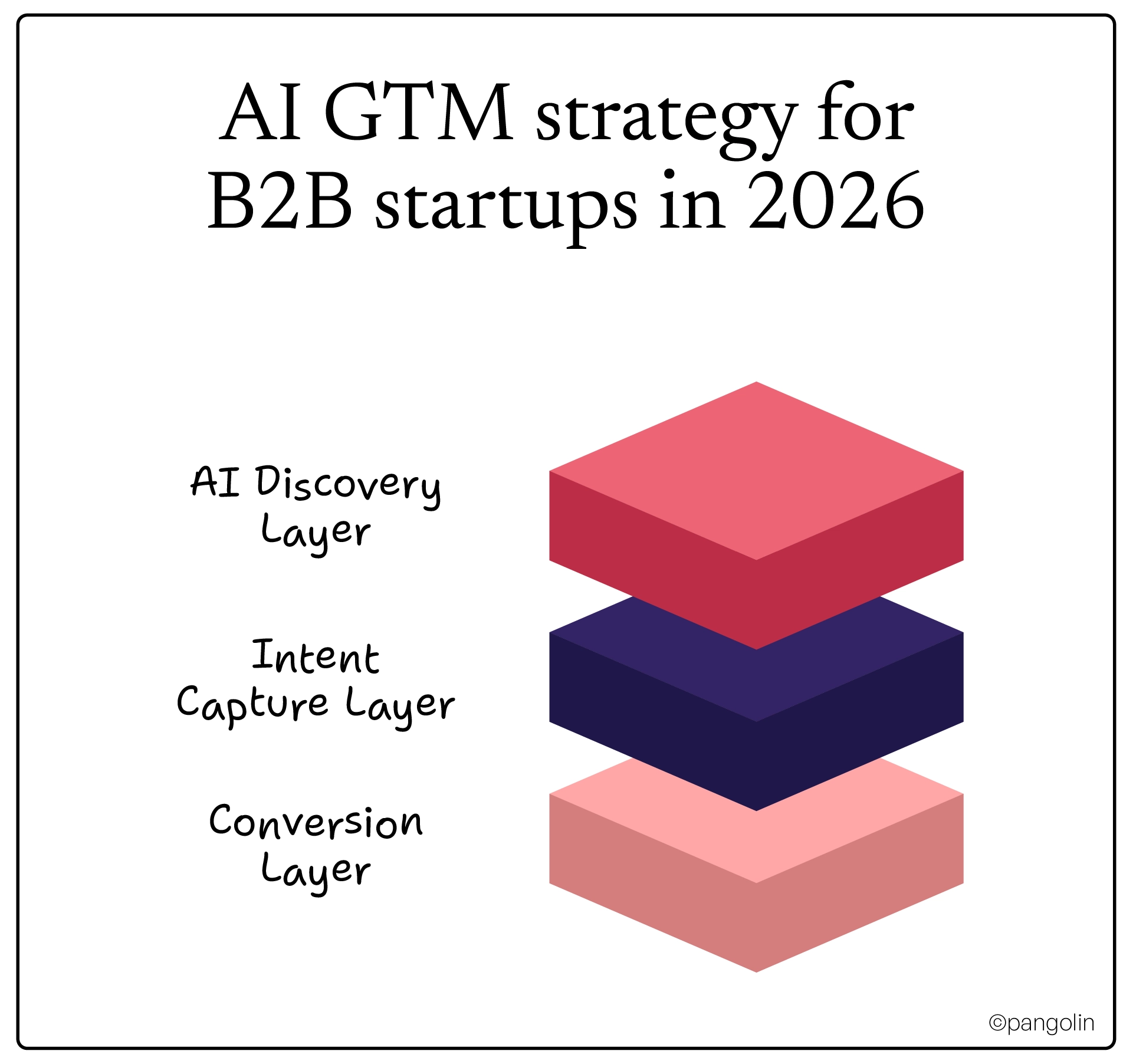
The AI Discovery Layer is the content infrastructure that gets your company named in AI-generated vendor shortlists. It produces citation-ready assets: structured educational content, industry-specific pages, and comparison frameworks that LLMs can extract. You know this layer is working when your company name appears in ChatGPT or Perplexity responses to category-level queries.
Building this layer requires a specific content architecture. Your pages need clear entity definitions, structured data markup, and answers formatted for extraction. The AI discovery layer for B2B startups in 2026 is not about volume. It's about structure.
The Intent Capture Layer converts AI-referred visitors into engaged prospects through case studies, use-case architectures, and proof-point content. It produces qualified engagement from buyers who arrive pre-educated and shortlist-ready. You know this layer is in place when visitors from AI referral sources spend more time on case study pages than on your homepage.
The intent signal from an AI-referred buyer is fundamentally different from a Google-referred one. These buyers already know your category. They need evidence that you deliver. AI vendor discovery depends on having this layer ready before you invest in top-of-funnel programmes.
The Conversion Layer turns engaged prospects into consultation requests and signed contracts through commercial-fear-based opening situations and direct service pages. It produces pipeline. You know this layer is working when your sales cycle shortens because buyers arrive with context they gathered from AI tools and your content.
When all three components of the AI-Era GTM Stack are in place, a B2B startup has a GTM system built for the 2026 buyer research journey: visible in AI discovery, structured for intent capture, and designed to convert.
The most common error B2B companies make is treating AI search as another distribution channel to push content through, rather than a discovery layer where buyers form opinions. Sophisticated marketing teams make this mistake because it maps onto existing mental models: they've spent years optimizing for Google distribution, so they apply the same logic to AI tools. The commercial consequence is severe: your content gets indexed but never cited, which means you're invisible at the exact moment a buyer builds their shortlist. The correction is to build content for AI citation and extraction, not for AI indexing.
This distinction matters because LLMs don't rank pages the way search engines do. They extract, summarize, and attribute. Your AI discovery layer in 2026 must produce content that reads as a citable source, not as marketing collateral. AI vendor discovery in your B2B GTM strategy requires a fundamentally different content architecture than the one you built for Google.
Companies that confuse distribution with discovery spend budget on content that performs well in traditional SEO metrics but generates zero AI-referred pipeline. The gap between those two outcomes is growing every quarter.
Pangolin builds its own GTM motion on the three-layer AI-era stack, using industry pages and educational content structured specifically for LLM citation. One specific example: Trundle's founder discovered Pangolin through a ChatGPT query about B2B product marketing agencies and signed without a formal sales process. This proves the AI-Era GTM Stack works in practice for B2B startup GTM in 2026. The confirmation signal is direct: pipeline generated entirely through AI-referred content, with zero outbound or paid media involved.
Any B2B company can replicate this by auditing which queries their buyer committee asks AI tools and building content that answers those queries in a citation-ready format. Pre-Google buyer discovery in B2B AI tools rewards companies that structure content for extraction. Pangolin's case study and use-case architecture converts intent into engagement. The service pages with commercial opening situations drive consultation requests. That's the full stack in production.
Pangolin delivered similar structural precision for Sprih, where a persona-driven website fuelled a $3M raise and US market launch. The same content architecture principles apply whether you're building for investor audiences or AI-referred buyer committees.
Ask ChatGPT, Perplexity, and Claude to recommend vendors in your category using the exact queries your buyers would use. You'll know within 30 minutes whether your company appears in AI-generated shortlists or not. That audit unlocks the first build decision: which content assets need restructuring for AI citation in your B2B go-to-market strategy for the AI era, and which gaps in your AI discovery layer need filling first.
Pangolin's GEO content strategy work and AI/ML industry page show what a fully built AI discovery layer looks like for B2B startups building their GTM strategy in 2026.
The pre-Google discovery layer is compounding right now. Every month that passes without structured AI-visible content is a month where your competitors accumulate citations, build entity authority, and lock in shortlist positions that become harder to displace. AI tools develop source preferences over time. The vendors they cite today get cited more frequently tomorrow.
B2B startups that build for AI discovery in 2026 aren't just adapting to a trend. They're securing a structural advantage in how their buyer committees find, evaluate, and shortlist vendors. The three-layer AI-Era GTM Stack gives you the architecture. The audit gives you the starting point. The window is open now, and it won't stay open indefinitely.
If your company sells to technical buyer committees and you haven't tested your AI visibility yet, that's the single most important action you can take this week. Not next quarter. This week.

Aniket leads content marketing at Pangolin, writing and editing for B2B tech clients who need sharp messaging and consistent output. He came from journalism and brings that newsroom discipline to content work, turning drafts around quickly and keeping quality high.