
Your pilot schools love the product. Teachers report higher engagement. Test scores moved. But the district CFO's procurement committee just asked for cost-per-student comparisons against existing programmes, and your deck has nothing that answers that question.
The RFP deadline is in six weeks. Every day without a financial business case is a day closer to losing a district-wide contract that took eighteen months to cultivate. This piece gives you the specific framework for translating learning outcomes into the operational ROI language that school district CFOs use to approve purchases.
If you're an EdTech founder or head of marketing sitting on strong efficacy data and wondering why it doesn't convert at the procurement stage, this is written for you. The gap between educational impact and a funded business case is the document you're handing to the wrong buyer with the wrong metrics.
EdTech products grow by proving they work in classrooms, which means every early metric tracks student outcomes. Product teams, curriculum designers, and pilot coordinators all reinforce this focus on learning data. The gap between learning metrics and operational ROI becomes visible the moment a district CFO enters the buying process.
No amount of upfront planning prevents this because the people who build EdTech products are not the people who approve school district budgets. The commercial cost is specific: stalled procurement cycles, lost RFPs, and eighteen-month sales cycles that end without a signed contract. With the proposed FY26 federal education budget at $66.7 billion, representing a 15.3% cut, district CFOs are under more pressure than ever to justify every dollar against operational benchmarks, not pedagogical ones.
This is a structural pattern that every EdTech company hits when moving from teacher-level adoption to district-level procurement.
Every attempt below is rational. Each one reflects a reasonable hypothesis about what a CFO needs. They all share the same structural flaw: they start from learning metrics and add financial language on top. The CFO's evaluation criteria require the case to be built from the other direction entirely.
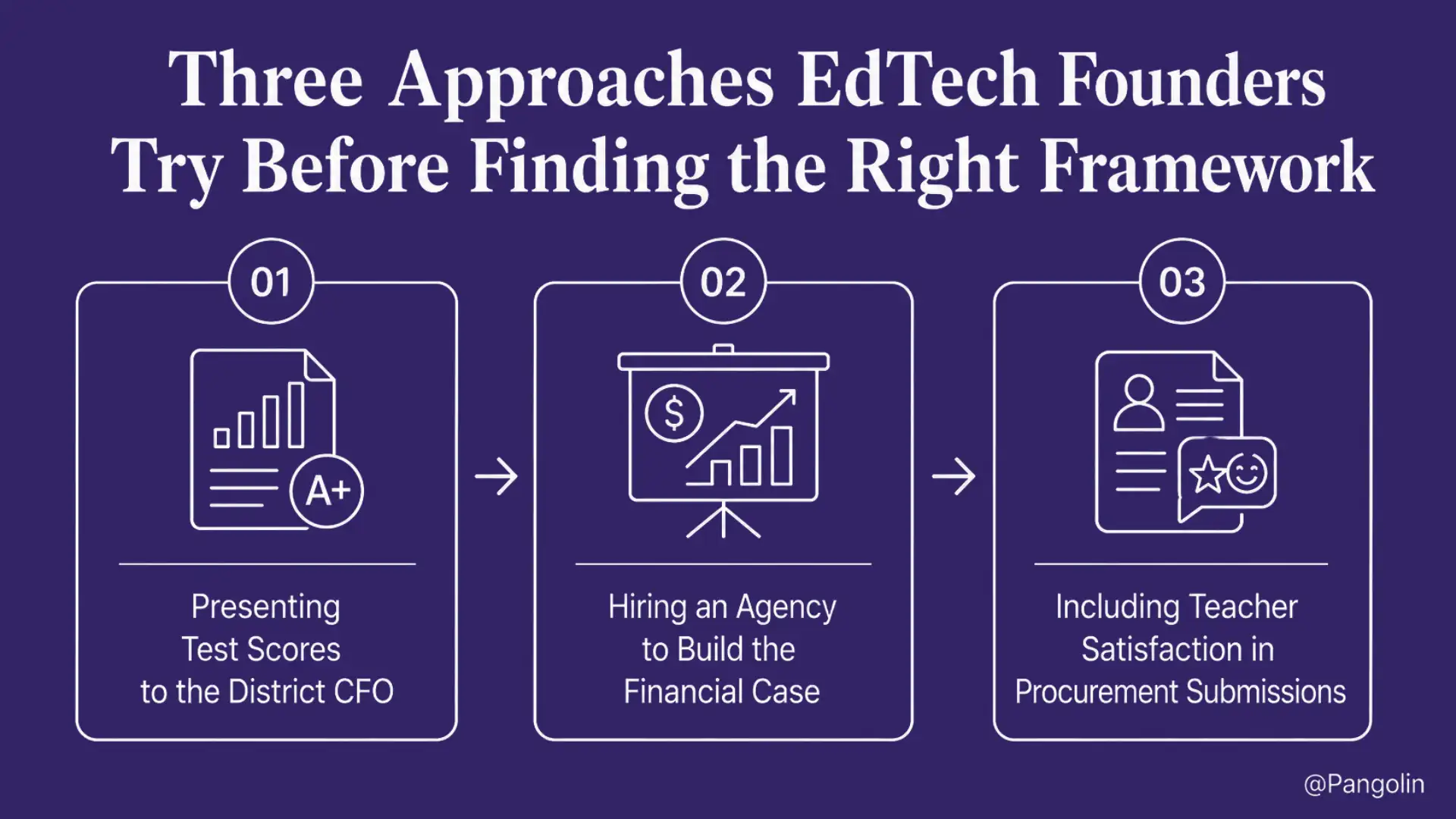
You showed completion rates and test score improvements. The CFO responded with a cost-per-student question you had no framework to answer. Learning data proves your product works, but it doesn't map to the EdTech school district procurement business case format CFOs evaluate.
You engaged an education marketing agency to produce a CFO-ready document. What came back was a teacher-audience case study with a cost line appended. The agency understood educational positioning but lacked the commercial infrastructure to translate EdTech learning metrics to operational ROI.
You added student testimonials and teacher satisfaction scores to the submission package. The procurement committee scored on budget impact and implementation overhead. The school district CFO EdTech value proposition requires financial proof points, not experiential ones.
Your learning data is not the problem. It's the wrong document for the wrong buyer. A district CFO's job is to allocate limited operational budgets across competing priorities. Efficacy data tells them your product works. It doesn't tell them what it replaces, what it costs per student, or what operational line items it reduces.
EdTech founders miss this because the people who champion the product internally are teachers and administrators who care about outcomes. The CFO enters the process late, with a completely different evaluation rubric. When you reframe your pitch around operational cost impact, procurement timelines compress. A specific example: instead of "92% student engagement rate," present "reduced remedial programme spending by $14 per student annually based on pilot data."
In CFO-facing documents, learning outcomes belong as supporting evidence inside an operational business case. The headline is the cost-per-student impact, not the engagement rate.
The solved state is a procurement submission where the CFO sees both educational impact and measurable operational returns in a single document. You know you've built the right EdTech school district procurement business case when the CFO's first response is a budget allocation question, not a clarification request.
SAHI faced the same structural problem: a platform serving both institutional buyers and individual users, with each buyer evaluating on completely different criteria. Before restructuring, SAHI's single-message approach satisfied no one on the buying committee.
Pangolin built buyer-role-specific positioning and commercial assets scoped across each stakeholder's evaluation criteria. The engagement delivered within a single quarter. The result: segmentation across buyer roles produced a 122% increase in conversion rates and a 28% CAC reduction by addressing each buyer's specific procurement concerns, directly translating EdTech learning metrics to operational ROI for the institutional buyer while preserving the user-facing value story.
122% - conversion rate increase from buyer-role segmentation
28% - customer acquisition cost reduction through targeted positioning
Take your three strongest learning outcome metrics and write one sentence for each that names the operational cost it reduces for a school district. This is higher priority than any other sales asset because it converts your existing data into the language the CFO's evaluation rubric actually scores. At the end of this exercise, you'll have a draft school district CFO EdTech value proposition built on numbers you already own.
This single reframe is the foundation of every successful EdTech school district procurement business case. It turns stalled deals into funded contracts.
If you need the full business case framework built for your specific buyer committee, Pangolin builds procurement-stage positioning for EdTech and B2B tech companies with the same methodology that produced SAHI's 122% conversion lift.