
You've signed the offer letter. Your new VP Sales starts in a month. The shared drive where battle cards should live has a single outdated PDF from 2022 and a product screenshot folder no one maintains. This is the reality of a B2B sales hire with no marketing collateral ready for their first week.
The commercial pressure is specific and measurable. Every day your VP Sales spends building their own materials is a day they're not generating pipeline. A six-figure hire creating their own pitch deck in Google Slides during week two is a direct cost you can calculate. This piece gives you the exact playbook for building sales enablement before your VP Sales joins enterprise conversations.
This is written for Series A to C founders and heads of marketing who've just made a senior sales hire and realized the cupboard is bare. You don't need motivation. You need a sequence of actions that produces usable collateral in 30 days or less.
Most B2B companies build their marketing function around demand generation first. That's the right call at early stages. Your team optimized for lead volume, website conversion, and paid media performance. Nobody hired a product marketing manager because nobody needed one yet.
The gap becomes visible the moment you hire a senior enterprise seller. That's the trigger event. Your demand gen team writes landing pages and ad copy, not battle cards or competitive positioning documents. The B2B enterprise sales collateral gap cost is a predictable consequence of building marketing for one job and then asking it to do a different one.
You couldn't have prevented this with better foresight. The need for positioning infrastructure before an enterprise sales hire only becomes urgent when the hire is made. Without it, your VP Sales loses deals in the first 90 days while building materials that should have existed on Day 1.
Every attempt below is rational. These aren't bad decisions. They're structurally insufficient because they treat the collateral gap as a content production problem. The actual gap is positioning infrastructure.
All three share the same misdiagnosis: the missing piece is a competitive argument, and individual documents cannot substitute for it.
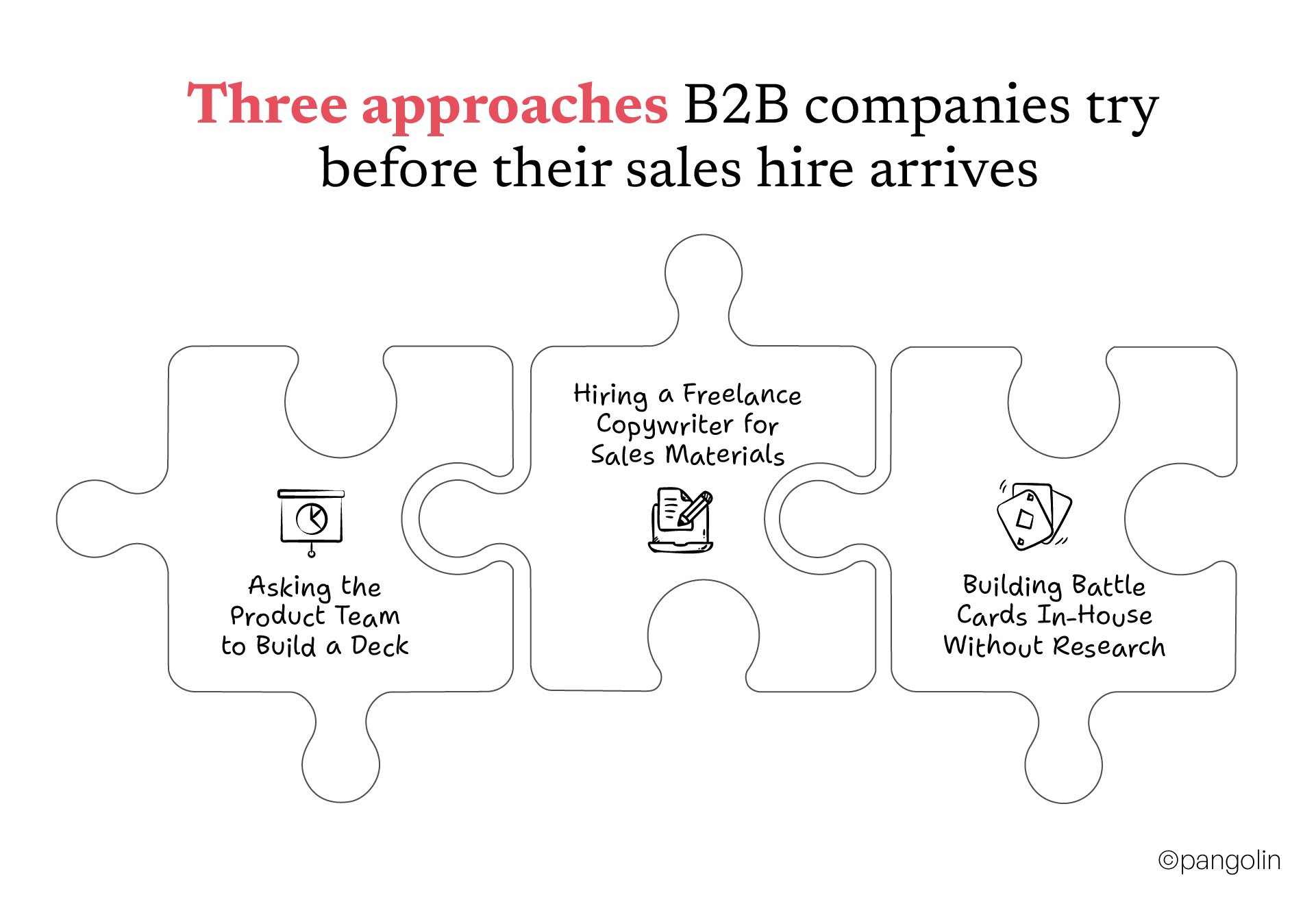
Your product team built a 40-slide feature walkthrough with architecture diagrams and roadmap timelines. It answers "what does this do?" but never answers "why should I buy this instead of the alternative?" The B2B enterprise sales collateral gap cost here is a deck that loses the room after slide six.
The freelancer delivered clean, professional language across a pitch deck and one-pager. But polished prose without competitive logic or buyer objection mapping gives your VP Sales a brochure, not a weapon. Positioning infrastructure before an enterprise sales hire requires strategic input no copywriter can invent alone.
Your marketing lead started a battle card template and stalled at competitor research. Building battle cards before the first enterprise sales meeting requires 40 to 60 hours of competitive analysis. That timeline doesn't fit inside your 30-day window when your team already has a full workload.
The missing piece is a positioning architecture that tells every piece of content what to say, to whom, and against which competitor. Companies miss this because the symptoms look like a content shortage. The root cause sits one layer deeper.
When you build positioning infrastructure before an enterprise sales hire, every deliverable writes faster. Battle cards, pitch decks, objection handlers, and competitive briefs all derive from the same source: a clear competitive position mapped to each member of the buyer committee.
Here's what this looks like in practice. One positioning framework produces a pitch deck for the economic buyer, a technical brief for the CTO, and battle cards before the first enterprise sales meeting. All three say different things. All three make the same argument.
Stop commissioning individual documents. Start building the positioning layer that makes every document possible. Organizations that implement a structured sales enablement process experience a 15% increase in win rates compared to those without one. That lift comes from infrastructure, not individual assets.
The solved state is specific. Named artefacts in named hands producing named commercial outcomes. You'll know the problem is solved when your VP Sales walks into their first enterprise meeting with materials they didn't build themselves, and the B2B enterprise sales collateral gap cost drops to zero.
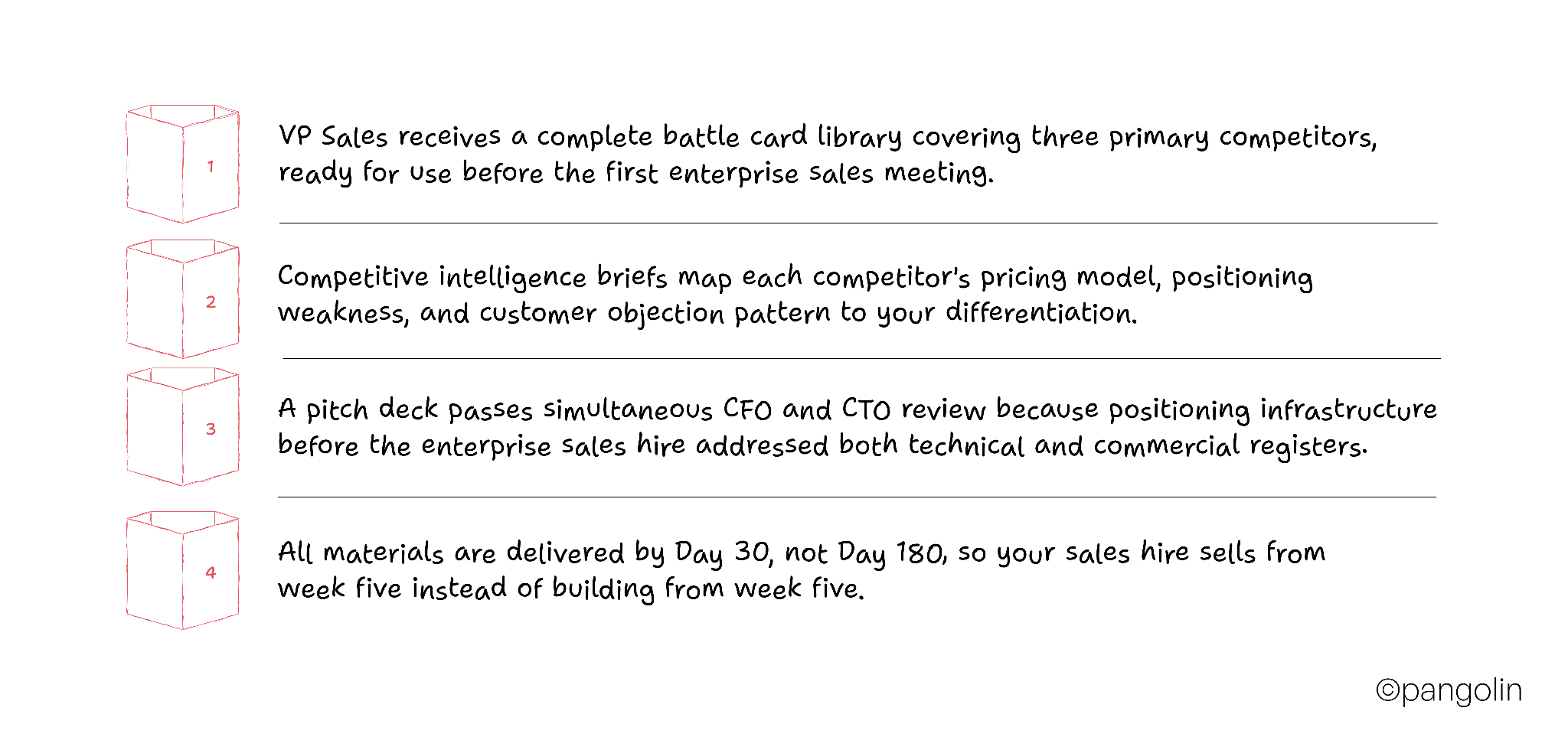
IntelliTrans faced the exact situation this article describes. A growing B2B tech company entering enterprise sales with no competitive positioning, no battle cards, and no pitch deck built for a sophisticated buyer committee. Previous attempts at internal collateral production had stalled, and the B2B enterprise sales collateral gap cost was accumulating with every week of delay.
Pangolin built the full positioning infrastructure before the enterprise sales push: competitive intelligence, battle cards, a pitch deck structured for multi-stakeholder evaluation, and objection handling documents mapped to specific buying roles. The collateral survived a Tata Motors-scale enterprise evaluation with zero accuracy corrections required. That's positioning infrastructure before an enterprise sales hire, delivered as a connected system rather than isolated documents.
4 weeks - complete sales enablement infrastructure built from zero
0 accuracy corrections - collateral passed enterprise-grade technical review
Tata Motors-scale - evaluation survived by collateral built in under 30 days
Read the full IntelliTrans story →
This week, list the three competitors your VP Sales will face most often in enterprise deals. For each one, write the single objection each buying role (CFO, CTO, end user) will raise about your product versus that competitor.
This action is higher value than any document you could produce this week. It forces the positioning conversation that makes battle cards before the first enterprise sales meeting actually possible. At the end of this exercise, you'll have a 3x3 grid: three competitors, three objections per role. That grid is the foundation that eliminates B2B enterprise sales collateral gap cost permanently.
If your VP Sales starts in 30 days and your B2B sales collateral doesn't exist yet, Pangolin's product marketing practice builds the positioning infrastructure, battle cards, and competitive intelligence that enterprise sellers need from Day 1.