
TL;DR
Product marketing for generative AI products in 2026 requires a three-register positioning framework: one technical register for CDOs and engineering evaluators, one commercial register for CFOs and procurement committees, and one strategic register for board members and investors. The single most important shift since 2024 is that "AI-powered" has become a commodity claim, and generative AI product positioning in B2B enterprise now depends on outcome specificity and risk architecture rather than model performance. The Three-Register AI Positioning Framework is the structure that makes this operational, and the rest of this piece unpacks each register, its audience, and its deliverables.
Over 80% of enterprises are expected to deploy generative AI-enabled applications by the end of 2026, making "AI-powered" a baseline feature rather than a differentiator. Product marketing for generative AI products that still leads with model capability faces immediate commoditization in procurement evaluations. Companies that adopt a three-register AI positioning framework for B2B buyers now hold a 12- to 18-month positioning advantage over competitors still relying on 2024-era messaging. That window is closing fast: by mid-2027, procurement committees will have standardized evaluation rubrics that penalize vendors who can't articulate outcome specificity, making it essential to know how to market generative AI to CFO and CTO audiences today.
Enterprise procurement teams have seen enough failed AI proofs of concept. They've learned to discount accuracy claims that lack production-environment validation. The positioning playbook that worked at Series A in 2024 reads as a commodity statement in a 2026 procurement evaluation. B2B companies that don't adapt will lose deals not because their product is worse, but because their positioning is indistinguishable.
The three-register AI positioning framework for B2B produces a positioning architecture where every member of the buyer committee receives a message calibrated to their evaluation criteria. It has three components: a technical register addressing CDO and engineering concerns, a commercial register addressing CFO and procurement concerns, and a strategic register addressing board and investor concerns.
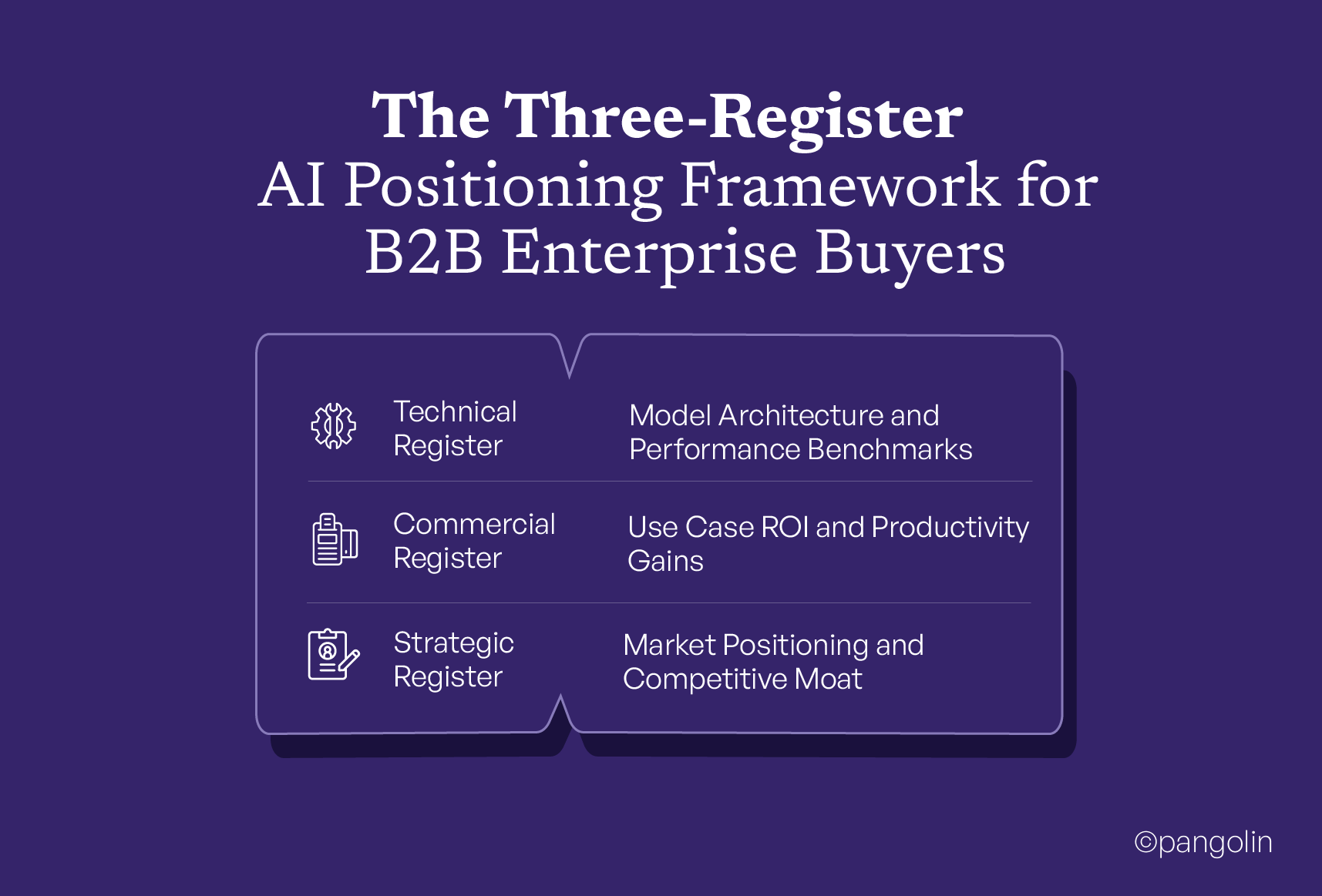
The technical register produces documentation that passes CDO and engineering evaluation: model architecture specifications, latency benchmarks, fine-tuning methodology, and compliance certifications like SOC 2, HIPAA, or FedRAMP. You know this register is in place when your technical documentation survives a CISO security review without supplemental requests for architecture diagrams or data-handling protocols.
The commercial register produces the business case that a CFO needs to approve a purchase order: named use case ROI projections, productivity gain calculations, and total cost of ownership models. This is the core of any generative AI enterprise messaging strategy for B2B. You know this register is in place when your champion can forward a single document to procurement and receive approval without building a custom internal business case.
The strategic register produces the narrative that board members and investors use to evaluate whether your product strengthens their company's competitive position over a three- to five-year horizon. Knowing how to market generative AI to CFO and CTO stakeholders is necessary, but the strategic register addresses a different question entirely: does this investment create a defensible advantage? You know this register is in place when board-level stakeholders reference your product's strategic value in earnings calls or investor updates, not just its operational utility.
When all three registers of the Three-Register AI Positioning Framework are in place, product marketing for generative AI products becomes a procurement asset rather than a sales pitch.
The most common mistake in product marketing for generative AI products is leading with model architecture and benchmark scores that are meaningless to the CFO who signs the contract. Engineering-led companies make this mistake because their founding teams genuinely believe F1 scores and latency benchmarks are the strongest proof of product quality, and they're right in a technical evaluation. The commercial consequence is severe: deals stall at procurement because the champion can't translate a 94.7% accuracy score into a dollar-denominated business case, and the three-register AI positioning framework for B2B collapses into a single-register pitch that reaches one evaluator out of five.
The correction is direct. Build the commercial register first. Translate every technical metric into a named business outcome before it enters any external-facing document. A generative AI enterprise messaging strategy for B2B that starts with "this saves your claims processing team 11 hours per week" outperforms one that starts with "our model achieves state-of-the-art performance on benchmark X."
Knowing how to market generative AI to CFO and CTO audiences means sequencing the commercial register ahead of the technical register in every buyer-facing asset.
Pangolin applies the three-register AI positioning framework for B2B across its own content architecture as a live demonstration of generative AI product positioning in B2B enterprise. The AI and ML industry page uses technical-register vocabulary in its domain sections: LLM architecture, agentic workflows, AI governance. Service page openings use commercial-register framing, addressing specific buyer situations like "POC completed but CFO can't build business case." Educational blog content, including this piece, uses strategic-register frameworks like GTM sequencing and positioning architecture.
This proves the three-register framework works across content types, not just in a single positioning document. Sprih's persona-driven website fuelled a $3M raise and US market launch, a direct result of positioning that addressed investor, buyer, and technical audiences simultaneously. A generative AI enterprise messaging strategy for B2B built on three registers generates pipeline from multiple buyer-committee entry points. Any B2B company can replicate this by auditing its existing content against the three registers and identifying which register is missing or underweight.
The highest-priority action for any B2B company applying product marketing for generative AI products is a commercial register audit of your top five sales assets. Review each document and tag every claim as technical, commercial, or strategic. You'll have a clear map of which register dominates and which register is absent from your buyer-facing materials, showing you exactly how to market generative AI to CFO and CTO evaluators simultaneously.
This audit unlocks the next build: a generative AI product positioning document for B2B enterprise that allocates equal weight to all three registers. A generative AI enterprise messaging strategy for B2B without this audit is guesswork.
Pangolin builds product marketing for generative AI products scoped from positioning architecture through GEO-optimized content: see the AI and ML industry page for a live example.