
You closed your first enterprise deals because CTOs trusted you as a peer. Now you're on every call, your pipeline is capped at your calendar, and the VP of Sales you hired can't replicate what you do instinctively. The founder-led sales to enterprise motion transition is the specific problem this piece addresses: how a technical founder scales B2B enterprise sales without becoming the permanent bottleneck. This is for Series A to C technical founders and their marketing leads who feel the wall forming between $1M and $5M ARR.
Most founders should wait until they have at least 10 closed customers and $10K+ in monthly recurring revenue before hiring their first sales rep. That benchmark exists because the founder needs enough closed deals to identify repeatable patterns. But hitting that threshold and actually being ready to step back are two very different things. The gap between "founder can sell" and "company can sell" is where most B2B technical companies stall.
What follows is a diagnosis of why this happens, what doesn't work, and the specific infrastructure that does.
The structural reason a technical founder hits a sales wall is predictable. It happens when the buyer committee grows beyond a single technical decision-maker. Early deals close because the founder speaks directly to a CTO or VP of Engineering as a peer. That peer dynamic breaks the moment a CFO, procurement lead, or business stakeholder enters the evaluation.
The founder's own strength created this gap unintentionally. When a technical founder stops being the best salesperson, it's not because their skills degraded. The trigger is the first deal where the economic buyer and the technical evaluator are different people. No amount of planning prevents this: it's a function of selling to larger organizations with formal buying processes. B2B technical founder sales credibility at enterprise scale depends on speaking to multiple registers simultaneously, and most founders have only practiced one.
The commercial cost is measurable. Each stalled evaluation represents 60 to 90 days of founder time that produced no revenue.
Every approach below is rational. None of them are bad decisions. They all share the same misdiagnosis: the founder's value in enterprise sales is perceived authority, and technical knowledge is what buyers assume is behind it. Building collateral around the wrong variable produces the same stall every time. B2B technical founder sales credibility at enterprise scale requires a different framing entirely.
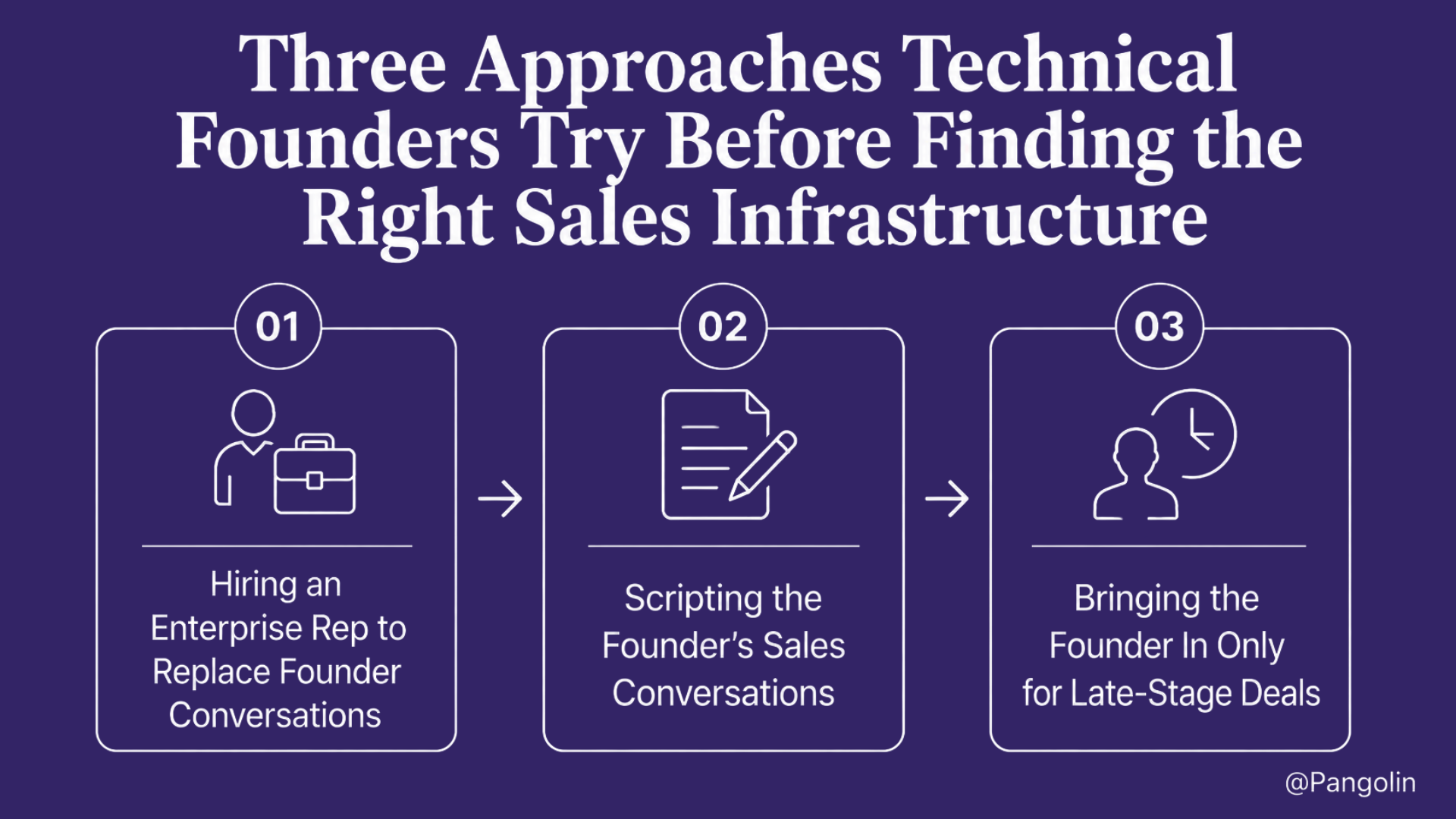
The company hired an enterprise rep, and the first three technical evaluations stalled at review. The rep had sales skills but lacked the perceived authority that made CTOs share competitive intelligence freely. This is a structural mismatch between what the rep carried into the room and what the buyer expected. The hire was correct. The infrastructure behind the hire was missing. When a technical founder stops being the best salesperson, replacement alone doesn't work.
The team wrote a script for the founder, and the founder improvised anyway. The script didn't reflect how the founder actually thought about competitive differentiation. Product marketing for founder-led B2B SaaS requires capturing the founder's mental model, not imposing an external framework on top of it.
The company reserved the founder for final-stage evaluations only. By that point, a competitor's positioning had already shaped the evaluation criteria. B2B technical founder sales credibility at enterprise scale requires influence over how the evaluation is framed, not just how it's closed.
The founder's advantage in enterprise sales is not technical depth. It is the buyer's perception that they're speaking to someone who can make commitments. Enterprise CTOs say things to a technical founder they won't say to a sales rep. They share roadmap concerns, competitive frustrations, and budget constraints because they believe the founder can act on that information immediately.
Companies miss this because they focus on replicating the founder's product knowledge. The variable that actually moves enterprise evaluation outcomes is perceived authority, and collateral infrastructure is how you transfer it. Which directly influences how much competitive intelligence the buyer shares during the evaluation.
When you apply this reframe, the commercial outcome changes. You stop trying to remove the founder from sales and start building collateral infrastructure that scales what the founder does instinctively. Product marketing for founder-led B2B SaaS means encoding the founder's positioning instincts into battle cards, evaluation frameworks, and objection-handling documents. In practice, this looks like a positioning framework the founder actually trusts because it reflects their mental model, not a generic messaging house.
The correct move is equipping reps with the authority signals the founder carries naturally. Training reps to replicate the founder's voice produces a weaker version of something the buyer has already calibrated against.
The solved state is specific and measurable: named deliverables, named buyer roles, named commercial outcomes. You know the problem is solved when the founder's calendar is no longer the constraint on pipeline volume, and when a technical founder stops being the only person who can advance enterprise evaluations past technical review.
CI53's Director of Marketing faced the exact situation described above: a technical founder whose credibility closed early deals, a growing pipeline that exceeded founder capacity. Previous attempts to capture the founder's positioning into sales collateral had produced materials the founder didn't trust or use. When a technical founder stops being the best salesperson, the first instinct is to document what they say. The real challenge is documenting how they think.
Pangolin built a positioning framework and competitive collateral set for CI53 within a single engagement cycle. The Director of Marketing found Pangolin through content demonstrating technical domain depth and signed without a prior relationship. B2B technical founder sales credibility at enterprise scale was preserved because the positioning framework required zero accuracy corrections from the technical team. The founder trusted the output because it reflected how they actually thought about competitive differentiation.
0 accuracy corrections required from the technical team
0 prior relationship before signing: content-sourced engagement
1 positioning framework the founder trusted and actively used
Record your next founder-led enterprise call this week. Identify the three moments where the founder's competitive positioning was improvised rather than structured. This single action is higher-value than any other sales enablement task because it reveals the exact gaps between what the founder knows and what the sales team can access. At the end of this exercise, you'll have a battle card brief: three specific positioning moments that product marketing for founder-led B2B SaaS can turn into repeatable collateral. When a technical founder stops being the best salesperson, these three moments are usually the reason deals stall without them.
Pangolin builds positioning and collateral infrastructure for technical founders scaling enterprise B2B sales beyond founder capacity.