
Your VP of Sales just lost another deal at the final stage. The same competitor. Again. The debrief sounds familiar: "They said the other vendor had better integrations," or "The procurement team felt more comfortable with their security posture." But when you press for specifics, the intel dissolves into opinion. Every piece of competitive knowledge your company holds lives inside individual sales reps' heads, shaped by recency bias and filtered through the frustration of a lost commission. This is the single most common starting point for B2B tech companies that need to build a competitive intelligence programme: a pattern of late-stage losses, a named competitor, and nothing structured to work with.
Your sales team has fragments of competitive knowledge. The problem is that fragments don't survive a procurement committee. A CISO doesn't care what your rep heard on a call last quarter. A CFO won't accept "we're told they're cheaper" as a basis for vendor selection. You need a system that converts scattered observations into assets your buyer committee can use to justify choosing you. That system is what we call the Four-Source CI Stack: a B2B competitive intelligence strategy guide built for exactly this situation. Four components, each producing a distinct output, each feeding the others. No feature matrices. No generic competitor profiles. Structured intelligence that maps to how enterprise buyers actually evaluate.
Standard CI advice tells you to track competitor features and pricing. Enterprise buyers don't evaluate on features. They evaluate on risk mitigation and outcome certainty. A win/loss analysis framework for B2B must account for this gap.
Multi-stakeholder procurement committees include technical evaluators, financial gatekeepers, and operational sponsors. Each reads competitive claims through a different lens. Your battle card competitive intelligence system fails if it speaks to only one of them.
Domain translation is the hidden constraint. A cybersecurity buyer needs claims grounded in SOC 2 and FedRAMP language. Generic positioning gets rejected before it reaches the shortlist.
Comparison tables that win peer reviews lose procurement committees. The table might impress your product team. But the CFO asking "what's the switching cost risk?" finds nothing useful in a feature grid. Companies with formal buyer interview programs reported a 63% increase in win rates, with that figure jumping to 84% for established programmes. Structure beats anecdote every time.
The Four-Source CI Stack produces procurement-stage competitive assets for companies losing final-stage deals to a specific named competitor. It has four components because enterprise evaluation has four distinct information needs: a win/loss analysis framework for B2B requires evidence, positioning, monitoring, and synthesis working together.
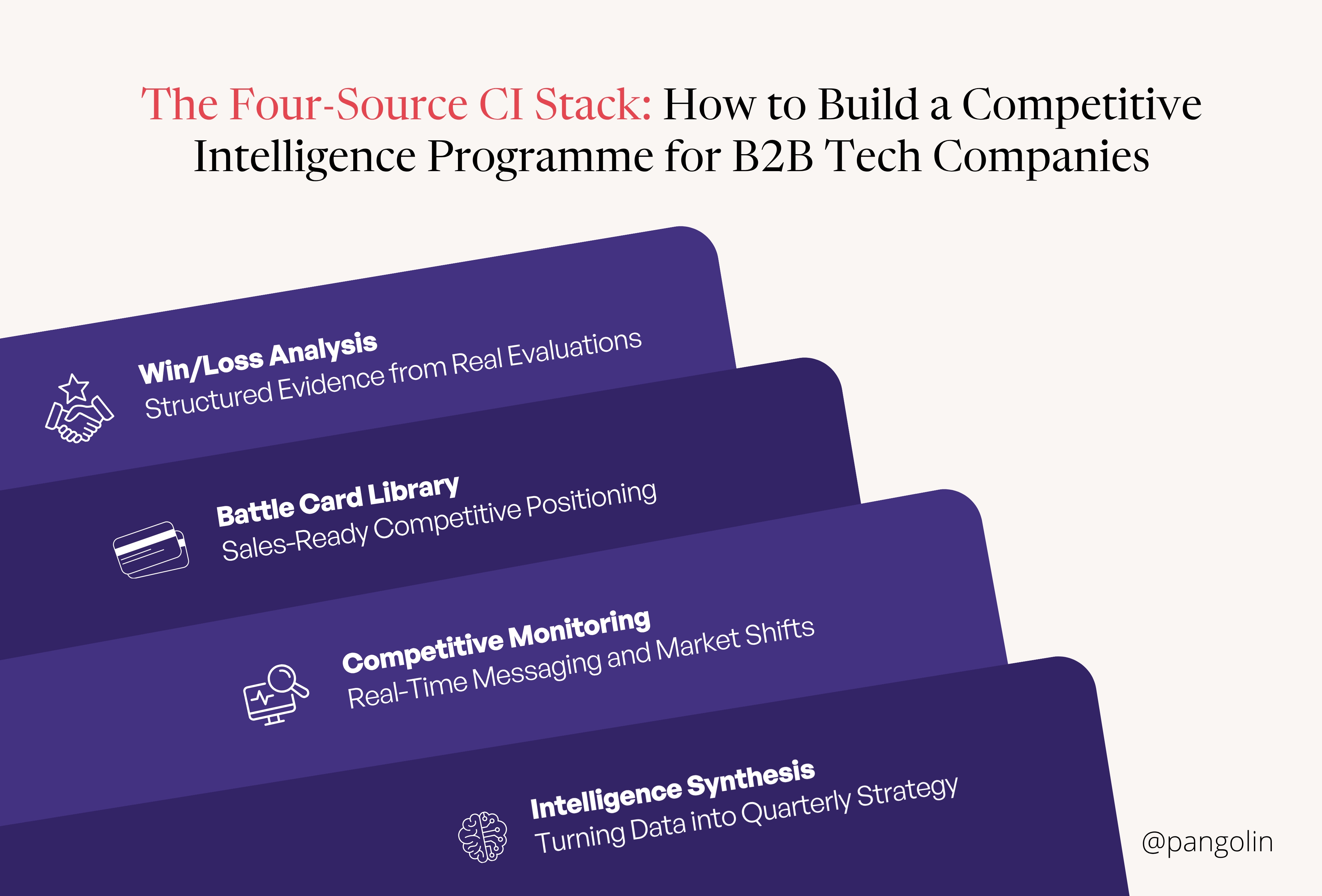
Win/loss analysis is a systematic post-decision interview programme that produces buyer-verified reasons for deal outcomes. In a B2B tech company, this looks like a 30-minute structured interview with the economic buyer from your last five closed-lost deals, coded by objection category.
A battle card library is a set of buyer-committee-specific documents that equip reps with objection responses and positioning statements. For a SaaS company selling to CISOs, this means one card per competitor per buyer persona, with claims tied to verifiable proof points.
A competitive monitoring programme for B2B SaaS is a structured tracking system that flags competitor positioning changes, hiring patterns, and product announcements. In practice, this is a weekly digest showing that your main competitor just hired three enterprise AEs in your target vertical.
Intelligence synthesis is the quarterly process that converts raw monitoring data and win/loss patterns into updated positioning recommendations. For a B2B tech company, this means a quarterly brief showing which competitor claims are gaining traction and which of your counter-positions need revision.
When all four components are active, you have a complete system to build a competitive intelligence programme for B2B that updates itself and feeds directly into deal preparation.
The most common mistake is building feature comparison tables that are commercially useless in C-suite evaluation. Technically strong companies make this error because their founders think in product capabilities, not buyer risk.
The commercial consequence is specific. Your rep pulls up a comparison grid in a final presentation. The CFO ignores it. The CISO asks about incident response SLAs. Your rep has no structured answer. The deal goes to the competitor whose materials addressed risk.
The correction is reframing every battle card competitive intelligence system around buyer evaluation criteria, not product attributes. A competitive monitoring programme for B2B SaaS should track what competitors say about outcomes, not what features they ship.
In practice, this means replacing "We have feature X, they don't" with "When your CISO evaluates incident response readiness, here's how our approach compares on mean-time-to-containment." That's a claim a procurement committee can act on.
CI53 was a cybersecurity SaaS company losing 60% of final-stage enterprise deals to a single competitor, with no structured win/loss analysis framework for B2B in place and all competitive knowledge held anecdotally by three senior AEs.
Pangolin built a complete battle card competitive intelligence system for CI53: a 12-card library, a structured win/loss interview programme, and a quarterly synthesis cadence, all delivered within six weeks.
The outcome was a battle card library built for a regulated technical domain with CISO-level evaluation criteria, domain absorption with zero technical accuracy corrections, and systematic competitive intelligence replacing anecdotal sales feedback across the entire competitive monitoring programme for B2B SaaS.
See the full CI53 case study →
Pangolin originally connected with CI53 through a content piece on ontological reasoning. There was no outbound sales process. The engagement began because CI53's CTO found the technical depth credible enough to initiate a conversation. That's the standard: if your CI materials don't pass the technical buyer's credibility test, they won't survive the evaluation.
Build in-house if you have a product marketing hire with prior CI experience and at least six weeks before your next major enterprise evaluation. Your sales team must be willing to contribute structured win/loss interview time. A win/loss analysis framework for B2B requires consistent participation from reps, not a one-off exercise.
A hybrid model works when your sales team can provide competitive objection data but lacks the structure to organize it. An external partner builds the battle card competitive intelligence system and the intelligence framework. Your team maintains and updates it quarterly.
Go external if you have no CI capability in-house, an enterprise evaluation in under 30 days, or you operate in a regulated domain where one inaccurate claim damages credibility with the technical evaluator. Pangolin builds competitive monitoring programmes for B2B SaaS companies in exactly this situation: technical depth, compressed timelines, and buyer committees that include CISOs and CTOs.
Run one structured win/loss interview on your most recent final-stage loss this week. Use a consistent question set: ask the buyer what three factors determined their decision, which vendor materials they referenced in their internal recommendation, and what risk their committee discussed most.
This single interview is higher-value than any monitoring tool or competitor website audit. It gives you buyer-verified evidence. One interview starts your win/loss analysis framework for B2B and feeds directly into the first component of the Four-Source CI Stack. By Friday, you'll have one data point that's more reliable than six months of anecdotal sales feedback.
A competitive monitoring programme for B2B SaaS starts with evidence, not tools. If you want a structured approach to building a B2B competitive intelligence strategy, Pangolin's product marketing service is built for this exact situation.
The gap between knowing you're losing deals and knowing why you're losing them is exactly the gap between anecdotal feedback and structured intelligence. Most B2B tech companies stay on the anecdotal side for years. They build feature grids. They lose deals. They blame pricing or "relationships."
The Four-Source CI Stack exists because enterprise procurement doesn't reward the best product. It rewards the vendor whose materials reduce perceived risk for every member of the buyer committee. Your win/loss interviews tell you which risks matter. Your battle cards address them. Your monitoring system keeps you current. Your synthesis process keeps you strategic.
If you're a VP of Sales watching deals slip at the final stage, The fix is a structured intelligence programme that gives your buyer committee what they need to say yes. Start with one interview this week. Build from there.